
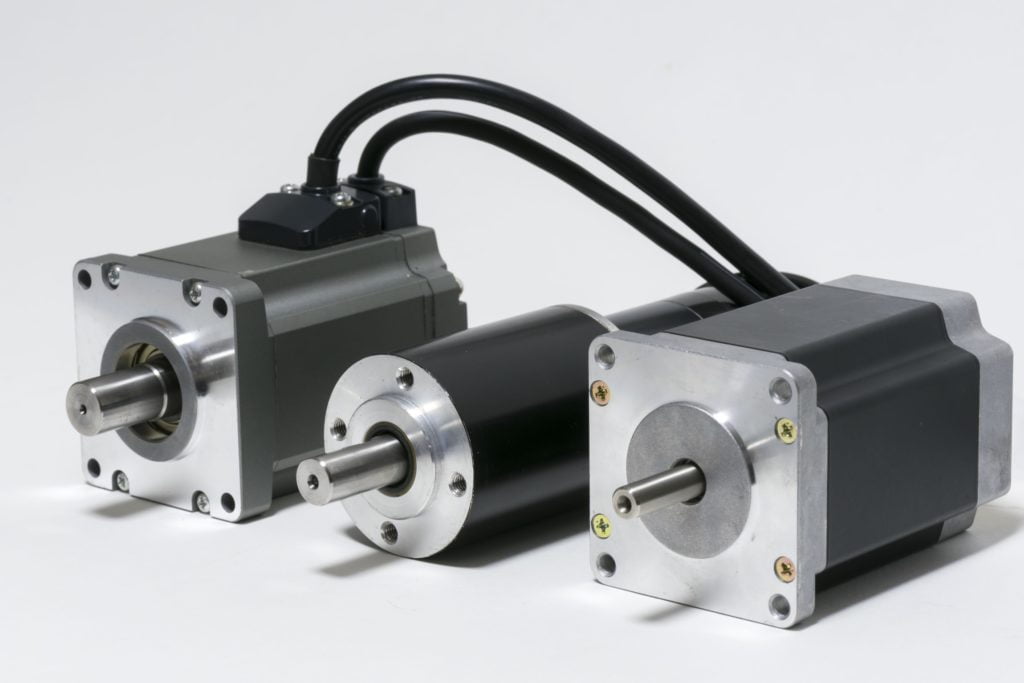
Servo Motor vs Stepper Motor: แรงบิด, ความเร็ว, Accuracy & Cost — How to Choose the Right One
If you are designing a motion control system — whether for a CNC router, a 3D printer, a robotic arm, or a high-speed packaging line — the servo motor vs stepper motor decision sits at the heart of your bill of materials. Both motor types deliver precise positioning, but they achieve it through fundamentally different architectures. One moves in discrete angular steps without position verification; the other continuously self-corrects against an encoder.
The real question is not which motor is “better,” but which one matches your speed, แรงบิด, ความแม่นยำ, and budget requirements. This guide breaks down the comparison across eight dimensions — control architecture, torque behavior, ความเร็ว, ความแม่นยำ, ประสิทธิภาพ, เสียงรบกวน, system cost, and application fit — with data drawn from real NEMA-frame testing and industrial drive configurations.
1. Architectural Difference: Open-Loop Steps vs Closed-Loop Continuous Motion
The most fundamental divide between these two motor types lies in how they verify position.
1.1 How a Stepper Motor Works
ก สเต็ปเปอร์มอเตอร์ divides a full 360° rotation into equal angular segments — typically 200 steps per revolution (1.8° per step) for a standard NEMA 17 หรือ NEMA 23 hybrid stepper. Each time the driver energizes a coil phase in sequence, the rotor advances exactly one step. Because the step angle is mechanically fixed, the controller can calculate position by simply counting pulses — no external sensor is needed. This is called open-loop control: the motor is told where to go, but it never reports back whether it actually arrived.
Microstepping — dividing each full step into 16, 32, or up to 256 sub-steps — improves motion smoothness and increases effective resolution. A 200-step motor with 256× microstepping offers 51,200 theoretical positions per revolution. อย่างไรก็ตาม, microstepping does not guarantee absolute accuracy: at low torque, holding position between full-step detent positions becomes uncertain. The ±5% step-angle tolerance (±0.09°) remains the practical accuracy floor.
Stepper Motor Types:
| พิมพ์ | มุมขั้นตอน | แรงบิด | ช่วงความเร็ว | Typical Cost |
|---|---|---|---|---|
| แม่เหล็กถาวร (น) | 7.5°–15° | ปานกลาง | ต่ำ-ปานกลาง | Lowest |
| ตัวแปรไม่เต็มใจ (วีอาร์) | 5°–15° | ต่ำ | สูง | ปานกลาง |
| Hybrid (ไม่มี 17/23/34) | 0.9°–1.8° | สูง | ปานกลาง-สูง | สูงกว่า |
1.2 How a Servo Motor Works
A servo motor — typically a มอเตอร์กระแสตรงไร้แปรงถ่าน (บีแอลดีซี) or permanent-magnet synchronous motor (PMSM) — operates inside a closed control loop. An encoder mounted on the shaft continuously reports actual position back to the drive. The drive compares commanded position against actual position, calculates the error, and adjusts motor current through a PID (proportional-integral-derivative) control loop to drive the error toward zero — tens of thousands of times per second.
This architecture means that servo motors verify position every control cycle. They do not “assume” they reached the target; they measure it. If an external force pushes the shaft off position, the drive detects the disturbance and compensates immediately. The encoder resolution determines the system’s positioning resolution: a 17-bit absolute encoder provides 131,072 discrete positions per revolution (≈0.0027°).
Key Servo Motor Subtypes:
- AC Servo Motors (synchronous/induction): Dominant in industrial automation — CNC machining centers, แขนหุ่นยนต์, packaging lines. Operate at 200–480 VAC with rated speeds of 3,000–6,000 RPM.
- DC Servo Motors (brushed/brushless): Common in smaller systems and battery-powered applications. Brushless DC servos offer higher efficiency and longer life than brushed variants.
1.3 Control Comparison at a Glance
| คุณลักษณะ | สเต็ปเปอร์มอเตอร์ (Open-Loop) | เซอร์โวมอเตอร์ (Closed-Loop) |
|---|---|---|
| ข้อเสนอแนะตำแหน่ง | ไม่มี (assumes step count = position) | Encoder — continuous real-time measurement |
| Position Verification | No — lost steps are undetected | Yes — error detected and corrected per cycle |
| ความซับซ้อนในการควบคุม | Low — step/direction pulses | High — PID tuning required (ปัจจุบัน, velocity, position loops) |
| Pole Count | 50–100+ poles (optimized for discrete stepping) | 4–8 poles (optimized for continuous rotation) |
| Motion Character | Incremental — discrete steps per pulse | Continuous — smooth rotation across full speed range |
| Drive Electronics | Simple pulse generator + ไดรเวอร์ stepper | Complex servo drive with FOC and multi-loop PID |
2. Torque Behavior: Why Steppers Hit a Wall at Speed
Torque is where the architectural differences translate into hard performance limits — and where many first-time motion designers get surprised.
2.1 Torque-Speed Curves: The Stepper Collapse
A stepper motor produces maximum torque at zero speed (holding torque), then torque falls approximately linearly as speed increases. The physics behind this: each coil winding has inductance that limits how quickly current can rise between steps. As step rate increases, the current never reaches its full rated value before the next phase switch — effective torque drops. By 1,000–1,500 RPM, a typical NEMA 23 stepper produces only 20–30% of its rated holding torque. โดย 3,000 รอบต่อนาที, output can fall below 0.1 N·m even for motors rated at 1.5 N·m holding torque.
A servo motor — by contrast — maintains rated torque from near-zero speed all the way to its rated RPM (typically 3,000–6,000 RPM). It can also deliver 2–3× rated torque as a transient peak for short-duration acceleration bursts. This fundamentally different torque-speed profile means that steppers and servos are not interchangeable in applications with significant speed requirements.
2.2 Real Torque Data: ไม่มี 23 Frame Comparison
| ความเร็ว | ไม่มี 23 สเตปเปอร์ (1.5 N·m rated) | 400W AC Servo (1.27 N·m rated) |
|---|---|---|
| 0 รอบต่อนาที (โฮลดิ้ง) | 1.5 น.ม | 0 น.ม (requires active braking) |
| 500 รอบต่อนาที | ≈1.2 N·m | 1.27 N·m continuous |
| 1,500 รอบต่อนาที | ≈0.3 N·m (80% การสูญเสีย) | 1.27 N·m continuous |
| 3,000 รอบต่อนาที | <0.1 น.ม (ใกล้ศูนย์) | 1.27 N·m continuous, 3.8 N·m peak |
Data from NEMA 23 hybrid stepper vs. 400W AC servo bench testing. Actual values vary by manufacturer and drive voltage.
2.3 Holding Torque vs Dynamic Torque
| Torque Type | สเต็ปเปอร์มอเตอร์ | เซอร์โวมอเตอร์ |
|---|---|---|
| แรงบิดถือ (0 รอบต่อนาที) | Full rated torque — no brake needed for vertical loads or clamping | Requires active current or mechanical brake to hold position |
| Low-Speed Torque (<500 รอบต่อนาที) | Excellent — close to holding torque | Good — rated continuous torque available |
| High-Speed Torque (>1,500 รอบต่อนาที) | Drops sharply — inductance limits current rise time | Full rated torque maintained across speed range |
| Peak/Overload Torque | None — exceeding torque limit causes silent step loss | 2–3× rated for short durations (acceleration bursts) |
Practical Implication: If your load requires holding position against gravity (a vertical Z-axis, a clamp, a paused conveyor gate), the stepper’s inherent holding torque is a real advantage — it locks in place for free. But if your application runs continuously above 1,000 รอบต่อนาที, the stepper’s torque collapse makes it effectively unusable regardless of its holding torque rating.
3. ความเร็วและการเร่งความเร็ว: The Crossover Point
3.1 Speed Ranges
| Speed Parameter | สเต็ปเปอร์มอเตอร์ | เซอร์โวมอเตอร์ |
|---|---|---|
| Usable Speed Range | 0–1,000 RPM (torque meaningful) | 0–6,000+ RPM (full torque maintained) |
| Optimal Operating Range | <500 รอบต่อนาที | Full rated range |
| Practical Crossover | 500–1,000 RPM — above this, servo is the clear choice | |
| Acceleration Capability | Limited — discrete stepping + high rotor inertia | High — low-inertia rotor; full speed in milliseconds |
The acceleration difference has real consequences. A stepper commanded to accelerate too aggressively will simply lose steps — the rotor cannot follow the magnetic field rotation. The system has no way to detect this failure. A servo drive, ในทางตรงกันข้าม, monitors encoder feedback in real time; if the commanded acceleration exceeds the system’s capability, the drive can fault, reduce the profile, or report an error rather than silently losing position. This makes servos the safer choice in applications where unexpected load changes are possible.
3.2 การจับคู่ความเฉื่อย
Load-to-rotor inertia ratio is a critical consideration often overlooked in stepper-to-servo comparisons. Stepper motors have higher rotor inertia due to their high pole-count construction, which makes them more tolerant of moderate inertia mismatches — ratios up to 10:1 are generally acceptable. เซอร์โวมอเตอร์, with their lower rotor inertia, often require tighter matching (3:1 ถึง 5:1 for high-performance systems, though modern auto-tuning drives can handle up to 10:1–20:1 with reduced bandwidth). When inertia mismatch is severe, ก กระปุกเกียร์ becomes necessary — adding cost and mechanical complexity to either solution.
4. ความแม่นยำของตำแหน่ง: The ±0.005° vs ±0.02° Trap
Accuracy numbers in motor datasheets are frequently misunderstood. A stepper motor’s ±0.005° per-step accuracy sounds better than a servo’s ±0.02° — but these numbers describe fundamentally different things.
4.1 Single-Step Accuracy vs Cumulative Accuracy
| Accuracy Metric | สเต็ปเปอร์มอเตอร์ | เซอร์โวมอเตอร์ |
|---|---|---|
| Single-Step Accuracy | ±0.005° (±5% of 1.8° step) | ±0.02° (encoder-dependent) |
| Cumulative Error | Unbounded — each lost step adds error, undetected | Bounded — encoder corrects every cycle |
| Error Under Load | Increases; no compensation mechanism | Stays within spec; PID corrects disturbances |
| Error Detection | None — open-loop assumes position is correct | Continuous — error = commanded − actual |
| 17-bit Encoder Cumulative Error | ไม่มี | ≈±0.0028° (after PID correction) |
เดอะ “trap”: A stepper’s single-step accuracy is genuinely good — ±0.005° is about 5% of one full step. But if the motor loses 4 steps during a 10,000-step move (perhaps due to a momentary load spike), those 4 missing steps add 7.2° of position error. The system never knows. A servo with ±0.02° per-encoder-count accuracy corrects that error in the next PID cycle — so after the move, the cumulative error is bounded by the encoder’s resolution, not by how many disturbances occurred along the way.
For applications where “close enough” is genuinely fine — a desktop 3D printer extruding PLA, a basic pick-and-place with generous tolerances — stepper accuracy is more than adequate. For applications where a single missed position could scrap a part — machining an aerospace turbine blade, semiconductor wafer alignment — the servo’s closed-loop correction is non-negotiable.
5. Efficiency and Thermal Behavior: เดอะ “Always-On” Stepper Problem
| Efficiency Metric | สเต็ปเปอร์มอเตอร์ | เซอร์โวมอเตอร์ |
|---|---|---|
| Low-Speed Efficiency | 70–80% | 80–90% |
| High-Speed Efficiency | 50–60% | 85–95% |
| Idle/Holding Power | Full rated current — constant, regardless of motion | Near-zero — only draws current proportional to load torque |
| Heat Output (Idle) | High — constant coil current generates continuous heat | Low — minimal current draw when static |
| เพาเวอร์แฟกเตอร์ | 0.5–0.7 | 0.8–0.9 |
| Energy Recovery | Not available | Available with regenerative drives (braking energy returned to DC bus) |
| Component Life Impact | Continuous heat degrades winding insulation and bearing grease | Cooler operation extends insulation and bearing life |
This is perhaps the most overlooked cost driver in long-running systems. A stepper motor draws rated current even while holding position — it must, because holding torque is generated by continuous coil excitation. ในก 24/7 production environment, that constant power draw translates to electricity costs and heat that must be managed. Servo motors draw current proportional to mechanical load: sitting idle, they consume near-zero power. Over a machine’s 5–10 year service life, the efficiency gap can offset much of the servo’s higher upfront cost — particularly in high-duty-cycle applications like conveyor systems or continuous packaging lines.
For intermittent-duty applications — a lab instrument that runs one cycle per hour, a 3D printer used weekends — the efficiency difference matters far less, and the stepper’s simplicity and lower upfront cost win easily.
6. เสียงรบกวน, การสั่นสะเทือน, and Motion Smoothness
| Operating Condition | Stepper Motor Noise (เดซิเบล) | Servo Motor Noise (เดซิเบล) |
|---|---|---|
| ความเร็วต่ำ (<100 รอบต่อนาที) | 50–60 | 40–50 |
| Medium Speed (100–500 RPM) | 60–70 | 50–60 |
| High Speed (>500 รอบต่อนาที) | 70–80 | 60–70 |
| Acceleration/Deceleration | 65–75 | 55–65 |
| Holding Position | 40–50 (hiss from coil current) | 30–40 (near-silent) |
Step motors produce a characteristic audible “whine” — the sound of each step exciting coil windings. At certain speeds, mechanical resonance amplifies this into vibration that can visibly shake the motor mount. Microstepping and advanced drivers (such as Trinamic TMC-series with StealthChop) can dramatically reduce this noise — many modern 3D printers are now effectively silent — but the fundamental resonance risk remains across the speed band.
Servo motors produce smoother, more continuous torque due to their low pole count and sinusoidal commutation (การควบคุมเชิงภาคสนาม). The result is quieter operation and less mechanical vibration across the full speed range — critical in medical devices, optical inspection equipment, and any application near sensitive instrumentation.
7. System Cost: The 3–5× Reality
Motor-only pricing comparisons are misleading. A stepper motor itself may be 20–30% cheaper than a servo motor of similar frame size — but the motor is only one component in the motion axis. What matters is the full bill of materials.
7.1 Single-Axis BOM Cost Comparison (2025–2026 Pricing)
| System Type | ส่วนประกอบ | Commissioning Time | Single-Axis BOM |
|---|---|---|---|
| Open-Loop Stepper | ไม่มี 23 เครื่องยนต์ + DM556 driver + pulse generator/indexer | <1 hour | $80–$180 |
| Closed-Loop Stepper | ไม่มี 23 เครื่องยนต์ + closed-loop driver + 1,000 PPR encoder | 1–2 hours | $200–$350 |
| AC Servo | 400W servo motor + servo drive + 17-bit absolute encoder (บูรณาการ) | 2–4 hours (PID + FOC tuning) | $400–$900 |
Key takeaways:
- The system-level cost gap between open-loop stepper and AC servo is 3–5×, not 20–30%.
- Closed-loop steppers bridge the gap at roughly 60% of servo system cost while capturing 70–80% of the accuracy benefit.
- Commissioning time is a real cost: a 6-axis servo robot may require a full day of PID tuning; a 6-axis stepper system can be running in hours.
7.2 Long-Term Cost Factors
| ปัจจัยด้านต้นทุน | สเตปเปอร์ | เซอร์โว |
|---|---|---|
| ต้นทุนพลังงาน (24/7 การดำเนินการ) | Higher — constant current draw | Lower — current proportional to load |
| Cooling/HVAC Load | Higher — continuous heat output | Lower — cooler operation |
| การซ่อมบำรุง | Lower — fewer components, no encoder | Higher — encoder, more complex electronics |
| Replacement Parts | Lower — simple driver swap | Higher — matched motor-drive pairs |
| Downtime Cost | Lower — quick replacement | Higher — system more complex to diagnose |
| Scalability (adding axes) | Small incremental cost — add driver + เครื่องยนต์ | Lower per-axis at scale — shared DC bus, multi-axis drives |
For a budget-constrained project with predictable motion profiles and low duty cycles, the open-loop stepper’s $80–$180 per axis is compelling. For a production machine running 24/7 with variable loads, the servo’s higher upfront cost is typically recovered through energy savings, reduced scrap, and higher throughput within the first 2–3 years. When you need a โซลูชันมอเตอร์แบบกำหนดเอง matched to your specific voltage, แรงบิด, and form-factor requirements, Greensky’s engineering team can help evaluate both options against your target BOM.
8. Closed-Loop Stepper: The Hybrid That Splits the Difference
Between the simplicity of an open-loop stepper and the performance of a full servo sits an increasingly popular middle ground: the closed-loop stepper system. By adding an incremental encoder (typically 1,000–4,000 PPR) to a stepper motor and pairing it with a drive that monitors feedback, closed-loop steppers address the open-loop variant’s two critical weaknesses — undetected step loss and constant full-current draw — without the cost and complexity of a servo.
8.1 What Closed-Loop Steppers Gain
| คุณสมบัติ | Open-Loop Stepper | Closed-Loop Stepper | AC Servo |
|---|---|---|---|
| Step-Loss Detection | ไม่มี | Yes — drive detects position deviation | Built into architecture |
| ระเบียบปัจจุบัน | Constant rated current | Dynamic — reduced at low load | Load-proportional (most refined) |
| Position Accuracy Under Load | Degrades; no correction | Corrected within encoder resolution | Full correction |
| High-Speed Torque Collapse | Same — physics unchanged | Same — physics unchanged | No collapse (different architecture) |
| แรงบิดระลอกคลื่น | Present — inherent to high pole count | Reduced but not eliminated | น้อยที่สุด (FOC sinusoidal drive) |
| Single-Axis BOM | $80–$180 | $200–$350 | $400–$900 |
8.2 What Closed-Loop Steppers Cannot Fix
The encoder corrects positional errors and reduces wasted current, but it cannot change the motor’s underlying physics. The torque-vs-speed collapse — torque plummeting past 1,500 RPM — is a consequence of the high-inductance, high-pole-count stepper architecture, not the control strategy. No amount of feedback restores torque at 3,000 RPM on a stepper. ในทำนองเดียวกัน, torque ripple and resonance remain inherent to discrete phase excitation; an encoder can detect the resulting position error but cannot fully smooth it out.
For applications where speed stays below 1,000 RPM but positional integrity matters — a mid-range CNC router cutting hardwood, a pick-and-place on a budget, an existing stepper machine being retrofitted — the closed-loop stepper is often the best value proposition. Upgrading an existing open-loop axis can cost under $250 ด้วย 1,000 PPR encoder and a closed-loop ตัวควบคุมมอเตอร์.
9. Application-Specific Selection Guide
No motor type wins every application. Below is a field-tested breakdown by machine type.
9.1 CNC Machines
| CNC Class | Budget | Recommended Motor | เหตุผล |
|---|---|---|---|
| Hobby/Desktop CNC Router (MDF, softwood) | <$3,000 | ไม่มี 23 Open-Loop Stepper | Low cutting forces, predictable loads |
| Mid-Range CNC Router (hardwood, aluminum) | $5,000–$15,000 | ไม่มี 23/34 Closed-Loop Stepper | Higher torque demands; step loss = ruined workpiece |
| Production CNC Mill/Lathe/Plasma | >$25,000 | AC Servo | Continuous torque >2,000 รอบต่อนาที, variable cutting loads |
9.2 3เครื่องพิมพ์ D
| 3D Printer Class | Recommended Motor | เหตุผล |
|---|---|---|
| Desktop FDM (Prusa, Bambu Lab, Voron) | ไม่มี 17 Open-Loop Stepper | Predictable loads, <300 mm/s, silent drivers available (TMC) |
| Industrial 3D Printer (HP MJF, Stratasys F-Series) | AC Servo | Print speeds approaching 1 M/S, 24/7 รอบหน้าที่ |
| Resin Printer (SLA/MSLA) | สเตปเปอร์ | Slow Z-axis movement, light build platform |
9.3 วิทยาการหุ่นยนต์
| Robot Type | Recommended Motor | เหตุผล |
|---|---|---|
| SCARA / 6-Axis Articulated Arm | AC Servo (each joint) | Multi-axis coordination, variable loads, high dynamic response |
| Collaborative Robot (Cobot) | เซอร์โว (with torque sensing) | Force control, safety-rated torque limiting |
| Simple Pick-and-Place (fixed path) | Stepper or Closed-Loop Stepper | Repetitive motion, predictable load, lower budget |
9.4 General Industrial Automation
| แอปพลิเคชัน | Recommended Motor | เหตุผล |
|---|---|---|
| Packaging Line (high-speed fill/seal/label) | เซอร์โว | Fast start/stop, frequent product changeovers, high throughput |
| ระบบสายพานลำเลียง (continuous or indexing) | เซอร์โว | Continuous motion, high duty cycle, energy efficiency matters |
| Laboratory Automation / Syringe Pump | สเตปเปอร์ | Very low speed, tiny loads, step loss virtually impossible |
| PCB Pick-and-Place / SMT | เซอร์โว (speed-dependent) or Closed-Loop Stepper | Cycle time constraints determine choice |
| Camera Gimbal / Pan-Tilt | สเตปเปอร์ | ความเร็วต่ำ, holding torque at position, quiet operation with TMC drivers |
| เครื่องจักรสิ่งทอ (tensioning, feeding) | สเตปเปอร์ | Consistent motion profiles, cost-sensitive industry |
10. Six-Point Decision Framework
When you’re evaluating a specific project, work through these six questions in order. The answers will push you clearly toward one motor type — or reveal that your application sits in the middle ground where a closed-loop stepper or a มอเตอร์เกียร์ coupled with a simpler motor may be the best fit.
| # | คำถาม | If Yes → Stepper | If Yes → Servo |
|---|---|---|---|
| 1 | Does continuous speed exceed 1,500 รอบต่อนาที? | No — stepper torque collapses | Yes — servo required |
| 2 | Does the load vary unpredictably during motion? | No — predictable loads work with open-loop | Yes — servo PID compensates in real time |
| 3 | Is holding position without a brake important? | Yes — stepper holds for free | No — servo needs active current or brake |
| 4 | Is per-axis BOM budget under $200? | Yes — open-loop stepper | No — consider servo or closed-loop stepper |
| 5 | Is accumulated position error (lost steps) unacceptable? | No — closed-loop stepper if budget allows | Yes — servo is the safe choice |
| 6 | Is noise/vibration a hard constraint (ทางการแพทย์, optics)? | Maybe — with premium silent drivers | Yes — servo is inherently smoother |
The middle-ground rule: If you answer “yes” to questions about speed or load variability, you need a servo — no stepper variant (open-loop or closed-loop) can compensate for the underlying torque-speed collapse or high-pole-count torque ripple. If your answers cluster in the stepper column but step loss concerns you, closed-loop steppers provide a cost-effective upgrade path. If budget is the dominant constraint and your motion profile fits the stepper’s sweet spot (ความเร็วต่ำ, predictable load, intermittent duty), don’t over-engineer — the $80 stepper axis is the right engineering decision.
For OEMs building at scale, Greensky’s stepper motor manufacturing in Jinhua, China and BLDC motor production lines offer both motor types with customization options — voltage, คดเคี้ยว, shaft configuration, and integrated ตัวควบคุมมอเตอร์. All motors pass 100% individual testing per ISO-certified testing standards ก่อนจัดส่ง.
11. คำถามที่พบบ่อย
ถาม: Is a servo motor just a stepper motor with an encoder?
เลขที่. They have fundamentally different architectures. A stepper motor has 50–100+ magnetic poles optimized for discrete angular steps; a servo motor has 4–8 poles optimized for continuous, smooth rotation. Adding an encoder to a stepper (creating a closed-loop stepper) detects position errors but does not change the motor’s torque-speed physics — the high-speed torque collapse and torque ripple remain. A servo’s low pole count and Field-Oriented Control enable smooth torque production across the full speed range that no stepper variant can match.
ถาม: At what speed should I switch from stepper to servo?
The practical crossover is around 500–1,000 RPM. Below 500 รอบต่อนาที, stepper torque is close to its rated holding value. Between 500 และ 1,000 รอบต่อนาที, torque begins a sharp decline. Above 1,000 รอบต่อนาที, stepper torque typically drops below 50% of rated — and continues falling. If your application requires sustained motion above 1,000 RPM or rapid acceleration/deceleration cycles, a servo motor is the correct choice.
ถาม: Why do most 3D printers still use stepper motors?
ค่าใช้จ่าย, simplicity, and the nature of the application. A NEMA 17 stepper plus an A4988 or TMC2209 driver costs $15–$30 per axis. An equivalent servo system costs $200+ per axis. 3D printers move slowly (typically 50–300 mm/s), the load is light and predictable (only filament back-pressure), and properly configured stepper currents make step loss extremely rare. The open-loop simplicity means no PID tuning, no encoder wiring, and straightforward firmware integration. For 3D printers, servos are overkill — until you reach industrial machines running at 1 m/s in 24/7 การผลิต.
ถาม: Can a stepper motor run at high speed?
Mechanically, yes — steppers can rotate above 3,000 รอบต่อนาที. Practically, no — because useful torque collapses long before that speed. Above 1,500 รอบต่อนาที, a NEMA 23 stepper rated at 1.5 N·m holding torque may deliver less than 0.3 N·m of usable torque. If your load requires meaningful torque at high speed, the stepper is the wrong motor regardless of what its no-load maximum RPM specification says.
ถาม: Do all servo motors require encoders?
ใช่. An encoder is what defines a servo system — it provides the position feedback that enables closed-loop control. Without an encoder, you have a standard BLDC or AC motor controlled open-loop, which can spin at a commanded speed but cannot guarantee position. Encoder types range from basic incremental (1,024 PPR) to high-end absolute (17-bit / 131,072 positions per revolution). The encoder resolution largely determines the system’s positioning precision.
ถาม: Can I retrofit an existing stepper machine with closed-loop control?
ใช่, and it is increasingly common. Adding a 1,000 PPR incremental encoder plus a closed-loop stepper drive costs under $250 per axis and provides step-loss detection, dynamic current reduction, and position error correction. The upgrade does not change the motor’s torque-speed curve — you cannot suddenly run at 3,000 RPM — but it does eliminate the risk of undetected positional errors, which is valuable for CNC routers, automated inspection stations, and any application where a missed step means a scrapped part. This is often the most cost-effective upgrade path for existing machinery, short of a full servo conversion. สำหรับ Chinese-manufactured stepper motors already in the field, this retrofit is straightforward with standard NEMA-frame mounting and encoder kits.
12. Industry Trends: Where Motion Control Is Heading
Three trends are reshaping the stepper-vs-servo landscape in 2025–2026:
1. Closed-loop stepper adoption is accelerating. Search interest in closed-loop stepper systems has grown steadily, driven by the combination of dropping encoder costs and improved drive electronics. At the sub-2 N·m torque tier, closed-loop steppers now overlap with entry-level servos in many applications — and the line is blurring further each year.
2. Digital current loops are closing the smoothness gap. Advanced stepper drives now implement Field-Oriented Control concepts (historically servo-only territory), producing smoother sinusoidal current waveforms that dramatically reduce noise, การสั่นสะเทือน, and torque ripple. A modern stepper with a digital current-loop drive runs significantly quieter and smoother than an equivalent motor from five years ago.
3. Servo costs continue to decline. Integrated servo drives (เครื่องยนต์ + ขับ + encoder in a single housing) are reducing wiring complexity, commissioning time, and per-axis cost. As these integrated solutions mature, the servo’s cost premium over closed-loop steppers narrows — particularly in multi-axis systems where a shared DC bus eliminates redundant power supplies.
4. IIoT and predictive maintenance. Modern servo drives stream real-time current, อุณหภูมิ, and vibration data to plant-level monitoring systems. This enables condition-based maintenance — replacing motors before they fail rather than after — which reduces unplanned downtime. Stepper systems are beginning to adopt similar data capabilities, though the ecosystem is less mature. For applications where uptime is measured in dollars per minute, the servo’s diagnostic capabilities provide operational value beyond pure motion performance.
อ้างอิง
- Association for Advancing Automation (A3). “Servo Systems vs. สเต็ปเปอร์มอเตอร์: Finding the Optimal Solution for Precision Automation.” Automate.org, อาจ 2025. https://www.automate.org/motion-control/blogs/servo-system-vs-stepper-motor-solutions-for-precision-automation
- Blyler, John. “Stepper vs Servo Motors: ข้อดี, ข้อเสีย, & How to Choose the Right One.” Design News, ตุลาคม 2025. https://www.designnews.com/motors-actuators-conveyors/stepper-vs-servo-motors-pros-cons-how-to-choose-the-right-one
- Kohli, Venus. “Stepper vs Servo Motors: Mastering Motor Selection for Precision Engineering.” Wevolver, กันยายน 2024. https://www.wevolver.com/article/stepper-vs-servo-motors-a-comprehensive-comparison-for-your-next-project
- iTrustBot Engineering. “Servo Motor vs Stepper Motor: ความแม่นยำ, แรงบิด, Cost Comparison.” iTrustBot Blog, เมษายน 2026. https://itrustbot.com/blogs/news/servo-motor-vs-stepper-motor
- Dietrich, Shawn. “Servo Motor vs Stepper Motor: Understanding the Differences.” Control.com Technical Articles, ธันวาคม 2022. https://control.com/technical-articles/servo-motor-vs-stepper-motor-understanding-the-differences/
- Festo AG. “Servo Motor vs Stepper Motor: Which One Is Right for Your Application?” Festo Blog, มีนาคม 2024. https://www.festo.com/us/en/e/blog/in-practice/comparison-between-stepper-motors-and-servomotors-which-is-better-id_1902091
- Performance Motion Devices, Inc. “Closed Loop Stepper vs Servo: How to Choose the Right Motor Control Approach.” PMD QuickBytes, มิถุนายน 2026. https://www.pmdcorp.com/quickbytes/closed-loop-stepper-vs-servo-how-to-choose-the-right-motor-control-approach
- RFTools Engineering. “Stepper vs Servo Motor: ความแม่นยำ, ความเร็ว & Cost Comparison.” RFTools Compare, มิถุนายน 2026. https://rftools.io/compare/stepper-vs-servo-motor/
- Electrical World. “Servo vs Stepper Motor: ความแตกต่างที่สำคัญ & Selection Guide.” Electrical World, มิถุนายน 2026. https://electrical-world.com/posts/servo-vs-stepper-motor-which-is-best-for-your-build
- JLCPCB Engineering. “Servo Motor vs Stepper Motor: Comparison of 5 Key Differences.” JLCPCB Blog. https://jlcmc.com/blog/difference-between-stepper-motor-and-servo-motor