
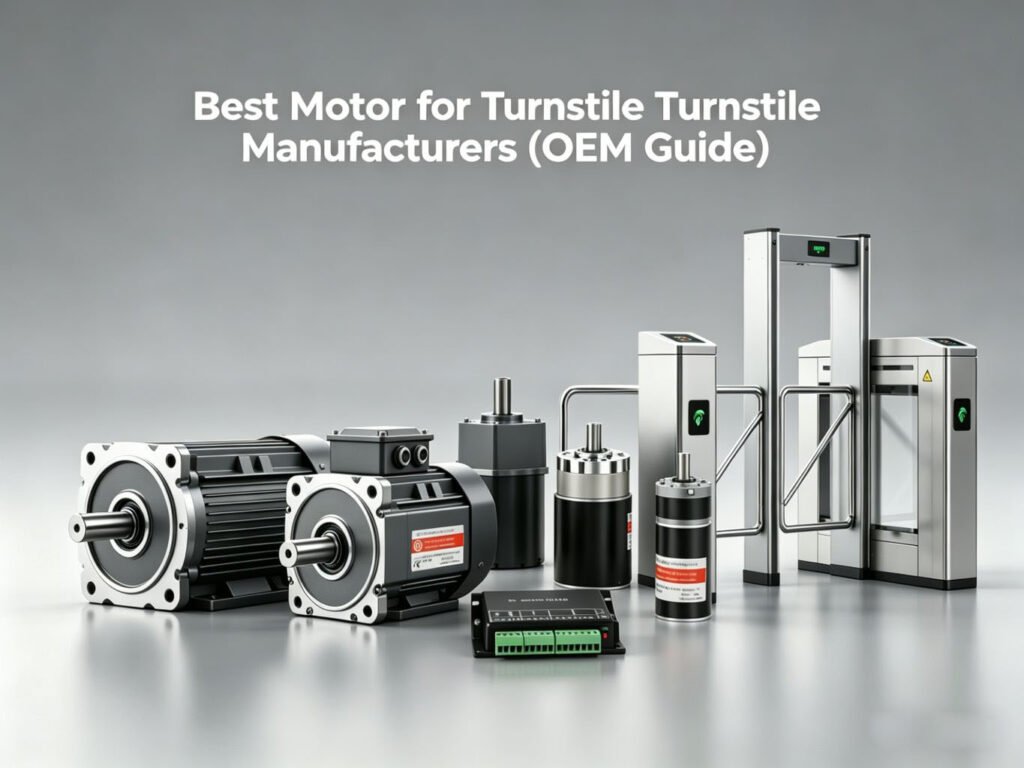
มอเตอร์ที่ดีที่สุดสำหรับผู้ผลิตประตูหมุน (คู่มือ OEM)
ตัวอย่างข้อมูลแนะนำ:
The best motor for turnstile systems depends on performance, ความทนทาน, and control requirements. For modern OEM turnstile manufacturers, BLDC motors are typically the optimal choice due to their high efficiency, การควบคุมที่แม่นยำ, อายุการใช้งานยาวนาน, and low maintenance. อย่างไรก็ตาม, brushed DC motors and servo motors are still used in cost-sensitive or high-precision applications. Selecting the right motor requires evaluating torque, ความเร็ว, แรงดันไฟฟ้า, control method, and duty cycle to match real-world operating conditions.
What Motor Is Used in Turnstile Systems?
Turnstile systems rely on controlled rotational motion to regulate pedestrian access. The motor serves as the core actuator, converting electrical energy into mechanical torque to drive the barrier arm or gate. The most commonly used motor types include BLDC motors, มอเตอร์กระแสตรงแบบแปรงถ่าน, และเซอร์โวมอเตอร์, each offering different performance characteristics.
In traditional systems, brushed DC motors were widely used due to their simple structure and low cost. อย่างไรก็ตาม, modern smart turnstiles increasingly adopt BLDC motors because they offer higher efficiency, อายุการใช้งานยาวนานขึ้น, and better integration with electronic control systems.
Servo motors are typically used in high-end applications where precise positioning, การเคลื่อนไหวที่ราบรื่น, and dynamic control are required, such as speed gates in airports or metro systems.
👉สำหรับโซลูชั่นประสิทธิภาพสูง, ตรวจสอบของเรา มอเตอร์ BLDC สำหรับประตูหมุน
Key Motor Functions in Turnstiles
- Drive rotation of arms or panels
- Control opening/closing speed
- Provide torque resistance for safety
- Enable bidirectional motion
Why Motor Selection Matters for Turnstile Manufacturers
การเลือกมอเตอร์ส่งผลโดยตรงต่อประสิทธิภาพของระบบ, ความน่าเชื่อถือ, and long-term maintenance cost. สำหรับผู้ผลิต OEM, choosing the wrong motor can lead to overheating, premature failure, poor user experience, and increased warranty claims.
Turnstiles operate in high-frequency environments such as metro stations, office buildings, and stadiums. This requires motors capable of continuous duty cycles, แรงบิดที่เสถียร, and fast response times.
นอกจากนี้, modern turnstiles must integrate with access control systems, requiring motors that support advanced control strategies such as PWM or field-oriented control.
BLDC vs Brushed vs Servo Motor for Turnstiles
| พารามิเตอร์ | มอเตอร์ BLDC | มอเตอร์ DC แบบแปรงถ่าน | เซอร์โวมอเตอร์ |
|---|---|---|---|
| ประสิทธิภาพ | สูง (85–92%) | ปานกลาง (70–80%) | สูงมาก |
| การซ่อมบำรุง | ต่ำ | สูง (การสึกหรอของแปรง) | ต่ำ |
| ความซับซ้อนในการควบคุม | ปานกลาง | ต่ำ | สูง |
| ค่าใช้จ่าย | ปานกลาง | ต่ำ | สูง |
| อายุการใช้งาน | ยาว | Short | Very Long |
| Best Application | Modern turnstiles | Budget systems | High-end gates |
จากมุมมองทางวิศวกรรม, BLDC motors provide the best balance between performance and cost. Brushed motors may still be viable for low-cost projects, while servo motors are justified when precision and responsiveness are critical.
Advantages of BLDC Motors for Turnstile OEMs
ประสิทธิภาพสูง
BLDC motors eliminate brush friction losses, improving efficiency and reducing heat generation. This is critical in turnstiles operating continuously throughout the day.
อายุการใช้งานยาวนาน
Without brushes, mechanical wear is minimized, extending operational life and reducing maintenance intervals.
การควบคุมที่แม่นยำ
BLDC motors support advanced control methods such as FOC, ทำให้สามารถเร่งความเร็วได้อย่างราบรื่น, การชะลอตัว, and positioning.
การทำงานของเสียงรบกวนต่ำ
Essential for indoor environments like offices and airports.
Typical solutions include 24V–72V BLDC motors integrated with gearboxes for torque amplification. OEM manufacturers often request customized designs for torque output and mounting structure.
Explore BLDC motor solutions →
Disadvantages of BLDC Motors
Despite their advantages, BLDC motors require electronic controllers, increasing system complexity and cost. นอกจากนี้, integration requires proper tuning of control algorithms.
อย่างไรก็ตาม, for most industrial applications, these challenges are outweighed by performance gains and lifecycle cost savings.
Key Engineering Factors: ประสิทธิภาพ, ความหนาแน่นของแรงบิด & ประสิทธิภาพการระบายความร้อน
ประสิทธิภาพ
Higher efficiency reduces power consumption and operating cost. In high-traffic environments, even small efficiency improvements significantly impact total energy usage.
ความหนาแน่นของแรงบิด
Turnstiles require compact motors capable of delivering sufficient torque. BLDC motors offer higher torque density compared to brushed motors, allowing smaller designs.
ประสิทธิภาพการระบายความร้อน
Heat is a major failure factor. Motors must be designed with proper cooling methods such as natural convection or aluminum housing heat dissipation.
ความน่าเชื่อถือ & อายุการใช้งาน
Continuous operation demands motors with minimal wear components. BLDC motors excel due to the absence of brushes.
Control Systems: Why They Matter in Turnstile Motors
The motor controller determines how effectively the motor performs under real-world conditions. In turnstiles, control systems must ensure smooth motion, quick response, และการปฏิบัติตามข้อกำหนดด้านความปลอดภัย.
Common Control Methods
- การควบคุมพีเอ็มดับเบิลยู (basic)
- Hall sensor-based commutation
- การควบคุมเชิงภาคสนาม (ฟค)
FOC control enables precise torque control and smooth rotation, making it ideal for high-end turnstiles.
วิธีการเลือกมอเตอร์ประตูหมุน (แรงบิด, รอบต่อนาที, คู่มือแรงดันไฟฟ้า)
ช่วงแรงดันไฟฟ้า
Most turnstiles use 24V, 48วี, or 72V systems. Higher voltage improves efficiency and reduces current losses.
ช่วงพลังงาน
Typical power ranges from 50W to 500W depending on gate size and load.
ความเร็ว (รอบต่อนาที)
Turnstile motors usually operate between 30–300 RPM after gearbox reduction.
ข้อกำหนดแรงบิด
Torque depends on arm length, น้ำหนัก, and resistance. Safety margins must be included.
วิธีการทำความเย็น
Passive cooling is common, but high-duty applications may require enhanced heat dissipation.
ความเข้ากันได้ของคอนโทรลเลอร์
Ensure motor matches controller type (เซ็นเซอร์ฮอลล์, ตัวเข้ารหัส, FOC driver).
ข้อควรพิจารณาเฉพาะการใช้งาน
- Indoor vs outdoor environment
- รอบหน้าที่ (ต่อเนื่องและไม่ต่อเนื่อง)
- Noise requirements
Request OEM motor customization →
Turnstile Applications and Motor Requirements
ทางอุตสาหกรรม & อาคารพาณิชย์
Require reliable, low-maintenance motors with moderate torque.
Transportation Systems
High-duty cycles demand efficient and durable BLDC motors.
High-End Security Systems
Require servo or high-performance BLDC motors for precision control.
EV Integration
Some modern turnstiles integrate battery systems, requiring energy-efficient motors.
Learn about EV motor solutions →
แนวโน้มในอนาคตของเทคโนโลยีมอเตอร์ประตูหมุน
The industry is moving toward intelligent, connected systems. BLDC motors with integrated drivers and IoT capabilities are becoming standard.
- Smart control integration
- Energy-efficient designs
- Compact high-torque motors
- Predictive maintenance systems
OEM manufacturers increasingly demand customized motor solutions tailored to their specific system architecture.
คำถามที่พบบ่อย: Turnstile Motor Selection
1. What is the best motor for turnstiles?
BLDC motors are generally the best choice due to their efficiency, อายุการใช้งานยาวนาน, and low maintenance requirements.
2. Why are BLDC motors better than brushed motors?
They eliminate brush wear, improving reliability and reducing maintenance while offering better efficiency.
3. What torque is required for a turnstile motor?
It depends on gate design, but typically ranges from 1 nm ถึง 20 Nm after gearbox reduction.
4. Can servo motors be used in turnstiles?
ใช่, especially in high-end applications requiring precise motion control and fast response.
5. มอเตอร์ประตูหมุนมีอายุการใช้งานนานเท่าใด?
BLDC motors can last over 20,000 ชั่วโมง, significantly longer than brushed motors.
บทสรุป: Which Motor Should Turnstile OEMs Choose?
For most turnstile manufacturers, BLDC motors represent the best balance between performance, ค่าใช้จ่าย, และความน่าเชื่อถือ. They enable efficient operation, การควบคุมที่แม่นยำ, และอายุการใช้งานยาวนาน, making them ideal for modern access control systems.
Brushed motors remain relevant for low-cost solutions, while servo motors are suitable for premium systems requiring advanced control.
ในที่สุด, selecting the best motor requires a holistic evaluation of application requirements, operating conditions, and long-term cost considerations.
ต้องการความช่วยเหลือในการเลือกมอเตอร์ที่เหมาะสม?
Request datasheets, get OEM solutions, or contact our engineers for technical consultation.
อ้างอิง
- ธุรกรรม IEEE เกี่ยวกับอิเล็กทรอนิกส์อุตสาหกรรม
- IEC Motor Standards Documentation
- Electric Motor Handbook – H. Wayne Beaty
- Brushless Motor Control Theory – TI Application Notes