
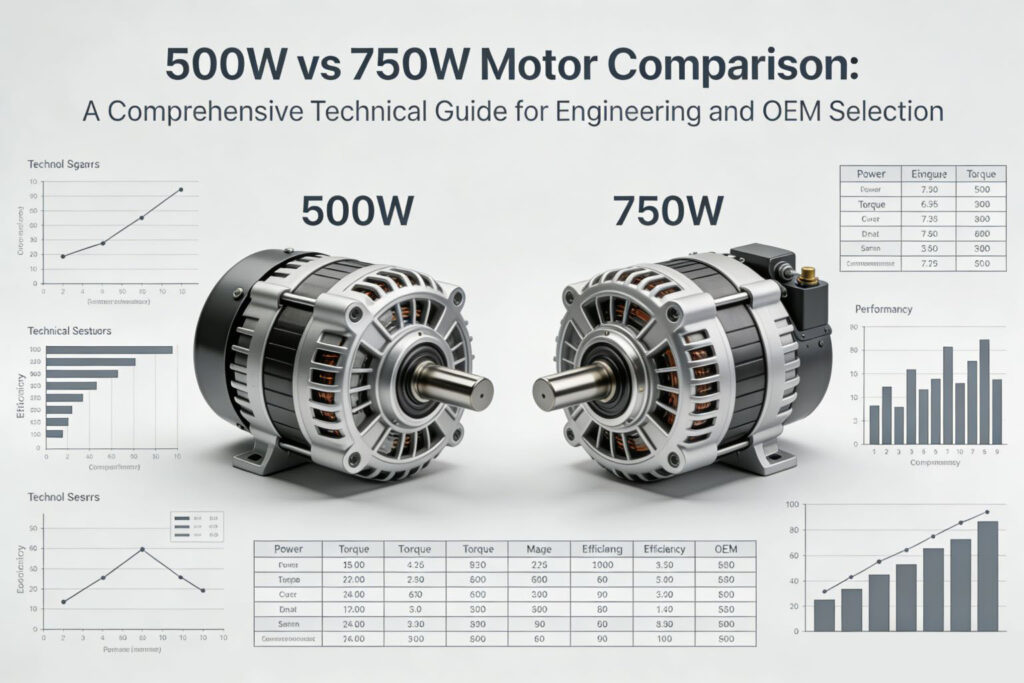
500การเปรียบเทียบมอเตอร์ W กับ 750W: A Comprehensive Technical Guide for Engineering and OEM Selection
Executive Summary: The Core Differences Between 500W and 750W Motors
In industrial automation and electric vehicle (อีวี) ออกแบบ, choosing between a 500W vs 750W motor involves more than just selecting a higher number on a datasheet. The primary difference lies in the continuous torque capacity, thermal overhead, and duty cycle performance. A 750W motor typically provides 50% more nominal power output than a 500W unit, allowing for significantly higher stall torque and better performance under heavy mechanical loads or steep inclines.
สำหรับวิศวกร, the decision often balances ประสิทธิภาพการใช้พลังงาน against peak performance requirements. While a 500W motor is optimized for lightweight, high-efficiency applications with consistent loads, a 750W motor offers the “power reserve” necessary for dynamic acceleration and demanding industrial cycles. Selecting the correct wattage ensures optimal ต้นทุนการเป็นเจ้าของทั้งหมด (ต้นทุนการเป็นเจ้าของ) by preventing premature motor failure due to thermal stress while avoiding the unnecessary cost and weight of over-specification.
1. Understanding Power Ratings: Nominal vs. Peak Power in 500W and 750W Systems
When comparing 500W and 750W motors, it is critical to distinguish between Nominal (ต่อเนื่อง) พลัง และ พลังสูงสุด. Nominal power, such as 500W, represents the output the motor can maintain indefinitely without exceeding its thermal class limits (เช่น., Class F or Class H insulation).
The Impact of Voltage on Power Delivery
พลัง ($P$) is the product of Voltage ($V$) and Current ($I$). สำหรับ 48V system, a 500W motor draws approximately 10.4A of continuous current, whereas a 750W motor draws roughly 15.6A. This increase in current requires thicker copper windings and more robust MOSFETs in the motor controller to handle the resultant heat ($I^2R$ losses).
OEMs must consider that a 750W motor paired with an undersized battery or controller will not reach its rated potential. ในทางกลับกัน, a 500W motor can often reach “จุดสูงสุด” outputs of 750W-1000W for short bursts (เช่น., 30 วินาที), but sustained operation at these levels will lead to demagnetization of the permanent magnets or winding insulation breakdown.
2. Torque Density and Mechanical Output Comparison
Torque is the “work” the motor performs, while wattage is the “rate” at which that work is done. ในก 500W vs 750W motor comparison, the torque profile is the most tangible difference for end-users.
- 500W Motors: Generally produce between 15–25 Nm of torque (depending on gear reduction). They are ideal for flat-terrain transport, precision conveyor belts, and small-scale robotics.
- 750W Motors: Often reach 30–45 Nm of torque. This increased torque density allows for higher “gradeability” in EVs and the ability to overcome higher static friction in industrial machinery.
For B2B applications, เช่น industrial BLDC motors, the 750W variant typically utilizes a larger rotor diameter or longer stack length to increase the magnetic flux, resulting in higher torque constants ($K_t$).
3. Efficiency Curves: Why More Power Isn’t Always Less Efficient
A common misconception is that a 750W motor consumes more energy than a 500W motor regardless of the load. In reality, ประสิทธิภาพของมอเตอร์ is a curve.
If an application requires a constant 450W of output, a 500W motor will be operating near its thermal limit (high stress), where efficiency often drops due to increased heat. อย่างไรก็ตาม, a 750W motor providing that same 450W may be operating in its “sweet spot” (โดยทั่วไป 70-80% of rated load), ส่งผลให้ cooler operation and potentially better battery life for the overall system.
The Role of Copper Losses
Efficiency is largely dictated by resistive losses in the windings. Because 750W motors are engineered to handle higher currents, they often feature lower internal resistance ($R$). For engineers calculating the ROI of an OEM project, analyzing the รอบหน้าที่ is paramount: if the motor spends 90% of its time at mid-loads, the 750W might actually be the more “มีประสิทธิภาพ” choice for the system’s lifespan.
4. Thermal Performance and Reliability: เดอะ “ความร้อนสูงเกินไป” ปัจจัย
Heat is the primary enemy of electric motors. When comparing 500W vs 750W, the 750W motor usually has a larger surface area and superior heat dissipation characteristics.
Thermal Mass and Duty Cycles
In industrial environments, motors often run in “S3” duty cycles (intermittent periodic duty). A 750W motor has greater thermal mass, meaning it takes longer to reach critical temperatures during high-load events.
Technical Note: A 500W motor operating at 600W will reach its thermal ceiling much faster than a 750W motor operating at the same load. For OEM applications requiring high reliability in hot environments, the 750W motor provides a “safety buffer” that reduces the risk of field failures.
5. การวิเคราะห์เปรียบเทียบ: 500W vs. 750W Technical Specifications
The following table outlines the typical performance metrics encountered by procurement managers when sourcing motors from manufacturers like Greensky Power.
| คุณสมบัติ | 500W Motor (มาตรฐาน) | 750W Motor (ประสิทธิภาพสูง) | ผลกระทบทางวิศวกรรม |
|---|---|---|---|
| Nominal Torque | 18 – 22 นิวตันเมตร | 32 – 40 นิวตันเมตร | 750W handles ~50% more load. |
| กระแสสูงสุด (48วี) | ~12A | ~18A | Requires higher-gauge wiring. |
| น้ำหนัก | 3.5 – 4.2 กิโลกรัม | 4.5 – 5.5 กิโลกรัม | 750W increases total system mass. |
| Heat Dissipation | Standard Fins | Enhanced Fins / Larger Housing | 750W handles longer duty cycles. |
| การใช้งานทั่วไป | Light AGVs, E-จักรยาน, ปั๊ม | Cargo Trikes, หุ่นยนต์อุตสาหกรรม | Selection based on “Worst Case” โหลด. |
6. ข้อควรพิจารณาเฉพาะการใช้งาน: Where Each Power Level Shines
Industrial Automation and Conveyors
In a factory setting, ก 500ดับเบิ้ลมอเตอร์ is often sufficient for driving belt conveyors carrying lightweight goods. อย่างไรก็ตาม, if the conveyor needs to start under a full load (High Starting Torque), เดอะ 750ดับเบิ้ลมอเตอร์ is required to overcome the inertia without triggering the controller’s over-current protection.
Electric Mobility (E-bikes and Scooters)
For OEM e-bike manufacturers, the choice is often dictated by regional regulations (เช่น., 250W/500W limits in some areas). อย่างไรก็ตาม, สำหรับ “Off-road” หรือ “Cargo” segments, the 750W motor is the industry standard. It provides the necessary torque for 15-20% inclines which a 500W motor would struggle to climb at a sustainable speed.
Pumps and HVAC Systems
In fluid management, the 750W motor allows for higher flow rates or the ability to handle higher viscosity fluids. Engineers must match the motor to the pump’s impeller curve to ensure the motor operates near its peak efficiency point.
7. B2B Selection Guide: How to Choose the Right Power Rating
Selecting a motor for an OEM project requires a structured approach. ที่ พลังงานกรีนสกี้, we recommend engineers follow these five steps:
- Calculate Continuous Torque: Determine the torque required during the longest portion of the motor’s operation. If it is $>20$ นิวตันเมตร, lean toward 750W.
- Identify Peak Loads: Does the application require frequent stops and starts? The higher peak current handling of a 750W system is safer.
- Analyze Voltage Constraints: 500W motors are common in 36V/48V. 750W motors perform best at 48V, 60วี, or 72V to keep current levels manageable.
- Evaluate Space and Weight: If the application is weight-sensitive (เช่น., a portable medical device), a 500W motor with a high-ratio gearbox may be better than a heavy 750W direct-drive motor.
- สภาพแวดล้อม: In enclosed spaces with poor ventilation, the 750W motor is preferable because it generates less heat relative to its total capacity.
8. Controller Compatibility and System Integration
A motor is only as good as its controller. สำหรับ 500W vs 750W motor comparison, the controller selection changes significantly.
A 750W motor requires a controller capable of handling at least 25A–30A peak currents. Using a “universal” controller for both can be risky. Modern ฟค (การควบคุมเชิงภาคสนาม) controllers can optimize the performance of both wattage levels, providing smoother acceleration and better regenerative braking. For B2B clients, ensuring the Communication Protocol (แคนบัส, อาร์เอส485) matches the rest of the industrial system is as important as the wattage itself.
9. Cost vs. ค่า: The Procurement Perspective
From a purchasing standpoint, a 750W motor usually carries a price premium of 15-25% over a 500ดับเบิ้ลมอเตอร์. อย่างไรก็ตาม, เดอะ Value Engineering perspective suggests looking at the lifespan.
A 500W motor pushed to its limits may have a lifespan of 2,000 hours before bearing or winding failure. A 750W motor doing the same job may last 5,000+ hours because it is never thermally stressed. For OEM brands, this translates to fewer warranty claims and higher brand prestige.
10. แนวโน้มในอนาคต: The Rise of High-Efficiency Mid-Range Motors
The industry is moving toward ความหนาแน่นของพลังงานสูง. New materials, such as high-grade Neodymium (NdFeB) magnets and thinner silicon steel laminations, are allowing 500W-sized housings to produce 750W of power.
As an EV motor specialist, Greensky Power is seeing increased demand for Custom Wound Motors that provide 750W performance specifically at low RPMs, catering to the growing robotics and AGV (ยานพาหนะนำทางอัตโนมัติ) ตลาด.
คำถามที่พบบ่อย: Technical Questions on 500W and 750W Motors
1. Can I replace a 500W motor with a 750W motor?
ใช่, but you must ensure your battery and controller can handle the increased current draw. A 750W motor will attempt to pull more Amps; if your battery’s BMS (Battery Management System) is rated for 15A and the motor needs 20A, the system will shut down.
2. Is a 750W motor significantly faster than a 500W motor?
Not necessarily. Top speed is determined by RPM and voltage. อย่างไรก็ตาม, a 750W motor will reach its top speed faster (การเร่งความเร็ว) and maintain that speed better when facing wind resistance or uphill grades.
3. Which is better for hill climbing?
เดอะ 750ดับเบิ้ลมอเตอร์ is objectively better for hill climbing. Torque is the force required to overcome gravity, and the 750W motor provides a higher sustained torque output, preventing the motor from “stalling” or overheating during long ascents.
4. Does a 750W motor drain the battery faster?
Only if you use the extra power. If you ride or operate at the same speed and load as you would with a 500W motor, the energy consumption will be nearly identical. อย่างไรก็ตาม, having the 750W “headroom” often encourages higher power usage, which can reduce range.
5. What are the maintenance differences?
For brushless (บีแอลดีซี) versions, maintenance is minimal for both. อย่างไรก็ตาม, because 750W motors handle more mechanical stress, checking gearbox lubrication and bearing wear is more critical in high-torque industrial applications.
บทสรุป: Making the Right Choice for Your OEM Project
The choice between a 500W vs 750W motor boils down to your specific application’s load requirements and environmental conditions. For light-duty, cost-sensitive projects, the 500W motor remains a reliable workhorse. For demanding industrial tasks, cargo transport, or high-performance robotics, the 750W motor provides the durability and power necessary for professional-grade results.
Ready to optimize your motor selection? Our engineering team at Greensky Power specializes in custom OEM solutions tailored to your torque and efficiency needs.
[ซีทีเอ]: Contact our engineers today for a technical datasheet or a custom motor quotation.