
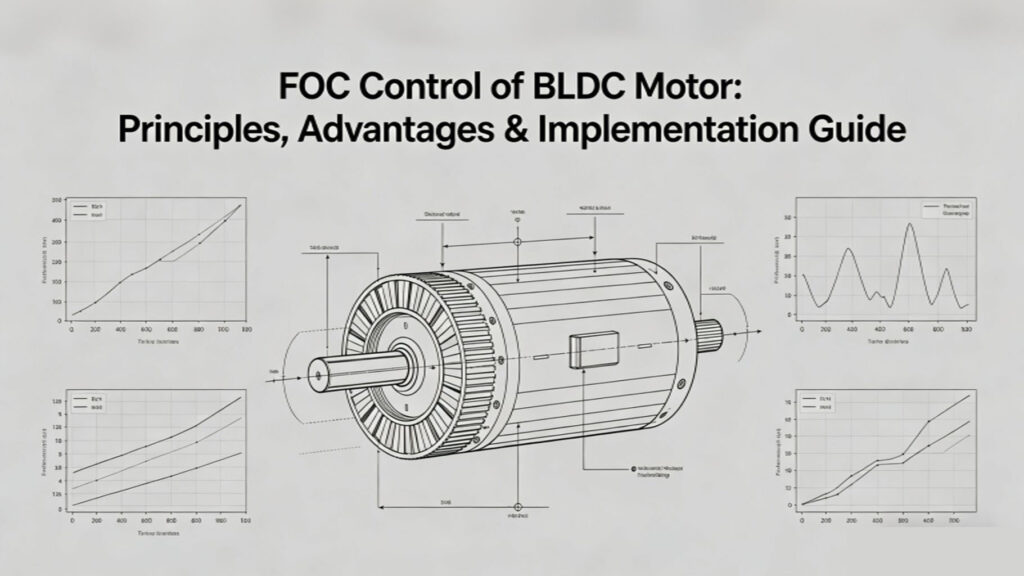
FOC-styrning av BLDC-motor: Principer, Fördelar & Implementeringsguide
Utvalt utdrag:
Fältorienterad kontroll (FOC) is an advanced control method for BLDC motors that enables precise torque and speed control by decoupling stator currents into orthogonal components. Compared to traditional trapezoidal control, FOC significantly improves efficiency, reduces torque ripple, and enhances dynamic performance. It is widely used in electric vehicles, robotik, and high-performance industrial systems. For engineers and OEMs, FOC is the preferred solution when performance, smidig drift, and energy efficiency are critical.
As industrial systems evolve toward higher efficiency and precision, FOC control of BLDC motor has become a standard in advanced motor drive systems. Unlike conventional control strategies, FOC leverages mathematical transformations and real-time feedback to achieve optimal electromagnetic performance. This article provides a comprehensive engineering-level analysis of FOC principles, fördelar, implementation challenges, and how to select the right solution for your application.
What Is FOC Control of BLDC Motor?
Fältorienterad kontroll (FOC), also known as vector control, is a technique that transforms trefasmotor currents into a rotating reference frame aligned with the rotor magnetic field. This allows independent control of torque and flux, similar to a DC motor.
Core Concept
- Transform stator currents into d-axis (flux) and q-axis (vridmoment) komponenter
- Control torque directly via q-axis current
- Maintain optimal flux via d-axis current
This decoupling enables precise torque control and high efficiency across a wide speed range.
Why FOC Control Is Used in Modern BLDC Motors
Traditional BLDC control methods, such as six-step (trapezoidal) kommutering, are simple but introduce torque ripple and inefficiencies. FOC addresses these limitations.
Engineering Drivers
- Higher efficiency under variable load conditions
- Smoother torque output → reduced vibration
- Better low-speed performance
- Improved acoustic noise characteristics
In applications like electric vehicles and robotics, these advantages directly translate into better system performance and user experience.
FOC vs Trapezoidal Control: Viktiga skillnader
| Parameter | FOC Control | Trapezoidal Control |
|---|---|---|
| Vridmoment Ripple | Mycket låg | Hög |
| Effektivitet | Hög | Måttlig |
| Kontrollkomplexitet | Hög | Låg |
| Buller | Låg | Högre |
| Ansökningar | EV, robotik, VVS | Fans, basic drives |
FOC offers superior performance but requires more advanced hardware and software.
Mathematical Principles Behind FOC
FOC relies on coordinate transformations to simplify motor control.
Clarke and Park Transformations
- Clarke transform: Converts 3-phase currents to 2D stationary frame
- Park transform: Converts to rotating frame aligned with rotor
Inverse Transformations
- Used to generate PWM signals for inverter switching
These transformations enable decoupled control of torque and flux, improving system stability and efficiency.
Efficiency and Thermal Performance in FOC Systems
FOC control significantly improves efficiency and thermal behavior.
Efficiency Improvements
- Optimized current vector → reduced copper losses
- Minimized harmonic distortion
Thermal Benefits
- Lower heat generation
- Improved thermal distribution
For high-power systems such as 48V and 72V BLDC motors, FOC helps extend component lifespan and reduce cooling requirements.
Torque Density and Dynamic Performance
FOC enables maximum torque utilization by aligning current with the rotor magnetic field.
- Higher torque per ampere
- Fast dynamic response
- Stable operation at low speeds
This is critical for applications such as AGVs, servosystem, and electric vehicles.
Control System Architecture for FOC
Implementing FOC requires a combination of hardware and software components.
Nyckelkomponenter
- Microcontroller or DSP
- Inverter (MOSFET/IGBT)
- Current sensors
- Position sensors (Hall, kodare) or sensorless algorithms
Control Loop Structure
- Current control loop (fast)
- Speed control loop (outer loop)
Modern controllers integrate these functions into compact, high-performance modules.
👉 Explore: BLDC Motor Solutions
Reliability and Lifespan Considerations
FOC systems improve motor reliability by reducing stress on components.
- Lower thermal stress → longer insulation life
- Reduced mechanical vibration
- Improved system stability
dock, system reliability depends heavily on controller design and software quality.
How to Choose FOC-Controlled BLDC Motor for Your Application
Selecting the right FOC system requires a detailed evaluation of system requirements.
Key Selection Factors
- Spänning: 24V / 48V / 72V platforms
- Power Range: From small drives to kW-level systems
- Fart & Vridmoment: Dynamic vs steady-state needs
- Kyl: Air or liquid cooling
- Controllerkompatibilitet: FOC-supported drivers
Application Recommendations
- Electric vehicles → FOC BLDC motor
- Robotics → FOC control for precision
- HVAC → energy-efficient FOC systems
👉 Get OEM solution: Custom Motor Development
Industrial Applications of FOC-Controlled BLDC Motors
- Elfordon (hub motors, dragmotorer)
- Robotics and automation
- HVAC systems and compressors
- Industrial pumps and fans
👉 EV motors: Electric Vehicle Motor Solutions
Cost vs Performance: Is FOC Worth It?
| Faktor | FOC Control | Basic Control |
|---|---|---|
| Initial kostnad | Högre | Lägre |
| Effektivitet | Högre | Lägre |
| Prestanda | Superior | Måttlig |
| Total Cost | Lower long-term | Högre |
For most industrial applications, FOC provides better long-term value despite higher initial investment.
Framtida trender: FOC in Smart Motor Systems
FOC is becoming the standard for intelligent motor control.
- Integration with IoT and AI systems
- Adoption in electric mobility
- Advancements in sensorless control
As Industry 4.0 evolves, FOC will play a central role in motor-driven systems.
FAQ: FOC-styrning av BLDC-motor
1. What is FOC control in BLDC motors?
FOC is a control method that allows independent control of torque and flux using coordinate transformations, improving efficiency and performance.
2. Why is FOC better than trapezoidal control?
FOC provides smoother torque, högre effektivitet, and lower noise, making it ideal for high-performance applications.
3. Does FOC require sensors?
FOC can use sensors like encoders or operate in sensorless mode using advanced algorithms.
4. Is FOC suitable for all BLDC motors?
FOC is suitable for most BLDC motors, especially in applications requiring precision and efficiency.
5. What are the disadvantages of FOC?
Higher complexity, kosta, and development effort compared to basic control methods.
Slutsats: Why FOC Is the Future of BLDC Motor Control
De FOC control of BLDC motor represents a significant advancement in motor control technology. By enabling precise, effektiv, and reliable operation, FOC is becoming the standard in modern industrial and OEM applications.
For engineers and procurement teams, investing in FOC-controlled systems ensures better performance, lägre energiförbrukning, och långsiktig tillförlitlighet.
Need help implementing FOC solutions?
✔ Request datasheet
✔ Get OEM motor + controller solution
✔ Contact our engineers today
Referenser
- IEEE-transaktioner på industriell elektronik
- Motor Control Theory Textbooks
- IEC Efficiency Standards