
Topp 12 Coreless Motor Manufacturers in the World: Ranked List & Buyer’s Guide
Quick Answer
Toppen 12 coreless motor manufacturers in the world in 2026 are Maxon, Faulhaber, Portescap, Nidec, Adamant Namiki, Allient (Allied Motion), Precision Microdrives, Constar, MÅNAR’ (鸣志), Dingzhi (鼎智), Topband (拓邦), and Greensky Power. A coreless motor — also called a hollow-cup or ironless motor — replaces the traditional iron-core rotor with a self-supporting, skew-wound copper cup. Because there is no iron in the rotor, it has zero cogging, almost no eddy-current or hysteresis loss, very low inertia, and a perfectly linear speed–torque curve.
European makers (Maxon, Faulhaber, Portescap) still lead the high-end scientific, flyg, and medical segments, while Japanese and Chinese suppliers dominate high-volume robotics and consumer applications. This guide ranks them and explains how to select the right coreless motor for your project.
What Is a Coreless Motor? (Definition)
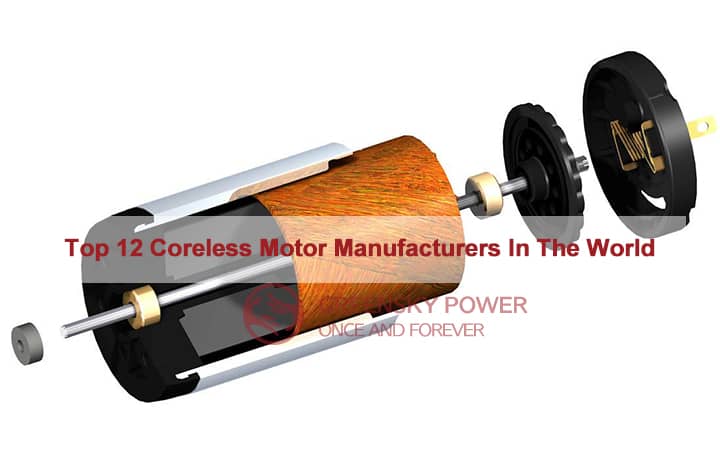
A coreless motor (also called a hollow-cup, ironless, eller slotless motor) is a permanent-magnet DC or brushless DC motor whose rotor winding is a self-supporting cylinder of copper — with no iron laminations inside the coil. In a conventional motor the copper is wound into slots of a laminated steel core; in a coreless motor the skew-wound copper forms a thin-walled cup that spins around (or inside) a stationary permanent magnet.
The design dates to 1958, when Dr. Fritz Faulhaber developed the skew-wound (rhombic) self-supporting coil, patented in 1965. Removing the iron from the rotating mass changes almost every performance metric that matters for precision motion:
- No cogging torque — there are no iron teeth to snap to the magnet, so the shaft can stop and hold at any position, and low-speed motion is perfectly smooth.
- No iron losses — with no rotor iron there are essentially zero eddy-current and hysteresis losses, which is why coreless motors reach very high efficiency (often 85–90% brushed, >90% borstlös).
- Very low rotor inertia — a hollow copper cup weighs a fraction of an iron rotor, giving mechanical time constants of just a few milliseconds and exceptional acceleration.
- Linear speed–torque behaviour — no magnetic saturation means torque is directly proportional to current and speed is proportional to voltage, so servo control is simple and accurate.
These traits make coreless motors the default choice wherever size, precision, response speed, and battery efficiency all matter at once: surgical robots, prosthetics, drönare, kameror, aerospace instruments, and the dexterous hands of humanoid robots.
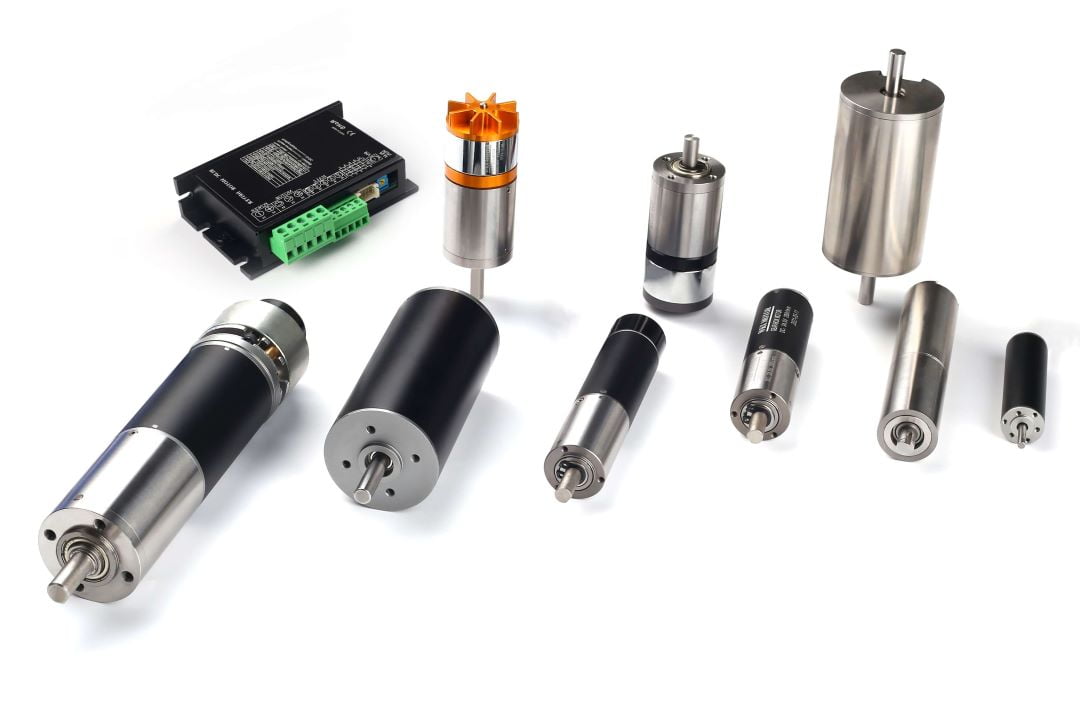
How a Coreless Motor Works: Step-by-Step
Take a classic brushed coreless motor as the reference (brushless coreless motors move the winding to the stator but follow the same ironless logic):
- The magnet sits at the center. A cylindrical rare-earth (usually NdFeB) permanent magnet is mounted on the stationary shaft, creating a radial magnetic field in the air gap.
- The copper cup surrounds it. The self-supporting, skew-wound copper coil forms a hollow cup that rotates in the air gap between the central magnet and an outer steel return ring (the flux path closes through the steel tube, not the rotor).
- Current energizes the coil. Brushes and a commutator (precious-metal or graphite) feed current into the rotating cup. Current in the magnetic field produces a Lorentz force on every conductor: F = B·I·L.
- Torque is generated with no iron in the loop. Because the coil has no core, torque is proportional to current with no cogging ripple: T = kT · I. The back-EMF is proportional to speed: Ui = kE · ω, and in SI units kT = kE.
- The light rotor accelerates almost instantly. With minimal inertia and no magnetic saturation, the motor reaches a linear operating point where U = I·R + kE·ω — speed set by voltage, torque set by current, with a mechanical time constant of only a few milliseconds.
The trade-off is thermal: with no iron mass to absorb and spread heat, the thin winding has limited heat capacity, so continuous current (och arbetscykel) must be managed carefully — the single biggest design constraint of coreless motors.
Coreless vs. Iron-Core Motors Compared
The clearest way to understand a coreless motor is to compare it directly with a conventional iron-core (slotted) motor of similar size.
| Characteristic | Coreless (hollow-cup / ironless) | Iron-core (slotted) motor |
|---|---|---|
| Rotor construction | Self-supporting skew-wound copper cup, no iron | Copper wound in laminated steel slots |
| Cogging torque | Ingen (stops at any position) | Present (detent torque) |
| Iron losses (eddy/hysteresis) | Essentially zero | Significant, rise with speed |
| Rotor inertia | Mycket låg | Hög |
| Mechanical time constant | ~2–10 ms | Tens of ms |
| Effektivitet (typical) | 85–90% brushed, >90% borstlös | 70–85% |
| Speed–torque curve | Linear | Slightly non-linear |
| Electrical noise / EMI | Låg (low inductance, less arcing) | Högre |
| Continuous power / heat capacity | Begränsad (no iron heat sink) | Högre (iron absorbs heat) |
| Typical size | Micro to small (ø3–40 mm) | Small to very large |
| Relative cost | Hög | Low–moderate |
Bottom line: choose coreless when precision, response, jämnhet, and efficiency in a small package outweigh cost and continuous-power limits. Choose iron-core when you need high continuous torque, high power, or low cost.
How We Ranked the Top 12 Coreless Motor Manufacturers
“Best” depends on your application, so this list is not a single revenue table. We scored each manufacturer across six weighted dimensions that matter to a real B2B buyer sourcing coreless (hollow-cup) motorer:
| Ranking dimension | Vikt | What it measures |
|---|---|---|
| Coreless technology depth | 25% | Skew-winding know-how, motor constant km, miniaturization limit |
| Product breadth | 20% | Brushed & brushless coreless, gearheads, kodare, servo modules |
| Kvalitet & pålitlighet | 20% | Life at high rpm, consistency, medical/aerospace track record |
| Global reach & support | 15% | Distribution, application engineering, lead time |
| Application coverage | 10% | Medicinsk, robotik, flyg, drönare, industriell, consumer |
| Innovation & R&D | 10% | Integrated drives, new materials, robotics/dexterous-hand programs |
Data comes from manufacturer technical documentation, IEC/NEMA standards practice, and third-party market research (Grand View, IntelMarketResearch). Rankings reflect 2026 positioning; the coreless-motor-for-dexterous-hand market alone was USD 740 million in 2024, projected to reach USD 1.5 miljarder med 2031 (CAGR ~8.7%).
Topp 12 Coreless Motor Manufacturers (2026 Ranking Table)
| Rank | Tillverkare | HQ | Core coreless products | Best known for |
|---|---|---|---|---|
| 1 | Maxon Group | Schweiz | Coreless brushed & BLDC, gearheads, kontroller | Flyg och rymd / Mars-rover-grade precision |
| 2 | Faulhaber | Tyskland | Skew-wound coreless DC, BLDC, micro drives | Inventor of the coreless coil; micro precision |
| 3 | Portescap (Nidec) | Schweiz / USA | Ironless brush DC, slotless BLDC, disc-magnet steppers | Medicinsk & incremental-motion drives |
| 4 | Nidec Corporation | Japan | Micro coreless, vibration & BLDC via group brands | Scale, breadth, robotics supply |
| 5 | Adamant Namiki | Japan | Micro coreless & vibration motors (ø3–12 mm) | Ultra-miniature medical & endoscopy |
| 6 | Allient (Allied Motion) | USA | Slotless BLDC, coreless servo | Medicinsk, försvar, industrial servo |
| 7 | Precision Microdrives | Storbritannien | Coreless & vibration motors, haptics | Fast-turn prototyping, haptics |
| 8 | Constar / Chaoli | Kina | Hollow-cup brushed & BLDC | High-volume consumer & model industry |
| 9 | MÅNAR’ (鸣志) | Kina | Coreless / hollow-cup, steppers, integrated drives | Robotik & automation scale-up |
| 10 | Dingzhi Technology (鼎智) | Kina | Hollow-cup, linjär & can-stack motors | Medicinsk & lab-automation micro drives |
| 11 | Topband (拓邦) | Kina | Coreless BLDC, motor + styrmoduler | Robotik & smart-appliance volume |
| 12 | Greensky Power | Kina | Coreless / BLDC / brushed DC + matched gearboxes | OEM/ODM custom drives, flexible MOQ |
Ranking reflects overall coreless-motor positioning for global B2B buyers in 2026 and is not a pure revenue ranking. European makers lead high-end precision; Japanese makers lead ultra-miniature; Chinese makers lead high-volume robotics, consumer, and cost-sensitive OEM work.
1. Maxon Group (Schweiz)
The benchmark for high-reliability coreless drives. Maxon motors have flown on multiple NASA Mars rovers and are standard in surgical robotics and lab instruments. Its DC-max and EC-max ranges pair coreless technology with matched planetary gearheads and controllers.
2. Faulhaber (Tyskland)
The original inventor of the self-supporting skew-wound coil. Faulhaber (with its US arm MicroMo) offers some of the highest motor constants and smallest precision coreless motors, favored in medical, optics, and aerospace instrumentation.
3. Portescap (Schweiz / USA, Nidec group)
A pioneer of the ironless rotor and disc-magnet stepper. Portescap’s REE (Reduced Electro-Erosion) commutation extends brush life dramatically, making it a leader in medical hand tools and incremental-motion systems.
4. Nidec Corporation (Japan)
The world’s largest small-motor group. Through its brands (including Portescap and Copal), Nidec supplies coreless, vibration, and micro BLDC motors at enormous scale, and is a key player in robotics and automotive micro-actuation.
5–7. Adamant Namiki, Allient & Precision Microdrives
Adamant Namiki (Japan) specializes in ultra-miniature coreless and vibration motors down to ~ø3 mm for endoscopy and wearables. Allient/Allied Motion (USA) supplies slotless BLDC servo for medical and defense. Precision Microdrives (Storbritannien) is the go-to for fast prototyping, haptics, and vibration motors.
8–11. Rising Chinese specialists
Driven by humanoid robotics and precision automation, Chinese makers have scaled fast. Chaoli/Constar, MÅNAR’ (鸣志), Dingzhi (鼎智), och Topband (拓邦) now offer competitive hollow-cup and coreless BLDC motors — increasingly as integrated “servo coreless modules” with encoders and drivers built in — at strong price/performance for high-volume programs.
12. Greensky Power (Kina)
An OEM/ODM specialist that supplies coreless, BLDC, and brushed DC motors with matched gearboxes for customers in 50+ länder. Greensky fits buyers who need custom windings, flexible MOQs, and engineering support alongside the tier-1 catalog brands above.
Coreless Motor Engineering Data: Effektivitet, Temperatur & Formler
To specify a coreless motor correctly you work from a handful of catalog constants. These are the parameters every manufacturer above publishes, and the equations that link them.
Key performance parameters
| Parameter | Symbol | Typical range (micro coreless) |
|---|---|---|
| Peak efficiency | eller | 85–90% brushed · >90% coreless BLDC |
| Utan lasthastighet | n0 | 5,000–50,000+ rpm |
| Continuous torque | T | ~0.5–150 mNm (up to ~600 mNm intermittent) |
| Torque constant | kT | 1–50 mNm/A (size dependent) |
| Mechanical time constant | τm | ~2–10 ms |
| Max winding temperature | Tmax | 100–125 °C (Class B/F resin) |
| Diameterintervall | ø | 3–40 mm |
Governing equations
- Vridmoment: T = kT · I — torque is directly proportional to current (no cogging, no saturation).
- Back-EMF: Ui = kE · ω, and in SI units kT = kE.
- Voltage balance: U = I·R + kE·ω — the linear operating line of the motor.
- Utan lasthastighet: åh0 ≈ U / kE.
- Motor (figure-of-merit) constant: km = kT / √R — higher km means more torque per watt of heat; the key quality metric.
- Mechanical time constant: τm = J·R / (kT·kE) — governs how fast the rotor accelerates.
- Thermal limit: ΔT = Ploss · Rth, med Ploss ≈ I²·R — the equation that sets continuous current.
Worked example
A coreless motor with kT = 10 mNm/A driving a 20 mNm load needs I = T/kT = 20/10 = 2 A. If winding resistance R = 1 Ω, copper loss is Ploss = I²R = 4 W. With thermal resistance Rth = 15 K/W the winding rises ΔT = 4 × 15 = 60 °C above ambient — so at 25 °C ambient the winding sits near 85 °C, safely under a 125 °C Class-F limit. This is exactly why coreless duty cycle must be checked, not just peak torque.
Best Applications for Coreless Motors
| Industri | Ansökan | Why coreless wins |
|---|---|---|
| Medicinsk | Surgical robots, prosthetic hands, insulin/infusion pumps, dental tools | Smooth, exakt, low-noise, high torque-to-size |
| Robotik | Humanoid dexterous hands, grippers, exoskeletons | Low inertia, fast response, kompakt (Tesla Optimus uses 12 per robot) |
| Flyg och rymd & försvar | Satellite instruments, UAV gimbals, guidance actuators | Hög effektivitet, pålitlighet, no cogging |
| Optics & bildbehandling | Camera autofocus/zoom, laser scanning, microscopy stages | Exakt positionering, zero detent torque |
| Industriell automation | Pick-and-place, lab automation, semiconductor handling | Fast start/stop, accurate incremental motion |
| Consumer & wearables | Drones, e-cameras, haptics, grooming devices | Battery efficiency, liten storlek, låg vibration |
How to Select a Coreless Motor: Step-by-Step
- Define the load and duty cycle. Fix the required continuous and peak torque, fart, and how long the motor runs. Duty cycle matters more for coreless than for iron-core because of the thermal limit.
- Check the thermal budget. Compute copper loss I²R and winding rise ΔT = Ploss·Rth. Keep the continuous point below the resin’s max temperature — never size on peak torque alone.
- Compare motor constant km. For a given size, a higher km = kT/√R delivers more torque per watt of heat. This is the single best cross-brand quality metric.
- Choose brushed vs. brushless coreless. Brushed coreless is cheaper and simpler; brushless coreless lasts far longer at high rpm and high duty, and enables integrated encoders/drivers.
- Match the gearhead. Most precision jobs need a planetary or spur gearhead. Match its rated torque and backlash to the motor and load; buy motor + gearhead as a set to guarantee concentricity.
- Specify feedback & interface. Add an encoder or Hall sensors if you need closed-loop position/speed; confirm connector, Spänning, and bus (EtherCAT/CAN) behov.
- Validate supplier & standarder. Confirm the vendor tests to relevant IEC 60034 / IEEE 112 practice, and can support your volume, lead time, and customization.
Common Engineering Mistakes with Coreless Motors
- Sizing on peak torque, ignoring duty cycle. De #1 error. A coreless motor has no iron heat sink, so a continuous load that looks fine on the torque curve can cook the winding. Always run the I²R and ΔT check.
- Överspänning / over-speed. The linear curve tempts users to push voltage for speed, but excessive rpm accelerates brush and bearing wear and can overheat the thin winding.
- Stalling a brushed coreless motor. At stall all electrical power becomes heat with zero cooling airflow — a coreless winding can burn out in seconds. Add current limiting.
- Mismatched gearhead. Bolting a cheap gearhead onto a precision motor introduces backlash and misalignment that destroy the very smoothness you paid for.
- Ignoring the motor constant km. Comparing only rated power hides efficiency and thermal headroom; km is the honest cross-brand metric.
- Wrong brush type. Precious-metal brushes suit low-current, batteri, and long-life jobs; graphite suits high peak-torque incremental motion. Using the wrong one shortens life.
Coreless Motor Troubleshooting Table
| Problem | Likely cause | Lösning |
|---|---|---|
| Winding burns out / smells hot | Continuous current above thermal limit; stall; poor heat sinking | Recalculate duty cycle & ΔT; add current limit; improve heat path |
| Short brush / commutator life | Over-speed, over-current, wrong brush material | Reduce rpm/current; select correct brush; consider brushless coreless |
| Excessive vibration at speed | Poor rotor dynamic balance or bearing wear | Use a quality vendor; check balance grade; replace bearings |
| Speed drifts under load | Voltage sag or rising winding resistance with temperature | Stiffen supply; run closed-loop; allow thermal margin |
| Rough / notchy low-speed motion | Damaged commutator or worn brushes (should be cog-free) | Inspect/replace commutation parts; verify controller |
| Lower torque than catalog | Undervoltage, high contact resistance, wrong winding variant | Verify supply & wiring; confirm kT of the exact variant |
| Audible electrical noise / EMI | Brush arcing, missing suppression | Add capacitors/chokes; use REE-type or brushless coreless |
| Gearhead backlash / play | Mismatched or low-grade gearhead | Use matched planetary gearhead rated to the load |
Vanliga frågor
Who makes the best coreless motors in the world?
For high-end scientific, flyg, and medical work, Maxon, Faulhaber, and Portescap lead. For ultra-miniature applications, Adamant Namiki and Nidec excel. For high-volume robotics and cost-sensitive OEM programs, Chinese makers such as MOONS’, Dingzhi, Topband, and Greensky Power offer strong price/performance.
What is a coreless (hollow-cup) motor?
It is a permanent-magnet motor whose rotor winding is a self-supporting copper cup with no iron core. Removing the iron eliminates cogging and iron losses, cuts inertia, and gives a linear speed–torque curve — ideal for precision, high-response, battery-powered applications.
Why are coreless motors more expensive?
The self-supporting skew-wound coil requires precision automated winding, resin impregnation, and tight balancing at very high rpm. This micron-level manufacturing, plus rare-earth magnets and precious-metal commutation, raises cost versus a slotted iron-core motor.
What is the main disadvantage of a coreless motor?
Limited continuous power and heat dissipation. With no rotor iron to absorb heat, the thin winding has low thermal capacity, so continuous current and duty cycle must be carefully managed to avoid burnout.
Are coreless motors brushed or brushless?
Both exist. Classic coreless motors are brushed with a self-supporting rotor coil. Coreless brushless (slotless BLDC) motors move the winding to the stator, keep the ironless, cog-free advantage, and last far longer at high speed and duty — increasingly the choice for robotics.
What are coreless motors used for?
Surgical robots and prosthetics, humanoid-robot dexterous hands, drones and UAV gimbals, camera autofocus, aerospace instruments, lab and semiconductor automation, and haptics — anywhere precision, fast response, and efficiency in a small package are essential.
Why Choose Greensky for Coreless & Custom Motors?
The tier-1 catalog brands above are excellent when a standard part fits. When you need a custom winding, a matched gearbox, or flexible volumes, Greensky Power is the OEM/ODM partner. Sedan 2011 we have engineered coreless, borstlös DC, brushed DC, and stepper motors with matched växellådor for customers in 50+ länder.
- Custom windings: torque constant, Spänning, and speed tuned to your load — not just catalog picks.
- Matched drivetrains: motor + gearhead supplied as one concentric assembly, no adapter guesswork.
- Flexible MOQ & lead time: support from prototype to mass production.
- 100% testat: every unit run-tested; run-out and vibration verified.
- Standards practice: designed to IEC 60034 / IEEE 112 test practice; ISO, CE certified.
- Local support: engineering help through United Motion Inc. in North America & Europa.
Referenser
- IEC 60034-1, Rotating electrical machines — Rating and performance. https://webstore.iec.ch/publication/60034-1
- IEC 60034-30-1, Rotating electrical machines — Efficiency classes (IE code). https://webstore.iec.ch/publication/30830
- NEMA MG 1, Motors and Generators. https://www.nema.org/standards/view/motors-and-generators
- IEEE Standard 112, Test Procedure for Polyphase Induction Motors and Generators. https://standards.ieee.org/ieee/112/4703/
- Maxon, Key information on maxon DC motors / coreless technology (technical library). https://www.maxongroup.com/maxon/view/content/technology-page
- Faulhaber, DC-Micromotors — Technology & coreless coil (technical notes). https://www.faulhaber.com/en/technology/
- Portescap, Brushed DC Motor Basics — Ironless Rotor. https://www.portescap.com/en/products/brush-dc-motors/brushed-dc-motor-basics
- SKF, Bearing rating life (L10) and mounting guidance. https://www.skf.com/group/support/engineering-tools/bearing-calculator
- Grand View Research / IntelMarketResearch, Coreless Motor Market & Coreless Motor for Dexterous Hand Market. https://www.intelmarketresearch.com/coreless-motor-for-dexterous-hand-market-4662
- U.S. Institutionen för energi, Motor Systems — Energy Conservation Program. https://www.energy.gov/eere/motors
https://youtu.be/nl-USfTe3z4
TOPP 10 Kinesiska BLDC-motortillverkare
TOPP 30 Tillverkare av elmotorer i Kina
TOPP 10 Kinesisk tillverkare av spiralväxelmotorer
TOPP 10 DC-motortillverkare i Kina