
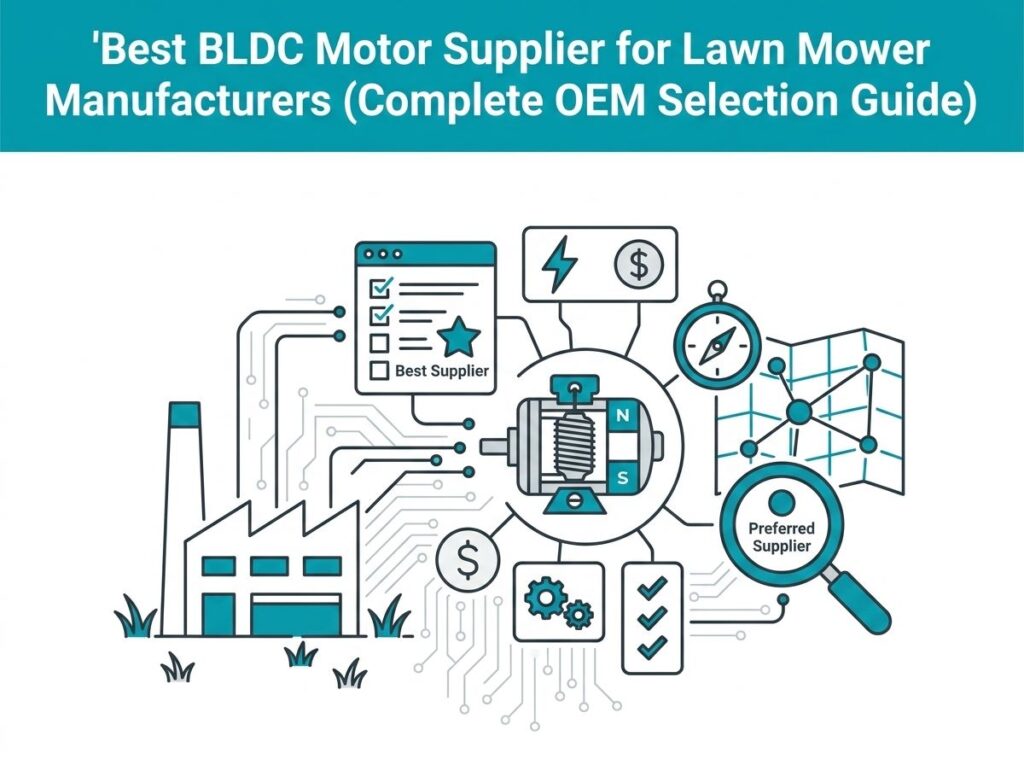
Bästa BLDC-motorleverantör för gräsklippartillverkare: Complete OEM Selection Guide
Quick answer
The best BLDC motor supplier for lawn mower manufacturers is not necessarily the lowest-cost vendor. The ideal supplier combines high motor efficiency, strong torque density, Långt livslängd, stable production capacity, engineering customization capabilities, and proven experience in electric lawn mower applications. For OEM lawn mower brands, selecting the right brushless DC motor supplier directly affects product performance, battery runtime, pålitlighet, warranty costs, and long-term competitiveness.
Modern electric lawn mowers and robotic lawn mowers increasingly rely on high-efficiency BLDC motors because they deliver superior torque, lägre underhållskrav, längre livslängd, and better energy utilization than brushed motors or traditional induction motors. This guide explains how engineers and procurement teams can evaluate and select the best BLDC motor supplier for lawn mower manufacturing projects.
What Is a BLDC Motor Supplier for Lawn Mower Manufacturers?
A BLDC motor supplier provides brushless DC motors specifically designed for lawn mower systems, robotic mowing platforms, battery-powered garden equipment, and commercial turf maintenance machinery.
Unlike general-purpose motor vendors, specialized lawn mower motor suppliers understand the unique operating conditions faced by mowing equipment:
- High shock loads from grass impact
- Continuous outdoor operation
- Dust and moisture exposure
- Battery-powered efficiency requirements
- Noise restrictions
- Seasonal temperature variations
- Compact installation space
A qualified supplier does much more than simply manufacture motors. They typically assist OEM customers with:
- Motor selection
- Performance simulation
- Controller matching
- Battery compatibility analysis
- Thermal management optimization
- Mechanical integration support
- Custom shaft and housing development
For lawn mower manufacturers, the motor supplier often becomes a strategic engineering partner rather than just a component provider.
Why Are BLDC Motors Becoming the Standard for Electric Lawn Mowers?
The global transition toward battery-powered outdoor power equipment has accelerated adoption of BLDC motors. Traditional brushed motors suffer from brush wear, minskad effektivitet, and higher maintenance requirements.
BLDC motors solve these limitations through electronic commutation, which eliminates mechanical brushes entirely.
Higher Efficiency
Most lawn mower BLDC motors achieve efficiencies between 85% och 93%, while many brushed designs operate in the 70%–80% range.
Higher efficiency translates directly into:
- Longer runtime
- Reduced battery size
- Lower operating temperature
- Higher cutting productivity
Higher Torque Density
Torque density is one of the most important factors for lawn mower performance. Thick grass, wet vegetation, and uneven terrain require strong torque output during sudden load spikes.
BLDC motors provide significantly higher torque per kilogram than many alternative motor technologies.
Minskat underhåll
Without brushes or commutators, maintenance requirements decrease dramatically. This is particularly important for robotic lawn mowers expected to operate autonomously for thousands of hours.
Longer Lifespan
High-quality BLDC motors routinely achieve service lives exceeding 10,000 hours when properly designed and cooled.
This extended lifespan reduces warranty costs and improves customer satisfaction.
What Makes a Great BLDC Motor Supplier?
Many suppliers claim to provide lawn mower motors, but only a small percentage possess the engineering capabilities required for large-scale OEM projects.
When evaluating suppliers, manufacturers should examine several key areas.
Application Experience
Experience with lawn mowers matters because mowing loads differ significantly from applications such as pumps or fans.
An experienced supplier understands:
- Blade inertia requirements
- Cutting torque fluctuations
- Peak current conditions
- Environmental protection requirements
Engineering Support
Strong engineering teams can optimize motor design before production begins.
Capabilities should include:
- Electromagnetic simulation
- Thermal analysis
- Mechanical design validation
- Controller tuning support
Production Capability
A supplier’s manufacturing infrastructure directly affects quality consistency and delivery performance.
Look for:
- Automated winding systems
- Rotor balancing equipment
- End-of-line testing
- Traceability systems
- ISO-certified processes
Customization Ability
Every lawn mower platform has unique requirements.
The best suppliers offer:
- Custom voltages
- Custom winding configurations
- Special shafts
- Integrerade växellådor
- Waterproof designs
- Custom connectors
BLDC Motor Supplier vs Generic Motor Manufacturer
| Faktor | Specialized BLDC Supplier | Generic Motor Manufacturer |
|---|---|---|
| Lawn Mower Experience | Extensive | Begränsad |
| Efficiency Optimization | Application-specific | General-purpose |
| Controller Matching | Supported | Often unavailable |
| Waterproof Design | Tillgängliga | Begränsad |
| OEM Customization | Strong | Grundläggande |
| Engineering Support | Dedicated | Minimal |
| Product Validation | Application-focused | Generic testing |
The engineering gap between a specialized lawn mower motor supplier and a general motor manufacturer often becomes evident during field testing. Specialized suppliers understand real-world mowing conditions and can proactively address performance challenges before mass production begins.
How Motor Efficiency Affects Lawn Mower Performance
Efficiency is frequently the most underestimated factor in lawn mower design.
Many OEM buyers focus primarily on motor cost while overlooking the long-term benefits of higher efficiency.
Battery Runtime
A motor operating at 92% efficiency converts more battery energy into useful mechanical output than a motor operating at 82%.
This difference significantly impacts runtime, especially in robotic lawn mowers.
Värmeproduktion
Every percentage point of efficiency improvement reduces heat losses.
Lower heat generation improves:
- Magnet life
- Bearing life
- Controller reliability
- Battery durability
System Cost Reduction
A more efficient motor may allow smaller battery packs to achieve identical runtime targets.
Since batteries are among the most expensive components in electric lawn mowers, this can substantially reduce overall system costs.
How Torque Density Influences Cutting Performance
Torque density measures how much torque a motor produces relative to its size and weight.
For lawn mower manufacturers, torque density directly affects:
- Cutting capability
- Machine weight
- Energieffektivitet
- Product compactness
When a mower encounters thick grass, the motor experiences rapid load increases.
Low torque density designs may stall or draw excessive current.
High torque density BLDC motors maintain blade speed more effectively under varying loads.
This results in:
- Cleaner cuts
- Higher productivity
- Improved user experience
- Reduced battery consumption
For commercial mowing applications, torque density often becomes a primary selection criterion.
Thermal Management Capabilities Suppliers Should Provide
Heat is one of the leading causes of motor failure.
A supplier’s ability to manage thermal performance directly impacts field reliability.
Advanced Stator Design
Optimized stator geometry improves heat transfer and minimizes copper losses.
Magnetval
High-temperature magnets help prevent demagnetization during prolonged operation.
Housing Design
Motor housings should act as effective heat sinks while maintaining structural integrity and environmental protection.
Thermal Simulation
Leading suppliers use simulation software to predict temperature distribution before prototype production.
This reduces development time and lowers engineering risk.
Why Reliability and Lifespan Matter More Than Initial Motor Cost
Procurement teams often compare suppliers based on unit pricing.
dock, focusing solely on purchase price can create expensive problems later.
A motor that costs 10% less but fails twice as often ultimately increases:
- Warranty expenses
- Service costs
- Brand damage
- Customer dissatisfaction
High-quality BLDC motors generally provide:
- Longer bearing life
- Lower winding degradation
- Higher insulation reliability
- Better environmental durability
The best suppliers prioritize lifecycle value rather than lowest acquisition cost.
How to Choose a BLDC Motor Supplier for Lawn Mower Applications
Selecting the best BLDC motor supplier requires more than comparing catalogs or requesting quotations. OEM lawn mower manufacturers must evaluate whether a supplier can support the complete product lifecycle—from concept development and prototyping to mass production and after-sales technical support.
The most successful lawn mower brands typically build long-term relationships with suppliers capable of providing engineering collaboration, not simply component delivery.
Voltage Range Selection
Battery voltage directly affects motor performance, current demand, controller design, and wiring requirements.
| Voltage Platform | Typical Application | Fördelar |
|---|---|---|
| 24V | Small robotic mowers | Low cost, simple architecture |
| 36V | Residential mowers | Balanced performance |
| 48V | Premium residential mowers | Higher efficiency and torque |
| 60V | Heavy-duty consumer mowers | Reduced current load |
| 72V | Commercial equipment | Maximum power capability |
Suppliers should offer multiple voltage platforms and demonstrate proven experience integrating motors with modern lithium battery systems.
Power Range Selection
Motor power requirements depend on cutting width, blade configuration, target grass density, and expected duty cycle.
- 300W–800W: Small robotic lawn mowers
- 800W–1500W: Residential electric mowers
- 1500W–3000W: Heavy-duty walk-behind mowers
- 3000W+: Commercial turf equipment
Speed and Torque Matching
A supplier should assist OEMs in balancing motor speed and torque characteristics. Excessive speed without sufficient torque results in blade slowdown under load. Excessive torque without proper speed reduces cutting quality and productivity.
The optimal motor delivers stable blade RPM while maintaining sufficient torque reserve during heavy grass cutting conditions.
Cooling Method Evaluation
Motor cooling strategies should align with mower operating conditions.
- Naturlig luftkylning
- Forcerad luftkylning
- Aluminum housing heat dissipation
- Integrated thermal paths
- Advanced thermal protection systems
Controllerkompatibilitet
The motor and controller must function as a complete system. Suppliers should provide controller matching support and verify compatibility with:
- foc kontroll
- Sensorless control
- Hall sensor control
- CAN communication
- Battery management systems
Application-Specific Requirements
Different mower categories require different optimization priorities.
- Robotic mowers: efficiency and low noise
- Residential mowers: performance and affordability
- Commercial mowers: durability and productivity
- Ride-on mowers: high torque and long duty cycles
Robotic Lawn Mower Motors vs Walk-Behind Lawn Mower Motors
Not all lawn mower motors are designed for the same operating conditions. Robotic mowers and walk-behind mowers have fundamentally different requirements.
| Faktor | Robotic Mower | Walk-Behind Mower |
|---|---|---|
| Primary Goal | Maximum runtime | Maximum cutting power |
| Arbetscykel | Very long | Intermittent |
| Noise Requirement | Mycket låg | Måttlig |
| Efficiency Priority | Extremely high | Hög |
| Torque Demand | Medium | Hög |
| Waterproof Requirement | Very high | Hög |
A qualified supplier should understand these distinctions and recommend motor designs accordingly.
Top Evaluation Checklist for OEM Lawn Mower Buyers
Before selecting a supplier, engineering and procurement teams should evaluate the following criteria.
| Evaluation Category | Key Questions |
|---|---|
| Ingenjörsförmåga | Can they customize motor design? |
| Manufacturing Capacity | Can they support volume growth? |
| Kvalitetskontroll | Do they perform 100% testning? |
| Industry Experience | Have they supplied mower OEMs before? |
| Supply Chain Stability | Can they ensure long-term availability? |
| Anpassning | Can they provide unique specifications? |
| Teknisk support | Do they support integration and validation? |
| Cost Competitiveness | Is total lifecycle cost optimized? |
Using a structured evaluation process significantly reduces sourcing risk and improves long-term product reliability.
Why Greensky BLDC Motors Are Suitable for Lawn Mower Manufacturers
For lawn mower OEMs seeking custom motor solutions, Greensky provides a combination of engineering expertise, manufacturing capability, and application-specific development support.
Greensky BLDC motor solutions are available across multiple voltage platforms including:
- 24V BLDC motors
- 36V BLDC motors
- 48V BLDC motors
- 60V BLDC motors
- 72V BLDC motors
Typical customization options include:
- Custom shaft configurations
- Integrerade växellådslösningar
- Waterproof motor structures
- Hall sensor and sensorless designs
- Controller matching support
- Application-specific winding optimization
For OEM projects requiring specialized performance targets, engineering teams can collaborate to optimize efficiency, vridmomentdensitet, thermal behavior, and cost objectives.
For detailed specifications, manufacturers can request a datasheet, discuss project requirements, or obtain a custom OEM motor proposal.
Future Trends in BLDC Motor Supply for Lawn Mower Manufacturers
The lawn mower industry continues to evolve rapidly as electrification expands globally.
Higher Voltage Platforms
48V and 72V architectures are becoming increasingly common because they improve efficiency and reduce current-related losses.
Integrated Drive Systems
Future systems increasingly combine motor, kontroller, sensorer, and communication interfaces into compact integrated packages.
Advanced FOC Control
Field-oriented control continues to improve efficiency, jämnhet, and acoustic performance.
Smart Diagnostics
Next-generation motors provide predictive maintenance capabilities through real-time monitoring of:
- Temperatur
- Nuvarande
- Vibration
- Bearing condition
Automation and Robotics Growth
The robotic lawn mower market is expected to grow faster than traditional mower categories. This trend increases demand for highly efficient, low-noise, long-life BLDC motor solutions.
Vanliga frågor (FAQ)
What is the best BLDC motor supplier for lawn mower manufacturers?
The best supplier depends on technical requirements, produktionsvolym, customization needs, and support capabilities. Manufacturers should prioritize suppliers with proven lawn mower experience, strong engineering resources, and reliable quality systems rather than focusing solely on price.
Why are BLDC motors preferred for robotic lawn mowers?
BLDC motors provide high efficiency, lågt ljud, minimal maintenance, and long operating life. These characteristics are essential for robotic mowers that operate autonomously for extended periods while maximizing battery runtime.
What voltage is best for electric lawn mower motors?
Common voltage platforms include 24V, 36V, 48V, 60V, och 72V. The optimal choice depends on power requirements, battery design, runtime targets, and system architecture. Many premium lawn mower platforms increasingly use 48V and 72V systems.
How important is motor efficiency in lawn mowers?
Motor efficiency directly affects battery runtime, termisk prestanda, pålitlighet, and operating costs. Even small efficiency improvements can significantly increase mowing time and reduce battery requirements.
Should OEM manufacturers choose Hall sensor or sensorless BLDC motors?
Hall sensor motors generally provide better low-speed performance and startup torque. Sensorless designs reduce component count and cost. The best choice depends on application requirements and controller strategy.
How long should a lawn mower BLDC motor last?
A properly designed BLDC motor can exceed 10,000 operating hours. Lifespan depends on bearing quality, termisk hantering, miljöskydd, and operating conditions.
What waterproof rating should a lawn mower motor have?
Most outdoor lawn mower applications require IP54 to IP67 protection depending on exposure levels. Robotic lawn mowers often require higher ingress protection because they operate unattended outdoors.
Can a supplier develop a custom OEM motor?
Ja. Leading suppliers typically provide custom winding configurations, shaft designs, housings, cooling solutions, voltage options, and controller integration support to meet specific OEM requirements.
Slutsats
Choosing the best BLDC motor supplier for lawn mower manufacturers is a strategic engineering decision that directly impacts product performance, pålitlighet, effektivitet, customer satisfaction, and long-term profitability.
The ideal supplier offers more than a motor. They provide engineering expertise, customization capabilities, production stability, quality assurance, and long-term technical support.
When evaluating suppliers, manufacturers should prioritize:
- Motoreffektivitet
- Torque density
- Thermal performance
- Reliability and lifespan
- Customization capability
- Controller integration support
- Lawn mower application experience
For OEMs developing next-generation electric lawn mowers and robotic mowing platforms, partnering with an experienced BLDC motor supplier can significantly accelerate development while improving final product competitiveness.
Request Datasheet | Get OEM Solution | Kontakta våra ingenjörer
Få gratis offert
Referenser
- https://www.energy.gov/eere/amo/articles/determining-electric-motor-load-and-efficiency
- https://www.nema.org
- https://www.iea.org/reports/energy-efficiency-2024
- https://ieeexplore.ieee.org/document/8460805
- https://ieeexplore.ieee.org/document/9057848
- https://www.mdpi.com/journal/energies
- https://www.sciencedirect.com/topics/engineering/brushless-dc-motor
- https://www.bldcmotor.org
- https://www.researchgate.net/publication/Brushless_DC_Motor_Drive_Technology