
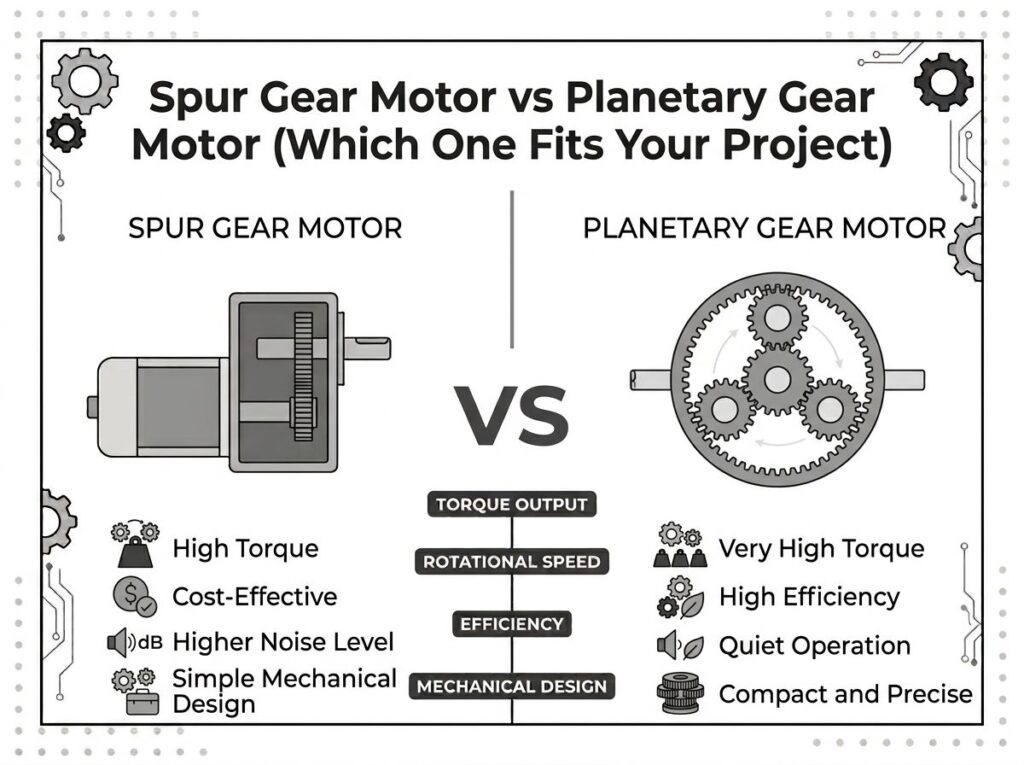
Прямозубый мотор-редуктор против планетарного мотор-редуктора: Какой из них подойдет вашему проекту?
If you’re sourcing a редукторный двигатель for a new product or a system upgrade, you’ve likely narrowed your choices down to two mainstream options: spur gear motors а также планетарные мотор-редукторы. Both reduce speed and multiply torque, but the way they do it — and the trade-offs involved — are quite different.
This guide breaks down the structural differences, тактико-технические характеристики, соображения стоимости, and real-world applications of each type, so you can make a selection that matches your torque requirements, space constraints, and budget.
Быстрый ответ: The Core Difference in One Paragraph
А цилиндрический мотор-редуктор uses straight-toothed gears mounted on parallel shafts. Power flows through one mesh point at a time, making the design simple, affordable, and efficient at moderate speeds — but noisier and limited in torque density. А планетарный мотор-редуктор arranges multiple planet gears around a central sun gear inside a ring gear, distributing load across several contact points simultaneously. This gives it higher torque capacity, lower backlash, and a more compact footprint — at a higher cost and complexity.
Rule of thumb: Tight space + высокий крутящий момент + precision → planetary. Budget priority + moderate load + simple maintenance → spur.
What Is a Spur Gear Motor?
A spur gear motor pairs an electric motor — typically a коллекторный двигатель постоянного тока или же бесщеточный двигатель постоянного тока — with a gearbox containing spur gears. These gears have straight teeth cut parallel to the shaft axis. A small pinion gear on the motor shaft drives a larger gear on the output shaft, and the tooth ratio between them determines the speed reduction and torque multiplication.
When more reduction is needed, additional gear stages can be stacked. Each stage adds length to the gearbox housing but multiplies the reduction ratio. The key characteristic of spur gearing is that only one pair of teeth engages at any given moment, meaning the entire load passes through a single contact point at each stage.
Advantages of Spur Gear Motors
- Бюджетный: Straight-tooth gears on parallel shafts are straightforward to machine, keeping manufacturing and tooling expenses down.
- Высокая эффективность передачи: Direct tooth engagement with minimal sliding means efficiency typically reaches 96–99% per stage.
- No axial thrust: Straight teeth generate only radial forces, so shaft bearings don’t need to handle axial loads — simplifying the bearing design.
- Простое обслуживание: The simple internal structure allows field-level inspection, lubrication checks, and component replacement with standard tools.
- Consistent speed ratio: Spur gears maintain a constant angular velocity ratio, providing stable motion transfer with minimal slip.
Limitations of Spur Gear Motors
- Noise at high speed: Abrupt tooth engagement and disengagement produce audible clicking or whining, which intensifies as RPM increases.
- Single load path: Because only one tooth pair carries the load at a time, torque capacity per stage is inherently limited compared to multi-contact designs.
- Lubrication dispersion: At higher speeds, centrifugal force tends to fling lubricant away from the mesh zone, reducing effectiveness and increasing wear risk.
- Sensitivity to misalignment: Even slight shaft misalignment causes uneven tooth contact, accelerating wear and increasing noise.
What Is a Planetary Gear Motor?
A planetary gear motor (also called an epicyclic gear motor) uses a fundamentally different architecture. Three components work together: a central солнечная шестерня driven by the motor, multiple планетарные шестерни that orbit around the sun gear, and an outer кольцевая шестерня (internal gear) fixed inside the housing. The planet gears mesh with both the sun gear and the ring gear simultaneously.
This arrangement means that instead of one contact point carrying the load, multiple planet gears share the load in parallel. A typical planetary stage with three planet gears distributes torque across three mesh points at once, which is the core reason planetary gearboxes achieve higher torque density in a smaller envelope.
Advantages of Planetary Gear Motors
- Высокая плотность крутящего момента: Load sharing across multiple planet gears allows significantly more torque output for a given housing size.
- Compact coaxial design: Input and output shafts are aligned on the same axis, so the gearbox stays cylindrical and short — no length growth with additional stages.
- Низкий люфт: Precise coordination between sun, планета, and ring gears allows backlash to be minimized, which matters for positioning accuracy in robotics and servo applications.
- Better lubrication retention: The internal meshing geometry tends to trap lubricant within the tooth contact zones, maintaining effectiveness even at elevated speeds.
- Coaxial input/output: The in-line shaft arrangement simplifies integration when the motor and driven load must share the same axis.
Limitations of Planetary Gear Motors
- Более высокая стоимость: More components (солнечная шестерня, несколько планетарных шестерен, кольцевая шестерня, планетарный носитель) and tighter manufacturing tolerances increase both material and machining costs.
- Управление температурным режимом: The compact design packs more power into less volume, which can lead to heat buildup in continuous high-load duty — sometimes requiring additional cooling consideration.
- More complex service: Sealed planetary assemblies are harder to open and repair in the field. Во многих случаях, a failed unit requires factory-level rebuild or complete replacement rather than component-level repair.
- Longer lead time for custom ratios: Custom planetary configurations require coordinated machining of sun, планета, and ring gears, extending production timelines compared to standard spur gear sets.
Side-by-Side Comparison Table
| Параметр | Прямозубый мотор-редуктор | Планетарный мотор-редуктор |
|---|---|---|
| Gear arrangement | Straight teeth on parallel shafts, offset | Sun gear + планетарные шестерни + кольцевая шестерня, coaxial |
| Load contact points | One tooth pair per stage | Multiple (обычно 3+ планетарные шестерни) через сцену |
| Плотность крутящего момента | Moderate — larger housing for same torque | High — compact for equivalent torque |
| Efficiency per stage | 96–99% | 94–98% |
| Reduction ratio per stage | Typically up to 6:1–8:1 | Обычно 3:1–10:1 (higher in multi-stage) |
| Уровень шума | Higher — single-frequency mesh tone, audible at speed | Lower — multiple mesh frequencies tend to cancel |
| Обратная реакция | Стандарт, harder to minimize across stages | Low backlash designs available, precision-grade |
| След | дольше (length grows with stages), wider | короче, cylindrical, length stays compact |
| Shaft configuration | Parallel offset | Coaxial (in-line) |
| Lubrication behavior | Grease/oil tends to disperse at high speed | Lubricant retained in mesh zone |
| Manufacturing cost | Lower — simple geometry, standard tolerances | Higher — precision components, tight tolerances |
| Maintenance access | Easy — field serviceable with standard tools | Difficult — often sealed, factory rebuild needed |
| Typical service life | Can exceed 100,000 hours with regular maintenance at moderate loads | 10,000–50,000 hours under proper conditions; load distribution reduces per-gear stress |
| Best suited for | Конвейеры, Техника, насосы, basic automation, cost-sensitive projects | Робототехника, AGV, медицинское оборудование, ЧПУ, сервосистемы, точное позиционирование |
Torque and Load Capacity
Torque is where the two designs diverge most clearly. In a spur gear system, the full load passes through a single tooth engagement at each stage. This works fine at moderate torque levels, but as loads increase, the contact stress on that single mesh point rises sharply — eventually exceeding what the gear material and tooth geometry can sustain without accelerated wear or tooth failure.
Planetary gears solve this by splitting the load. With three planet gears sharing the torque, each gear tooth sees roughly one-third of the total contact force. This is why a planetary gearbox can deliver significantly more output torque in a housing that’s physically smaller than an equivalent-capacity spur gearbox. For applications where high torque must fit in a tight envelope — robot joints, AGV drive wheels, medical pumps — planetary is almost always the better choice.
That said, spur gear motors can handle higher loads by adding reduction stages. A three-stage spur gearbox can achieve high overall ratios and respectable output torque. The trade-off is length: each stage extends the housing, and the accumulated backlash across multiple meshes grows. Для intermittent-duty or light-load applications where size isn’t critical, this is often an acceptable compromise.
Efficiency and Speed Characteristics
Both gear types are efficient, but the numbers tell slightly different stories:
- Spur gears: 96–99% efficiency per stage. The straight-tooth engagement has minimal sliding friction, so power loss is low — especially at moderate speeds where tooth engagement is smooth.
- Планетарные передачи: 94–98% efficiency per stage. Slightly lower than spur due to the more complex tooth sliding action between sun-planet and planet-ring meshes, but still excellent.
На первый взгляд, spur gears appear more efficient. Однако, there’s a practical caveat: lubrication retention. In spur gear systems, especially at higher speeds, centrifugal force tends to throw lubricant away from the mesh zone. This can lead to dry running, increased friction, and efficiency drop-off over time. Planetary systems trap lubricant within the internal gear meshing area, maintaining better lubrication at elevated RPM.
Для high-speed, высокий крутящий момент continuous operation, planetary gear motors often deliver better real-world efficiency and longevity despite the slightly lower per-stage theoretical number. Для low-speed, light-load duty, spur gear motors maintain their efficiency advantage with simpler lubrication needs.
Шум, Вибрация, and Backlash
Шум
Spur gears produce a characteristic meshing tone — a rhythmic clicking or whine caused by teeth engaging and disengaging abruptly. At high speeds, this becomes pronounced enough to be a design concern in noise-sensitive environments (медицинское оборудование, бытовая электроника, офисная техника). Planetary gears generate multiple mesh frequencies simultaneously, which tend to partially cancel each other out, resulting in quieter operation overall.
Вибрация
The single contact point in spur gearing creates periodic load fluctuations that transmit as vibration through the housing. Planetary load distribution smooths these fluctuations, producing lower vibration levels — beneficial for precision equipment and for reducing fatigue on mounting structures.
Обратная реакция
Backlash — the angular “play” between input and output when direction reverses — accumulates at each gear mesh. In a multi-stage spur gearbox, total backlash is the sum of all stage backlashes, making it harder to minimize. Planetary systems can be designed with low or near-zero backlash through precise gear coordination, which is why they’re standard in servo and positioning applications where directional accuracy matters.
Размер, Shape, и стоимость
Physical Envelope
Planetary gear motors are generally shorter and more cylindrical because the coaxial design stacks stages without growing length. The output shaft is in-line with the motor shaft, making integration simpler when the load must be on the same axis. Spur gear motors are longer and wider — each reduction stage extends the housing along the parallel shaft arrangement, and the offset between input and output shafts requires more lateral space.
If your application has a tight cylindrical envelope (inside a robot joint, a hand tool, a pump housing), planetary is typically the only viable option. If the mounting area is open and rectangular (a conveyor base, a machine frame), spur gear’s larger footprint is rarely a problem.
Cost Structure
| Фактор стоимости | Прямозубый мотор-редуктор | Планетарный мотор-редуктор |
|---|---|---|
| Component count | Fewer — pinion + driven gear per stage | More — sun gear + 3+ планетарные шестерни + кольцевая шестерня + carrier per stage |
| Machining tolerance | Standard — parallel shafts, straightforward gear cutting | Tight — precise coordination of sun/planet/ring required |
| Material volume | More housing material (larger envelope) | Less housing material but harder gear steel often needed |
| Assembly labor | Simple stacking of gear stages | Complex alignment of planet carrier assembly |
| Tooling investment | Ниже | Выше |
| Unit price (типичный) | Lower — 30–50% less than equivalent planetary | Higher — premium for compactness and precision |
For high-volume, cost-sensitive products where moderate torque is sufficient, spur gear motors deliver better per-unit economics. For performance-critical applications where the cost of a larger or heavier motor assembly would exceed the planetary premium, the investment pays for itself.
Application Scenarios for Each Type
When to Choose a Spur Gear Motor
- Конвейерные системы: Moderate torque, continuous duty, open mounting space, cost-sensitive — spur gear motors are the workhorse choice for belt and roller conveyors in factories and warehouses.
- Бытовые приборы: Blenders, кухонные комбайны, миксеры, and similar devices benefit from spur gear’s simplicity and low cost at low-to-moderate torque levels.
- Vending and dispensing machines: Low-duty-cycle operation where the higher noise of spur gears is acceptable and the cost savings matter at scale.
- Paper towel dispensers and electric door locks: Прерывистый режим работы, low torque requirement, budget-driven design.
- Basic packaging machinery: Where positioning accuracy requirements are standard (not precision-grade) and maintenance access is straightforward.
- Pumps and small blowers: Constant-speed applications with moderate load, paired with a микро двигатель переменного тока or DC motor.
When to Choose a Planetary Gear Motor
- Robotics and AGVs: Robot joints and automated guided vehicle drives need high torque in compact spaces with low backlash for precise positioning — the classic planetary use case.
- CNC machines and servo systems: Precision motion control demands low backlash, высокая плотность крутящего момента, and smooth operation that planetary gearing provides.
- Медицинские приборы: Хирургические роботы, инфузионные насосы, and diagnostic equipment require quiet operation, Точный контроль, and compact form factors.
- Промышленная автоматизация: Label printing machines, laser measuring apparatus, and vinyl cutting systems use planetary gear motors for their high precision and efficiency.
- Automotive auxiliary drives: Electric power steering, actuator mechanisms, and auxiliary systems in vehicles benefit from the torque-to-size ratio of planetary designs.
- Aerospace components: Weight-sensitive applications where the compactness and load distribution of planetary gears deliver critical performance per kilogram.
Руководство по выбору: 5 Questions to Ask
Before committing to either gear motor type, work through these five questions in order. They’ll narrow your choice quickly:
1. What’s your peak torque requirement?
Высокий крутящий момент (relative to motor size) points toward planetary — the load-sharing design handles more torque per unit volume. Lower torque needs can be met with spur gears at lower cost.
2. What reduction ratio do you need?
Ratios above 10:1 in a single stage favor planetary. For lower ratios, spur gears work well and cost less. Multi-stage spur configurations can reach high ratios but grow longer with each stage.
3. How tight is your space envelope?
Cylindrical, compact mounting space → planetary (coaxial, короткий). Открыть, rectangular space → spur (параллельные валы, longer but wider tolerance for housing dimensions).
4. What’s your precision requirement?
Applications requiring low backlash, precise positioning, or smooth directional changes → planetary. Standard positioning tolerance and one-way rotation → spur.
5. What’s your budget and maintenance plan?
Cost-sensitive projects with field-serviceable maintenance needs → spur. Premium-performance projects where the motor will run sealed for its service life → planetary.
Quick decision: If you answered “высокий крутящий момент” или же “tight space” или же “точность” to any of questions 1–4, planetary is likely your answer. If all your answers lean toward “moderate” а также “cost matters,” spur is the practical choice.
Часто задаваемые вопросы
Is a planetary gear motor always better than a spur gear motor?
Нет. “Better” depends on the application. Planetary gear motors excel in high-torque, компактный, precision-demanding scenarios but cost more and are harder to service. Spur gear motors are more cost-effective and easier to maintain for moderate-load applications. Choosing the wrong type — either over-engineering with planetary when spur suffices, or under-specifying with spur when planetary is needed — leads to wasted budget or premature failure.
Which gear motor type is quieter?
Planetary gear motors are generally quieter. The multiple mesh points distribute load and generate overlapping frequencies that partially cancel out. Spur gears produce a more audible single-frequency mesh tone, especially noticeable at higher speeds.
Can I use a spur gear motor for a robotics application?
It depends on the precision required. Для простого, one-directional robotic movements with standard positioning tolerance, a spur gear motor may work. For multi-axis robots, AGV, or any application requiring low backlash and precise bidirectional control, planetary gear motors are the standard choice.
How long do spur and planetary gear motors typically last?
Service life depends heavily on load, рабочий цикл, и обслуживание. Spur gearboxes can exceed 100,000 hours with regular maintenance at moderate loads. Planetary gearboxes typically achieve 10,000–50,000 hours under proper conditions — their load distribution reduces per-gear stress, but the sealed compact design can make heat management a factor in continuous high-load duty.
Are spur gear motors more cost-effective for high-volume production?
Generally yes. The simpler manufacturing process, меньше компонентов, and standard tolerances of spur gear motors make them more economical at scale — especially when the application doesn’t demand high torque density or precision. For high-volume consumer products with moderate performance requirements, spur gear motors often deliver the best cost-to-performance ratio.
Can Greensky Power supply both types of gear motors?
Да. As a China-based gear motor manufacturer serving OEM customers in over 50 страны, Greensky Power offers both spur and planetary gear motor solutions paired with our щеточные двигатели постоянного тока, бесщеточные двигатели постоянного тока, а также микродвигатели переменного тока. Our engineering team can help you evaluate which configuration fits your specific application — свяжитесь с нами with your specifications for a tailored recommendation.
Need Help Choosing the Right Gear Motor?
Selecting between a spur gear motor and a planetary gear motor comes down to matching the gear architecture to your application’s torque, скорость, космос, точность, and budget requirements. If you’re still unsure which type fits your project — or if you need a custom gear motor solution — our engineering team is ready to help.
Грински Пауэр занимается разработкой и производством двигателей постоянного тока, коробки передач, and integrated motion solutions since 2011. We provide:
- OEM/ODM customization for specific torque, скорость, и требования к монтажу
- Both spur and planetary gear motor configurations
- 100% individual product testing to international standards (see our testing process)
- Regional engineering and after-sales support for North America and Europe
Send us your specifications and we’ll recommend the optimal gear motor configuration for your application. Explore our full gearbox product line or browse all motor and gearbox products.
Ссылки
- Power Motor. “Planetary Gear Motor vs. Прямозубый мотор-редуктор: Difference Explained.” Power Motor Technologies & Путеводители. Доступно на: https://www.power-motor.com/Technologies/599.html (Accessed: Июль 2025).
- Etonm Motor. “Planetary Gear Motors vs. Spur Gear Motors: A Complete Comparison.” Etonm Motor. Доступно на: https://etonmmotor.com/planetary-gear-motors-vs-spur-gear-motors/ (Accessed: Июль 2025).
- ISL Products. “Planetary Gear Motors vs. Spur Gear Motors.” ISL Products Design Note. Доступно на: https://islproducts.com/design-note/planetary-gear-motors-vs-spur-gear-motors/ (Accessed: Июль 2025).
- Gian Transmission. “Planetary Gear Motors vs. Spur Gear Motors: A Comprehensive Comparison.” Gian Transmission Blog. Доступно на: https://www.gian-transmission.com/planetary-gear-motors-vs-spur-gear-motors-a-comprehensive-comparison/ (Accessed: Июль 2025).
- Cotta, LLC. “Planetary Gear vs Spur Gear: Expert Guide.” Cotta Engineering Blog. Доступно на: https://cotta.com/blog/planetary-gear-vs-spur-gear-expert-guide/ (Accessed: Июль 2025).
- ISL Products. “Spur Gearbox vs. Small Planetary Gear Motor: Ключевые различия & Applications.” ISL Products. Доступно на: https://ineedmicromotors.com/spur-gearbox-vs-planetary-gear-motor-key-differences-apps/ (Accessed: Июль 2025).
- RaxMotor. “Planetary vs Spur Gear Motors: A Comprehensive Guide.” RaxMotor. Доступно на: https://www.raxmotor.com/planetary-vs-spur-gear-motors/ (Accessed: Июль 2025).
- SGGearbox. “Micro Gearbox Selection Guide: Spur Gearbox vs Planetary Gearbox vs Worm Gearbox.” SGGearbox. Доступно на: https://sggearbox.com/micro-gearbox-selection-guide-spur-gearbox-vs-planetary-gearbox-vs-worm-gearbox/ (Accessed: Июль 2025).
- ISL Products. “Spur Vs Planetary Gear Motor Comparison Guide.” ISL Products. Доступно на: https://ineedmicromotors.com/spur-vs-planetary-gear-motor-comparison-guide/ (Accessed: Июль 2025).