
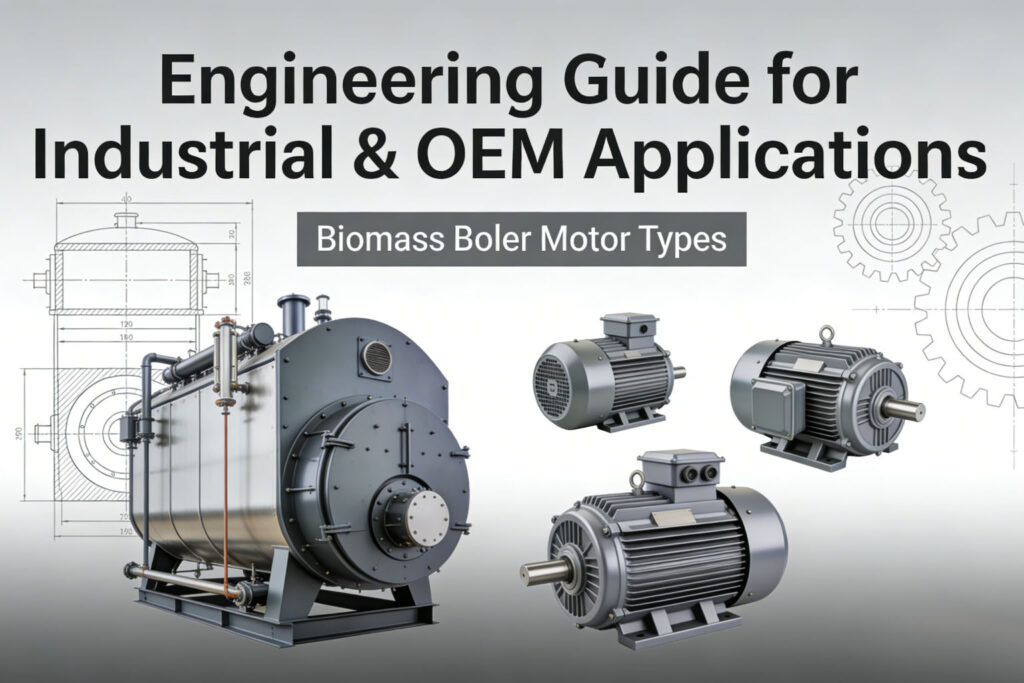
Quais motores são usados em caldeiras de biomassa? Guia de engenharia para indústria & Aplicações OEM
Trecho em destaque:
Biomass boilers use multiple types of electric motors to ensure stable combustion, fuel feeding, airflow control, and heat distribution. The most commonly used motors include fan motors (for combustion and exhaust), auger or conveyor motors (for fuel feeding), and pump motors (for heat circulation). Depending on system requirements, motores de indução CA, motores BLDC, and geared motors are selected based on efficiency, torque, precisão de controle, e confiabilidade. Proper motor selection is critical for optimizing biomass boiler performance, reducing downtime, and improving overall system efficiency in industrial applications.
Quais motores são usados em caldeiras de biomassa?
Biomass boilers are complex thermal systems that rely heavily on motor-driven subsystems. Each stage of operation—from fuel handling to combustion and heat transfer—requires specific motor types.
Main Motor Types
- Combustion fan motors – supply controlled airflow
- Induced draft fan motors – regulate flue gas flow
- Fuel feeding motors – drive augers or conveyors
- Circulation pump motors – move heated water or steam
These motors must operate continuously under high temperature and dust conditions, making reliability and efficiency critical.
Explore industrial motor options: Soluções para motores BLDC
Why Motor Selection Matters in Biomass Boiler Systems
Motor performance directly impacts combustion efficiency, consumo de energia, and system stability.
Key Engineering Impacts
- Airflow precision affects combustion quality
- Fuel feeding consistency impacts thermal output
- Pump reliability ensures heat distribution
System-Level Insight
In biomass boilers, even small inefficiencies in motor control can lead to incomplete combustion, higher emissions, and increased fuel consumption.
Types of Motors Used in Biomass Boilers
1. Motores de indução CA
Widely used due to robustness and cost-effectiveness. Ideal for fans and pumps.
2. Motores BLDC
Increasingly used for high-efficiency systems requiring precise control and lower energy consumption.
3. Motoredutores
Used in fuel feeding systems where high torque and low speed are required.
4. Servo Motors
Used in advanced systems for precise control of fuel and airflow.
Efficiency of Motors in Biomass Boilers
Motor efficiency directly affects the overall energy efficiency of biomass boiler systems.
Efficiency Considerations
- motores BLDC: up to 90–95%
- motores de indução CA: 80–90%
- Geared motors: depends on gear losses
Energy Savings Impact
Using high-efficiency motors in fans and pumps can reduce energy consumption by 10–20% in industrial biomass systems.
Torque Density and Performance Requirements
Different subsystems require different torque characteristics.
High Torque Applications
- Fuel feeding systems (augers)
- Sistemas transportadores
High-Speed Applications
- Combustion fans
- Induced draft fans
BLDC motors provide higher torque density, allowing more compact system designs.
Thermal Performance and Motor Durability
Biomass boilers operate in high-temperature environments, making thermal performance critical.
Desafios térmicos
- Ambient heat from combustion chamber
- Dust and particulate exposure
- Continuous operation cycles
Engineering Solutions
- High-temperature insulation
- IP-rated motor enclosures
- Efficient cooling systems
Motor Control Systems in Biomass Boilers
Advanced control systems improve performance and efficiency.
Control Technologies
- Unidades de frequência variável (VFD)
- Controladores BLDC (Controle FOC)
- PLC-based automation
Benefícios
- Precise airflow regulation
- Optimized fuel feeding
- Energy savings
Custom motor integration: Soluções de motores OEM
BLDC vs AC Motors vs Geared Motors in Biomass Boilers
| Parâmetro | Motor BLDC | Motor de indução CA | Motorredutor |
|---|---|---|---|
| Eficiência | Alto (90–95%) | Moderado (80–90%) | Moderado |
| Densidade de Torque | Alto | Moderado | Muito alto |
| Ao controle | Avançado | Moderado | Simples |
| Custo | Moderado | Baixo | Moderado |
| Best Use | Fans, bombas | Aplicações gerais | Fuel feeding |
Interpretação de Engenharia
BLDC motors are ideal for energy-efficient systems, while AC motors remain popular for cost-sensitive projects. Geared motors are essential for high-torque feeding systems.
How to Choose Motors for Biomass Boiler Systems
Motor selection should be based on system requirements, condições ambientais, and control strategies.
Faixa de tensão
- 24V–72V: pequenos sistemas
- 220V–380V: sistemas industriais
Faixa de potência
- 0.5kW–5kW: alimentadores
- 5kW–50kW: fans and pumps
Velocidade / Torque
Combine as características do motor com as necessidades da aplicação (high torque vs high speed).
Método de resfriamento
- Air-cooled motors
- Forced ventilation
Compatibilidade do controlador
Ensure compatibility with VFDs or BLDC controllers.
Considerações de aplicação
- Dust and humidity levels
- Continuous vs intermittent operation
- Maintenance accessibility
CTA: Request a datasheet or contact our engineers for a customized motor solution.
Applications of Motors in Biomass Boiler Systems
Aplicações Industriais
- Usinas de energia
- Manufacturing facilities
HVAC and Heating Systems
- District heating
- Commercial buildings
Agricultural Systems
- Grain drying
- Greenhouse heating
Integration Example
A typical biomass boiler uses multiple motors working in coordination to maintain stable combustion and heat output.
Future Trends in Biomass Boiler Motors
The future of biomass boiler systems is closely tied to motor innovation.
Principais Tendências
- High-efficiency BLDC motor adoption
- Smart motor control systems
- Integration with IoT and automation
- Compactar, integrated motor-drive units
Perguntas frequentes: Biomass Boiler Motors
1. Quais motores são usados em caldeiras de biomassa?
Biomass boilers use fan motors, pump motors, and feeding motors. These can be AC, BLDC, or geared motors depending on application requirements.
2. Why are BLDC motors used in biomass boilers?
Os motores BLDC oferecem maior eficiência, controle preciso, e maior vida útil, making them suitable for modern biomass systems.
3. How do I choose the best motor for biomass boilers?
Considere a tensão, potência, torque, resfriamento, e condições ambientais. Custom solutions are recommended for optimal performance.
4. What is the lifespan of motors in biomass systems?
High-quality motors can last 10,000–30,000 hours depending on operating conditions and maintenance.
5. Are geared motors necessary?
Sim, for fuel feeding systems requiring high torque at low speed, geared motors are essential.
Conclusão: Optimizing Biomass Boilers with the Right Motors
Motors are the backbone of biomass boiler systems, enabling efficient fuel handling, combustion control, and heat distribution. Selecting the right motor type ensures optimal system performance, eficiência energética, e confiabilidade a longo prazo.
Para clientes OEM e compradores industriais, investing in high-quality motor solutions is critical to achieving stable and cost-effective biomass operations.
Próxima etapa: Contact our engineering team to develop a customized motor solution for your biomass boiler system.
Referências
- IEEE Industrial Motor Applications
- Renewable Energy Engineering Journals
- IEA Bioenergy Reports
- Industrial Heating System White Papers