
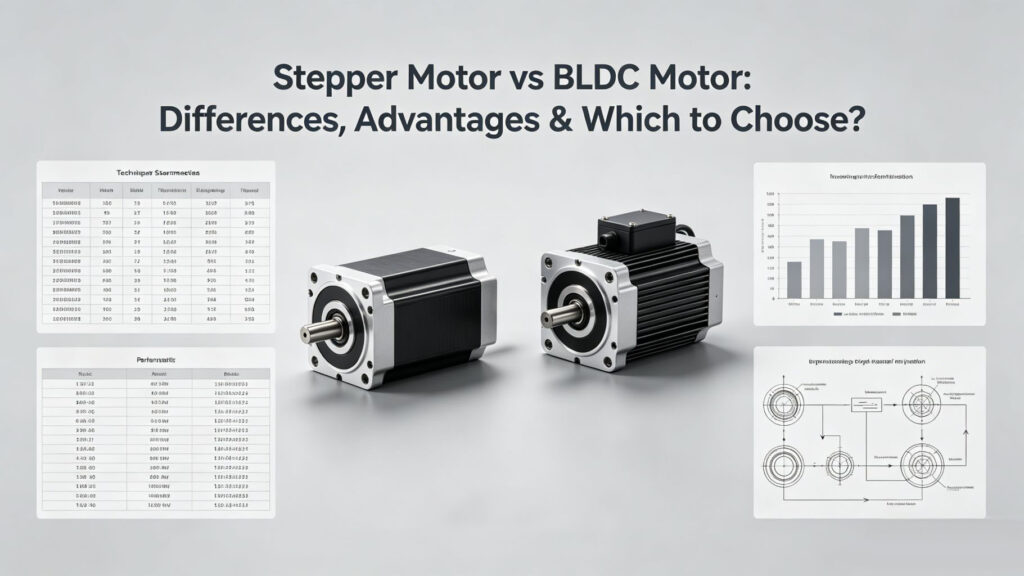
Motor de passo vs motor BLDC: Diferenças, Vantagens & Qual escolher?
Trecho em destaque:
Os motores de passo são ideais para posicionamento preciso e controle de baixa velocidade sem sistemas de feedback, enquanto motores BLDC oferecer maior eficiência, melhor densidade de torque, e desempenho superior em aplicações dinâmicas e de alta velocidade. A melhor escolha depende se sua aplicação prioriza a precisão, simplicidade de custo, ou eficiência energética e confiabilidade a longo prazo. Para compradores OEM e industriais, Os motores BLDC são normalmente preferidos para sistemas orientados por desempenho, enquanto os motores de passo permanecem ideais para aplicações focadas em posicionamento, como CNC e impressão 3D.
Ao avaliar motor de passo vs motor BLDC, engenheiros e gerentes de compras devem considerar mais do que especificações básicas. A decisão afeta a arquitetura do sistema, estratégia de controle, consumo de energia, e custos de manutenção a longo prazo. Em ambientes industriais modernos – onde a automação, eficiência, e a confiabilidade são essenciais – compreender as compensações de engenharia entre esses tipos de motores é essencial.
O que é um motor de passo?
Um motor de passo é um motor síncrono sem escovas que divide uma rotação completa em passos discretos. Cada pulso enviado ao motor resulta em um movimento angular preciso, permitindo o controle de posição em malha aberta sem sistemas de feedback.
Principais características de engenharia
- Movimento de passo discreto (por exemplo., 1.8° por passo)
- Alto torque de retenção quando parado
- Controle simples sem loop de feedback
- Menor eficiência em comparação com motores BLDC
Os motores de passo são amplamente utilizados em aplicações onde é necessário um posicionamento preciso, como máquinas CNC, 3Impressoras D, e dispositivos médicos.
O que é um motor BLDC?
Um DC sem escova (BLDC) o motor usa comutação eletrônica e ímãs permanentes para fornecer rotação contínua com alta eficiência e controle preciso.
Principais características de engenharia
- Rotação contínua com saída de torque suave
- Alta eficiência (85–95%)
- Requer controlador eletrônico de velocidade (ESC)
- Alta densidade de potência
Os motores BLDC são amplamente utilizados em veículos elétricos, robótica, Sistemas HVAC, e automação industrial.
👉 Explore soluções: Gama de produtos de motores BLDC
Motor de passo vs motor BLDC: Principais diferenças explicadas
| Parâmetro | Motor de passo | Motor BLDC |
|---|---|---|
| Tipo de controle | Malha aberta (sem feedback) | Ciclo fechado (com controlador) |
| Eficiência | Baixo (50–70%) | Alto (85–95%) |
| Comportamento de Torque | Alta em baixa velocidade | Consistente em toda a faixa de velocidade |
| Faixa de velocidade | Baixo a moderado | Largo (velocidade baixa a alta) |
| Precisão | Precisão de posicionamento muito alta | Requer feedback para precisão |
| Custo | Menor custo do sistema | Custo inicial mais alto |
A principal diferença está em como o movimento é gerado: motores de passo se movem em passos discretos, enquanto os motores BLDC fornecem rotação contínua. Isso leva a diferenças fundamentais no desempenho, eficiência, e requisitos de controle.
Por que os motores BLDC são mais eficientes que os motores de passo
A eficiência é um fator chave na seleção de motores modernos, especialmente em sistemas industriais sensíveis à energia.
Análise de Engenharia
- Os motores de passo consomem corrente constante independentemente da carga → perda de energia
- Os motores BLDC ajustam a corrente dinamicamente com base na carga
- Perdas reduzidas de cobre e ferro no projeto BLDC
Em aplicações como sistemas de transporte ou mobilidade elétrica, mudar de motores de passo para motores BLDC pode reduzir significativamente o consumo de energia e os custos operacionais.
Comparação de densidade de torque e desempenho dinâmico
A densidade de torque e a resposta dinâmica são essenciais em sistemas de automação modernos.
Características do motor de passo
- Alto torque de retenção em velocidade zero
- O torque cai rapidamente em velocidades mais altas
Vantagens do motor BLDC
- Alto torque em ampla faixa de velocidade
- Melhor aceleração e desaceleração
- Maior densidade de potência
Para sistemas dinâmicos como AGVs ou braços robóticos, Os motores BLDC proporcionam desempenho superior.
Desempenho térmico e gerenciamento de calor
O gerenciamento térmico impacta diretamente a vida útil e a confiabilidade do motor.
Motores de passo
- A corrente contínua leva à geração constante de calor
- Menor eficiência aumenta o estresse térmico
Motores BLDC
- Menor calor devido à maior eficiência
- Calor concentrado no estator → resfriamento mais fácil
Isso torna os motores BLDC mais adequados para aplicações industriais de serviço contínuo.
Diferenças no sistema de controle: Motor de passo vs motor BLDC
A estratégia de controle é um fator chave de decisão para engenheiros.
Controle de motor de passo
- Controle simples baseado em pulso
- Não é necessário feedback (circuito aberto)
- Menor complexidade do sistema
Controle de Motor BLDC
- Requer ESC ou driver
- Suporta controle de circuito fechado com sensores
- Permite alta precisão e integração inteligente
Para a indústria 4.0 e automação inteligente, Os motores BLDC proporcionam mais flexibilidade.
Comparação de confiabilidade e vida útil
A confiabilidade é uma preocupação fundamental para os compradores OEM.
- Motores de passo: Design simples, mas sujeito a superaquecimento
- Motores BLDC: Vida útil mais longa devido à operação eficiente
Em sistemas de uso contínuo, Os motores BLDC normalmente oferecem melhor confiabilidade a longo prazo.
Como escolher motor de passo ou BLDC para sua aplicação
A seleção do motor deve ser baseada nos requisitos da aplicação e não nas preferências gerais.
Principais fatores de seleção
- Tensão: 12V / 24V / 48V / 72Sistemas V
- Poder: Desde pequenos motores de precisão até sistemas de nível kW
- Velocidade & Torque: Necessidades de torque contínuo versus retenção
- Resfriamento: Resfriamento passivo ou forçado
- Controlador: Driver de passo versus ESC
Recomendações baseadas em aplicativos
- CNC / 3Impressão D → Motor de passo
- Veículos elétricos → motor BLDC
- Robótica → motor BLDC
- Posicionamento de precisão → Motor de passo
👉 Obtenha suporte OEM: Soluções de motores personalizados
Aplicações Industriais de Motores de Passo e BLDC
Aplicações de motores de passo
- máquinas CNC
- 3Impressoras D
- Equipamento médico
- Sistemas de posicionamento de precisão
Aplicações de motores BLDC
- Veículos elétricos (48V / 72Sistemas V)
- Robótica e automação
- Sistemas HVAC
- Máquinas industriais
👉 Explore soluções EV: Motor de veículo elétrico
Comparação de custos: Motor de passo vs motor BLDC
| Fator de custo | Motor de passo | Motor BLDC |
|---|---|---|
| Custo Inicial | Mais baixo | Mais alto |
| Custo Operacional | Mais alto (ineficiente) | Mais baixo |
| Manutenção | Baixo | Baixo |
| Custo total de propriedade | Maior no uso a longo prazo | Abaixe para operação contínua |
Embora os motores de passo ofereçam custos iniciais mais baixos, motores BLDC fornecer melhor ROI em aplicações com uso intensivo de energia.
Tendências futuras: Motor de passo versus motor BLDC na indústria moderna
As tendências da indústria estão mudando em direção à eficiência e aos sistemas inteligentes.
- Aumento da adoção de motores BLDC na automação
- Integração com IoT e sistemas de controle inteligentes
- Regulamentações de eficiência energética impulsionando o crescimento do BLDC
Os motores de passo continuarão relevantes em aplicações de precisão de nicho, mas os motores BLDC estão se tornando dominantes no uso industrial mais amplo.
Perguntas frequentes: Motor de passo vs motor BLDC
1. Qual motor é melhor para aplicações de precisão?
Os motores de passo são melhores para posicionamento preciso porque se movem em passos fixos e não requerem sistemas de feedback.
2. Por que os motores BLDC são mais eficientes?
Os motores BLDC ajustam a corrente com base na carga e eliminam o consumo constante de energia, reduzindo significativamente as perdas de energia.
3. Os motores BLDC podem substituir motores de passo?
Em algumas aplicações, sim. No entanto, motores de passo ainda são preferidos por baixo custo, tarefas de posicionamento de alta precisão.
4. Qual motor é melhor para operação contínua?
Os motores BLDC são melhores devido à maior eficiência e menor geração de calor.
5. Qual é a diferença de custo?
Motores de passo têm custo inicial mais baixo, mas os motores BLDC oferecem melhor valor a longo prazo.
6. O BLDC é melhor que o motor de passo??
Nenhum dos dois é universalmente melhor – o BLDC se destaca em eficiência em alta velocidade e torque dinâmico, enquanto os steppers lideram em simplicidade de posicionamento em malha aberta e estabilidade em baixa velocidade.
7. Qual motor é mais preciso?
Os motores de passo normalmente oferecem precisão superior de posicionamento em malha aberta sem hardware de feedback, enquanto os BLDCs exigem codificadores para corresponder à precisão.
8. O BLDC pode substituir o motor de passo no CNC?
Sim, mas apenas com sistemas de controle de malha fechada; Os BLDCs têm desempenho superior em tarefas de corte de alta rotação, enquanto os steppers permanecem mais simples para fresamento de precisão em baixa velocidade.
Conclusão: Qual motor você deve escolher?
Ao comparar motor de passo vs motor BLDC, a escolha depende das prioridades da sua aplicação. Os motores de passo se destacam pela precisão e simplicidade, enquanto os motores BLDC oferecem eficiência superior, desempenho, e confiabilidade a longo prazo.
Para a maioria das aplicações industriais e OEM modernas, Os motores BLDC estão se tornando a escolha preferida devido à sua eficiência e escalabilidade.
Precisa de ajuda para selecionar o motor certo?
✔ Solicitar ficha técnica
✔ Obtenha solução de motor OEM
✔ Entre em contato com nossos engenheiros hoje
Referências
- Transações IEEE em Eletrônica Industrial
- Padrões de eficiência de motores IEC
- Relatórios de controle de movimento industrial