
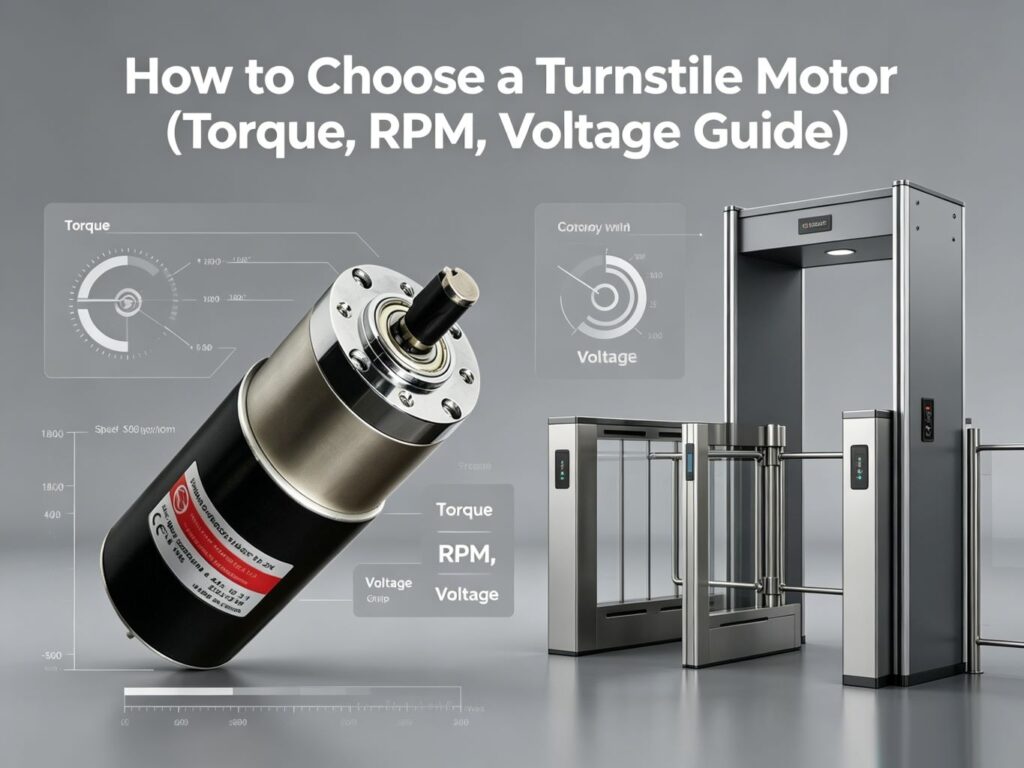
Como escolher um motor de catraca (Torque, RPM, Guia de tensão)
Trecho em destaque:
Choosing the right turnstile motor requires evaluating torque, RPM, tensão, eficiência, and control strategy based on the application. BLDC motors are typically preferred for modern turnstiles due to higher efficiency, vida útil mais longa, and smoother motion control, while brushed motors may be used in cost-sensitive systems. Key selection factors include required torque for barrier movement, velocidade de rotação (RPM), voltage compatibility (typically 24V–48V), and system integration with controllers. Proper motor sizing ensures reliable operation, manutenção reduzida, and optimal lifecycle cost.
Turnstile systems are critical components in access control infrastructure, used in metro stations, office buildings, stadiums, and industrial facilities. The motor is the core actuator that determines system performance, confiabilidade, and user experience. Para engenheiros, OEM designers, and procurement managers, selecting the correct motor is not simply about power rating—it requires a detailed understanding of torque requirements, speed profiles, electrical constraints, and control architecture.
This engineering guide explains how to choose a turnstile motor with a focus on torque calculation, RPM selection, voltage compatibility, and real-world application considerations. It is designed to support both technical decision-making and B2B procurement.
What Is a Turnstile Motor and Why It Matters?
A turnstile motor is the electromechanical component responsible for driving the rotation or movement of barriers in access control systems. It converts electrical energy into controlled mechanical motion, enabling smooth and secure passage of individuals.
Key Functional Roles
- Drive barrier rotation or swing motion
- Control opening and closing speed
- Provide holding torque for locking positions
- Ensure smooth and safe user interaction
The motor directly affects throughput efficiency, nível de ruído, durabilidade, and maintenance frequency. Poor motor selection often leads to issues such as jerky movement, superaquecimento, or premature failure.
👉For high-performance solutions, check our Motor BLDC para catraca
Types of Motors Used in Turnstiles
Several motor types are used in turnstile systems, each with unique characteristics.
1. Motores BLDC
- Alta eficiência (85–92%)
- Longa vida útil
- Precise control (FOC)
2. Motores CC escovados
- Baixo custo
- Controle simples
- High maintenance
3. Motores de passo
- Alta precisão de posicionamento
- Limited efficiency
Modern systems increasingly favor BLDC motors due to performance and reliability advantages.
How to Calculate Required Torque for Turnstile Motor
Torque is the most critical parameter when selecting a turnstile motor. It determines whether the motor can overcome inertia, atrito, and external loads.
Torque Calculation Formula
Torque (T) = Force × Radius
Onde:
- Force = resistance from barrier weight and friction
- Radius = distance from rotation center
Engineering Considerations
- Barrier weight and length
- Friction in bearings
- Safety margin (typically 1.5–2x)
Por exemplo, a heavy glass swing gate requires significantly higher torque than a lightweight tripod turnstile.
How to Determine RPM for Turnstile Applications
RPM (rotations per minute) defines how fast the turnstile operates.
Typical RPM Range
- Tripod turnstile: 10–30 RPM
- Swing gate: 20–60 RPM
- Flap barrier: 30–100 RPM
Speed Considerations
- User comfort
- Safety regulations
- Throughput requirements
Excessive speed can compromise safety, while low speed reduces efficiency.
Voltage Selection: 24V vs 48V vs Higher Systems
Voltage affects system efficiency, current consumption, and wiring design.
Common Voltage Options
- 24V DC – standard for most systems
- 48V DC – higher efficiency, corrente mais baixa
- 72V+ – high-power industrial systems
Engineering Trade-offs
- Higher voltage → lower current → less heat
- Lower voltage → safer but higher current
Many modern turnstiles use 24V or 48V BLDC motors.
Eficiência, Densidade de Torque, and Performance Analysis
Motor efficiency directly impacts operating cost and thermal performance.
Vantagens do motor BLDC
- High efficiency reduces energy consumption
- Higher torque density enables compact design
- Less heat generation improves reliability
Brushed Motor Limitations
- Menor eficiência
- Higher heat generation
- Reduced lifespan
For high-traffic environments, efficiency improvements translate into significant cost savings.
Desempenho térmico e métodos de resfriamento
Thermal management is critical for continuous operation.
Cooling Methods
- Resfriamento de ar natural
- Resfriamento por ar forçado
- Heat sink integration
BLDC motors generate less heat, reducing cooling requirements and improving system reliability.
Control System and Controller Compatibility
Motor control defines system performance and smoothness.
Controle BLDC
- FOC (Controle Orientado a Campo)
- Smooth acceleration and deceleration
- Controle de posição preciso
Brushed Motor Control
- Simple PWM control
- Limited precision
Advanced turnstiles require precise control, making BLDC the preferred choice.
Reliability and Lifespan Considerations
Turnstiles often operate 24/7 in high-traffic environments.
- BLDC motors have no brushes → longer lifespan
- Brushed motors require maintenance
Reduced downtime is critical for access control systems.
BLDC vs Brushed Motor Comparison for Turnstile
| Parâmetro | Motor BLDC | Motor escovado |
|---|---|---|
| Eficiência | Alto | Médio |
| Manutenção | Baixo | Alto |
| Vida útil | Longo | Short |
| Ao controle | Avançado | Simples |
| Custo | Maior adiantamento | Menor adiantamento |
BLDC motors provide better long-term value despite higher initial cost.
How to Choose a Turnstile Motor for Your Application
This is the most critical decision-making section for engineers and buyers.
Key Selection Parameters
- Tensão: 24V / 48V
- Poder: 50W–500W
- Torque: Based on barrier weight
- Velocidade: Application-specific RPM
- Resfriamento: Resfriamento de ar
- Controlador: FOC for BLDC
Recomendações Específicas de Aplicativos
- High-traffic metro → BLDC motor
- Low-cost indoor → brushed motor
- Smart access control → BLDC + FOC
👉 Get OEM solution: Design de motor personalizado
Applications of Turnstile Motors
- Metro and railway systems
- Office buildings
- Fábricas industriais
- Stadiums and public venues
Each application has different torque, velocidade, and reliability requirements.
Future Trends in Turnstile Motor Technology
- Adoption of BLDC motors
- Integration with IoT systems
- Higher efficiency standards
BLDC motors will dominate future access control systems.
Perguntas frequentes: Turnstile Motor Selection
1. What torque is required for a turnstile motor?
Torque depends on barrier weight, comprimento, and friction. Engineers typically apply a safety factor of 1.5–2x to ensure reliable operation.
2. What is the best RPM for turnstiles?
Typical RPM ranges from 10 para 100 depending on the type of turnstile and required user throughput.
3. Why choose BLDC motor for turnstile?
Os motores BLDC oferecem maior eficiência, vida útil mais longa, and better control, making them ideal for modern systems.
4. What voltage is commonly used?
Most turnstiles use 24V or 48V DC systems for safety and efficiency balance.
5. How to reduce maintenance?
Use BLDC motors and proper thermal management to minimize wear and extend lifespan.
Conclusão: Engineering Decision Guide
Choosing the right turnstile motor requires balancing torque, RPM, tensão, eficiência, e requisitos de controle. BLDC motors provide the best overall performance and lifecycle cost, especially in high-traffic environments.
Need help selecting your motor?
✔ Solicitar ficha técnica
✔ Get OEM solution
✔ Contact our engineers
Referências
- https://ieeexplore.ieee.org
- https://www.sciencedirect.com
- https://www.mdpi.com