
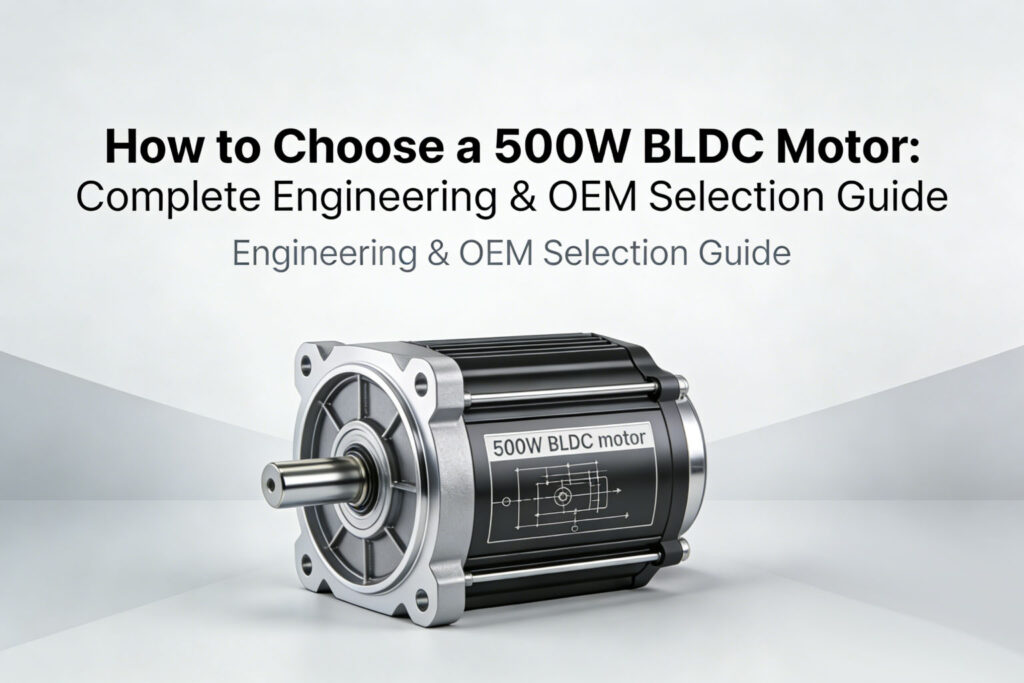
How to Choose a 500W BLDC Motor: Engenharia Completa & Guia de seleção de OEM
Trecho em destaque:
Choosing a 500W BLDC motor requires evaluating voltage, torque, velocidade, eficiência, desempenho térmico, and control compatibility. Compared to traditional motors, Os motores BLDC oferecem maior eficiência, melhor densidade de torque, e maior vida útil, making them ideal for industrial, VE, and automation applications. Engineers must match motor specifications to load characteristics, ciclo de trabalho, and environmental conditions to ensure optimal performance, confiabilidade, e custo total de propriedade.
What Is a 500W BLDC Motor?
A 500W BLDC (DC sem escova) motor is an electronically commutated motor that delivers approximately 500 watts of mechanical output power. It uses permanent magnets on the rotor and electronic controllers instead of brushes, resultando em maior eficiência, manutenção reduzida, and longer operational life compared to brushed motors.
Características principais
Típico 500Motores W BLDC operate within voltage ranges such as 24V, 36V, 48V, e 72V. They are widely used in electric bikes, bombas, fãs, AGVs, e sistemas de automação industrial. Their compact design and high power density make them ideal for OEM integration.
Why Choose a 500W BLDC Motor Over Other Motor Types?
BLDC motors are increasingly replacing brushed and induction motors in medium-power applications due to their superior efficiency and control flexibility. A 500W BLDC motor provides a strong balance between performance and cost, making it suitable for both industrial and commercial applications.
Key Advantages
Compared to brushed motors, BLDC motors eliminate mechanical commutation losses. Compared to AC induction motors, they provide better efficiency and torque density in compact designs. These advantages translate into lower energy consumption and improved system reliability.
500W BLDC Motor vs Brushed Motor vs AC Motor
| Parâmetro | 500Motor W BLDC | Motor escovado | Motor de indução CA |
|---|---|---|---|
| Eficiência | 85–92% | 70–80% | 75–88% |
| Manutenção | Baixo | Alto (desgaste da escova) | Baixo |
| Densidade de Torque | Alto | Moderado | Moderado |
| Ao controle | Avançado (controller required) | Simples | Moderado (VFD necessário) |
| Custo | Médio | Baixo | Médio |
Do ponto de vista da engenharia, BLDC motors provide the best performance-to-efficiency ratio in this power range, especially for OEM systems prioritizing energy efficiency and compact design.
Efficiency Analysis of 500W BLDC Motors
Efficiency is one of the primary reasons engineers select BLDC motors. A well-designed 500W BLDC motor can achieve efficiencies above 90%, significantly reducing energy consumption over time. This is especially important in continuous-duty applications such as pumps or conveyors.
Por que os motores BLDC são mais eficientes
BLDC motors use electronic commutation, eliminating friction losses from brushes. Adicionalmente, their optimized magnetic design reduces copper and iron losses. This results in higher system efficiency and lower heat generation.
Torque Density and Performance Characteristics
Torque density is critical for compact equipment design. 500W BLDC motors offer high torque output relative to size, making them ideal for applications where space is limited.
Speed-Torque Relationship
BLDC motors maintain stable torque across a wide speed range. This makes them suitable for variable-speed applications such as e-bikes and industrial automation systems.
Desempenho térmico e considerações de resfriamento
Thermal management directly affects motor lifespan and reliability. BLDC motors generate less heat than brushed motors due to higher efficiency, but proper cooling design is still essential in continuous-duty applications.
Cooling Methods
Common cooling methods include natural air cooling, forced air cooling, and liquid cooling for high-performance systems. Engineers must ensure that motor temperature remains within safe operating limits.
Control System and Controller Compatibility
BLDC motors require electronic controllers to manage commutation and speed control. The controller must match the motor’s voltage, atual, and control strategy.
Control Options
Common control methods include trapezoidal control and sinusoidal control. Advanced applications may use field-oriented control (FOC) for smoother performance and higher efficiency.
👉 For compatible solutions, explore our BLDC motor product range.
Reliability and Lifespan of 500W BLDC Motors
BLDC motors are known for their long lifespan due to the absence of brushes and reduced mechanical wear. Em ambientes industriais, this translates into lower maintenance costs and improved uptime.
Proper thermal management, high-quality bearings, and well-designed controllers further enhance reliability, making BLDC motors ideal for OEM applications.
How to Choose a 500W BLDC Motor for Your Application
Faixa de tensão
Select voltage based on system requirements. As opções comuns incluem 24V, 48V, e 72V. Higher voltage systems generally offer better efficiency and lower current losses.
Power and Load Matching
Ensure that the motor’s rated power matches or exceeds application requirements. Consider peak load conditions and safety margins.
Requisitos de velocidade e torque
Determine required RPM and torque based on load characteristics. Por exemplo, pumps require steady torque, while EV applications require high starting torque.
Método de resfriamento
Choose appropriate cooling based on duty cycle. Continuous applications may require forced cooling.
Compatibilidade do controlador
Ensure the controller supports required voltage, atual, and control algorithms. Mismatched controllers can reduce performance and reliability.
Considerações Específicas da Aplicação
Environmental conditions such as temperature, umidade, and dust levels must be considered. Industrial applications may require IP-rated enclosures.
CTA: Precisa de ajuda para selecionar o motor certo? Contact our engineers or request a customized OEM solution.
Industrial Applications of 500W BLDC Motors
Electric Vehicles and E-Bikes
500W BLDC motors are widely used in e-bikes and light electric vehicles, offering high efficiency and reliable performance.
Automação Industrial
Applications include conveyors, AGVs, and robotic systems where precision and efficiency are critical.
Pumps and HVAC Systems
BLDC motors improve energy efficiency in pumps and fans, reducing operating costs in HVAC systems.
👉 Explore related solutions: Motores EV
Advantages and Disadvantages of 500W BLDC Motors
Vantagens
Alta eficiência, baixa manutenção, tamanho compacto, and long lifespan make BLDC motors ideal for modern industrial systems.
Disadvantages
Higher initial cost and the need for electronic controllers can increase system complexity.
Tendências Futuras na Tecnologia de Motores BLDC
BLDC motors are becoming increasingly popular due to energy efficiency regulations and the growth of electric mobility. Advances in control algorithms and materials are further improving performance and reducing costs.
Perguntas frequentes: 500W BLDC Motor Selection
1. What is the best voltage for a 500W BLDC motor?
48V is commonly used due to its balance between efficiency and safety. Higher voltages like 72V offer better efficiency but require more advanced controllers.
2. How do I calculate torque for a 500W motor?
Torque can be calculated using power and speed: Torque = Power / Angular speed. Engineers must consider operating RPM to determine required torque.
3. Por que os motores BLDC são mais eficientes?
They eliminate brush friction and use optimized electronic commutation, reducing energy losses.
4. Can a 500W BLDC motor run continuously?
Sim, if properly cooled and operated within rated conditions. Continuous-duty applications require careful thermal management.
5. Qual é a vida útil de um motor BLDC?
Typically 10,000–30,000 hours or more, depending on operating conditions and maintenance.
Conclusão
Selecting the right 500W BLDC motor requires balancing efficiency, desempenho, custo, e requisitos de aplicação. Para compradores e engenheiros OEM, understanding these parameters ensures optimal system performance and long-term reliability.
CTA: Looking for a reliable supplier? Get your OEM motor solution or request a datasheet today.
Referências
- IEEE Motor Design Standards
- IEC Efficiency Standards for Electric Motors
- Industrial Motor Application Handbook
- Energy Efficiency in Electric Drives (Comissão da UE)