
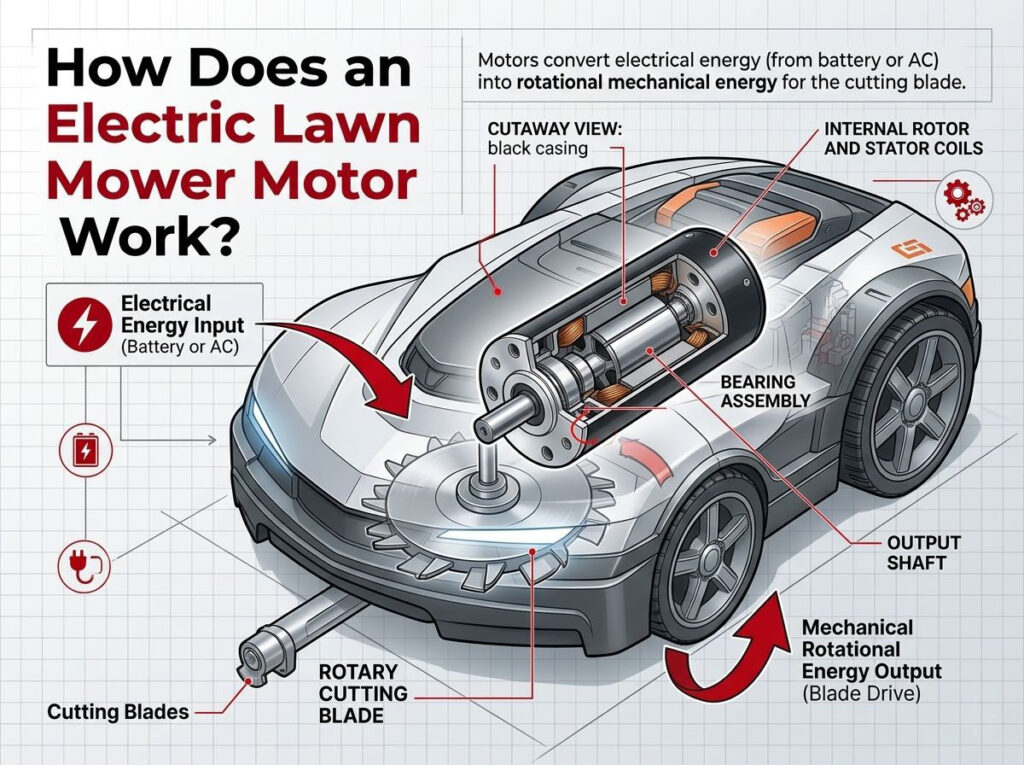
Como funciona um motor elétrico de cortador de grama?
Electric lawn mower motors work by converting electrical energy from a battery or AC power source into rotational mechanical energy that drives the cutting blade. Modern electric lawn mowers increasingly use BLDC (DC sem escova) motors because they offer higher efficiency, melhor densidade de torque, menor manutenção, operação mais silenciosa, and longer lifespan compared with brushed motors or small gasoline engines.
In a typical system, the controller regulates current flow through the motor windings to create a rotating magnetic field. The rotor follows this field, producing torque that spins the mower blade at high speed. Advanced electric lawn mower motors also integrate thermal protection, variable-speed control, Sensores de salão, and intelligent power management to improve cutting performance under varying grass loads.
For OEM manufacturers and commercial equipment designers, understanding how electric lawn mower motors work is essential for selecting the right voltage platform, torque curve, método de resfriamento, and controller architecture. Motor selection directly impacts cutting quality, battery runtime, confiabilidade, nível de ruído, and long-term operating cost.
What Is an Electric Lawn Mower Motor?
An electric lawn mower motor is the core drive component responsible for rotating the cutting blade in electric mowing equipment. Unlike traditional gasoline engines that rely on combustion, electric mower motors use electromagnetic principles to generate rotational force. These motors are commonly powered by lithium battery systems ranging from 24V to 72V depending on mower size and application.
The most common motor technologies used in modern lawn mowers include:
- Motores CC escovados
- DC sem escova (BLDC) motores
- motores de indução CA
- Motores universais
Among these options, BLDC motors have become the preferred solution for premium residential and commercial lawn mowers because of their high efficiency and intelligent speed control capabilities.
A typical electric lawn mower motor system includes:
- Rotor and stator assembly
- Controlador eletrônico
- Power MOSFET or inverter stage
- Position sensing system
- Thermal management components
- Battery management integration
For commercial OEM equipment, the motor is often integrated with reduction gears, blade adapters, overload protection systems, and waterproof housings for outdoor operation.
Como funciona um motor elétrico de cortador de grama?
Electromagnetic Torque Generation
Electric lawn mower motors operate using electromagnetic interaction between the stator magnetic field and the rotor magnets or conductors. Em motores BLDC, electronic commutation replaces traditional mechanical brushes. The controller sequentially energizes stator windings, criando um campo magnético rotativo.
O rotor, which contains permanent magnets, follows this magnetic field and generates rotational motion. This rotational energy transfers directly to the mower blade shaft.
Electronic Speed Regulation
Modern electric lawn mowers do not operate at a fixed speed continuously. Em vez de, intelligent controllers dynamically adjust RPM according to grass density and cutting load. When thick or wet grass increases resistance, the controller supplies additional current to maintain blade torque.
This closed-loop control strategy improves:
- Cutting consistency
- Battery runtime optimization
- Eficiência do motor
- Estabilidade térmica
- Noise reduction
Power Delivery Process
The energy flow inside an electric mower typically follows this sequence:
- Battery pack supplies DC voltage
- Motor controller converts power into controlled phase currents
- Stator windings generate rotating magnetic field
- Rotor rotates with magnetic synchronization
- Blade shaft spins and cuts grass
This process occurs continuously at high switching frequencies, often above 10kHz in advanced BLDC systems.
Why BLDC Motors Dominate Modern Electric Lawn Mowers
Brushless DC motors are increasingly replacing brushed motors and small gasoline engines in lawn care equipment because they offer significant engineering advantages.
Maior eficiência
BLDC motors typically achieve efficiencies between 85% e 93%, while brushed motors may operate below 75%. Reduced electrical loss directly improves battery runtime and lowers thermal stress.
Higher Torque Density
Torque density refers to how much torque a motor can produce relative to its size and weight. High-speed BLDC motors provide strong cutting torque in compact form factors, enabling lightweight mower designs without sacrificing cutting performance.
Manutenção reduzida
Traditional brushed motors require periodic brush replacement because brushes wear through friction and electrical arcing. BLDC motors eliminate brushes entirely, significantly increasing operational lifespan.
Menor ruído
Commercial landscaping equipment increasingly faces urban noise restrictions. BLDC motors operate more quietly than gasoline engines and brushed motors due to smoother electronic commutation.
Improved Intelligent Control
Modern mower manufacturers increasingly demand smart functions such as:
- Adaptive blade speed
- Obstacle detection
- Otimização da bateria
- IoT connectivity
- Autonomous mowing compatibility
BLDC platforms support these advanced features much more effectively than conventional motor technologies.
BLDC Motor vs Brushed Motor vs Gasoline Engine for Lawn Mowers
| Parâmetro | Motor BLDC | Motor CC escovado | Gasoline Engine |
|---|---|---|---|
| Eficiência | 85–93% | 65–75% | 20–30% |
| Manutenção | Muito baixo | Médio | Alto |
| Nível de ruído | Baixo | Médio | Alto |
| Controle de Torque | Excelente | Básico | Limitado |
| Emissions | Zero Local Emissions | Zero Local Emissions | Alto |
| Vida útil | Longo | Moderado | Moderado |
| OEM Integration | Excelente | Básico | Complex |
| Gerenciamento térmico | Avançado | Limitado | Combustion Heat |
Do ponto de vista da engenharia, BLDC motors provide superior controllability and system efficiency. Although initial system cost may be higher than brushed motors, the total lifecycle cost is usually lower because of reduced maintenance and improved energy efficiency.
Understanding Torque and Speed in Lawn Mower Motors
Why Torque Matters
Torque determines the mower’s ability to cut thick, wet, or dense grass. Insufficient torque causes blade slowdown, uneven cutting, and potential motor overload.
Commercial lawn mowers typically require high starting torque to overcome blade inertia and maintain stable cutting under variable load conditions.
Why Speed Matters
Blade tip speed directly influences cutting quality. Higher RPM improves grass cutting smoothness but also increases aerodynamic drag and power consumption.
Engineering teams must balance:
- Torque output
- Blade speed
- Nível de ruído
- Battery runtime
- Estabilidade térmica
Variable Speed Control
Advanced electric lawn mower motors dynamically adjust speed using PWM (Modulação de largura de pulso). This allows the mower to operate efficiently under light load while still delivering peak torque when required.
Por exemplo, a 48V BLDC mower motor may operate at:
- 2500 RPM during light trimming
- 4000 RPM during dense grass cutting
- Reduced standby speed during idle conditions
Thermal Management and Cooling in Electric Lawn Mower Motors
Thermal performance is one of the most critical factors affecting electric lawn mower motor lifespan and reliability.
Heat Sources
Motor heating mainly originates from:
- Copper winding losses
- Iron core losses
- MOSFET switching losses
- Bearing friction
- Aerodynamic blade load
Cooling Methods
| Método de resfriamento | Vantagens | Limitations |
|---|---|---|
| Resfriamento de ar natural | Baixo custo | Limited heat dissipation |
| Resfriamento de Ar Forçado | Improved airflow | Additional fan noise |
| Aluminum Housing Cooling | Passive heat spreading | Higher material cost |
| Liquid Cooling | Excellent thermal control | Rare in lawn mowers |
Commercial-grade lawn mower motors increasingly use aluminum housings combined with forced airflow to maintain stable operating temperatures during continuous operation.
Effective thermal management improves:
- Motor lifespan
- Efficiency stability
- Bearing reliability
- Magnet protection
- Controller durability
How to Choose an Electric Lawn Mower Motor for OEM Applications
Faixa de tensão
Voltage selection significantly impacts overall system architecture.
- 24Sistemas V: Entry-level residential mowers
- 36Sistemas V: Medium residential applications
- 48Sistemas V: Commercial walk-behind mowers
- 72Sistemas V: Professional riding mowers
Higher voltage systems reduce current requirements, improving efficiency and reducing cable heating.
Faixa de potência
Typical electric lawn mower motor power ratings include:
- 500W–1200W: Small residential mowers
- 1.5kW–3kW: Commercial walk-behind systems
- 4kW – 10 kW: Riding lawn mowers
Requisitos de velocidade e torque
OEM engineers should analyze:
- Blade diameter
- Grass density
- Terrain conditions
- Desired cutting speed
- Duty cycle requirements
High torque at low RPM is especially important for commercial mowing applications.
Compatibilidade do controlador
Controller integration is critical for:
- Hall sensor compatibility
- Field-oriented control (FOC)
- CAN bus communication
- Battery management integration
- Thermal protection logic
Proteção Ambiental
Outdoor mower motors should support:
- IP54–IP67 protection
- Corrosion resistance
- Waterproof connectors
- Dust protection
- UV-resistant housings
For OEM projects, many manufacturers now request custom motor solutions optimized for noise reduction, blade response, and battery efficiency. To keep motor wiring secure and organized during assembly, manufacturers also rely on quality products from a trusted cable ties manufacturer to prevent vibration damage and ensure long-term reliability.
Related product pages:
Applications of Electric Lawn Mower Motors
Residential Lawn Mowers
Battery-powered residential mowers prioritize low noise, lightweight construction, and ease of maintenance. Compact BLDC motors are ideal because they offer sufficient torque while minimizing user fatigue.
Commercial Landscaping Equipment
Commercial operators require:
- Continuous-duty operation
- Alta fiabilidade
- Long runtime
- Fast charging compatibility
- Reduced maintenance downtime
Commercial mowing fleets increasingly adopt 48V and 72V BLDC systems for improved operating efficiency.
Autonomous Robotic Lawn Mowers
Robotic lawn mowers rely heavily on compact high-efficiency motors because battery optimization is critical. These systems often integrate:
- Sensor fusion
- Precision speed control
- Low-noise operation
- Smart navigation systems
Industrial Turf Maintenance
Golf courses, sports stadiums, and municipal landscaping increasingly use industrial electric mowing systems to reduce emissions and maintenance costs.
Common Failure Modes in Electric Lawn Mower Motors
Superaquecimento
Excessive thermal buildup can damage insulation and demagnetize permanent magnets. Poor airflow and overloaded blades are common causes.
Bearing Wear
Outdoor dust, vibração, and moisture accelerate bearing degradation. High-quality sealed bearings significantly improve reliability.
Controller Failure
MOSFET overheating, poor PCB protection, or voltage spikes can damage motor controllers. Industrial-grade controllers improve long-term stability.
Water Ingress
Electric lawn mower motors must operate in humid and wet environments. Insufficient sealing may cause corrosion or short circuits.
Future Trends in Electric Lawn Mower Motor Technology
High-Efficiency FOC Control
Field-Oriented Control is becoming standard in premium mower systems because it improves torque smoothness and energy efficiency.
Smart Connectivity
Future mower motors increasingly integrate:
- IoT monitoring
- Cloud diagnostics
- Predictive maintenance
- Battery analytics
Higher Voltage Platforms
72V and even 96V systems are emerging in commercial lawn care equipment because higher voltage reduces current losses and improves system scalability.
Integrated Drive Systems
Motor manufacturers increasingly provide integrated motor-controller assemblies that simplify OEM development and reduce installation complexity.
Why OEM Buyers Prefer Custom BLDC Lawn Mower Motors
OEM manufacturers often require customized motor platforms rather than standard catalog motors. Key customization areas include:
- Custom shaft dimensions
- Specific torque curves
- Noise optimization
- Waterproof design
- Integração do controlador
- Thermal optimization
Por exemplo, commercial lawn mower OEMs may require:
- 48V or 72V architecture
- Peak torque optimization
- Extended duty-cycle capability
- CAN communication support
- Low-noise blade operation
Working with an experienced OEM motor supplier helps reduce product development risk and accelerates time-to-market.
To request a datasheet or discuss a custom mower motor project, OEM buyers can contact Greensky engineers for application-specific recommendations.
Perguntas frequentes: Electric Lawn Mower Motors
Are brushless lawn mower motors better than brushed motors?
Sim. Brushless motors offer higher efficiency, menor manutenção, operação mais silenciosa, e maior vida útil. They also support advanced speed control and adaptive torque management, making them ideal for commercial and robotic lawn mower applications.
What voltage is best for an electric lawn mower motor?
The optimal voltage depends on application size and duty cycle. Residential mowers commonly use 24V–48V systems, while commercial equipment increasingly uses 72V platforms for improved efficiency and reduced current losses.
Why does torque matter in lawn mower motors?
Torque determines the mower’s ability to maintain blade speed under heavy grass loads. High torque improves cutting consistency, prevents blade stall, and reduces motor overheating during demanding operation.
How long do BLDC lawn mower motors last?
High-quality BLDC motors can operate for thousands of hours with minimal maintenance. Lifespan depends on cooling quality, bearing design, environmental sealing, and controller protection.
What is the most efficient motor for commercial lawn mowers?
BLDC motors with Field-Oriented Control are currently the most efficient solution for commercial electric lawn mowers. They combine high efficiency, controle de velocidade preciso, baixa manutenção, and strong torque density.
Can electric lawn mower motors work in wet conditions?
Sim, but they must use appropriate waterproof protection. Commercial-grade mower motors often use IP54 to IP67 sealing systems to prevent moisture ingress and corrosion.
Conclusão
Electric lawn mower motors have evolved rapidly as the lawn care industry transitions toward cleaner, quieter, and more energy-efficient equipment. Among all available technologies, BLDC motors now dominate premium residential, comercial, and robotic mower platforms because of their superior efficiency, densidade de torque, desempenho térmico, and intelligent control capabilities.
For OEM manufacturers and procurement teams, selecting the right electric lawn mower motor involves much more than choosing a power rating. Voltage architecture, método de resfriamento, torque curve, controller compatibility, Proteção Ambiental, and long-term reliability all directly affect mower performance and lifecycle cost.
As commercial landscaping equipment increasingly adopts 48V and 72V high-efficiency systems, motor engineering becomes a critical competitive factor. OEM buyers seeking custom BLDC mower motors should evaluate suppliers based on application engineering support, thermal design capability, reliability testing, and controller integration expertise.
To discuss OEM electric lawn mower motor solutions, request datasheets, or evaluate custom BLDC motor platforms, contact Greensky Power engineering specialists for technical consultation.
Referências
1. https://www.energy.gov/eere/amo/articles/determining-electric-motor-load-and-efficiency
2. https://www.iea.org/reports/energy-efficiency-2023
3. https://www.nema.org/standards/view/motors-and-generators
4. https://www.sciencedirect.com/topics/engineering/brushless-dc-motor
5. https://www.mdpi.com/topics/Brushless_DC_Motor
6. https://www.controleng.com/articles/understanding-bldc-motor-control-algorithms/
7. https://www.electronicdesign.com/technologies/power/article/21195984/understanding-brushless-dc-motors