
Como funciona um motor BLDC? (Complete Beginner-to-Engineer Guide)
Trecho em destaque:
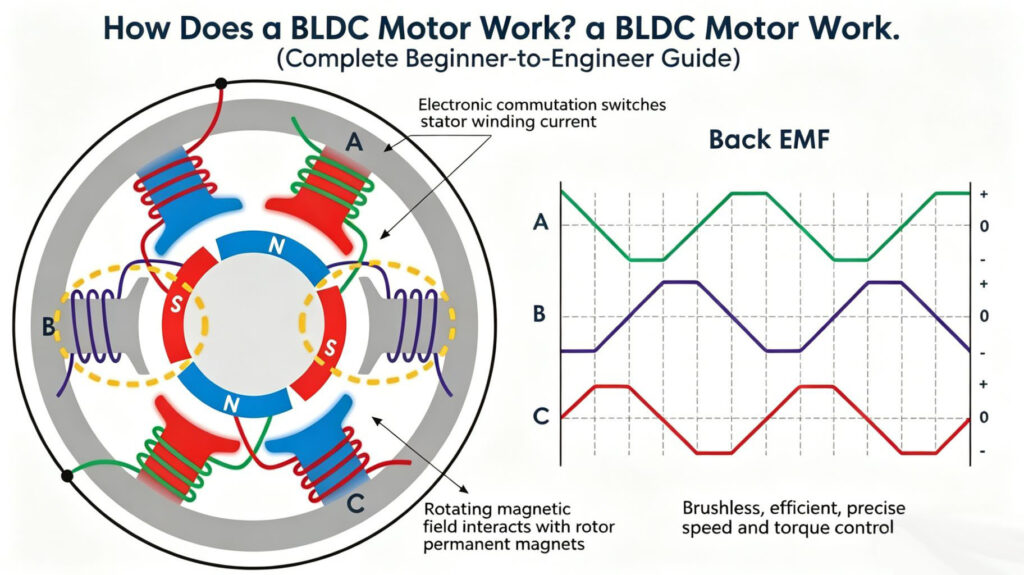
A BLDC motor works by using electronic commutation to switch current through stator windings, creating a rotating magnetic field that interacts with permanent magnets in the rotor. This eliminates brushes, improves efficiency, and enables precise speed and torque control. Compared to traditional motors, Os motores BLDC oferecem maior eficiência, melhor desempenho térmico, e maior vida útil, tornando-os ideais para automação industrial, Veículos elétricos, and HVAC systems.
Entendimento how does a BLDC motor work is essential for engineers, OEM designers, and procurement teams selecting high-performance motor solutions. Ao contrário dos motores escovados, BLDC motors rely on advanced control electronics and electromagnetic principles to achieve superior performance. This article provides an engineering-level breakdown of BLDC motor operation, including working principles, control strategies, efficiency factors, and how to select the right solution for industrial applications.
What is a BLDC Motor and How Does It Work?
A BLDC (DC sem escova) motor is an electric motor that operates without brushes, using electronic commutation instead of mechanical contact.
It works by generating a rotating magnetic field in the stator, which causes the rotor (com ímãs permanentes) to follow and rotate.
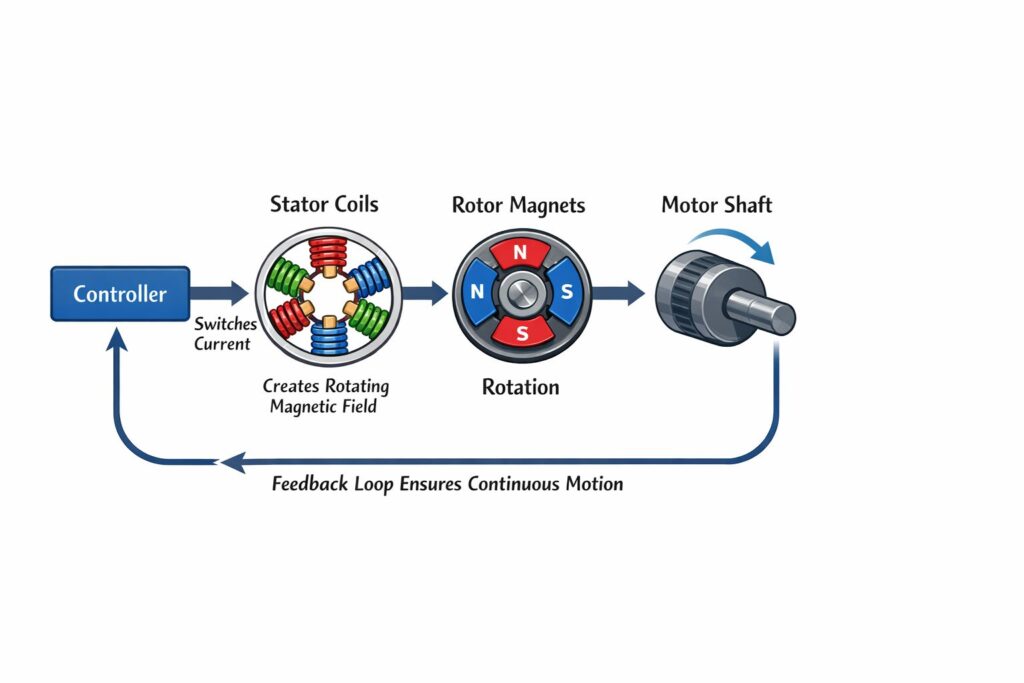
A controller continuously switches current in the stator windings to maintain smooth and efficient motion.
Componentes -chave
- Rotor with permanent magnets
- Stator windings (3-Estágio)
- Controlador eletrônico (ESC)
- Position sensors (Hall sensors or sensorless system)
BLDC motors are widely used in applications requiring high efficiency and precise control, como robótica, VEs, e automação industrial.
👉 Explore: Soluções para motores BLDC
BLDC Motor Working Principle (Passo a passo)
1. Stator Generates a Rotating Magnetic Field
The stator consists of multiple coils. When current flows through these coils, it creates magnetic poles.
By energizing different coils in sequence, a rotating magnetic field is produced.
2. Rotor Follows the Magnetic Field
The rotor is made of permanent magnets. These magnets naturally align with the stator’s magnetic field, causing the rotor to turn as the field rotates.
3. Controller Switches Current (Comutação Eletrônica)
Instead of brushes, a controller uses sensors (such as Hall sensors) or sensorless algorithms to detect rotor position.
It then switches current between stator windings at the correct timing to keep the motor spinning continuously.
Simple Diagram (Conceptual):
BLDC Motor Structure Explained
Estator
The stator is the stationary part containing copper windings. It is responsible for generating the electromagnetic field that drives the motor.
Rotor
The rotor contains permanent magnets and rotates inside or around the stator depending on motor design (inner rotor or outer rotor).
Controlador
The controller is the “brain” of the system. It manages current switching, controle de velocidade, e otimização de eficiência.
Step-by-Step Visual Explanation
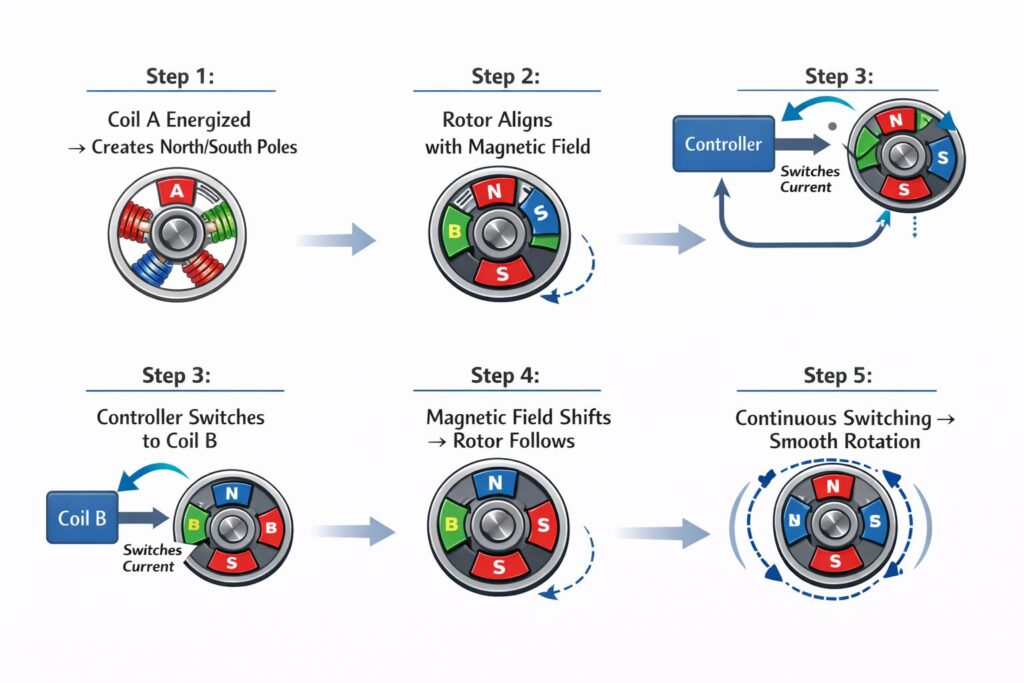
Etapa 2: Rotor aligns with magnetic field
Etapa 3: Controller switches to Coil B
Etapa 4: Magnetic field shifts → rotor follows
Etapa 5: Continuous switching → smooth rotation
This step-by-step electromagnetic interaction replaces the mechanical commutation found in traditional motors, resulting in higher efficiency and lower wear.
Why BLDC Motors Are More Efficient Than Brushed Motors
Efficiency is one of the main reasons BLDC motors are widely adopted.
Engineering Reasons
- Sem perdas por fricção nas escovas
- Reduced electrical losses
- Optimized current control
BLDC motors typically achieve efficiencies above 85–90%, significantly reducing energy consumption in industrial systems.
Torque Generation and Magnetic Field Interaction
Torque in a BLDC motor is generated by the interaction between the stator magnetic field and rotor magnets.
Key Factors
- Magnetic field strength
- Current magnitude
- Rotor position alignment
Precise control of these factors allows BLDC motors to deliver high torque density and smooth operation.
Control Systems in BLDC Motors
Control systems are critical to BLDC motor performance.
Types of Control
- Trapezoidal (seis passos) ao controle
- Controle Orientado a Campo (FOC)
Controller Functions
- Switching current between phases
- Regulação de velocidade
- Torque control
Advanced control methods such as FOC provide superior efficiency and performance.
Desempenho térmico e gerenciamento de calor
Thermal management is essential for reliability.
Vantagens do BLDC
- Lower heat generation due to high efficiency
- Heat concentrated in stator for easier cooling
Cooling methods include air cooling and liquid cooling for high-power applications such as 48V and 72V systems.
Reliability and Lifespan of BLDC Motors
BLDC motors offer longer lifespan due to reduced mechanical wear.
- No brushes → no wear components
- Lower heat → less insulation degradation
- Stable operation under varying loads
This makes them ideal for continuous-duty industrial applications.
BLDC Motor vs Brushed Motor vs AC Motor
| Parâmetro | Motor BLDC | Motor escovado | Motor CA |
|---|---|---|---|
| Eficiência | Alto | Moderado | Moderado |
| Manutenção | Baixo | Alto | Baixo |
| Ao controle | Avançado | Simples | Moderado |
| Aplicativos | VE, robótica | Low-cost devices | Industrial systems |
BLDC motors provide the best balance of performance and efficiency for modern applications.
Como escolher um motor BLDC para sua aplicação
Selecting the right BLDC motor requires careful analysis.
Key Selection Criteria
- Tensão: 24V / 48V / 72Sistemas V
- Poder: From watts to kW range
- Velocidade & Torque: Based on load requirements
- Resfriamento: Air or liquid cooling
- Compatibilidade do controlador: ESC or FOC controller
Exemplos de aplicação
- Electric vehicles → 48V/72V BLDC motor
- Robotics → precision BLDC motor
- HVAC → energy-efficient BLDC motor
👉 Request OEM solution: Custom Motor Development
Industrial Applications of BLDC Motors
- Veículos elétricos e e-bikes
- Automação industrial
- Sistemas HVAC
- Bombas e compressores
👉 Explore EV motors: Soluções para motores de veículos elétricos
Cost vs Performance: Is BLDC Worth It?
| Fator | Motor BLDC | Traditional Motor |
|---|---|---|
| Custo Inicial | Mais alto | Mais baixo |
| Eficiência | Mais alto | Mais baixo |
| Vida útil | Longer | Mais curto |
| Total Cost | Lower long-term | Mais alto |
For most industrial applications, BLDC motors provide better long-term ROI.
Tendências Futuras na Tecnologia de Motores BLDC
BLDC motors are at the forefront of modern motor technology.
- Integration with smart control systems
- Growth in electric mobility
- Advancements in sensorless control
These trends are driving widespread adoption across industries.
Key Advantages of BLDC Motors
- Alta eficiência: Reduced energy losses improve overall system performance
- Longa vida útil: No brushes means less wear and longer operation
- Baixa manutenção: Minimal servicing required
- Alta densidade de torque: More power in a compact size
- Operação de baixo ruído: Ideal for precision and quiet applications
Common Applications of BLDC Motors
- Veículos Elétricos: High efficiency and torque control
- Fans & Sistemas HVAC: Energy-saving and quiet operation
- Robótica: Precise speed and position control
- Automação Industrial: Reliable and long-lasting performance
These advantages make BLDC motors a key component in energy-efficient and high-performance systems across industries.
Perguntas frequentes: Como funciona um motor BLDC
1. How does a BLDC motor generate torque?
Torque is generated by the interaction between the stator magnetic field and rotor permanent magnets, controlled electronically.
2. Por que os motores BLDC são mais eficientes?
They eliminate brush friction and use optimized current control, reducing energy losses.
3. What are the main advantages of BLDC motors?
Alta eficiência, baixa manutenção, longa vida útil, e controle preciso.
4. Where are BLDC motors used?
They are used in EVs, robótica, Sistemas HVAC, e automação industrial.
5. What controls a BLDC motor?
A BLDC motor is controlled by an electronic controller that switches current in the stator windings based on rotor position.
6. Does a BLDC motor need a controller?
Sim. A controller is essential for switching current and maintaining rotation, as BLDC motors cannot operate directly from a DC power supply.
Conclusão: Why BLDC Motors Dominate Modern Applications
Entendimento how does a BLDC motor work provides a foundation for selecting high-performance motor solutions. With their superior efficiency, confiabilidade, and control capabilities, BLDC motors are becoming the standard in modern industrial and OEM applications.
Need help selecting the right BLDC motor?
✔ Solicitar ficha técnica
✔ Obtenha solução de motor OEM
✔ Entre em contato com nossos engenheiros hoje
Referências
- Transações IEEE em Eletrônica Industrial
- Electric Motor Design Handbook
- IEC Efficiency Standards