
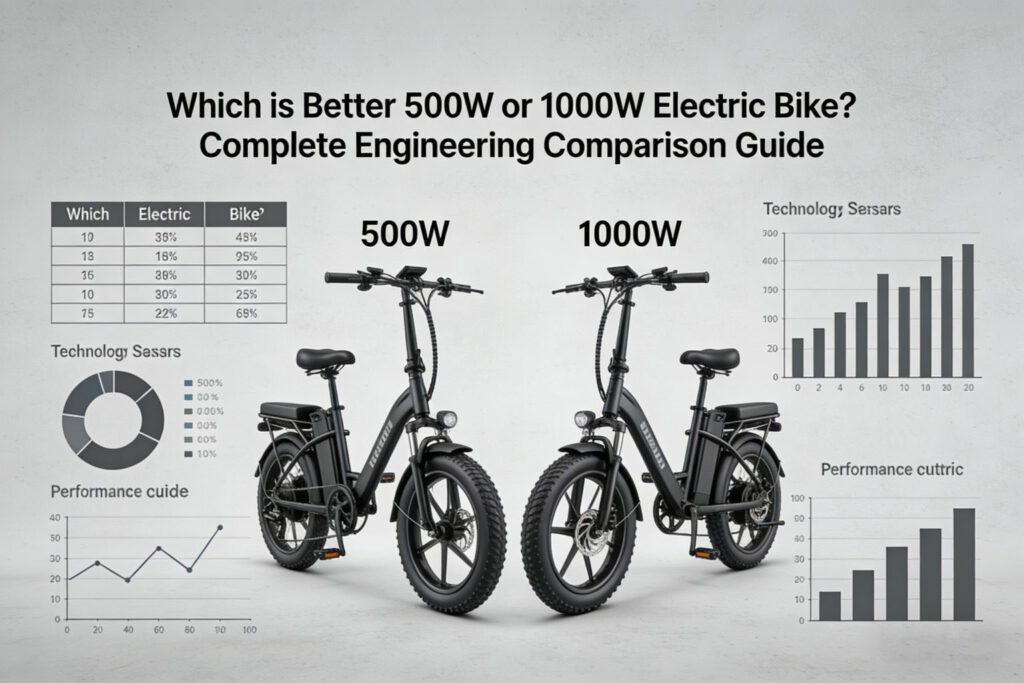
Wat is beter: een elektrische fiets van 500 W of 1000 W? Volledige technische vergelijkingsgids
Uitgelicht fragment:
The choice between a 500W and 1000W electric bike depends on application requirements such as torque, snelheid, terrein, and regulatory constraints. A 500W e-bike offers better efficiency, lagere kosten, and compliance with most regulations, making it ideal for urban commuting. A 1000W e-bike delivers higher torque and acceleration, suitable for off-road, zware belasting, or high-performance use. Vanuit een technisch perspectief, the “better” option is determined by load demand, inschakelduur, and system design rather than power alone.
What is a 500W and 1000W Electric Bike Motor?
A 500W or 1000W electric bike refers to the rated continuous output power of the motor, typically a BLDC (borstelloze gelijkstroom) motor. These motors are commonly used in hub motor or mid-drive configurations for electric mobility systems.
A 500W BLDC motor is designed for moderate load conditions, providing sufficient torque for flat terrain and light inclines. In tegenstelling tot, A 1000W BLDC motor is engineered for higher torque output, enabling better climbing performance and acceleration under heavier loads.
From an OEM perspective, power rating directly influences system design, including battery capacity, controller selection, thermisch beheer, and cost structure. Daarom, choosing between 500W and 1000W is not just a performance decision but a complete system-level engineering consideration.
Why Power Rating Matters in Electric Bike Performance
Power rating determines how much work the motor can perform over time. Echter, in practical engineering applications, torque and efficiency are equally important.
A higher power motor (1000W) can deliver more torque at the same speed, which translates into better acceleration and load-handling capability. This is critical for applications such as cargo bikes, off-road e-bikes, and steep terrain riding.
Echter, increased power also leads to higher energy consumption, increased heat generation, and the need for more robust controllers and battery systems. For procurement managers, this creates a trade-off between performance and system cost.
In most urban applications, a 500W motor provides sufficient performance while maintaining higher system efficiency and lower operational costs.
500W vs 1000W Electric Bike: Prestatievergelijking
| Parameter | 500W Electric Bike | 1000W Electric Bike |
|---|---|---|
| Topsnelheid | 25–35 km/h | 40–55 km/h |
| Koppeluitvoer | Gematigd | Hoog |
| Climbing Ability | Light to medium slopes | Steep hills |
| Energy Consumption | Lager | Hoger |
| Battery Requirement | Smaller capacity | Larger capacity |
| Kosten | Lager | Hoger |
From an engineering standpoint, the key difference lies in torque output and system load capability. A 1000W motor is better suited for demanding applications, while a 500W motor excels in efficiency-driven designs.
Efficiency and Energy Consumption Analysis
Efficiency is a critical factor in electric bike design, especially for OEM manufacturers targeting long-range and energy-saving solutions.
500W motors typically operate at higher efficiency under normal load conditions because they are closer to their optimal operating point. In tegenstelling tot, 1000W motors may operate below optimal efficiency in low-load scenarios, resulting in energy losses.
This means that for commuting applications, a 500W system can achieve longer range per charge. For high-performance applications, the efficiency trade-off of a 1000W motor is justified by its superior torque output.
Torque Density and Acceleration Comparison
Torque density is a key parameter in motor selection. It defines how much torque a motor can produce relative to its size and weight.
1000W motors generally offer higher torque density due to stronger magnetic fields and higher current capacity. This results in faster acceleration and better performance under heavy loads.
Bijvoorbeeld, in cargo e-bikes or delivery vehicles, higher torque ensures stable operation even with significant payloads. In tegenstelling tot, 500W motors are sufficient for lightweight applications where efficiency is prioritized over raw power.
Thermal Performance and Cooling Requirements
Thermal management becomes increasingly important as motor power increases. A 1000W motor generates more heat due to higher current and power output.
Without proper cooling, excessive heat can reduce motor efficiency, degrade insulation, and shorten lifespan. Daarom, 1000W systems often require enhanced cooling solutions such as improved heat dissipation structures or active cooling.
500W motors, aan de andere kant, typically rely on natural cooling and have lower thermal stress, making them more reliable in continuous operation scenarios.
Control System and Reliability Considerations
Control systems play a crucial role in motor performance. Both 500W and 1000W motors rely on electronic controllers to regulate speed and torque.
Echter, 1000W systems require more advanced controllers capable of handling higher current and providing precise torque control. This increases system complexity and cost.
In terms of reliability, operating a motor close to its maximum capacity reduces lifespan. A 500W motor used within its optimal range may offer longer service life compared to a 1000W motor operating under high stress conditions.
500W vs 1000W vs Mid-Drive Systems: Vergelijkingstabel
| Parameter | 500W-naafmotor | 1000W-naafmotor | Mid-Drive Motor |
|---|---|---|---|
| Efficiëntie | Hoog | Gematigd | Zeer hoog |
| Koppel | Gematigd | Hoog | Zeer hoog (gear-assisted) |
| Complexiteit | Laag | Gematigd | Hoog |
| Onderhoud | Laag | Gematigd | Hoger |
| Sollicitatie | Urban commuting | Off-road / cargo | Hoge prestaties / OEM |
This comparison highlights that power alone does not define performance. System architecture plays a critical role in determining efficiency and torque output.
How to Choose the Right Electric Bike Motor for Your Application
Spanningsbereik
500W systems typically use 36V–48V, while 1000W systems often require 48V–72V to maintain efficiency and reduce current.
Vermogensbereik
Choose 500W for standard applications and 1000W for high-load or high-performance requirements.
Speed and Torque
Define required speed and torque based on terrain and load conditions. Higher torque is essential for climbing and acceleration.
Koelmethode
1000W motors may require enhanced cooling solutions to maintain performance under continuous load.
Compatibiliteit van controllers
Ensure the controller supports the motor’s voltage and current requirements for stable operation.
Toepassingsspecifieke overwegingen
Urban commuting, cargo transport, and off-road riding each require different motor characteristics.
Explore more solutions:
Electric Vehicle Motors |
BLDC-motoroplossingen |
CTA: Request datasheet or contact our engineers for OEM motor selection support.
Toepassingen: Where 500W or 1000W Motors Perform Best
Stedelijk woon-werkverkeer
500W motors provide sufficient power with better energy efficiency and compliance with regulations.
Cargo and Delivery
1000W motors offer higher torque for carrying heavy loads and maintaining performance.
Off-Road and Mountain
1000W systems excel due to superior climbing ability and acceleration.
Industrial and OEM Systems
Both options are used depending on application requirements such as AGV systems or light electric vehicles.
Cost vs Performance Trade-Off
From a procurement perspective, cost is a major factor. 500W systems are more cost-effective due to smaller batteries, simpler controllers, and lower material requirements.
1000W systems require higher investment but deliver superior performance. The key is to evaluate total cost of ownership, including energy consumption, onderhoud, and system lifespan.
Toekomstige trends in elektrische fietsmotortechnologie
The future of e-bike motors is focused on higher efficiency, improved torque density, and smarter control systems. Advances in BLDC technology and battery systems are enabling more compact and powerful designs.
Integration with IoT and smart controllers allows real-time monitoring and optimization, improving performance and reliability in OEM applications.
Veelgestelde vragen: 500W vs 1000W Electric Bike
1. Is a 1000W e-bike faster than 500W?
Ja, a 1000W e-bike typically achieves higher top speeds and better acceleration due to increased power output.
2. Which is better for hills, 500W or 1000W?
1000W is better for steep hills due to higher torque and load capacity.
3. Is a 500W motor enough for daily commuting?
Ja, 500W is sufficient for most urban commuting scenarios and offers better efficiency.
4. Does a 1000W motor consume more battery?
Ja, higher power output leads to increased energy consumption and reduced range.
5. Which motor lasts longer?
A properly used 500W motor may last longer due to lower thermal stress and operating load.
Conclusie: Engineering Decision Between 500W and 1000W
The decision between a 500W and 1000W electric bike motor depends on application requirements rather than a simple “better” choice. Engineers and OEM buyers must evaluate torque, efficiëntie, thermal performance, en kosten.
For most urban and light-duty applications, 500W motors provide the best balance of efficiency and cost. For high-performance or heavy-load scenarios, 1000W motors are the preferred solution.
CTA: Contact our engineers to get a customized e-bike motor solution or request a detailed datasheet tailored to your application.
Referenties
- IEEE-transacties op industriële elektronica
- Electric Vehicle Technology Handbook
- IEC 60034 Rotating Electrical Machines Standards
- BLDC Motor Design and Control Theory