
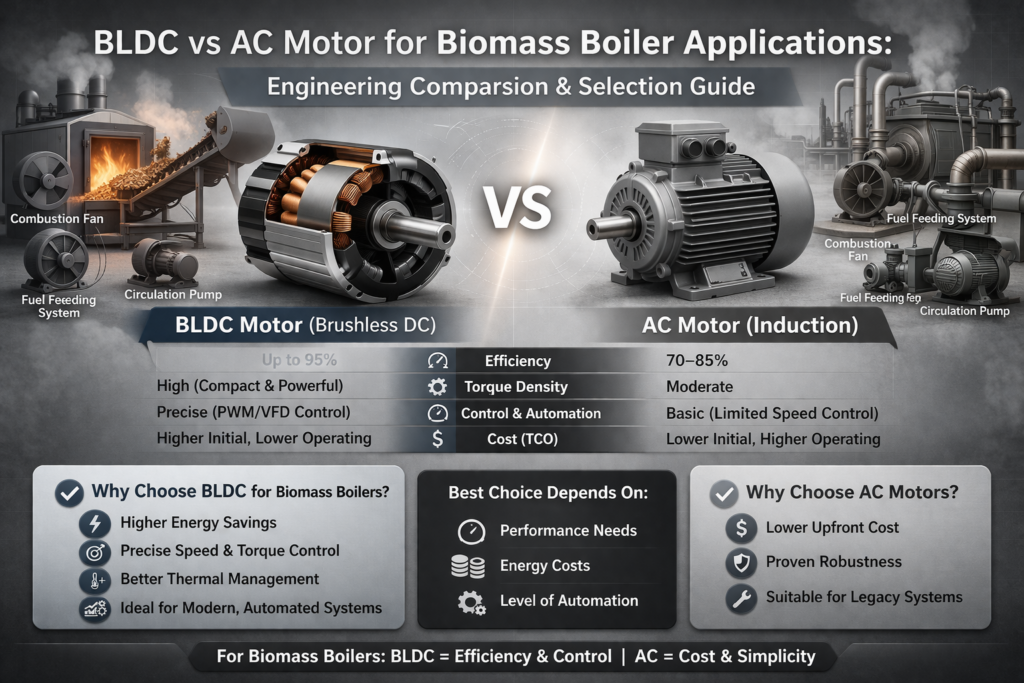
BLDC versus AC-motor voor biomassaketeltoepassingen: Technische vergelijking & Selectiegids
Uitgelicht fragment:
BLDC-motoren bieden een hoger rendement (tot 95%), betere koppeldichtheid, en nauwkeurige snelheidsregeling, making them ideal for modern biomass boiler systems. AC-motoren, while more cost-effective and robust, provide lower efficiency and limited control flexibility. For biomass boiler applications such as combustion fans, fuel feeding systems, and circulation pumps, the choice depends on performance requirements, energiekosten, and automation level. Engineers increasingly prefer BLDC motors for energy savings and system optimization, while AC motors remain common in cost-sensitive or legacy systems.
What is BLDC vs AC Motor for Biomass Boiler Applications?
BLDC (Borstelloze gelijkstroom) motors and AC (Alternating Current) motors are the two most widely used motor types in biomass boiler systems. Each serves critical functions such as airflow control, fuel feeding, and heat transfer, but they differ significantly in performance characteristics.
BLDC Motor Overview
BLDC motors use electronic commutation and permanent magnets, enabling high efficiency, compact ontwerp, en nauwkeurige controle.
AC Motor Overview
AC-motoren, particularly induction motors, rely on electromagnetic induction. They are widely used due to their durability and lower initial cost.
Explore BLDC solutions: BLDC Motor Products
Why Compare BLDC vs AC Motor in Biomass Boiler Systems?
In biomass boiler applications, motor selection directly affects combustion efficiency, fuel consumption, en onderhoudskosten. Engineers must evaluate both technologies based on real operational demands.
Key Decision Factors
- Energy efficiency in continuous operation
- Torque performance under varying loads
- Integration with control systems
- Total cost of ownership
Industry Shift
As energy efficiency standards tighten, many OEMs are transitioning from traditional AC motors to BLDC solutions.
Efficiëntievergelijking: BLDC versus AC-motor
Efficiency is one of the most critical factors in biomass boiler systems due to continuous operation.
BLDC Motor Efficiency
- Typically 90–95%
- Low electrical and mechanical losses
AC Motor Efficiency
- Typically 75–90%
- Higher rotor losses
Technisch inzicht
In fan and pump applications running 24/7, even a 5–10% efficiency improvement can significantly reduce energy costs over time.
Torque Density and Load Performance
De koppeldichtheid bepaalt hoeveel koppel een motor kan leveren in verhouding tot zijn grootte.
BLDC-motoren
- Hoge koppeldichtheid
- Compact ontwerp
- Excellent for variable loads
AC-motoren
- Moderate torque density
- Larger size for same output
Application Insight
Fuel feeding systems benefit from high torque density, while fans require stable torque across varying speeds.
Thermische prestaties en koelingsoverwegingen
Biomass boiler environments are harsh, with high temperatures and dust exposure.
BLDC-motoren
- Lower heat generation due to higher efficiency
- Verminderde koelvereisten
AC-motoren
- Higher heat generation
- Require robust cooling systems
Technisch inzicht
Lower thermal stress improves motor lifespan and reduces maintenance frequency.
Besturingssystemen: BLDC versus AC-motor
Control capability is a major differentiator between BLDC and AC motors.
BLDC-motorbesturing
- Electronic commutation
- Nauwkeurige snelheids- en koppelregeling
- Integratie met slimme systemen
AC-motorbesturing
- Requires VFD for variable speed
- Less precise control
Technisch inzicht
Advanced control improves combustion efficiency by optimizing airflow and fuel feeding.
Betrouwbaarheid en levensduurvergelijking
Reliability is critical for continuous industrial operations.
BLDC-motoren
- No brushes, minder slijtage
- Lange levensduur (20,000+ uren)
AC-motoren
- Robust design
- Maintenance required for bearings and insulation
System Impact
Reduced downtime and maintenance costs are key advantages of BLDC motors.
BLDC versus AC-motor: Full Comparison Table
| Parameter | BLDC-motor | AC-motor |
|---|---|---|
| Efficiëntie | 90–95% | 75–90% |
| Koppeldichtheid | Hoog | Gematigd |
| Controle | Geavanceerd | Basis (met VFD) |
| Thermische prestaties | Uitstekend | Gematigd |
| Onderhoud | Laag | Gematigd |
| Initiële kosten | Hoger | Lager |
| Lifecycle Cost | Lager | Hoger |
Technische interpretatie
BLDC motors provide better long-term value, while AC motors remain suitable for budget-limited projects.
Advantages and Disadvantages of BLDC vs AC Motors
BLDC-motorvoordelen
- Hoge efficiëntie
- Precise control
- Lange levensduur
BLDC Motor Disadvantages
- Hogere initiële kosten
- Requires controller
AC Motor Advantages
- Lage kosten
- Simple design
- Widely available
AC Motor Disadvantages
- Lagere efficiëntie
- Limited control
How to Choose Between BLDC vs AC Motor for Biomass Boiler Applications
Motor selection should be based on system requirements and long-term cost considerations.
Spanningsbereik
- BLDC: 24V–72V or higher
- AC: 220V–380V industrial standard
Vermogensbereik
- Fans: 5kW–50kW
- Feed systems: 0.5kW–10 kW
Snelheid / Koppel
Match torque output to load requirements, especially for feeding systems.
Koelmethode
- Air cooling for standard applications
- Enhanced cooling for high-temperature zones
Compatibiliteit van controllers
BLDC requires dedicated controllers; AC motors use VFDs.
Toepassingsoverwegingen
- Continuous vs intermittent operation
- Energy cost sensitivity
- Automation level
CTA: Request datasheet or contact our engineers for a customized motor solution.
Applications of BLDC and AC Motors in Biomass Systems
Industriële toepassingen
- Elektriciteitscentrales
- Manufacturing facilities
HVAC-systemen
- District heating
- Commercial buildings
Agricultural Applications
- Drying systems
- Greenhouses
For EV-related motors: EV-motoroplossingen
Toekomstige trends: BLDC Replacing AC Motors?
The industry is moving toward high-efficiency solutions.
Belangrijkste trends
- Adoption of BLDC motors in industrial systems
- Integratie met slimme besturingssystemen
- Focus on energy efficiency and sustainability
BLDC motors are expected to dominate future biomass boiler systems.
Veelgestelde vragen: BLDC versus AC-motor voor biomassaketeltoepassingen
1. Which motor is better for biomass boilers?
BLDC motors are better for efficiency and control, while AC motors are suitable for cost-sensitive applications.
2. Zijn BLDC-motoren de kosten waard??
Ja, due to energy savings and lower maintenance costs over time.
3. Can AC motors be upgraded to BLDC?
Ja, but it requires system redesign and controller integration.
4. Wat is het levensduurverschil?
BLDC motors typically last longer due to reduced mechanical wear.
5. Which motor is easier to maintain?
BLDC motors require less maintenance compared to AC motors.
Conclusie: Choosing the Right Motor for Biomass Boiler Applications
BLDC and AC motors each have advantages, but the trend clearly favors BLDC motors for modern biomass boiler systems. Their superior efficiency, controle, and reliability make them the preferred choice for OEMs and industrial buyers.
Echter, AC motors remain a viable option for cost-sensitive projects or simpler systems.
Volgende stap: Contact our engineering team to develop a customized motor solution tailored to your biomass boiler application.
Referenties
- IEEE Motor Control Research
- IEA Bioenergy Reports
- Industrial Motor Engineering Journals
- Energy Efficiency Studies