
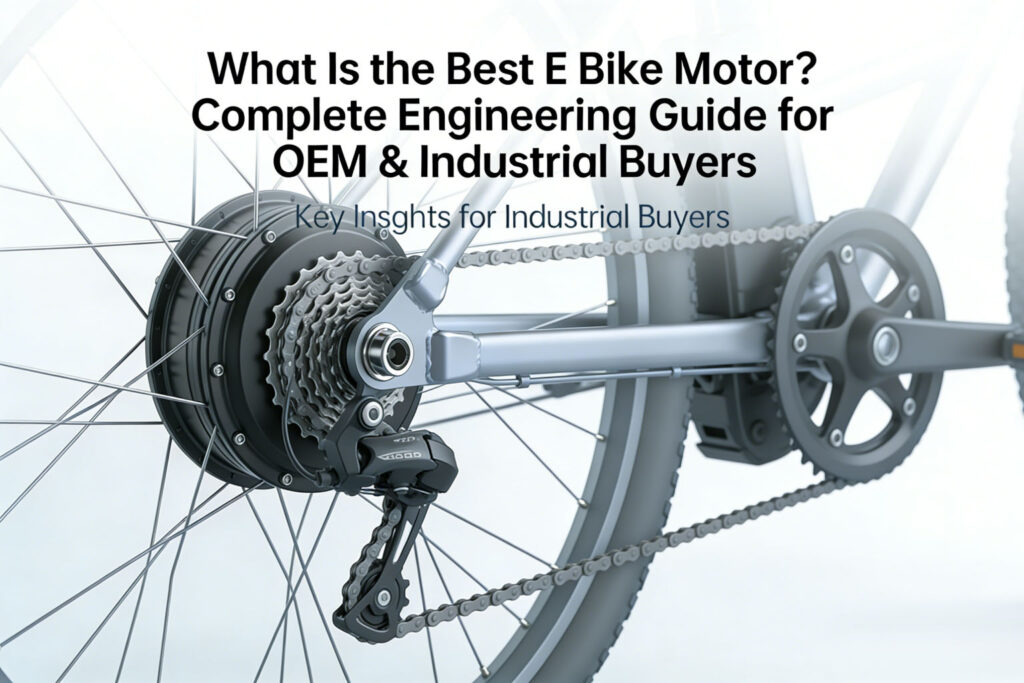
What Is the Best E Bike Motor? Complete Engineering Guide for OEM & Pembeli Industri
Coretan Pilihan:
The best e bike motor depends on application requirements such as torque, kecekapan, terrain, dan kos. Hub motors are ideal for simplicity and low cost, while mid-drive motors provide superior torque and climbing performance. Dari perspektif kejuruteraan, the optimal motor balances torque density, thermal performance, kecekapan, and control integration. For OEMs and procurement teams, selecting the right e bike motor requires evaluating voltage range, keserasian pengawal, and lifecycle cost to ensure long-term reliability and performance.
What Is an E Bike Motor and How Does It Work?
An e bike motor is an electric propulsion unit that assists or replaces human pedaling in electric bicycles. Most modern e bike motors are based on brushless DC (BLDC) technology due to its high efficiency, penyelenggaraan yang rendah, dan keupayaan kawalan yang tepat. These motors convert electrical energy from the battery into mechanical torque that drives the wheel.
The motor works in coordination with a controller and sensors. The controller regulates current and voltage based on rider input (throttle or pedal assist), while sensors detect cadence or torque to adjust output dynamically. This system ensures smooth acceleration, optimized energy consumption, and improved riding experience.
From an OEM perspective, the integration of motor, pengawal, and battery is critical. Many manufacturers now offer integrated solutions such as hub motors or mid-drive systems (see electric vehicle motor solutions) designed for efficiency and scalability.
Why Choosing the Best E Bike Motor Matters
Choosing the right e bike motor directly impacts performance, user experience, and total cost of ownership. For end users, the motor determines acceleration, hill-climbing ability, and range. For manufacturers, it affects product differentiation, kebolehpercayaan, and compliance with regulations.
Efficiency is one of the most critical factors. A more efficient motor extends battery life and reduces heat generation. Torque output determines how well the bike handles heavy loads or steep terrain. Thermal performance affects long-term reliability, especially in high-power applications.
From a B2B perspective, selecting the wrong motor can lead to increased warranty claims, poor customer satisfaction, and higher lifecycle costs. Oleh itu, engineers must evaluate performance metrics alongside cost and manufacturability when selecting the best e bike motor.
Types of E Bike Motors: Hub vs Mid Drive
Hub Motors
Hub motors are integrated into the wheel (front or rear). They are simple, cost-effective, dan memerlukan penyelenggaraan yang minimum. Rear hub motors are the most common due to better traction and performance.
Mid Drive Motors
Mid-drive motors are mounted at the crank and drive the bike through the chain. They provide better torque utilization and efficiency, especially on hills, but are more complex and expensive.
Hub Motor vs Mid Drive Motor: Which Is Better?
| Parameter | Hub Motor | Motor Pemacu Tengah |
|---|---|---|
| Kecekapan | Sederhana (80–90%) | Tinggi (85–95%) |
| Torque Output | Lower, pemanduan terus | Higher, uses gear system |
| kos | Lower | Higher |
| Penyelenggaraan | rendah | Sederhana |
| Best Application | Ulang-alik bandar | Mountain / basikal kargo |
From an engineering standpoint, mid-drive motors are superior in performance and efficiency, while hub motors are preferred for cost-sensitive and simple designs.
BLDC vs Brushed Motors in E Bikes
| Parameter | motor BLDC | Brushed Motor |
|---|---|---|
| Kecekapan | Tinggi | Lower |
| Penyelenggaraan | rendah | Tinggi (memakai berus) |
| Kawalan | Advanced controller required | Simple control |
| Jangka hayat | Panjang | Shorter |
BLDC motors dominate modern e bike applications due to their efficiency, kebolehpercayaan, and compatibility with advanced control systems (see BLDC motor solutions).
Key Engineering Factors: Kecekapan, Ketumpatan tork, Thermal Performance
Kecekapan
Efficiency determines how much battery energy is converted into propulsion. High-efficiency motors extend range and reduce heat generation. BLDC motors typically achieve 85–95% efficiency.
Ketumpatan tork
Torque density is critical for compact e bike designs. Higher torque density allows for smaller motors with better performance, especially in mid-drive systems.
Thermal Performance
Heat management is essential for motor reliability. Overheating can degrade magnets and insulation, reducing lifespan. Engineers must consider cooling methods and operating conditions.
Control System
Advanced controllers enable precise speed and torque control. Features such as field-oriented control (FOC) improve efficiency and ride quality.
Reliability & Jangka hayat
High-quality motors can last thousands of hours. Proper design, bahan, and thermal management are key to ensuring long-term reliability.
How to Choose the Best E Bike Motor for Your Application
Julat voltan
Common voltage systems include 36V, 48V, dan 72V. Higher voltage systems provide better efficiency and power for high-performance applications.
Julat Kuasa
Typical e bike motors range from 250W to 1000W or higher. Selection depends on regulatory limits and performance requirements.
Speed and Torque
Torque is critical for acceleration and climbing, while speed determines top performance. Engineers must balance these factors based on application.
Kaedah Penyejukan
Most e bike motors use passive air cooling. High-power systems may require enhanced thermal design.
Keserasian Pengawal
Ensure compatibility with controllers and battery systems. Integration affects performance and reliability.
Application-Specific Considerations
Consider terrain, memuatkan, and usage patterns. Sebagai contoh, cargo bikes require higher torque, while commuter bikes prioritize efficiency.
CTA: Need help selecting the best e bike motor? Minta lembaran data atau contact our engineers for OEM solutions.
Applications of E Bike Motors
E bike motors are used in a wide range of applications. Urban commuting bikes prioritize efficiency and low cost, while mountain bikes require high torque and durability. Cargo bikes demand powerful motors for heavy loads.
In industrial and commercial sectors, e bike motors are used in delivery systems, shared mobility platforms, and light electric vehicles. These applications require high reliability and long lifespan.
Advantages and Disadvantages of E Bike Motor Types
| Jenis Motor | Kelebihan | Disadvantages |
|---|---|---|
| Hub Motor | Low cost, simple, penyelenggaraan yang rendah | Lower torque, less efficient on hills |
| Mid Drive | Tork tinggi, cekap, better climbing | Higher cost, more complex |
Future Trends in E Bike Motor Technology
The e bike industry is rapidly evolving with advancements in motor technology. Trends include higher efficiency motors, integrated motor-controller systems, and smart connectivity features. Lightweight materials and improved thermal management are also driving innovation.
BLDC motors will continue to dominate due to their efficiency and compatibility with digital control systems. As battery technology improves, higher voltage systems will become more common, enabling better performance and longer range.
Soalan Lazim: Best E Bike Motor
1. What is the best e bike motor for hills?
Mid-drive motors are best for hills because they leverage the bike’s gear system, providing higher torque and better efficiency on steep terrain.
2. Which is better: hub motor or mid drive?
Hub motors are better for cost and simplicity, while mid-drive motors offer superior performance and efficiency.
3. What voltage is best for e bike motors?
48V systems are the most common balance of performance and cost, while 72V systems are used for high-performance applications.
4. How long do e bike motors last?
High-quality BLDC motors can last 5–10 years or more with proper use and maintenance.
5. Why are BLDC motors used in e bikes?
BLDC motors offer high efficiency, penyelenggaraan yang rendah, and precise control, making them ideal for e bike applications.
Kesimpulan: Engineering-Based E Bike Motor Selection
The best e bike motor depends on application requirements, performance expectations, and cost constraints. Engineers must evaluate efficiency, ketumpatan tork, thermal performance, and control systems to select the optimal solution. Untuk OEM, focusing on lifecycle cost and system integration is essential for long-term success.
CTA: Looking for a reliable e bike motor solution? Get an OEM solution, request a datasheet, atau contact our engineers today.
Rujukan
- IEC 60034 – Mesin Elektrik Berputar
- IEEE Motor Efficiency Guidelines
- European E-Bike Regulations
- Boldea, I., Electric Machines Handbook