
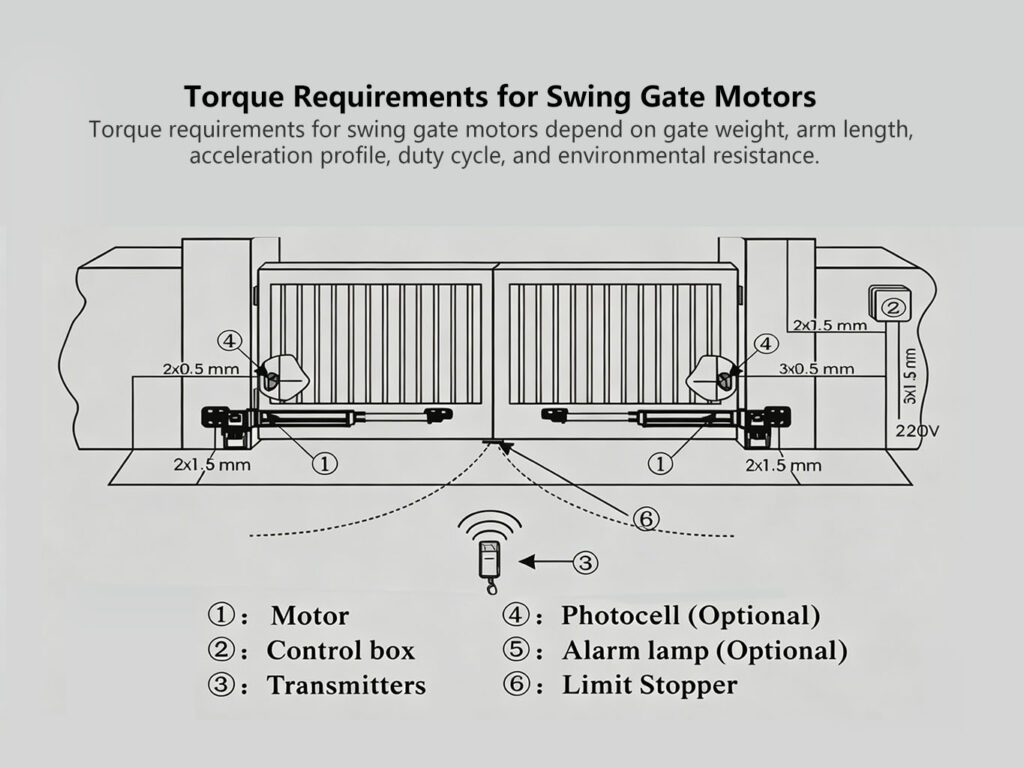
Torque Requirements for Swing Gate Motors
Coretan Pilihan:
Torque requirements for swing gate motors depend on gate weight, arm length, acceleration profile, kitaran tugas, and environmental resistance. In modern swing gate turnstile systems, engineers typically select motors based on peak torque rather than continuous torque because access control gates operate in repeated start-stop cycles. BLDC motors are commonly preferred for their high efficiency and low maintenance, while servo motors are used where precise positioning and dynamic control are required. Proper torque sizing improves reliability, reduces overheating, extends motor lifespan, and ensures stable operation in high-traffic environments.
What Are Torque Requirements for Swing Gate Motors?
Torque is the rotational force required to move the swing gate arm from closed position to open position within a specified time. In swing gate turnstiles, torque directly affects opening speed, user safety, anti-tailgating performance, and long-term mechanical reliability.
Unlike continuous rotary systems, swing gate motors operate under intermittent dynamic loads. Each opening cycle requires acceleration, steady-state movement, deceleration, and holding torque. This means the motor experiences repeated transient loads rather than constant operation. Engineers therefore focus heavily on peak torque capability and overload tolerance during motor selection.
Typical swing gate turnstile systems use low-speed geared motors with torque outputs ranging from 3 Nm to over 50 Nm depending on gate dimensions and application environment. Lightweight office access gates may only require 5–10 Nm, while wide-lane ADA or industrial security gates may require significantly higher torque.
Incorrect torque selection creates several operational problems:
- Gate stalling during opening
- Overheating under high traffic
- Reduced motor lifespan
- Mechanical vibration and noise
- Poor user experience
- Controller overload faults
For OEM manufacturers, torque sizing is therefore one of the most important engineering decisions in turnstile system development.
Why Torque Calculation Matters in Swing Gate Turnstiles
Many low-cost turnstile systems fail because engineers underestimate real-world torque demands. Laboratory conditions rarely reflect actual installation environments. Dust, temperature variation, bearing wear, user pushing force, and airflow resistance all increase motor load over time.
Torque calculation is essential because it affects nearly every aspect of system performance:
Opening and Closing Speed
Higher torque enables faster acceleration and smoother operation. In transportation hubs and metro stations, rapid gate response is necessary to maintain passenger flow efficiency.
Safety Performance
Insufficient torque can cause unstable motion or incomplete closing cycles. Excessive torque without proper control can create safety risks during pedestrian interaction.
Thermal Stability
Motors operating near maximum torque continuously generate excessive heat. Over time, this degrades winding insulation and shortens bearing life.
Long-Term Reliability
Proper torque margin reduces mechanical stress on gearboxes, shafts, gandingan, and hinges. This significantly improves lifecycle durability.
In high-duty applications, engineers commonly apply a safety factor of 1.5–2.0 when calculating required torque to account for unexpected loading conditions.
How to Calculate Swing Gate Motor Torque
The basic torque formula for swing gate systems is:
:contentReference[oaicite:0]{index=0}
di mana:
- T = Torque (Nm)
- F = Force applied (N)
- r = Distance from pivot point (m)
Namun begitu, real swing gate calculations are more complex because acceleration and inertia must also be considered.
Inertia Torque
During startup, the motor must overcome rotational inertia:
:contentReference[oaicite:1]{index=1}
di mana:
- J = Moment of inertia
- α = Angular acceleration
Practical Example
Consider a swing gate arm:
- Berat badan: 12 kg
- Arm length: 0.5 m
- Opening time: 0.8 saat
The required startup torque may exceed steady-state torque by 2–3 times. Oleh itu, engineers typically size the motor according to peak acceleration demand rather than nominal operating load.
This is why many modern turnstile systems use BLDC motors with high overload capability and precise electronic control.
BLDC vs Servo Motor Torque Performance
| Parameter | motor BLDC | Motor Servo |
|---|---|---|
| Peak Torque Capability | Tinggi | Sangat Tinggi |
| Ketumpatan tork | Excellent | Excellent |
| Control Precision | Good | Outstanding |
| kos | Lower | Higher |
| Kecekapan | 85–92% | 80–90% |
| Thermal Stability | Very Good | Good |
| Penyelenggaraan | rendah | rendah |
| Best Application | Commercial turnstiles | High-security precision systems |
BLDC motors are widely used because they provide strong torque density at relatively low cost. Servo motors offer better positioning accuracy and dynamic response but require more sophisticated control systems.
For most OEM turnstile manufacturers, BLDC motors provide the best balance between cost, kebolehpercayaan, and torque performance.
Efficiency and Torque Density in Swing Gate Motors
Why Efficiency Matters
Motor efficiency directly affects heat generation and energy consumption. High-efficiency motors reduce electrical losses and improve system stability in continuous operation environments.
BLDC motors are particularly advantageous because electronic commutation minimizes friction losses associated with traditional brushed systems.
Torque Density Advantages
Torque density refers to the amount of torque produced relative to motor size and weight. Compact turnstile cabinets require motors with high torque density because internal installation space is limited.
Modern 48V BLDC motors achieve excellent torque density using rare-earth permanent magnets and optimized stator design. This allows OEM manufacturers to reduce cabinet dimensions without sacrificing performance.
Thermal Performance and Heat Management
Thermal management is one of the most overlooked aspects of turnstile motor engineering.
High torque demand increases current draw, which generates heat inside the motor windings and controller. If thermal dissipation is inadequate, several problems occur:
- Reduced efficiency
- Controller thermal shutdown
- Demagnetization risk
- Bearing degradation
- Penuaan penebat
Cooling Methods
Most swing gate motors use passive air cooling because turnstile systems operate in enclosed spaces.
Important thermal optimization strategies include:
- Aluminum motor housing
- Efficient winding design
- Reduced current ripple
- Optimized controller PWM frequency
- Heat sink integration
High-efficiency BLDC motors generally outperform servo systems in thermal stability during long-duty operation.
Control System Requirements for High Torque Applications
Motor torque performance depends heavily on controller design.
BLDC Controller Systems
BLDC controllers regulate torque through current control and electronic commutation. Advanced Field-Oriented Control (FOC) algorithms provide smoother torque delivery and quieter operation.
FOC technology is increasingly common in premium swing gate systems because it reduces vibration and improves dynamic response.
Servo Drive Systems
Servo drives continuously monitor encoder feedback to maintain precise torque and position control. These systems provide excellent synchronization and adaptive load compensation.
Namun begitu, servo systems increase overall system complexity and cost.
For most commercial access control systems, BLDC motors with encoder feedback provide sufficient control performance at significantly lower cost.
How to Choose the Right Torque for Swing Gate Applications
Julat voltan
Typical swing gate systems use:
- 24V systems for compact indoor gates
- 48V systems for standard commercial applications
- 72V systems for heavy-duty industrial gates
Higher voltage reduces current demand and improves efficiency.
Julat Kuasa
Most swing gate motors operate between 50W and 300W depending on gate size and traffic intensity.
Speed and RPM
Typical output shaft speed ranges from 20–80 RPM after gearbox reduction.
Faster gate movement requires higher acceleration torque.
Keserasian Pengawal
OEM manufacturers should ensure compatibility between:
- Motor Hall sensors
- Encoders
- CAN communication
- Access control logic
- Safety sensors
Application Environment
Outdoor installations require additional torque margin due to wind load, temperature changes, and contamination.
CTA: Need help selecting the correct motor torque for your turnstile project? Visit /custom-motor/ to request an OEM engineering solution.
Common Torque Selection Mistakes
Undersized Motors
Low-cost systems often use undersized motors to reduce BOM cost. This causes overheating and premature failure.
Ignoring Duty Cycle
Peak torque capability alone is insufficient. Engineers must evaluate continuous operating load under real traffic conditions.
Insufficient Gearbox Design
Even with adequate motor torque, poor gearbox efficiency reduces usable output torque.
Lack of Safety Margin
Torque calculations should always include additional margin for aging, friction increase, and environmental resistance.
Applications of Swing Gate Motors
Swing gate motors are widely used across multiple industries.
Commercial Buildings
Office buildings require quiet operation, saiz padat, dan jangka hayat yang panjang.
Transportation Systems
Metro stations demand rapid response, high duty cycle capability, and exceptional reliability.
Industrial Facilities
Factories require robust motors capable of handling harsh environments and frequent operation.
Robotik dan Automasi
Some motion control technologies used in turnstiles overlap with robotic servo systems.
Future Trends in Swing Gate Motor Torque Technology
The future of swing gate motor systems is moving toward:
- Integrated motor-drive units
- Higher torque density
- AI-assisted predictive maintenance
- Low-noise FOC control
- Smart IoT diagnostics
BLDC motors will likely dominate future commercial systems due to efficiency and lower lifecycle cost.
Servo technology will continue to grow in premium security applications requiring precise motion control.
Soalan Lazim: Torque Requirements for Swing Gate Motors
1. What torque is needed for a swing gate motor?
Most swing gate turnstiles require between 3 Nm and 50 Nm depending on gate size, kelajuan, and traffic conditions. Heavy-duty industrial gates may require even higher torque outputs.
2. Why is peak torque important?
Peak torque is critical because swing gates experience high startup loads during acceleration. Motors must overcome inertia quickly to ensure smooth opening performance.
3. Are BLDC motors better for swing gates?
BLDC motors are commonly preferred because they offer high efficiency, strong torque density, penyelenggaraan yang rendah, and long lifespan at lower cost than servo systems.
4. How does RPM affect torque selection?
Higher RPM generally reduces available output torque unless gear reduction is used. Engineers must balance opening speed with required rotational force.
5. What voltage is best for swing gate motors?
48V systems are widely used because they provide good efficiency, moderate current levels, and excellent compatibility with modern controllers.
Kesimpulan
Torque requirements for swing gate motors are influenced by gate mass, acceleration profile, environmental resistance, control strategy, and operational duty cycle. Proper torque sizing improves reliability, thermal stability, and overall system performance.
For most commercial swing gate turnstiles, BLDC motors provide the best balance of efficiency, ketumpatan tork, lifespan, dan kos. Servo motors remain valuable for precision-controlled high-security systems where dynamic response is critical.
OEM manufacturers should prioritize accurate torque calculation, sufficient safety margin, and controller compatibility during motor selection.
CTA: Looking for a custom swing gate motor solution? Terokai kami /bldc-motor/ solutions or contact our engineers for a tailored OEM recommendation.
Rujukan
- https://www.motioncontroltips.com/what-is-torque-density-in-electric-motors/
- https://www.controleng.com/articles/understanding-servo-motor-sizing/
- https://ieeexplore.ieee.org/document/brushless-dc-motor-performance
- https://www.sciencedirect.com/topics/engineering/electric-motor-torque
- https://www.nema.org/standards/view/motors-and-generators