
Panduan Pembuatan Motor Pemotong Rumput Elektrik OEM
Jawapan Pantas: What Is OEM Electric Lawn Mower Motor Manufacturing?
OEM electric lawn mower motor manufacturing is the process of designing, kejuruteraan, ujian, and producing custom electric motors for lawn mower brands and equipment manufacturers. Unlike off-the-shelf motors, OEM motors are optimized for specific voltage systems, cutting performance targets, torque requirements, battery platforms, thermal conditions, and product cost objectives.
For modern electric and robotic lawn mowers, high-efficiency BLDC (DC tanpa berus) motors have become the preferred solution because they deliver higher efficiency, jangka hayat yang lebih lama, penyelenggaraan yang lebih rendah, better torque density, and improved battery runtime compared with brushed motors. Selecting the right OEM motor manufacturer directly impacts mower performance, kebolehpercayaan, production scalability, warranty costs, and long-term competitiveness.
This guide explains how lawn mower motors are designed, manufactured, disesuaikan, diuji, and sourced from an engineering and procurement perspective.
Why OEM Electric Lawn Mower Motors Matter
The global lawn care equipment industry is undergoing rapid electrification. Consumer demand for quieter operation, lower emissions, reduced maintenance, and battery-powered convenience is driving OEMs away from gasoline engines and toward electric drive systems.
In this transition, the motor becomes one of the most critical components inside the machine. While batteries receive significant attention, motor efficiency often determines actual runtime, cutting capability, thermal stability, and customer satisfaction.
Many mower manufacturers initially select standard catalog motors to reduce development costs. Namun begitu, standardized motors rarely achieve optimal performance because lawn mowers operate under highly variable loads.
Grass density changes continuously. Blade inertia varies by deck size. Ambient temperatures fluctuate significantly. Battery voltage drops during discharge cycles. These variables require motor designs tailored specifically for mower applications.
OEM motor development allows manufacturers to optimize:
- Power output
- Torque characteristics
- Efficiency maps
- Thermal management
- Waterproof protection
- Controller integration
- Noise reduction
- Battery compatibility
- Manufacturing cost
For large-volume lawn mower brands, a custom motor can improve overall system efficiency by 5%–15%, which directly translates into longer runtime and stronger market differentiation.
What Types of Motors Are Used in Electric Lawn Mowers?
Motor DC Berus
Brushed motors were widely used in early cordless lawn mowers due to their simple construction and low cost.
Kelebihan termasuk:
- Low controller complexity
- Simple manufacturing
- Low initial cost
Disadvantages include:
- Pakai berus
- Lower efficiency
- Higher maintenance requirements
- Increased heat generation
- Shorter lifespan
Hari ini, brushed motors primarily appear in entry-level residential products.
Motor DC tanpa berus (BLDC)
BLDC motors dominate modern lawn mower designs.
A BLDC motor uses electronic commutation instead of mechanical brushes. Electronic switching allows significantly higher efficiency and reliability.
Typical efficiency ranges from:
- Brushed motor: 70–80%
- motor BLDC: 85–95%
For battery-powered equipment, this efficiency difference can add substantial runtime improvements.
Hub Motors
Robotic lawn mowers often use hub motors integrated directly into drive wheels.
Kelebihan termasuk:
- Compact packaging
- Reduced mechanical losses
- Lower maintenance
- Simplified drivetrain architecture
Companies such as Greensky Power supply customized hub motor solutions for robotic lawn mower OEMs seeking integrated mobility systems.
BLDC Motors vs Brushed Motors vs Induction Motors
| Parameter | motor BLDC | Brushed Motor | Induksi motor |
|---|---|---|---|
| Kecekapan | 85–95% | 70–80% | 80–90% |
| Ketumpatan tork | Sangat Tinggi | Medium | Medium |
| Penyelenggaraan | Very Low | Tinggi | rendah |
| Noise | rendah | Medium | Medium |
| Battery Compatibility | Excellent | Good | Poor |
| Controller Complexity | Medium | rendah | Tinggi |
| Jangka hayat | Panjang | Short | Panjang |
| Robotic Mower Suitability | Excellent | Poor | Terhad |
From an engineering standpoint, BLDC motors provide the best balance of efficiency, power density, kebolehpercayaan, and battery utilization. This is why virtually every premium robotic mower manufacturer now relies on brushless motor platforms.
Key Engineering Requirements for Lawn Mower Motor Manufacturing
Designing a lawn mower motor differs significantly from designing motors for fans, pam, or industrial conveyors.
Lawn mower motors experience highly dynamic loads and harsh environmental conditions.
High Starting Torque
Grass-cutting applications require substantial startup torque to overcome blade inertia.
Motor designers must optimize:
- Magnet configuration
- Pole count
- Stator winding design
- Controller current limits
High Peak Load Capability
Dense or wet grass can temporarily increase load by several hundred percent.
The motor must withstand these overload conditions without demagnetization or thermal damage.
Water Resistance
Lawn mowers operate in:
- Rain
- Dew
- Wet grass
- Mud
- Dust
IP54, IP65, and IP67 protection ratings are commonly specified by OEM customers.
Thermal Stability
Extended mowing sessions can expose motors to prolonged high-current operation.
Thermal design directly affects:
- Kecekapan
- Jangka hayat
- Warranty claims
- Battery runtime
How OEM Lawn Mower Motors Are Designed
Step 1: Requirement Definition
The development process begins with customer specifications.
Typical inputs include:
- Battery voltage
- Cutting width
- Target runtime
- Peak torque
- Continuous power
- Noise limits
- Cost targets
Step 2: Electromagnetic Design
Engineers perform electromagnetic simulations to optimize:
- Magnetic flux density
- Copper fill factor
- Back EMF characteristics
- Tork riak
- Efficiency curves
Step 3: Mechanical Design
Mechanical engineers develop:
- Housing structures
- Shaft systems
- Bearing arrangements
- Waterproof sealing
- Cooling structures
Step 4: Prototype Validation
Prototype testing validates:
- Kecekapan
- Temperature rise
- Noise
- Vibration
- Ketahanan
Step 5: Mass Production Release
After testing and customer approval, production tooling and quality-control systems are finalized for mass manufacturing.
Efficiency and Torque Density: The Core Competitive Advantages
Efficiency and torque density are the two most important metrics for modern lawn mower motors.
Kecekapan
Higher efficiency means more battery energy reaches the blade instead of becoming heat.
Sebagai contoh:
- 85% efficiency motor
- 92% efficiency motor
The 92% design can significantly extend mowing time using the same battery pack.
This advantage becomes increasingly important in robotic lawn mowers operating for multiple hours per day.
Ketumpatan tork
Torque density measures torque output relative to motor size and weight.
Higher torque density allows:
- Smaller motor packages
- Lighter equipment
- Improved maneuverability
- Reduced material cost
Premium OEM suppliers invest heavily in magnetic optimization and advanced motor topologies to maximize torque density.
Thermal Management and Cooling Design
Heat is the primary enemy of electric motor reliability.
Excessive temperature accelerates:
- Magnet degradation
- Penuaan penebat
- Bearing wear
- Controller failures
OEM manufacturers therefore devote significant engineering effort to thermal management.
Common cooling strategies include:
- Penyejukan udara semulajadi
- Forced airflow cooling
- Aluminum housing heat dissipation
- Integrated cooling fins
- Thermally conductive potting compounds
Advanced thermal simulation software allows engineers to predict hot spots before physical prototypes are built.
How to Choose an OEM Lawn Mower Motor Supplier
Selecting the right OEM electric lawn mower motor supplier is often more important than selecting the motor itself. A capable supplier contributes not only manufacturing capacity but also engineering expertise, design optimization, testing resources, and long-term production stability.
Many lawn mower brands encounter challenges after commercialization because their supplier cannot maintain consistent quality, support engineering modifications, or scale production as demand increases.
Evaluate Engineering Capabilities
A qualified motor supplier should offer:
- Electromagnetic simulation capability
- Thermal analysis expertise
- Mechanical design support
- Controller matching assistance
- Prototype development services
Engineering support becomes especially important when optimizing robotic lawn mowers, where motor efficiency directly affects battery runtime and navigation performance.
Assess Manufacturing Capacity
Production scalability should be evaluated carefully.
Questions buyers should ask include:
- What is the monthly production capacity?
- How many automated winding lines are available?
- What percentage of processes are automated?
- Can production expand during peak season?
- What is the typical lead time?
Review Quality Systems
Reliable suppliers typically maintain:
- ISO 9001 pensijilan
- Incoming material inspection systems
- Automated end-of-line testing
- Traceability systems
- Statistical process control
Untuk pelanggan OEM, quality consistency is more valuable than achieving the absolute lowest unit cost.
How to Choose the Right Motor for Electric Lawn Mower Applications
Motor selection should begin with application requirements rather than motor specifications alone.
Voltage Range Selection
Battery voltage directly influences current, kecekapan, controller size, and wiring requirements.
| voltan | Typical Application | Kelebihan |
|---|---|---|
| 24V | Compact residential mowers | Low cost |
| 36V | Mid-size cordless mowers | Balanced performance |
| 48V | Professional walk-behind mowers | Excellent efficiency |
| 60V | Commercial-grade equipment | Higher power output |
| 72V | Large robotic and riding mowers | Lower current losses |
For most OEM lawn mower programs, 48V has become the industry sweet spot because it balances safety, kecekapan, cost, and controller complexity.
Power Range Selection
| Mower Type | Typical Motor Power |
|---|---|
| Small Residential | 500W–1000W |
| Walk-Behind Mower | 1000W–2500W |
| Professional Mower | 2500W–5000W |
| Robotic Lawn Mower | 200W–1500W |
| Riding Mower | 5kW–20kW+ |
Keperluan Kelajuan dan Tork
Blade cutting quality depends heavily on blade tip speed.
Most electric mower blade motors operate between:
- 2500 RPM
- 4500 RPM
Drive motors for robotic mowers typically prioritize torque over speed because terrain climbing capability is more important than rotational speed.
Kaedah Penyejukan
Common cooling options include:
- Natural convection
- Forced-air cooling
- Integrated fan cooling
- Aluminum heat-sink housing
Commercial applications often require more advanced cooling solutions due to extended operating periods.
Keserasian Pengawal
Motor performance depends heavily on controller integration.
Important considerations include:
- Hall sensor compatibility
- Sensorless control support
- Field-oriented control (FOC)
- CAN communication
- Battery management integration
The best OEM suppliers provide complete motor-controller matching support rather than supplying motors as standalone components.
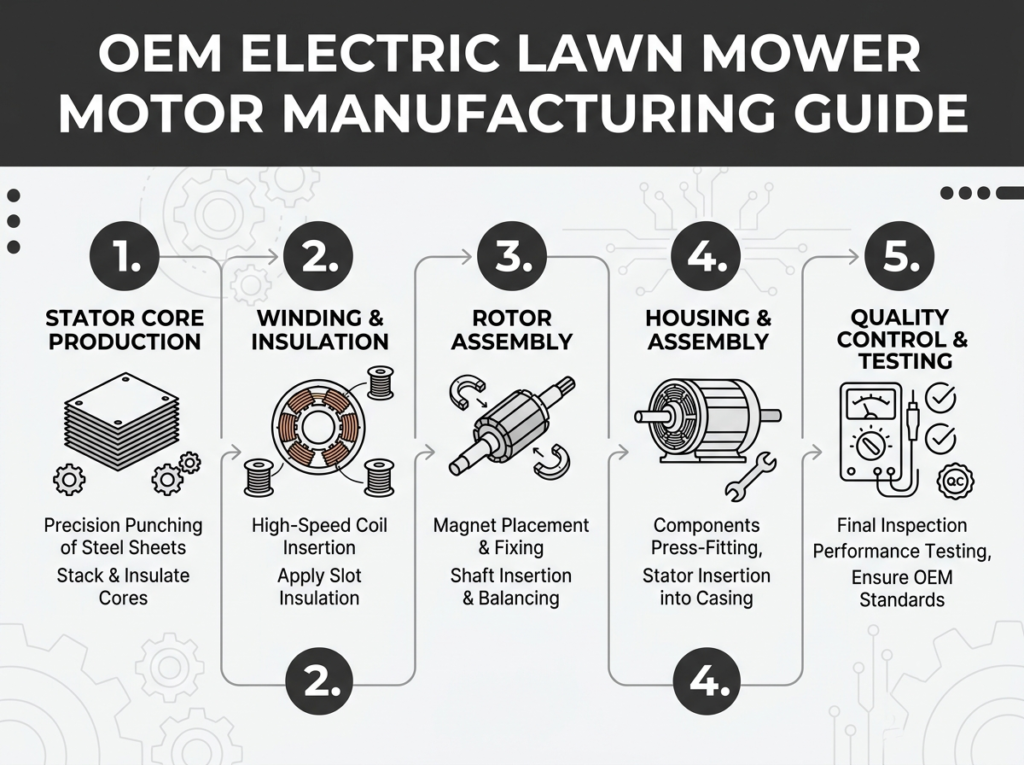
OEM Motor Manufacturing Process Explained
Understanding how motors are manufactured helps procurement teams evaluate supplier capability and quality consistency.
Raw Material Selection
Motor performance begins with material quality.
Critical materials include:
- Electrical steel laminations
- Rare-earth magnets
- Copper winding wire
- Bearings
- Aluminum housings
Material selection directly affects efficiency, ketahanan, and production cost.
Stator Manufacturing
The stator is the heart of the motor.
Modern factories use automated winding machines to ensure:
- Consistent winding quality
- High copper fill rates
- Reduced labor variability
Rotor Assembly
Rotor manufacturing requires precise magnet placement and balancing.
Imbalance can create:
- Noise
- Vibration
- Bearing wear
- Reduced lifespan
Motor Assembly
Assembly processes include:
- Bearing installation
- Rotor insertion
- Housing assembly
- Seal installation
- Electrical connection
Testing and Validation
Every production motor should undergo functional testing before shipment.
Typical tests include:
- Arus tanpa beban
- Insulation resistance
- High-voltage withstand testing
- Speed verification
- Noise inspection
Quality Control Standards for Lawn Mower Motor Manufacturing
The reliability expectations of lawn mower consumers continue to increase. Manufacturers can no longer rely on basic electrical testing alone.
Leading OEM motor suppliers implement comprehensive validation programs.
Performance Testing
- Efficiency mapping
- Torque testing
- Power verification
- Current analysis
Environmental Testing
- Temperature cycling
- Humidity testing
- Salt spray testing
- Waterproof validation
- Dust ingress testing
Durability Testing
- Life-cycle testing
- Bearing endurance testing
- Continuous load testing
- Shock testing
- Vibration testing
For robotic lawn mower applications, durability testing often exceeds 2,000–5,000 operating hours before production approval.
OEM vs ODM vs Off-the-Shelf Lawn Mower Motors
| Factor | OEM | ODM | Standard Catalog Motor |
|---|---|---|---|
| Penyesuaian | Highest | Sederhana | rendah |
| Performance Optimization | Excellent | Good | Terhad |
| Development Cost | Higher | Medium | Lowest |
| Brand Differentiation | Excellent | Sederhana | Minimal |
| Time to Market | Longer | Medium | Fastest |
| Unit Cost at Scale | Lowest | Medium | Higher |
For manufacturers producing tens of thousands of units annually, OEM motor development typically delivers the best long-term return on investment.
Applications of OEM Lawn Mower Motors
Motor technologies developed for lawn mower applications often extend into other industries.
Robotic Lawn Mowers
Robotic mowers require:
- Drive motors
- Blade motors
- Navigation actuators
High-efficiency BLDC motors help maximize autonomous operating time.
Commercial Turf Equipment
Professional landscaping equipment increasingly adopts:
- 48V systems
- 60V systems
- 72V systems
These platforms demand robust industrial-grade motor solutions.
Aplikasi Perindustrian
Many lawn mower motor technologies are transferable to:
- Industrial cleaning machines
- Agricultural equipment
- Autonomous robots
- Material handling systems
Electric Vehicle Systems
The same BLDC technologies used in mower drive systems are widely used in light electric vehicles and mobility platforms.
Future Trends in Electric Lawn Mower Motor Manufacturing
Several industry trends are reshaping OEM motor development.
Higher Voltage Platforms
Manufacturers are gradually moving toward:
- 60V systems
- 72V systems
- 96V systems
Higher voltage reduces current and improves system efficiency.
Kawalan Berorientasikan Medan (FOC)
FOC technology is becoming standard because it offers:
- Smoother operation
- Lower noise
- Kecekapan yang lebih tinggi
- Improved torque control
Smart Connected Motors
Future motors increasingly incorporate:
- CAN communication
- Diagnostic monitoring
- Predictive maintenance capabilities
- Cloud-based analytics
Integrated Drive Systems
Rather than supplying motors alone, OEM suppliers increasingly provide:
- Motor + controller packages
- Motor + gearbox assemblies
- Hub motor systems
- Complete drive modules
This integration simplifies development and reduces engineering risk for mower manufacturers.
B2B Buyer Decision Framework: How to Evaluate an OEM Lawn Mower Motor Partner
Many procurement teams focus primarily on unit price when selecting a motor supplier. Namun begitu, experienced OEM manufacturers understand that the lowest purchase price rarely results in the lowest total ownership cost.
A motor supplier should be evaluated across five critical dimensions:
- Engineering Capability – Ability to customize motors and solve application-specific challenges.
- Quality Consistency – Stable production processes that minimize field failures.
- Manufacturing Scalability – Capacity to support future growth.
- Supply Chain Stability – Reliable sourcing of magnets, galas, laminations, and electronic components.
- Sokongan Teknikal – Fast response to design modifications and field issues.
A supplier capable of improving motor efficiency by only 3–5% may generate significantly greater value than a supplier offering a slightly lower purchase price. Increased efficiency can reduce battery costs, improve runtime, strengthen customer satisfaction, and lower warranty claims.
For robotic lawn mower manufacturers, where battery cost represents a substantial portion of total machine cost, motor efficiency improvements often create measurable competitive advantages.
OEM RFQ Checklist for Lawn Mower Motor Projects
To receive accurate quotations and engineering recommendations, OEM customers should provide detailed project information during the RFQ stage.
The following checklist can significantly accelerate development:
| Parameter | Required Information |
|---|---|
| Application Type | Walk-behind mower, robotic mower, riding mower, commercial mower |
| Battery Voltage | 24V, 36V, 48V, 60V, 72V, dan lain-lain. |
| Kuasa Dinilai | Continuous operating power |
| Peak Power | Maximum temporary load |
| Kelajuan Dinilai | Required RPM range |
| Peak Torque | Startup and overload requirements |
| Kitaran Tugas | Continuous or intermittent operation |
| Tahap Perlindungan | IP54, IP65, IP67, dan lain-lain. |
| Controller Type | Sensor dewan, sensorless, FOC |
| Annual Volume | Expected production quantity |
| Certification Requirements | UL, CE, RoHS, REACH |
Providing these parameters early reduces engineering iterations and helps suppliers recommend the most cost-effective motor architecture.
Why High-Efficiency Motors Create Long-Term Cost Savings
Many buyers initially focus on motor purchase price without considering lifetime system economics.
In battery-powered lawn equipment, efficiency directly influences:
- Battery size requirements
- Runtime performance
- Penjanaan haba
- Cooling requirements
- Component lifespan
- Warranty exposure
Sebagai contoh, a motor operating at 92% efficiency instead of 85% efficiency wastes significantly less energy as heat.
The benefits include:
- Longer mowing time
- Smaller battery packs
- Reduced charging frequency
- Improved user experience
- Lower operating temperature
This is one reason premium robotic mower manufacturers prioritize motor efficiency during product development.
The long-term savings often exceed the initial motor cost difference.
Why Greensky Power Is a Strategic OEM Motor Partner
For lawn mower manufacturers seeking customized electric drive solutions, supplier selection should extend beyond component sourcing.
Greensky Power focuses on providing engineering-driven motor solutions that support both product performance and manufacturing scalability.
Key capabilities include:
- Custom BLDC motor development
- 48V lawn mower motor solutions
- 72V high-power motor platforms
- Robotic lawn mower drive motors
- Hub motor systems
- Integrated motor and controller solutions
- Waterproof motor designs
- OEM and ODM manufacturing support
Engineering teams can support:
- Motor sizing
- Torque optimization
- Efficiency improvement
- Thermal management design
- Controller matching
- Prototype validation
For brands developing next-generation robotic or commercial lawn mowers, early engineering collaboration often reduces development cycles while improving final product performance.
Frequently Asked Questions (Soalan Lazim)
What motor is best for an electric lawn mower?
For most modern electric lawn mowers, BLDC motors are the preferred choice. They offer higher efficiency, greater torque density, lower maintenance requirements, and significantly longer service life than brushed motors. Brushless motors also improve battery runtime, making them ideal for cordless and robotic lawn mower applications.
Why do robotic lawn mowers use BLDC motors?
Robotic lawn mowers require efficient and reliable operation over extended periods. BLDC motors provide excellent energy efficiency, precise speed control, tahap bunyi yang rendah, and long operational life. Their maintenance-free design makes them particularly suitable for autonomous equipment operating daily.
What voltage is best for a lawn mower motor?
The optimal voltage depends on mower size and power requirements. Residential walk-behind mowers commonly use 36V or 48V systems. Commercial and robotic lawn mowers increasingly use 48V, 60V, or 72V platforms because higher voltage reduces current and improves overall efficiency.
How long does a BLDC lawn mower motor last?
A properly designed BLDC motor can often exceed 10,000 operating hours. Actual lifespan depends on thermal management, operating environment, waterproof protection, bearing quality, and controller performance. High-quality OEM motors typically provide many years of maintenance-free service.
What IP rating should a lawn mower motor have?
Most lawn mower applications require at least IP54 protection. Premium robotic lawn mowers often specify IP65 or IP67 protection to withstand rain, moisture, grass debris, habuk, and outdoor operating conditions.
What is the difference between Hall sensor and sensorless motors?
Hall sensor motors use position sensors to provide precise rotor location information, improving low-speed performance and startup torque. Sensorless motors eliminate sensors, reducing cost and complexity. The best choice depends on application requirements and controller design.
Can one motor platform support multiple mower models?
ya. Many OEM manufacturers develop modular motor platforms that support multiple mower models. By adjusting controller programming, nisbah gear, and winding configurations, a single motor architecture can often cover several product categories.
How important is motor efficiency in robotic lawn mowers?
Motor efficiency directly impacts battery runtime and energy consumption. Even small efficiency improvements can significantly increase operating time and reduce battery requirements, making efficiency one of the most important design parameters in robotic mower development.
What certifications are commonly required for OEM lawn mower motors?
Requirements vary by market but often include CE, UL, RoHS, and REACH compliance. Manufacturers should also verify environmental testing, safety standards, and customer-specific quality requirements before production launch.
Should OEM brands choose custom motors or catalog motors?
For low-volume projects, standard motors may be sufficient. Namun begitu, medium- and high-volume manufacturers usually benefit from custom motor development because OEM designs improve efficiency, reduce system cost, optimize packaging, and create stronger product differentiation.
Kesimpulan
The electric lawn mower industry continues to evolve rapidly as manufacturers pursue higher efficiency, lower emissions, reduced noise, and improved user experiences. At the center of this transformation is the motor.
A well-designed OEM lawn mower motor affects every critical performance metric, including cutting power, runtime, kebolehpercayaan, thermal stability, ketahanan, and production cost.
For engineers and procurement teams, successful motor sourcing requires evaluating far more than unit price. Engineering capability, manufacturing quality, scalability, testing resources, and long-term technical support are equally important factors.
As battery-powered and robotic mowing platforms continue gaining market share, partnerships with experienced OEM motor manufacturers become increasingly valuable.
If you are developing a new lawn mower platform or upgrading an existing product line, consider working with a supplier that can provide complete engineering support—from concept design and prototype validation to mass production and continuous optimization.
Request Datasheet | Get OEM Solution | Hubungi Jurutera Kami
Rujukan
- https://www.ieee.org
- https://www.nema.org
- https://www.energy.gov
- https://www.motorbenchmarking.org
- https://www.ul.com
- https://www.iec.ch
- https://www.boschrexroth.com
- https://www.maxongroup.com
- https://www.kollmorgen.com
- https://www.mitsubishielectric.com
- https://www.yaskawa.com
- https://www.automationdirect.com
- https://www.mdpi.com
- https://www.sciencedirect.com
- https://www.researchgate.net