
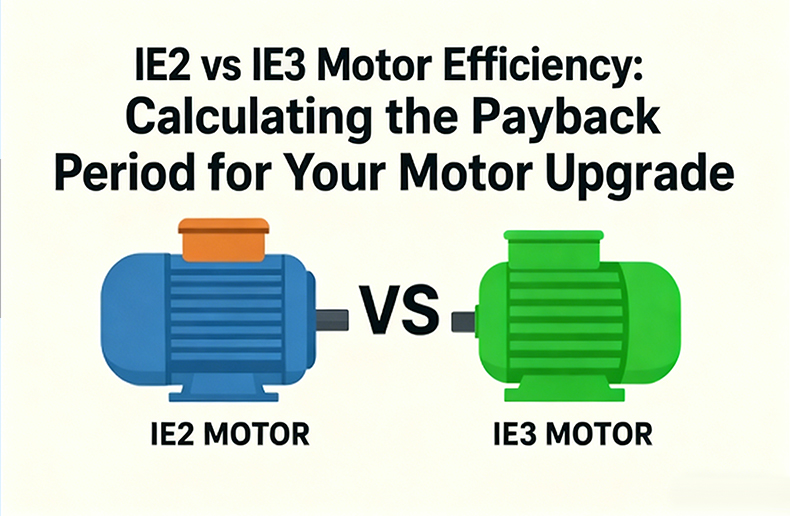
IE2 VS IE3 Motor Efficiency: Calculating the Payback Period for Your Motor Upgrade
In an era of rising energy costs and stringent environmental regulations, industrial motor efficiency has become a critical factor in operational planning. The transition from IE2 (Standard Efficiency) to IE3 (Kecekapan Tinggi) motors represents not just a technical upgrade, but a strategic financial decision. For facility managers, plant engineers, and financial controllers, understanding the true cost of motor ownership—encompassing purchase price, energy consumption, and maintenance—is essential for sustainable operations. This article provides a comprehensive framework for comparing IE2 and IE3 motors, detailing how to calculate the payback period with precision. By moving beyond initial purchase price to analyze long-term savings, businesses can make informed decisions that enhance profitability and reduce their carbon footprint.

Understanding the IE Classification System
The International Efficiency (IE) classification, established by the International Electrotechnical Commission (IEC), provides a global standard for comparing the energy performance of electric motors. This system ranges from IE1 (Standard Efficiency) to IE4 (Super Premium Efficiency). For many industrial applications, the most relevant comparison lies between IE2 and IE3.
An IE3 motor achieves higher efficiency by incorporating design improvements such as higher-quality magnetic steel, optimized rotor and stator geometries, and reduced fan losses. These enhancements result in lower energy losses converted into waste heat. For a typical 15 kW motor running continuously, an IE3 model can be 1-2% more efficient than its IE2 counterpart. While this percentage may seem small, it translates into substantial kilowatt-hour (kWh) savings over the motor’s operational lifespan, which often exceeds 20,000 Jam.
Perbezaan Utama: IE2 vs. IE3 at a Glance
The primary distinction is the reduction in energy losses. At full load, an IE3 motor can have up to 20% lower losses compared to an IE2 motor. This improvement is most pronounced at partial loads, a common scenario in real-world applications like pumping and fan systems where motors rarely operate at 100% capacity.
It is a common misconception that IE3 motors are significantly larger or heavier. While they may have a slightly larger frame size or use more copper, modern manufacturing techniques have minimized these differences. Tambahan pula, the potential for reduced cooling requirements can sometimes allow for a more compact design. Another critical point is compatibility; IE3 motors are fully compatible with existing Variable Frequency Drives (VFD), making them an ideal choice for applications requiring kawalan kelajuan.
The Financial Imperative: Calculating the True Cost of Ownership
The total cost of ownership (Tco) for an industrial motor is dominated by energy expenses, which can account for over 95% of the TCO over a 10-year period. The initial purchase price is merely a fraction of the total financial outlay. Oleh itu, the decision to upgrade must be based on a rigorous financial analysis rather than a simple comparison of invoice prices.
Step-by-Step Guide to Calculating Payback Period
The payback period is the time required for the cumulative energy savings to equal the additional investment cost of the more efficient motor. Here is a detailed methodology:
1. Determine Annual Energy Savings
Pertama, calculate the annual energy cost savings using the formula:
Annual Savings (Dolar Amerika) = Kuasa (kW) × Operating Hours/Year × Electricity Cost (USD/kWh) × (η_IE3 – η_IE2) / η_IE2
di mana:
- Kuasa (kW): Motor’s rated output power.
- Operating Hours/Year: Annual runtime (cth., 8,000 hours for a three-shift operation).
- Electricity Cost (USD/kWh): Your local industrial electricity rate.
- η_IE3 & η_IE2: Full-load efficiency values of the respective motors (expressed as a decimal, cth., 93% = 0.93).
Contoh Pengiraan:
Consider a 22 kW water pump motor.
- IE2 Efficiency:, 92.1% (0.921)
- IE3 Efficiency:, 93.8% (0.938)
- Operating Hours:, 6,000 hours/year
- Electricity Cost:, $0.12 per kWh
Annual Savings = 22 kW × 6,000 hrs × $0.12 × (0.938 – 0.921) / 0.938
Annual Savings ≈ $287 per year
2. Calculate the Net Investment Cost
The net investment is the price difference between the IE3 and IE2 motors, minus any available government rebates or incentives for energy-efficient equipment.
Net Investment Cost = Price_IE3 – Price_IE2 – Rebates
3. Compute the Simple Payback Period
The simple payback period is the most straightforward metric:
Simple Payback Period (Years) = Net Investment Cost / Annual Savings
Continuing the example:
If the IE3 motor costs 50 utility rebate, the net investment is $150.
Payback Period = 287 ≈ 0.52 tahun (approx. 6 bulan)
This remarkably short payback period demonstrates a rapid return on investment.
Case Study: Demonstrating Tangible ROI
A municipal water treatment plant was operating forty 30 kW IE2 motors on its aeration blowers. Facing rising energy bills, the plant management conducted a feasibility study for an upgrade to IE3 motors.
- Initial Assessment: Each IE3 motor had a price premium of 0.11/kWh, the annual savings per motor were calculated at $520.
- Financial Analysis: The simple payback period was calculated at approximately 9 bulan. The plant management approved a phased upgrade, replacing ten motors per year.
- Outcome: After the first year, the ten upgraded motors delivered over $5,000 in verified energy savings, aligning closely with projections. The success of the initial phase justified accelerating the remaining upgrades. The project not only reduced operational costs but also decreased the cooling load on the facility, contributing to additional energy savings.
Factors Influencing Your Payback Period
Several variables can significantly impact your calculation:
- Operating Profile: Motors running 24/7 will have a much shorter payback period than those used intermittently.
- Load Factor: Motors operating at 75-100% load will maximize efficiency gains. The payback period is longest for very lightly loaded motors.
- Local Electricity Tariffs: Higher electricity costs shorten the payback period.
- Maintenance Costs: While not always quantified, higher efficiency motors often run cooler, potentially extending bearing and insulation life and reducing maintenance expenses.
Why Choose Greensky’s IE3 Motors?
Di Greensky, we engineer our IE3 motors not just for compliance, but for performance and durability. Our motors are designed to deliver the promised efficiency gains reliably over their entire service life. Key advantages include:
- Certified Performance: Our motors are tested and certified to meet IE3 standards, ensuring you achieve the calculated savings.
- Robust Design: Built with high-quality materials and superior thermal management to withstand demanding industrial environments.
- Full Technical Support: Our engineering team can assist you in performing a detailed payback analysis tailored to your specific application and operational data.
Upgrading to a more efficient motor is one of the most effective investments an industrial operation can make. The combination of lower energy costs, reduced environmental impact, and potential maintenance benefits creates a compelling business case.
Take the Next Step Towards Efficiency
Ready to calculate your specific savings? Visit our High-Efficiency Motor Product Pageto explore our range of IE3 motors. For a personalized payback analysis, contact our technical team with your motor specifications and operational data. We are committed to helping you optimize your energy usage and improve your bottom line.
Rujukan
- “International Standard IEC 60034-30-1: Rotating electrical machines – Bahagian 30-1: Efficiency classes of line operated AC motors,” Suruhanjaya Elektroteknik Antarabangsa, IEC Webstore.
- “Energy Efficiency Policy Opportunities for Electric Motor-Driven Systems,” International Energy Agency, IEA Publications.
- “Determining Electric Motor Load and Efficiency,” U.S. Department of Energy, Office of Industrial Technologies, DOE Guidelines.
- “Motor Systems Efficiency Supply Curve,” American Council for an Energy-Efficient Economy.