
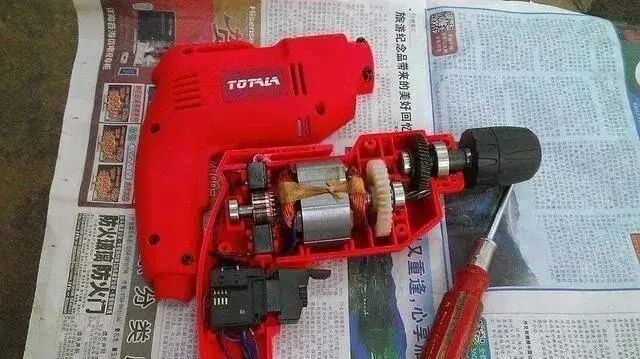
Why Do Power Tools Generally Use Brushed Motors?
What “브러시 모터” Means in a Power Tool
When an engineer says a power tool “uses a brushed motor,” they almost always mean a 범용 모터 — a series-wound DC motor that, thanks to its commutator and carbon brushes, also runs on single-phase AC. (Cordless tools sometimes use a permanent-magnet DC, PMDC, 모터, which is also brushed.) The brushes are spring-loaded carbon blocks that press on a spinning copper 정류기, reversing current in each armature coil so torque always acts in one direction.
The alternative is a 브러시리스 DC (BLDC) 모터, where the commutator is replaced by an electronic controller and fixed stator coils. No brushes means no sparking, no brush wear — but it means a circuit board, 센서, and firmware that a brushed tool simply does not have.

DC 브러시 모터 원리
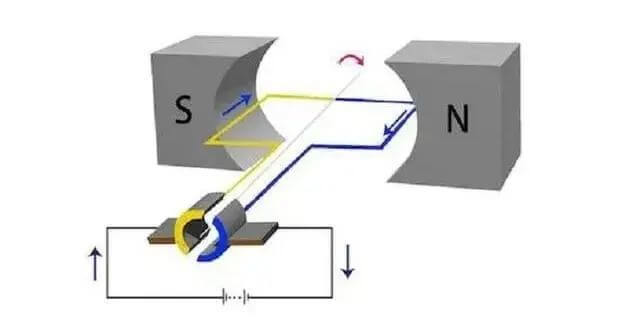
그림과 같이 1, 이것은 DC 브러시 모터 구조 모델입니다.. 고정 이방성 자석 2개, 코일 중앙에 위치, 코일의 끝은 두 개의 반원형 구리 링에 연결되었습니다., 구리 링 끝 및 고정 카본 브러시 접점, 그런 다음 카본 브러시 끝 부분에 DC 전원 공급 장치에 연결되었습니다..
수치 1
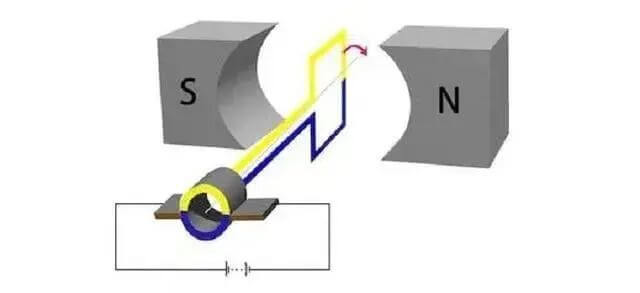
전원을 연결한 후, 전류는 그림의 화살표로 표시된 것과 같습니다. 1. 왼손 법칙에 따르면, 노란색 코일은 수직 상향 전자기력을 받습니다.; 파란색 코일은 수직 하향 전자기력을 받습니다.. 모터 로터가 시계 방향으로 회전하기 시작합니다. 90 회전 각도, 그림과 같이 2.
수치 2
이때, 카본 브러시는 두 개의 구리 링 사이의 틈 중앙에 있습니다., 전체 코일 회로에 전류가 없습니다. 그러나 관성의 작용으로, 로터는 여전히 계속 회전하고 있습니다..
수치 3
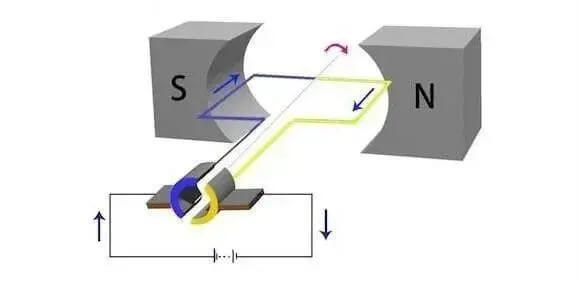
관성이 작용하여 로터가 위의 위치로 회전할 때, 코일 전류는 그림에 나와 있습니다. 3. 왼손 법칙에 따르면, 파란색 코일은 수직 상향 전자기력을 받습니다.; 노란색 코일은 수직 하향 전자기력을 받습니다.. 모터 로터는 시계 방향으로 계속 회전합니다., ~ 후에 90 도, 그림과 같이 4: 이 시간에, 카본 브러시는 두 개의 구리 링 사이의 중간 간격에 있습니다., 전체 코일 회로에 전류가 없습니다. 그러나 관성의 작용으로, 로터는 여전히 계속 회전하고 있습니다.. 그런 다음 위의 단계를 반복합니다., 그리고 그 사이클은 계속된다.
브러시리스 DC 모터
그림과 같이 5, 이것은 DC 브러시리스 모터 구조의 모델 다이어그램입니다.. 고정자와 회전자로 구성되어 있다., 회전자에 한 쌍의 자극이 있는 경우; 고정자는 많은 코일 세트로 감겨 있습니다., 여섯 세트의 코일이 다이어그램에 표시됩니다..
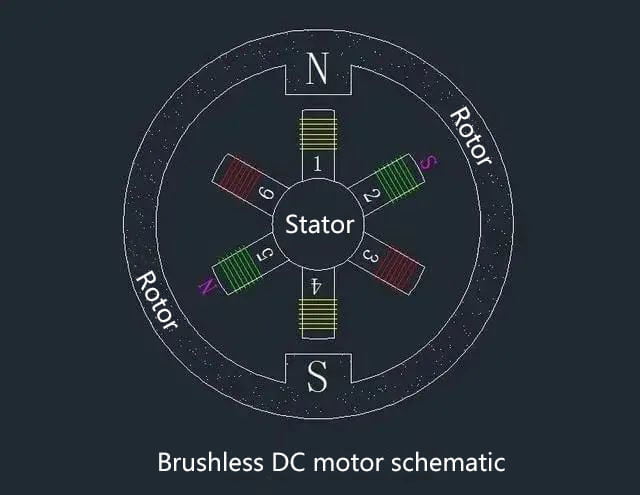
수치 5
고정자 코일에 전류를 흘릴 때 2 그리고 5, 코일 2 그리고 5 자기장을 발생시키게 된다, 고정자는 막대 자석과 같습니다., 어디 2 S는요 (남쪽) 극과 5 그렇다면 (북쪽) 폴. 동성극끼리 서로 끌어당기니까, 로터 N극이 코일로 회전합니다. 2 위치에 있으면 로터 S극이 코일로 회전합니다. 5 위치, 수치 6.
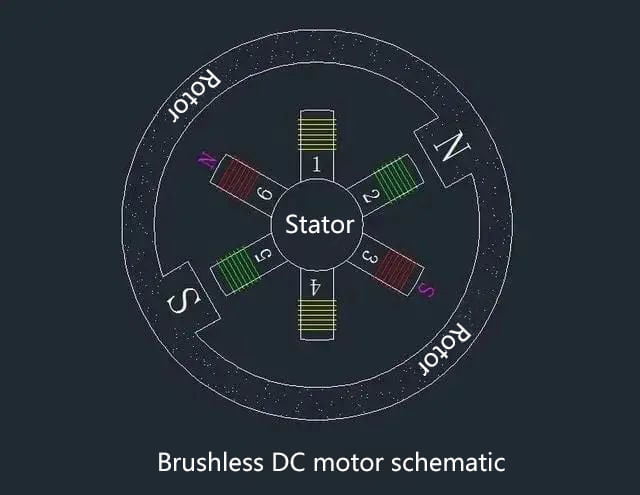
수치 6
그런 다음 고정자 코일에서 전류를 인출합니다. 2 그리고 5 고정자 코일에 전류를 전달합니다. 3 그리고 6. 이때, 코일 3 그리고 6 자기장을 발생시키게 된다, 고정자는 막대 자석과 같습니다., 어디 3 S는요 (남쪽) 극과 6 그렇다면 (북쪽) 폴. 동성 자극은 서로 끌어당기기 때문에, 로터 N극이 코일로 회전합니다. 3 위치에 있으면 로터 S극이 코일로 회전합니다. 6 위치, 수치 7.
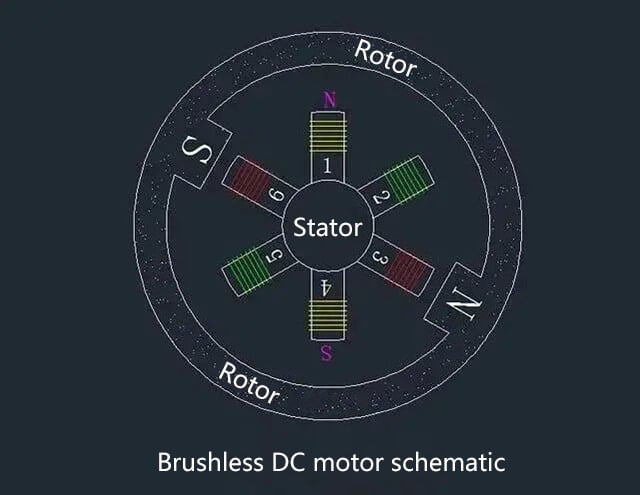
수치 7
비슷하게, 그런 다음 고정자 코일에서 전류를 제거하십시오. 3 그리고 6, 그런 다음 고정자 코일에 전류를 전달합니다. 4 그리고 1. 이때, 코일 4 그리고 1 자기장을 발생시키게 된다, 고정자는 막대 자석과 같습니다., 어디 4 S는요 (남쪽) 극과 1 그렇다면 (북쪽) 폴. 반대극끼리 서로 끌어당기므로, 로터 N극이 코일로 회전합니다. 4 위치에 있으면 로터 S극이 코일로 회전합니다. 1 위치. 까지
여기까지, 모터가 반 바퀴 회전했습니다 …. 후반 턴은 이전 원리와 동일합니다., 그러니 여기서는 반복하지 않겠습니다. 당나귀 앞에서 당근을 낚는 것처럼 DC 브러시리스 모터를 간단히 이해하면 됩니다., 당나귀가 당근을 향해 계속 움직일 수 있도록.

그렇다면 서로 다른 순간에 서로 다른 코일에 정확한 전류를 어떻게 전달할 수 있습니까?? 이를 위해서는 전류 정류 회로가 필요합니다. …… 여기서는 자세히 다루지 않겠습니다.
브러시 DC 모터와 브러시리스 DC 모터의 장점과 단점 비교
DC 브러시 모터: 빠른 시작, 적시에 제동, 부드러운 속도 조절, 간단한 제어, 간단한 구조, 값이 싼. 가격이 저렴하다는 게 포인트! 가격이 저렴해요! 가격이 저렴해요! 그리고 시동 전류가 높습니다., 높은 토크 (회전력) 저속으로, 그리고 매우 무거운 짐을 운반할 수 있습니다.
하지만, 카본브러시와 정류자 사이의 마찰로 인해, DC 브러시 모터는 스파크를 발생시키기 쉽습니다., 열, 소음, 외부 환경에 대한 전자기 간섭, 효율이 낮고 수명이 짧습니다.. 카본 브러쉬는 마모가 심한 제품이기 때문에, 실패하기 쉽다, 일정 기간이 지나면 교체해야 합니다..

DC 브러시리스 모터: DC 브러시리스 모터는 카본 브러시를 제거하기 때문에, 그래서 소음도 적고, 유지 보수 없음, 낮은 실패율, 긴 수명, 작동 시간과 전압이 더 안정적입니다., 무선 장비 간섭이 작도록. 하지만 비싸다! 값비싼! 값비싼!
전동공구는 생활 속에서 흔히 볼 수 있는 도구입니다., 브랜드도 다양하고 경쟁도 치열해요, 그래서 사람들은 가격에 매우 민감하다.. 그리고 매우 무거운 짐을 운반해야 하는 전동 공구, 시동 토크가 커야 합니다., 핸드 드릴과 같은, 임팩트 드릴. 그렇지 않으면, 드릴링할 때, 드릴 비트가 걸려서 모터가 쉽게 작동하지 않을 수 있습니다..

저렴한 가격의 브러시 DC 모터를 상상해보세요, 높은 시동 토크와 무거운 하중을 견딜 수 있음; 브러시리스 모터는 고장률이 낮고 수명이 길다, 하지만 가격이 비싸고 시동 토크가 브러시 모터보다 훨씬 적습니다.. 당신이 선택하는 경우, 당신은 어떻게 선택하시겠습니까?, 나는 대답이 자명하다고 생각한다..
Brushed vs Brushless — The Core Difference
| 측면 | 솔질된 (만능인 / PMDC) | 무브러시 (BLDC) |
|---|---|---|
| 정류 | Mechanical — brushes + 정류기 | Electronic — controller + 홀 센서 |
| Control electronics | 없음 (스위치 + triac for AC speed) | Required driver PCB + 펌웨어 |
| 시작 토크 | 매우 높음 (stall current = V/Rₐ) | 높은, but limited by controller current cap |
| Power source | AC 또는 DC (만능인) | DC only (or via rectifier) |
| Fragile parts | None electronic — robust in dust/heat | Controller sensitive to moisture/ESD/spikes |
| 유지 | 브러시 교체 (wear part) | Virtually maintenance-free |
| Upfront cost | Low — 30–50% cheaper | 프리미엄 (20–50% more) |
How a Brushed (만능인) Motor Produces High Starting Torque
The reason brushed motors dominated drills, 그라인더, and saws comes down to one physics fact about the 직렬로 감긴 설계. Walk through it:
- The field and armature are in series. Field current equals armature current, so at high current the magnetic field is also at its strongest.
- At standstill, back-EMF is zero. The induced voltage E = kₑ·ω is proportional to speed ω; when ω = 0, E = 0.
- Current is only limited by winding resistance. I = (V − E)/Rₐ = V/Rₐ, which is huge because Rₐ is small (fractions of an ohm).
- Torque surges. T = kₜ·Iₐ, so the stall current produces a large stall torque — for a series (만능인) 모터, torque scales roughly with the square of current (T ∝ I²).
- As it spins up, back-EMF rises and current falls to a steady operating value — the motor self-regulates to the load.
- The commutator keeps it one-way. Brushes switch current direction in each coil at the right instant, so torque never cancels out.
This is exactly why a drill doesn’t stall when the bit binds in hardwood: the motor pulls a massive inrush current and converts it directly into torque. An IEEE analytical study of universal motors confirms they remain in use for “drills and saws” precisely because of their “wide variable-speed range, 높은 시동 토크, low cost and attractive power/weight ratio” (IEEEX, 5994773).
The Starting-Current Reality (Worked Example)
Real brushed motors exploit this inrush rather than fight it. Measured on a maxon RE 30 brushed DC motor at 24 V (EDN, brushed DC motor current):
| 상태 | 현재의 | 힘 | 메모 |
|---|---|---|---|
| Spin-up peak (≈1 ms) | 29 ㅏ | ≈700 W | Brief inrush to overcome inertia |
| Stall (rotor held) | 34 ㅏ | 816 승 | Maximum torque condition |
| Continuous running | 2 ㅏ | 48 승 | Rated operating point |
| Max allowed continuous | 3.5 ㅏ | 84 승 | Thermal limit to avoid damage |
A brushless controller must cap this inrush with closed-loop current limiting; a brushed tool simply lets the copper and magnets handle it. maxon itself notes brushed DC motors “can be operated without external electronics… a useful alternative to BLDC motors,” with torque control “implemented using the current” 그리고 “low start-up voltage even after a long period in standstill” (maxon DCX program).
Brushed vs Brushless Power Tools — Quantitative Comparison
The reason the market has shifted (but not fully) is visible in the numbers. Ranges reflect typical consumer-to-professional corded and cordless tools.
| 매개 변수 | 솔질된 (만능인) | 무브러시 (BLDC) | 원천 / note |
|---|---|---|---|
| 능률 | 50–60% (cheap universal); 70-85% (good PMDC) | 85–90%+ | BLDC loses less to friction/heat |
| Upfront cost | 기준선 | +20–50% premium | PowerToolLab, KitD data |
| 배터리 런타임 (same pack) | 기준선 | +30–50% more holes/charge | PowerToolLab drill test (276 대 397 구멍) |
| 브러시 / maintenance life | 500–2,000 h (consumer grinder 50–100 h) | Much longer (no wear part) | Duty-cycle dependent |
| 시작 토크 | 매우 높음; self-limited only by Rₐ | 높은; capped by controller | T = k·Iₐ vs current limit |
| Speed range | 10,000–20,000+ RPM (geared down) | 넓은, EC-controlled | Universalmotor high-speed design |
| Environmental robustness | 훌륭한 (no electronics to fry) | 좋은, but controller vulnerable | Dust/heat/moisture sensitivity |
Why the Cost Gap Exists
| 요소 | 솔질된 | 무브러시 |
|---|---|---|
| Motor windings | 기준, high-volume | 기준 |
| 정류 | 정류기 + carbon brushes (~$2) | 없음 |
| 제어 장치 | 없음 (스위치 + triac) | PCB + MOSFET + 펌웨어 |
| 센서 | 없음 | 홀 센서 (or sensorless algo) |
| Manufacturing complexity | 낮은 | 높은 (SMT, 구경 측정) |
ㅏ 2020 deep-slot universal-motor study for power tools (Northwestern Polytechnical University & China’s National Engineering Research Center for Small & 정밀 모터) even optimized the slot design specifically “to reduce the cost of universal motor materials and improve production efficiency” (Springer JoPE, 2020) — cost is engineered in at the source.
엔지니어링 데이터: 능률, 온도 & Life Limits
These are the numbers a design or procurement engineer actually uses when choosing motor architecture.
| 매개 변수 | 일반적인 값 | 기준 / note |
|---|---|---|
| Brushed universal efficiency | 50–60% (값이 싼); up to ~75% loaded | Small universal motors lower at light load |
| Brushed PMDC efficiency | 70-85% | maxon RE series reaches ~90% |
| BLDC efficiency | 85–90%+ | UL / manufacturer lab data |
| Brushless cost premium | +20–50% | 제어 장치 + sensors drive it |
| 브러쉬 수명 | 500–2,000 h (grinder 50–100 h) | High current shortens life |
| 무부하 속도 (만능인) | 10,000–20,000+ RPM | Gear-reduced to tool output |
| Commutator temp class | 클래스 B 130 ° C / 에프 155 ° C | IEC 60034-1 limits |
| Stall current | V / Rₐ (10–30× running) | EDN maxon RE30: 34 A stall @24 V |
주요 공식
| 수량 | 공식 | Meaning for tool design |
|---|---|---|
| 역기전력 | E = kₑ · ω | Zero at standstill → max current at start |
| 토크 | T = kₜ · Iₐ | Torque tracks armature current |
| Stall current | I_stall = V / Rₐ | Bounded only by winding resistance |
| Series-motor torque | T ∝ I² (approx.) | Universal motor: torque rises with current² |
| 속도 (loaded) | N ∝ V / (k · Φ), inversely with load | Drops under load; no-load can overspeed |
Sparking Acceptance (IEC 60034-1)
The commutator sparks — that is normal, but only to a limit. IEC 60034-1 defines four sparking grades; a service tech should never accept Class 3.
| 수업 | 설명 | 허용됨? |
|---|---|---|
| 1 | 불꽃이 없습니다; 정류자와 브러시는 변경되지 않음 | 모든 부하에 이상적 |
| 1½ | 브러시 가장자리에서만 희미한 스파크 발생 | 지속적으로 허용됨 |
| 2 | Permissible under stated overload | 허용된, 하지만 조사해봐 |
| 3 | 위험한 스파크, 화재/침식 위험 | 절대 용납되지 않음 |
Best Applications for Brushed Power Tools
Brushed motors remain the right call wherever low cost, 간단한 제어, 높은 시동 토크, or rough-environment robustness outrank maintenance-free life.
| 애플리케이션 | Why brushed fits | Watch-out |
|---|---|---|
| Corded drills / impact drivers (예산) | Cheap, huge starting torque, AC line power | Brush wear over heavy use |
| Angle grinders | Universal motor spins 10k+ RPM natively | High current → short brush life |
| Corded saws / 샌더 | No battery runtime concern; 건장한 | 정류자 유지 관리 |
| DIY / homeowner tools | Low upfront cost, occasional use | Long idle → brush seat-in needed |
| Dusty / hot job sites | No fragile controller to fry | Vent ingress accelerates wear |
| Repair-focused fleets | Brushes are a cheap field-replaceable part | Spares inventory required |
When the application needs precise, low-maintenance motion instead, brushless or gear-reduced BLDC is the better fit — see our guide on 로봇 팔에 감속기가 필요한 이유.
선택 가이드: When to Choose a Brushed Motor
- Budget is the priority: if upfront cost dominates (DIY, give-away kits, high-volume OEM), brushed wins by 20–50%.
- The tool is corded or AC-powered: a universal motor runs straight off the line — no battery, no inverter.
- You need stall-grade starting torque: 훈련, 믹서, and augers that bind under load benefit from the V/Rₐ inrush.
- AC/DC flexibility matters: job-site generators or engine-driven welders can be DC; universal motors handle both.
- The environment is harsh: 먼지, 수분, 열, and voltage spikes destroy controllers faster than they wear brushes.
- Field repair is expected: if operators swap brushes themselves, brushed keeps the tool out of the shop.
- Choose brushless instead when: cordless runtime, tool life, and low noise are worth the premium (professional daily use).
Common Engineering Mistakes With Brushed Power-Tool Motors
| 실수 | 왜 아픈가 |
|---|---|
| Assuming “brushed = obsolete” | Misses the cost, 토크, and robustness cases where brushed is still optimal |
| Ignoring brush life in the duty cycle | Consumer grinder brushes wear in 50–100 h; spares must be planned |
| Undersizing the supply for stall current | Stall pulls 10–30× running current; weak supplies brown out |
| Wrong brush grade for the load | High-current tools need electrographitic/metal-graphite, not pure carbon |
| Forgetting the IEC sparking limit | 수업 3 sparking erodes commutator and is a fire risk |
| Overlooking AC/DC requirement | A PMDC won’t run on AC; a universal will — verify the source |
Brushed Power-Tool Motor Troubleshooting (문제 → 원인 → 해결책)
| 문제 | 가능한 원인 | 해결책 |
|---|---|---|
| Weak / low torque under load | 낡은 브러쉬, poor commutator contact, low supply | Replace brush set; 클린/시트 정류자; check voltage |
| 과도한 스파크 | 낡은 브러시, 잘못된 성적, 홈이 있는 정류자 | Fit correct grade; 재표면 정류자; set spring pressure |
| Motor runs hot | 초과 적재, 아크, blocked vents, high ambient | 부하 감소; clear vents; verify duty vs IEC class |
| 빠른 브러시 마모 | Too much spring pressure, 연마 먼지, 고전류 | 압력 재설정; 깨끗한 환경; correct grade |
| No start / 간헐적인 | 브러쉬가 사라졌습니다, 느슨한 리드, 압수된 베어링 | New brush set; 리드를 조이세요; 프리 샤프트 |
| Burns out on stall | Held stalled beyond thermal limit (I = V/Rₐ) | Add current limit / thermal cutoff; don’t bind the bit |
For the full diagnostic sequence — including winding resistance and insulation tests — use our DC 모터 문제 해결 가이드.
자주 묻는 질문
Why do power tools use brushed motors instead of brushless?
솔질된 (mostly universal) motors are 20–50% cheaper because they need no controller, 센서, or firmware, and they deliver very high starting torque by exploiting the stall inrush (I = V/Rₐ). They also run on AC or DC and survive dust and heat without fragile electronics. Brushless wins on battery life and longevity, but brushed stays best for budget, corded, and repairable tools.
Do brushed power tools have more torque than brushless?
At the instant of starting or binding, a brushed series motor can pull a larger current spike (only limited by winding resistance), so its 정점 starting torque is very high. Brushless motors are capped by their controller’s current limit, though they hold torque more consistently under sustained load and run more efficiently overall.
Are brushed power tools still good?
Yes — for corded tools, budget DIY use, 가혹한 환경, and fleets that field-replace brushes, brushed motors are a perfectly good, cost-effective choice. For professional cordless daily use where runtime and tool life dominate, brushless is the better long-term investment.
브러시 모터가 더 저렴한 이유?
They replace an entire electronic control system with a commutator and two carbon brushes. No PCB, no MOSFETs, no Hall sensors, no firmware calibration — just a switch (and a triac for AC speed control). High-volume winding and stamping keep per-unit cost low.
Can a brushed motor run on AC and DC?
ㅏ 만능인 motor can — that is its defining feature and why it suits power tools plugged into any outlet or driven by a DC job-site source. A permanent-magnet DC (PMDC) brushed motor runs on DC only unless externally rectified.
How long do power-tool motor brushes last?
Typically 500–2,000 operating hours depending on current and duty; consumer-grade angle-grinder brushes can wear in as little as 50–100 hours under heavy use. Because brushes are a planned-replacement wear part, they are designed to be swapped cheaply rather than ending the tool’s life.
Brushed를 위해 Greensky를 선택하는 이유 & 브러시리스 모션
Whether your tool design stays with brushed simplicity or moves to brushless efficiency, Greensky supplies both from one source, 에 내장 IEC 60034 그리고 NEMA MG 1 크기가 기존 마운트에 떨어지도록 합니다.:
- 브러시드 PMDC & 범용 모터 문서화된 정류자 사양 포함, selectable brush grades, 유지보수 팀을 위한 브러시 교체 프로그램.
- 무브러시 (BLDC) 모터 및 기어 모터 일치하는 홀 센서 및 드라이브를 사용하여 브러시 마모 제거, 스파크, and commutation maintenance for cordless platforms.
- 통합 기어 모터 that multiply output torque, 전류를 감소 (그리고 브러쉬 스트레스) 모터 코어가 처리해야 합니다. 기어박스 대 기어 모터 가이드.
- 플랜지 호환성: 맞춤형 파일럿 직경을 갖춘 IEC B5/B14 및 NEMA C-페이스 - 당사 참조 모터 플랜지 가이드.
- 낮은 MOQ OEM/ODM: 예비 프로그램 및 맞춤형 샤프트/엔코더 구성을 위한 소규모 배치.
관련 독서
- DC 모터 란?? 유형, 원칙 & 방식
- 모터 브러시란 무엇입니까?? 유형 & 작동 방식
- 브러시 모터가 스파크를 일으키는 이유? 원인 & 수정
- What Causes a DC Motor to Lose Torque?
- DC 모터 문제를 해결하는 방법: 단계별 가이드
- 엔지니어가 알아야 할 BLDC 모터의 단점
- DC 모터를 단락시키는 방법 (단락 제동)
- AC 대 DC 모터: 어느 것을 선택할 것인가
- 모터 플랜지란?? IEC 대 NEMA 장착
- 기어박스 대 기어 모터: 차이점 & 선택
참조
- IEC 60034-1 — 회전 전기 기계: 평가 및 성능 (온도 & 스파크 수업). webstore.iec.ch/publication/67467
- IEC 60034-30-1 — 회전 전기 기계의 효율성 등급 (IE1~IE5). webstore.iec.ch/publication/67784
- MG 없음 1 — 모터 및 발전기 (안전, 열의, 장착 치수). nema.org/standards/view/mg-1-motors-and-generators
- IEEE 112 — 다상 유도에 대한 표준 테스트 절차 & DC 모터 (efficiency/loss methods). standards.ieee.org/ieee/112/4213
- IEEE Xplore — Analytical model and parameter computation for universal motors (높은 시동 토크, 저렴한 비용). ieeexplore.ieee.org/document/5994773
- Qi, 시간. 외. (2020) — Design and research of deep slot universal motor for electric power tools. Journal of Power Electronics, Springer. 도이: 10.1007/s43236-020-00131-6
- maxon — Brushed DC motors (DCX program): operable without external electronics, current-based torque control. maxonmotor.com/dcx-program
- FAULHABER — DC 모터 기술 정보 (brushed commutation, precious-metal brushes). faulhaber.com/en/technical-information
- 우리를. DOE — 전기 모터 효율 결정 & 수리 지침. Energy.gov/eere/amo/articles/determination-electric-motos
- SKF — Electric motor maintenance and bearing lubrication. skf.com/us/products/maintenance-products/bearing-maintenance