
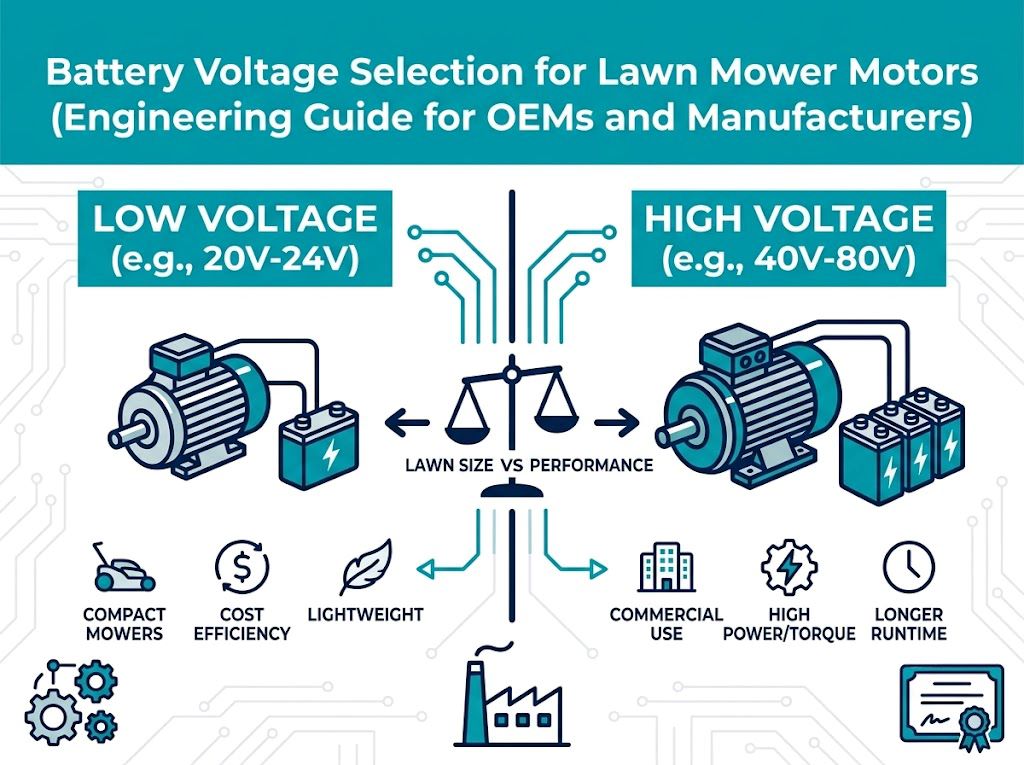
잔디 깍는 기계 모터용 배터리 전압 선택: 완전한 엔지니어링 가이드
Battery voltage selection is one of the most important engineering decisions when designing an electric lawn mower. The chosen voltage directly affects motor efficiency, current draw, controller size, 열 성능, runtime, wiring cost, 전반적인 시스템 신뢰성. While lower-voltage systems such as 24V and 36V may reduce initial cost, higher-voltage platforms such as 48V, 60V, and 72V often provide better efficiency, 낮은 전류, improved thermal management, and higher cutting performance. For most modern cordless and robotic lawn mowers, 48V has become the mainstream solution, while premium commercial mowers increasingly adopt 60V and 72V architectures to support higher power levels and longer operating cycles.
This engineering guide explains how to select the optimal battery voltage for electric lawn mower motors, compares common voltage platforms, and provides practical selection criteria for OEM designers, procurement teams, and product development engineers.
What Is Battery Voltage in an Electric Lawn Mower System?
Battery voltage represents the electrical potential supplied to the motor controller and ultimately to the lawn mower motor. In BLDC-powered lawn mowers, the battery does not directly drive the motor. 대신에, the battery supplies DC power to an electronic controller, which converts the energy into three-phase current used to drive the motor.
The voltage level determines how much current must flow to achieve a specific power output. Since electric lawn mowers frequently operate between 500W and 3000W depending on application, voltage selection becomes critical for system efficiency.
Basic Power Relationship
기본 방정식은:
P = V × 나
어디:
- P = 전력 (Watts)
- V = Voltage (Volts)
- I = Current (Amps)
예를 들어:
| 힘 | 전압 | Current Required |
|---|---|---|
| 1000승 | 24V | 41.7ㅏ |
| 1000승 | 48V | 20.8ㅏ |
| 1000승 | 72V | 13.9ㅏ |
This simple relationship explains why voltage selection significantly impacts motor temperature, wiring size, controller requirements, and battery performance.
Why Battery Voltage Matters for Lawn Mower Motor Performance
Many buyers focus only on motor power ratings while overlooking the importance of battery voltage. 하지만, voltage selection often determines whether a mower performs reliably under real-world grass cutting conditions.
작동 중, lawn mower motors encounter rapidly changing loads caused by:
- Dense grass
- 젖은 식물
- 고르지 않은 지형
- Blade acceleration
- Obstacle impacts
When voltage is too low, the motor must draw higher current to maintain power output. Higher current creates several engineering challenges:
- Increased copper losses
- Higher motor temperatures
- Larger cable requirements
- Greater battery stress
- Reduced controller efficiency
Higher voltage systems reduce current requirements while maintaining the same mechanical output power. This improves efficiency throughout the entire drivetrain.
For robotic lawn mowers where energy efficiency directly affects mowing time and charging frequency, voltage optimization becomes even more important.
24V vs 36V vs 48V vs 60V vs 72V Lawn Mower Systems
The most common battery platforms used in electric lawn mowers range from 24V to 72V. Each voltage level serves a different market segment.
| 전압 | Typical Power | Current Level | 능률 | 공통 응용 |
|---|---|---|---|---|
| 24V | 300–800W | 높은 | 보통의 | Entry-level mowers |
| 36V | 500–1200W | 보통의 | 좋은 | Residential cordless mowers |
| 48V | 800–2500W | 낮은 | 훌륭한 | Premium residential & robotic mowers |
| 60V | 1200–3500W | 낮추다 | 매우 높음 | Commercial cordless mowers |
| 72V | 2000–5000W+ | 최저 | 훌륭한 | Commercial ride-on mowers |
엔지니어링 관점에서, 48V has become the industry sweet spot because it balances performance, 안전, battery cost, 컨트롤러 복잡성, and global component availability.
How Voltage Affects Motor Efficiency
Motor efficiency determines how much electrical energy becomes useful mechanical power.
One of the biggest efficiency losses in lawn mower systems comes from copper loss:
Copper Loss = I²R
This means losses increase with the square of current.
Consider a 1500W mower motor:
| 전압 | 현재의 | Relative Copper Loss |
|---|---|---|
| 24V | 62.5ㅏ | 100% |
| 48V | 31.3ㅏ | 25% |
| 72V | 20.8ㅏ | 11% |
The reduction in copper loss is dramatic.
This is why many premium robotic lawn mower manufacturers are transitioning from traditional 24V architectures to 36V and 48V systems. 효율성이 높다는 것은:
- Longer mowing runtime
- Smaller battery requirements
- Lower operating temperatures
- Extended component life
For OEMs targeting premium product segments, higher voltage platforms often provide a strong competitive advantage.
How Battery Voltage Influences Torque and Cutting Power
Many engineers mistakenly assume that voltage directly creates torque. 실제로는, motor torque primarily depends on current. 하지만, battery voltage indirectly influences torque production by allowing the controller to maintain higher current under load.
When thick grass suddenly increases blade resistance, the motor controller attempts to maintain target speed.
A higher voltage system provides:
- Greater voltage headroom
- Faster current response
- Improved transient performance
- Reduced voltage sag
This results in stronger cutting performance during difficult mowing conditions.
Dense Grass Example
A mower operating at 48V typically experiences less battery voltage drop under heavy load compared with a similar 24V system.
The result is:
- Higher blade tip speed
- Improved cut quality
- Less stalling
- Reduced thermal stress
This is one reason why many commercial-grade electric lawn mowers increasingly use 60V and 72V architectures.
Battery Voltage and Thermal Management
Heat is the primary enemy of electric motor lifespan.
과도한 온도가 가속화됩니다.:
- 절연 열화
- 베어링 마모
- Magnet aging
- 컨트롤러 오류
- Battery degradation
Higher voltage systems reduce current flow, which directly lowers heat generation throughout the electrical system.
Motor Temperature Benefits
- Lower winding temperatures
- Reduced hotspot formation
- Improved efficiency at high load
- Longer insulation life
Controller Temperature Benefits
- Lower MOSFET losses
- Smaller heatsinks
- Reduced thermal cycling
- Higher reliability
For robotic lawn mowers that operate continuously for several hours, thermal management often becomes a key factor in voltage selection.
Battery Voltage Selection for Robotic Lawn Mowers
Robotic lawn mowers have unique operating requirements compared with walk-behind mowers.
Key priorities include:
- Maximum runtime
- 낮은 에너지 소비
- Compact packaging
- 조용한 작동
- Autonomous charging
Most robotic mower manufacturers choose between:
- 24V 시스템
- 36V 시스템
- 48V 시스템
Modern premium robotic mowers increasingly favor 36V and 48V BLDC motors because they deliver higher efficiency while minimizing battery current demand.
For robotic mower drive motors, Greensky frequently supports custom BLDC motor solutions optimized for:
- High efficiency operation
- Compact packaging
- Low-noise commutation
- IP-rated outdoor environments
- Extended battery runtime
How to Choose Battery Voltage for Electric Lawn Mower Motors
For OEM product development teams, battery voltage should never be selected based solely on marketing considerations. The decision should be driven by power requirements, thermal targets, runtime goals, 및 총 시스템 비용.
How to Choose Battery Voltage for Electric Lawn Mower Motors
Battery voltage selection should begin with application requirements rather than battery availability. Many OEMs make the mistake of selecting a battery platform first and then attempting to fit the motor around it. A more effective engineering approach is to define required blade torque, cutting width, runtime, and environmental conditions before determining the optimal voltage architecture.
Voltage Range Selection
| 애플리케이션 유형 | Recommended Voltage | Typical Motor Power |
|---|---|---|
| Small Robotic Mower | 24V~36V | 200–800W |
| Residential Push Mower | 36V~48V | 800–1800W |
| Premium Self-Propelled Mower | 48V–60V | 1200–2500W |
| Commercial Walk-Behind Mower | 60V~72V | 2000–4000W |
| Ride-On Electric Mower | 72V+ | 3000–8000W+ |
Power Range Considerations
As power requirements increase, higher voltage systems become increasingly attractive. 예를 들어, delivering 3 kW at 24V requires over 125A of current, creating significant thermal and wiring challenges. The same power at 72V requires only about 42A, greatly reducing electrical stress.
속도 및 토크 요구 사항
Lawn mower motors must maintain blade speed under varying grass density. 엔지니어는 평가해야 합니다.:
- Rated RPM
- Peak torque requirements
- Startup torque
- Overload capability
- Blade inertia
Higher voltage systems generally provide faster controller response and better speed regulation during heavy cutting conditions.
Cooling Method Selection
| 냉각방식 | Suitable Voltage Range | 일반적인 응용 |
|---|---|---|
| Natural Air Cooling | 24V~48V | Residential Mowers |
| Forced Air Cooling | 48V~72V | Commercial Mowers |
| Advanced Thermal Design | 72V+ | Heavy-Duty Applications |
컨트롤러 호환성
Battery voltage directly affects controller design. OEMs should ensure compatibility regarding:
- DC bus voltage rating
- MOSFET voltage margin
- Current sensing capability
- Regenerative braking support
- CAN communication integration
- Safety certifications
Modern 48V and 72V BLDC systems often offer the best balance between controller efficiency and system complexity.
48V vs 72V Lawn Mower Motor Systems
One of the most common OEM design questions is whether to adopt a 48V or 72V architecture.
| 요인 | 48V System | 72V System |
|---|---|---|
| 시스템 비용 | 낮추다 | 더 높은 |
| Current Demand | 보통의 | 낮은 |
| 모터 효율 | 훌륭한 | 훌륭한 |
| 컨트롤러 복잡성 | 보통의 | 더 높은 |
| Residential Suitability | 훌륭한 | 좋은 |
| Commercial Suitability | 좋은 | 훌륭한 |
| Runtime Potential | 높은 | 매우 높음 |
For most residential and robotic lawn mowers, 48V remains the optimal platform. For commercial products exceeding 3 kW, 72V often delivers superior overall efficiency and thermal performance.
Battery Voltage and Reliability: Long-Term Impact on Motor Lifespan
Motor reliability depends heavily on operating temperature, electrical stress, and load cycles. Since voltage selection affects all three factors, it has a direct influence on lifespan.
Higher voltage systems generally contribute to:
- Reduced winding temperature rise
- Lower connector stress
- Improved controller longevity
- Reduced battery degradation
- Extended bearing life
In fleet and commercial environments, these improvements can significantly reduce total cost of ownership.
조달 관점에서, the cheapest voltage platform is not always the most economical over the product lifecycle. Lower maintenance costs and fewer warranty claims often justify the investment in higher-efficiency architectures.
Industrial Applications Beyond Lawn Mowers
The same voltage selection principles used in lawn mower design apply across numerous industrial applications.
로봇공학
Mobile robots increasingly use 48V BLDC systems due to efficiency and safety advantages.
전기 자동차
Light electric vehicles frequently operate in 48V and 72V ranges to balance power density and cost.
HVAC Equipment
Variable-speed fans and pumps benefit from reduced current and improved thermal management.
산업 자동화
Automated machinery often uses higher-voltage BLDC platforms to minimize electrical losses and improve reliability.
These cross-industry trends reinforce the growing popularity of 48V and 72V motor ecosystems.
Future Trends in Lawn Mower Battery Voltage Platforms
The electric lawn mower market continues to evolve toward higher-performance battery systems.
Several trends are driving voltage increases:
- Demand for longer runtime
- Growth of commercial cordless equipment
- Improved lithium battery technology
- Higher-power BLDC motors
- Advanced smart controllers
- Connected robotic mower platforms
Industry development indicates that:
- 24V systems will remain primarily in entry-level products
- 36V systems will continue in mid-range residential equipment
- 48V will dominate premium robotic and residential mowers
- 60V and 72V will expand rapidly in commercial equipment
Manufacturers investing in scalable motor platforms today should consider future voltage migration strategies to remain competitive over the next decade.
How Greensky Supports OEM Lawn Mower Motor Development
As electric lawn mower technology advances, OEMs increasingly require customized motor solutions rather than standard catalog products.
Greensky provides customized BLDC motor development for:
- 로봇식 잔디 깍는 기계
- Walk-behind electric mowers
- Commercial mowing equipment
- Self-propelled drive systems
- Integrated wheel hub motors
Available engineering capabilities include:
- 24V, 36V, 48V, 60V, and 72V platforms
- Custom winding optimization
- High-efficiency magnetic circuit design
- Waterproof IP-rated solutions
- Low-noise motor architectures
- Integrated controller compatibility
If you are evaluating battery voltage selection for a new mower platform, our engineering team can help determine the optimal combination of voltage, 모터 파워, controller configuration, and thermal design.
Request datasheet.
Get OEM solution.
Contact our engineers.
FAQ: 잔디 깍는 기계 모터용 배터리 전압 선택
Is a higher voltage lawn mower always better?
꼭 그런 것은 아니다. 전압이 높을수록 효율이 향상되고 전류가 감소합니다., but it may increase battery and controller costs. The best voltage depends on power requirements, runtime goals, and application type.
Why are many modern lawn mowers using 48V motors?
48V systems provide an excellent balance between efficiency, 성능, 안전, battery availability, and controller cost. They are widely considered the optimal solution for premium residential and robotic lawn mowers.
What voltage is best for robotic lawn mowers?
Most robotic lawn mowers use 24V, 36V, or 48V architectures. Higher-end robotic systems increasingly favor 36V and 48V platforms because they offer better runtime and lower thermal losses.
Does higher voltage increase motor torque?
Torque is primarily related to current. 하지만, higher voltage allows the controller to maintain current more effectively under load, which can improve real-world cutting performance and speed stability.
What is the difference between 48V and 72V mower systems?
72V systems require less current for the same power output, resulting in lower heat generation and improved efficiency. 하지만, they typically cost more and are mainly used in commercial equipment.
How does voltage affect battery runtime?
Voltage itself does not determine runtime. 하지만, higher-voltage systems often operate more efficiently, reducing energy losses and improving usable runtime under heavy load conditions.
Can the same BLDC motor operate at multiple voltages?
Some motor designs can be adapted through winding modifications and controller changes. 하지만, optimal efficiency and performance usually require a motor specifically designed for the target voltage platform.
What voltage should OEM manufacturers choose for future products?
For most premium residential and robotic mower applications, 48V remains the strongest long-term choice. Commercial equipment increasingly benefits from 60V and 72V architectures.
결론
Battery voltage selection is one of the most influential decisions in electric lawn mower motor design. Voltage affects efficiency, 열 성능, 신뢰할 수 있음, wiring requirements, controller size, runtime, and overall system cost.
For most modern cordless and robotic lawn mowers, 48V offers the best combination of efficiency, 성능, 그리고 비용 효율성. Commercial products requiring higher power levels increasingly benefit from 60V and 72V systems, which reduce current demand and improve thermal performance.
OEMs should evaluate voltage selection based on complete system requirements rather than battery cost alone. A properly optimized voltage architecture can improve cutting performance, extend motor lifespan, reduce maintenance costs, and create a more competitive product.
For customized lawn mower motor solutions, including 48V and 72V high-efficiency BLDC platforms, contact Greensky engineers to discuss your application requirements and request a tailored OEM motor solution.
참조
- https://www.energy.gov/eere/amo/electric-motors
- https://www.nema.org/standards
- https://www.iea.org/reports/energy-efficiency-2024
- https://www.batteryuniversity.com
- https://www.ieee.org
- https://www.sciencedirect.com/topics/engineering/brushless-dc-motor
- https://www.mdpi.com/journal/energies
- https://www.researchgate.net/publication/Brushless_DC_Motor_Applications