
Why Do Power Tools Generally Use Brushed Motors?
何 “ブラシ付きモーター” Means in a Power Tool
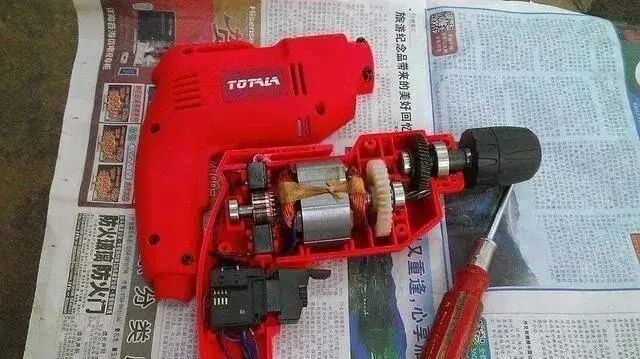
When an engineer says a power tool “uses a brushed motor,” they almost always mean a ユニバーサルモーター — a series-wound DC motor that, thanks to its commutator and carbon brushes, also runs on single-phase AC. (Cordless tools sometimes use a permanent-magnet DC, PMDC, モーター, which is also brushed.) The brushes are spring-loaded carbon blocks that press on a spinning copper 整流子, reversing current in each armature coil so torque always acts in one direction.
The alternative is a ブラシレスDC (BLDC) モーター, where the commutator is replaced by an electronic controller and fixed stator coils. No brushes means no sparking, no brush wear — but it means a circuit board, センサー, and firmware that a brushed tool simply does not have.

DCブラシモーターの原理
図に示すように 1, これはDCブラシモーター構造モデルです. 2つの固定異方性磁石, コイルの真ん中に配置されます, コイルの端は2つの半円形の銅リングに接続されていました, 銅リングの端と固定カーボンブラシの接触, そして、カーボンブラシの端にDC電源に接続されていました.
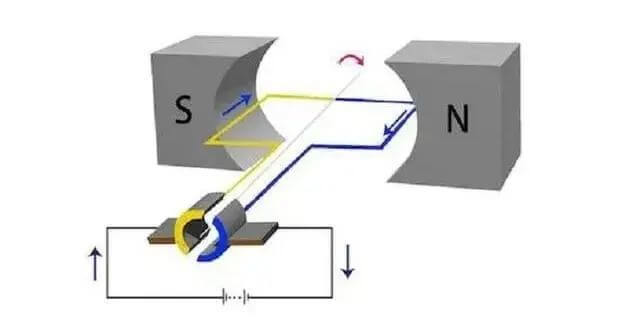
形 1
電源が接続された後, 電流は、図の矢印で示されているとおりです 1. 左側のルールによると, 黄色のコイルは垂直方向の上向きの電磁力にさらされます; 青いコイルは垂直方向の下向きの電磁力を受けます. モーターローターは時計回りに回転し始めます 90 回転度, 図に示すように 2.
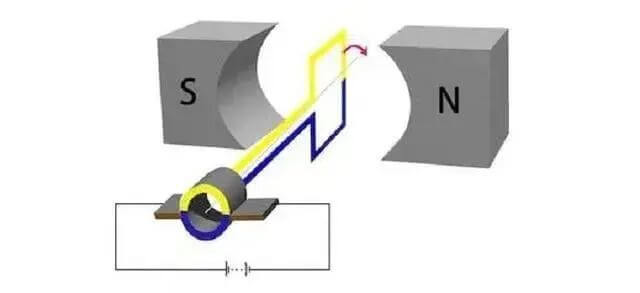
形 2
現時点では, カーボンブラシは、2つの銅リングの間のギャップの真ん中にあります, コイル回路全体に電流はありません. しかし、慣性の作用の下で, ローターはまだ回転し続けています.
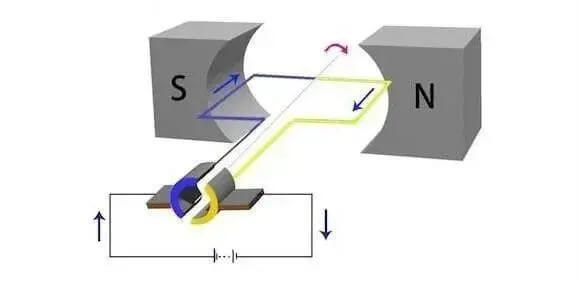
形 3
ローターが慣性の下で上記の位置に変わるとき, コイル電流を図に示します 3. 左側のルールによると, 青いコイルは、垂直方向の上向きの電磁力にさらされます; 黄色のコイルは垂直方向の下向きの電磁力を受けます. モーターローターは時計回りに回転し続けます, 後 90 学位, 図に示すように 4: 現時点では, カーボンブラシは、2つの銅リングの間の真ん中の隙間にあります, コイル回路全体に電流はありません. しかし、慣性の作用の下で, ローターはまだ回転し続けています. その後、上記の手順が繰り返されます, そして、サイクルは続きます.
ブラシレス DC モーター
図に示すように 5, これはDCブラシレスモーター構造のモデル図です. ステーターとローターで構成されています, ここで、ローターには磁性極があります; ステーターには、多くのコイルが巻かれています, 6セットのコイルが図に示されています.
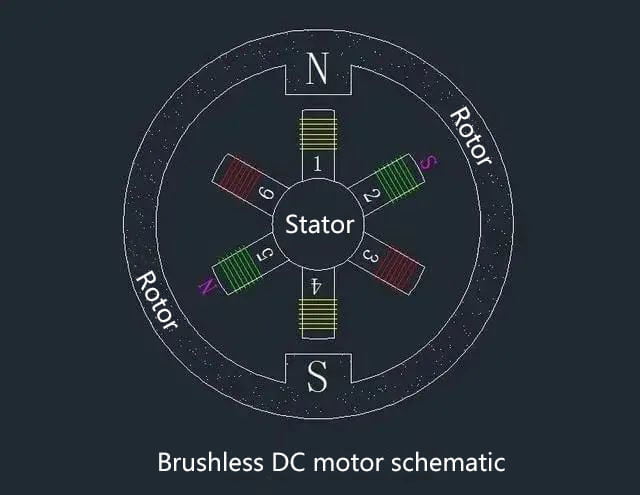
形 5
電流をステーターコイルに渡すとき 2 と 5, コイル 2 と 5 磁場が生成されます, ステーターはバーの磁石に相当します, どこ 2 sです (南) ポールと 5 nです (北) ポール. 同性の極が互いに引き付けるので, ローターNポールはコイルに回転します 2 位置とローターSポールはコイルに回転します 5 位置, 形 6.
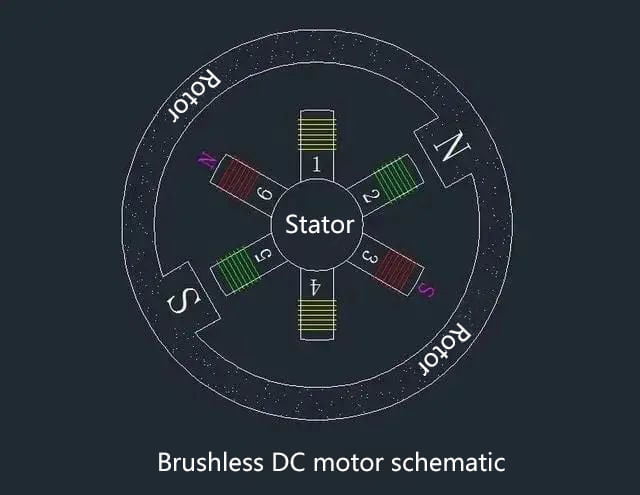
形 6
次に、ステーターコイルから電流を引き出します 2 と 5 電流をステーターコイルに渡します 3 と 6. 現時点では, コイル 3 と 6 磁場が生成されます, ステーターはバーの磁石に相当します, どこ 3 sです (南) ポールと 6 nです (北) ポール. 同性の磁気極が互いに引き付けるので, ローターNポールはコイルに回転します 3 位置とローターSポールはコイルに回転します 6 位置, 形 7.
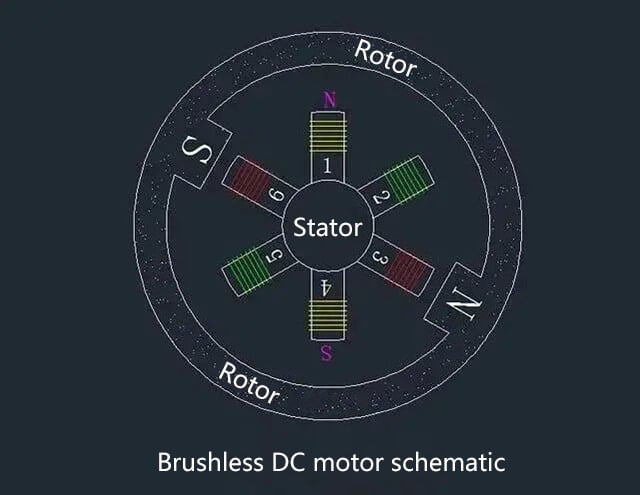
形 7
同様に, 次に、ステーターコイルから電流を取り外します 3 と 6, そして、電流をステーターコイルに渡します 4 と 1. 現時点では, コイル 4 と 1 磁場が生成されます, ステーターはバーの磁石に相当します, どこ 4 sです (南) ポールと 1 nです (北) ポール. 反対側の極が互いに引き付けるので, ローターNポールはコイルに回転します 4 位置とローターSポールはコイルに回転します 1 位置. まで
この時点まで, モーターは半ターンを回転させました …. 後半のターンは前の原則と同じです, したがって、ここでは繰り返しません. DCブラシレスモーターは、ロバの前でにんじんを釣るようなものであるように理解することができます, ロバがニンジンに向かって動き続けるように.

では、異なる瞬間に正確な電流を異なるコイルに渡すにはどうすればよいですか? これには、現在の整流回路が必要です …… ここでは詳しく説明しません.
ブラシDCモーターとブラシレスDCモーターの利点と短所比較
DCブラシモーター: 高速開始, タイムリーなブレーキ, 滑らかな速度規制, 単純なコントロール, シンプルな構造, 安い. ポイントは、価格が安いということです! 価格は安いです! 価格は安いです! そして、それは高い開始電流を持っています, 高トルク (回転力) 低速で, 非常に重い負荷を運ぶことができます.
しかし, カーボンブラシと整流子の間の摩擦のため, DCブラシモーターはスパークを簡単に生成できます, 熱, ノイズ, 外部環境への電磁干渉, そして、効率が低く短い人生. カーボンブラシは摩耗と涙製品だから, 失敗するのは簡単です, 一定期間後に交換する必要があります.

DCブラシレスモーター: DCブラシレスモーターはカーボンブラシを排除するためです, したがって、ノイズは小さいです, メンテナンスなし, 低障害率, 長寿命, そして、実行時間と電圧はより安定しています, 無線機器の干渉が小さいため. しかし、それは高価です! 高い! 高い!
電動工具は、人生において非常に一般的なツールです, そして、さまざまなブランドと激しい競争があります, したがって、人々は価格に非常に敏感です. そして、非常に重い負荷を運ぶために必要な電動工具, 多くの開始トルクである必要があります, ハンドドリルなど, インパクトドリル. さもないと, 掘削するとき, ドリルビットがスタックしているため、モーターは簡単に実行できません.

低価格のブラシDCモーターを想像してください, 高い開始トルクと重い負荷を運ぶことができます; ブラシレスモーターの故障率は低く、寿命が長いです, しかし、それは高価であり、開始トルクはブラシモーターよりもはるかに少ないです. 選択した場合, どのように選びますか, 答えは自明だと思います.
Brushed vs Brushless — The Core Difference
| 側面 | つや消し (普遍的な / PMDC) | ブラシレス (BLDC) |
|---|---|---|
| 転流 | Mechanical — brushes + 整流子 | Electronic — controller + ホールセンサー |
| Control electronics | なし (スイッチ + triac for AC speed) | Required driver PCB + ファームウェア |
| 開始トルク | 非常に高い (stall current = V/Rₐ) | 高い, but limited by controller current cap |
| Power source | 交流または直流 (普遍的な) | DC only (or via rectifier) |
| Fragile parts | None electronic — robust in dust/heat | Controller sensitive to moisture/ESD/spikes |
| メンテナンス | ブラシを交換する (wear part) | Virtually maintenance-free |
| Upfront cost | Low — 30–50% cheaper | プレミアム (20–50% more) |
How a Brushed (ユニバーサル) Motor Produces High Starting Torque
The reason brushed motors dominated drills, グラインダー, and saws comes down to one physics fact about the 直巻き デザイン. Walk through it:
- The field and armature are in series. Field current equals armature current, so at high current the magnetic field is also at its strongest.
- At standstill, back-EMF is zero. The induced voltage E = kₑ·ω is proportional to speed ω; when ω = 0, E = 0.
- Current is only limited by winding resistance. I = (V − E)/Rₐ = V/Rₐ, which is huge because Rₐ is small (fractions of an ohm).
- Torque surges. T = kₜ·Iₐ, so the stall current produces a large stall torque — for a series (普遍的な) モーター, torque scales roughly with the square of current (T ∝ I²).
- As it spins up, back-EMF rises and current falls to a steady operating value — the motor self-regulates to the load.
- The commutator keeps it one-way. Brushes switch current direction in each coil at the right instant, so torque never cancels out.
This is exactly why a drill doesn’t stall when the bit binds in hardwood: the motor pulls a massive inrush current and converts it directly into torque. An IEEE analytical study of universal motors confirms they remain in use for “drills and saws” precisely because of their “wide variable-speed range, 高い始動トルク, low cost and attractive power/weight ratio” (IEEEX, 5994773).
The Starting-Current Reality (作業例)
Real brushed motors exploit this inrush rather than fight it. Measured on a maxon RE 30 brushed DC motor at 24 V (EDN, brushed DC motor current):
| 状態 | 現在 | 力 | 注記 |
|---|---|---|---|
| Spin-up peak (≈1 ms) | 29 あ | ≈700 W | Brief inrush to overcome inertia |
| ストール (rotor held) | 34 あ | 816 W | Maximum torque condition |
| Continuous running | 2 あ | 48 W | Rated operating point |
| Max allowed continuous | 3.5 あ | 84 W | Thermal limit to avoid damage |
A brushless controller must cap this inrush with closed-loop current limiting; a brushed tool simply lets the copper and magnets handle it. maxon itself notes brushed DC motors “can be operated without external electronics… a useful alternative to BLDC motors,” with torque control “implemented using the current” と “low start-up voltage even after a long period in standstill” (maxon DCX program).
Brushed vs Brushless Power Tools — Quantitative Comparison
The reason the market has shifted (but not fully) is visible in the numbers. Ranges reflect typical consumer-to-professional corded and cordless tools.
| パラメーター | つや消し (普遍的な) | ブラシレス (BLDC) | ソース / note |
|---|---|---|---|
| 効率 | 50–60% (cheap universal); 70–85% (good PMDC) | 85–90%+ | BLDC loses less to friction/heat |
| Upfront cost | ベースライン | +20–50% premium | PowerToolLab, KitD data |
| Battery runtime (same pack) | ベースライン | +30–50% more holes/charge | PowerToolLab drill test (276 vs 397 穴) |
| みがきます / maintenance life | 500–2,000 h (consumer grinder 50–100 h) | Much longer (no wear part) | Duty-cycle dependent |
| 開始トルク | 非常に高い; self-limited only by Rₐ | 高い; capped by controller | T = k·Iₐ vs current limit |
| 速度範囲 | 10,000–20,000+ RPM (geared down) | 広い, EC-controlled | Universalmotor high-speed design |
| Environmental robustness | 素晴らしい (no electronics to fry) | 良い, but controller vulnerable | Dust/heat/moisture sensitivity |
Why the Cost Gap Exists
| 成分 | つや消し | ブラシレス |
|---|---|---|
| Motor windings | 標準, high-volume | 標準 |
| 転流 | 整流子 + カーボンブラシ (~$2) | なし |
| コントローラ | なし (スイッチ + triac) | PCB + MOSFET + ファームウェア |
| センサー | なし | ホールセンサー (or sensorless algo) |
| Manufacturing complexity | 低い | 高い (SMT, 較正) |
あ 2020 deep-slot universal-motor study for power tools (Northwestern Polytechnical University & China’s National Engineering Research Center for Small & 精密モーター) even optimized the slot design specifically “to reduce the cost of universal motor materials and improve production efficiency” (Springer JoPE, 2020) — cost is engineered in at the source.
エンジニアリングデータ: 効率, 温度 & Life Limits
These are the numbers a design or procurement engineer actually uses when choosing motor architecture.
| パラメーター | Typical value | 標準 / note |
|---|---|---|
| Brushed universal efficiency | 50–60% (安い); up to ~75% loaded | Small universal motors lower at light load |
| Brushed PMDC efficiency | 70–85% | maxon RE series reaches ~90% |
| BLDC efficiency | 85–90%+ | UL / manufacturer lab data |
| Brushless cost premium | +20–50% | コントローラ + sensors drive it |
| Brush service life | 500–2,000 h (grinder 50–100 h) | High current shortens life |
| 無負荷速度 (普遍的な) | 10,000–20,000+ RPM | Gear-reduced to tool output |
| Commutator temp class | クラスB 130 ℃ / ふ 155 ℃ | IEC 60034-1 限界 |
| Stall current | V / Rₐ (10–30× running) | EDN maxon RE30: 34 A stall @24 V |
重要な公式
| 量 | 式 | Meaning for tool design |
|---|---|---|
| 逆起電力 | E = kₑ · ω | Zero at standstill → max current at start |
| トルク | T = kₜ · Iₐ | Torque tracks armature current |
| Stall current | I_stall = V / Rₐ | Bounded only by winding resistance |
| Series-motor torque | T ∝ I² (approx.) | Universal motor: torque rises with current² |
| スピード (loaded) | N ∝ V / (k · Φ), inversely with load | Drops under load; no-load can overspeed |
Sparking Acceptance (IEC 60034-1)
The commutator sparks — that is normal, but only to a limit. IEC 60034-1 defines four sparking grades; a service tech should never accept Class 3.
| クラス | 説明 | 許容できる? |
|---|---|---|
| 1 | 火花が出ない; 整流子とブラシは変更なし | あらゆる負荷において理想的 |
| 11/2 | ブラシのエッジのみでかすかに火花が出る | 連続許容 |
| 2 | Permissible under stated overload | 許可された, でも調べてください |
| 3 | 危険な火花発生, 火災/浸食のリスク | 決して受け入れられない |
Best Applications for Brushed Power Tools
Brushed motors remain the right call wherever low cost, 単純なコントロール, 高い始動トルク, or rough-environment robustness outrank maintenance-free life.
| 応用 | Why brushed fits | Watch-out |
|---|---|---|
| Corded drills / impact drivers (予算) | 安い, huge starting torque, AC line power | Brush wear over heavy use |
| Angle grinders | Universal motor spins 10k+ RPM natively | High current → short brush life |
| Corded saws / サンダース | No battery runtime concern; 屈強 | Commutator maintenance |
| DIY / homeowner tools | Low upfront cost, occasional use | Long idle → brush seat-in needed |
| Dusty / hot job sites | No fragile controller to fry | Vent ingress accelerates wear |
| Repair-focused fleets | Brushes are a cheap field-replaceable part | Spares inventory required |
When the application needs precise, low-maintenance motion instead, brushless or gear-reduced BLDC is the better fit — see our guide on why robotic arms need speed reducers.
セレクションガイド: When to Choose a Brushed Motor
- Budget is the priority: if upfront cost dominates (DIY, give-away kits, high-volume OEM), brushed wins by 20–50%.
- The tool is corded or AC-powered: a universal motor runs straight off the line — no battery, no inverter.
- You need stall-grade starting torque: ドリル, ミキサー, and augers that bind under load benefit from the V/Rₐ inrush.
- AC/DC flexibility matters: job-site generators or engine-driven welders can be DC; universal motors handle both.
- The environment is harsh: ほこり, 水分, 熱, and voltage spikes destroy controllers faster than they wear brushes.
- Field repair is expected: if operators swap brushes themselves, brushed keeps the tool out of the shop.
- Choose brushless instead when: cordless runtime, tool life, and low noise are worth the premium (professional daily use).
Common Engineering Mistakes With Brushed Power-Tool Motors
| 間違い | Why it hurts |
|---|---|
| Assuming “brushed = obsolete” | Misses the cost, トルク, and robustness cases where brushed is still optimal |
| Ignoring brush life in the duty cycle | Consumer grinder brushes wear in 50–100 h; spares must be planned |
| Undersizing the supply for stall current | Stall pulls 10–30× running current; weak supplies brown out |
| Wrong brush grade for the load | High-current tools need electrographitic/metal-graphite, not pure carbon |
| Forgetting the IEC sparking limit | クラス 3 sparking erodes commutator and is a fire risk |
| Overlooking AC/DC requirement | A PMDC won’t run on AC; a universal will — verify the source |
Brushed Power-Tool Motor Troubleshooting (問題→原因→解決策)
| 問題 | 考えられる原因 | 解決 |
|---|---|---|
| Weak / low torque under load | 磨耗したブラシ, poor commutator contact, low supply | Replace brush set; clean/seat commutator; check voltage |
| 過度のスパーク | 磨耗したブラシ, wrong grade, grooved commutator | Fit correct grade; 整流子を再表面化する; set spring pressure |
| Motor runs hot | 過負荷, arcing, blocked vents, 高環境 | 負荷を軽減する; 通気孔をクリア; verify duty vs IEC class |
| ブラシの摩耗が早い | Too much spring pressure, abrasive dust, 大電流 | Reset pressure; clean environment; correct grade |
| No start / 間欠 | Brushes gone, loose lead, ベアリングの焼き付き | New brush set; tighten lead; free shaft |
| Burns out on stall | Held stalled beyond thermal limit (I = V/Rₐ) | Add current limit / thermal cutoff; don’t bind the bit |
For the full diagnostic sequence — including winding resistance and insulation tests — use our DC motor troubleshooting guide.
よくある質問
Why do power tools use brushed motors instead of brushless?
つや消し (mostly universal) motors are 20–50% cheaper because they need no controller, センサー, or firmware, and they deliver very high starting torque by exploiting the stall inrush (I = V/Rₐ). They also run on AC or DC and survive dust and heat without fragile electronics. Brushless wins on battery life and longevity, but brushed stays best for budget, corded, and repairable tools.
Do brushed power tools have more torque than brushless?
At the instant of starting or binding, a brushed series motor can pull a larger current spike (only limited by winding resistance), so its ピーク starting torque is very high. Brushless motors are capped by their controller’s current limit, though they hold torque more consistently under sustained load and run more efficiently overall.
Are brushed power tools still good?
Yes — for corded tools, budget DIY use, 過酷な環境, and fleets that field-replace brushes, brushed motors are a perfectly good, cost-effective choice. For professional cordless daily use where runtime and tool life dominate, brushless is the better long-term investment.
ブラシ付きモーターはなぜ安いのか?
They replace an entire electronic control system with a commutator and two carbon brushes. No PCB, no MOSFETs, no Hall sensors, no firmware calibration — just a switch (and a triac for AC speed control). High-volume winding and stamping keep per-unit cost low.
Can a brushed motor run on AC and DC?
あ 普遍的な motor can — that is its defining feature and why it suits power tools plugged into any outlet or driven by a DC job-site source. A permanent-magnet DC (PMDC) brushed motor runs on DC only unless externally rectified.
How long do power-tool motor brushes last?
Typically 500–2,000 operating hours depending on current and duty; consumer-grade angle-grinder brushes can wear in as little as 50–100 hours under heavy use. Because brushes are a planned-replacement wear part, they are designed to be swapped cheaply rather than ending the tool’s life.
ブラッシュドに Greensky を選ぶ理由 & Brushless Motion
Whether your tool design stays with brushed simplicity or moves to brushless efficiency, Greensky supplies both from one source, built to IEC 60034 およびNEMA MG 1 既存のマウントに収まる寸法:
- Brushed PMDC & universal motors with documented commutator specs, selectable brush grades, and replacement-brush programs for maintenance teams.
- ブラシレス (BLDC) motors and gear motors with matched Hall sensors and drives — eliminating brush wear, スパークする, and commutation maintenance for cordless platforms.
- Integrated gear motors that multiply output torque, reducing the current (and brush stress) the motor core must handle — see our gearbox vs gear motor guide.
- フランジの互換性: IEC B5/B14 and NEMA C-face with customized pilot diameters — see our モーターフランジガイド.
- 低MOQ OEM/ODM: スペアプログラムおよびカスタムシャフト/エンコーダ構成用の小バッチ.
関連書籍
- DCモーターとは? 種類, 原理 & 数式
- What Are Motor Brushes? 種類 & 仕組み
- ブラシ付きモーターがスパークする理由? 原因 & 修正
- What Causes a DC Motor to Lose Torque?
- How to Troubleshoot a DC Motor: Step-by-Step Guide
- エンジニアが知っておくべき BLDC モーターの欠点
- How to Short a DC Motor (Short-Circuit Braking)
- AC モーターと DC モーター: どれを選ぶか
- モーターフランジとは? IEC と NEMA の取り付け
- ギアボックスとギアモーター: 違い & 選択
参照
- IEC 60034-1 — 回転電機: 評価と性能 (温度 & スパークリングクラス). webstore.iec.ch/publication/67467
- IEC 60034-30-1 — 回転電機の効率クラス (IE1~IE5). webstore.iec.ch/publication/67784
- MGはありません 1 — モーターと発電機 (安全性, 熱, 取付寸法). nema.org/standards/view/mg-1-motors-and-generators
- IEEE 112 — Standard Test Procedure for Polyphase Induction & DCモーター (efficiency/loss methods). standards.ieee.org/ieee/112/4213
- IEEE Xplore — Analytical model and parameter computation for universal motors (高い始動トルク, 低コスト). ieeexplore.ieee.org/document/5994773
- Qi, H. 他. (2020) — Design and research of deep slot universal motor for electric power tools. Journal of Power Electronics, Springer. 土肥: 10.1007/s43236-020-00131-6
- maxon — Brushed DC motors (DCX program): operable without external electronics, current-based torque control. maxonmotor.com/dcx-program
- FAULHABER — DC-Motors Technical Information (brushed commutation, precious-metal brushes). faulhaber.com/en/technical-information
- 私たち. DOE — 電気モーターの効率の決定 & Repair Guidance. energy.gov/eere/amo/articles/determination-electric-motors
- SKF — Electric motor maintenance and bearing lubrication. skf.com/us/products/maintenance-products/bearing-maintenance