
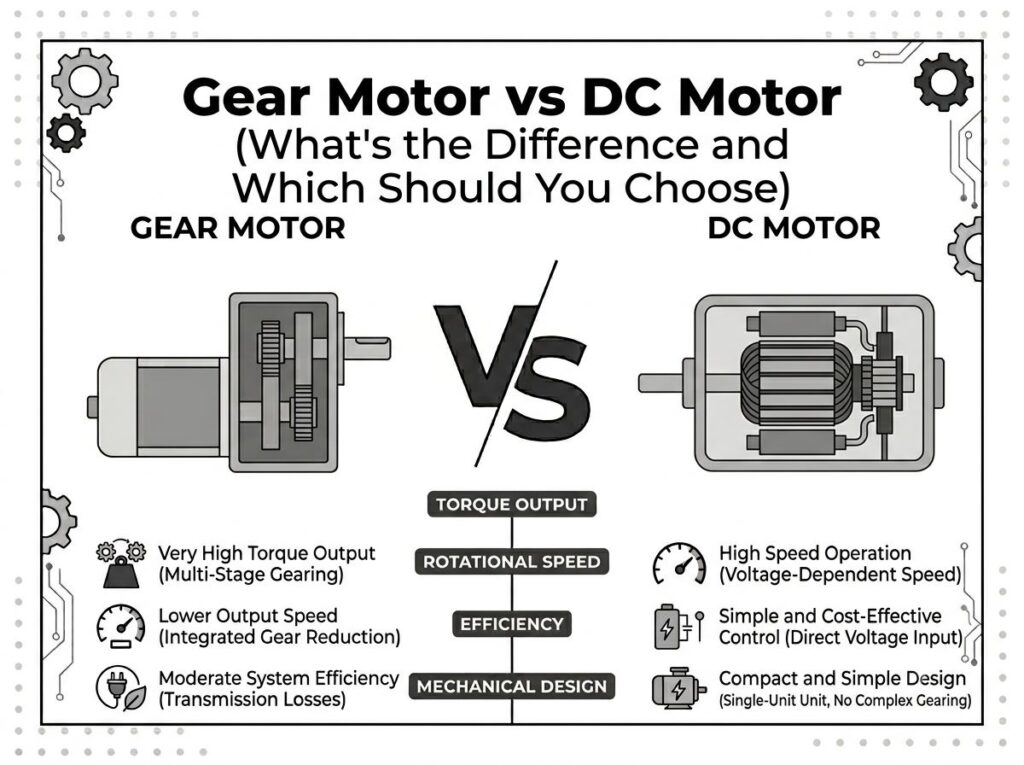
ギアモーターとDCモーター: 違いは何ですか、どちらを選択すべきですか?
簡単な回答:
あ 歯車モーター is a DC or AC motor combined with a gearbox, その間 DCモーター refers only to the electric motor itself. Gear motors provide significantly higher torque and lower output speed by using mechanical gear reduction, making them ideal for conveyors, ロボット工学, 自動化設備, and motion control systems. 対照的に, DC motors typically deliver higher rotational speed and are commonly used in direct-drive applications such as pumps, ファン, and cutting blades.
Many industrial gear motors today actually use permanent magnet DC motors or brushless DC motors paired with planetary, 拍車, ワーム, or helical gearboxes to achieve the desired balance between speed, トルク, 効率, and positioning precision.
DCモーターとは?
あ DC (Direct Current) モーター is an electric motor powered by direct current. It converts electrical energy into rotational mechanical energy through electromagnetic interaction between the stator and rotor.
Because of their simple construction, 早い反応, コンパクトサイズ, and relatively easy speed control, DC motors have been widely used for decades in industrial automation, 医療機器, 家庭用器具, 電気自動車, ロボット工学, パワーツール, and battery-powered equipment.
Unlike gear motors, a standard DC motor does not inherently reduce speed or increase torque. その代わり, it delivers its output directly from the motor shaft. If lower speed or higher torque is required, a gearbox can be added externally to create a DC gear motor.
Basic Construction of a DC Motor
Although different DC motor technologies exist, most share several fundamental components:
- ローター (アーマチュア) — the rotating component that generates mechanical output.
- ステータ — produces the stationary magnetic field surrounding the rotor.
- Permanent Magnets or Field Windings — create magnetic flux required for torque generation.
- ベアリング — support the rotating shaft while minimizing friction.
- 出力軸 — transfers rotational power to the driven equipment.
The interaction between the magnetic fields of the rotor and stator generates electromagnetic torque, causing the rotor to rotate continuously.
Types of DC Motors
Modern industrial systems generally use two primary categories of DC motors.
1. ブラシ付き DC モーター
Brushed DC motors use carbon brushes and a mechanical commutator to switch current through the rotor windings during rotation.
Their advantages include:
- Simple controller requirements
- Low initial cost
- 簡単な取り付け
- Excellent starting torque
- Widely available worldwide
しかし, brushes gradually wear over time, requiring periodic maintenance. Mechanical commutation also produces electrical noise, 火花, and friction, limiting lifespan in demanding industrial environments.
代表的な用途
- 電動工具
- 自動車用アクセサリー
- 家電製品
- Small actuators
- Portable equipment
2. ブラシレス DC モーター (BLDC)
Brushless DC motors eliminate mechanical brushes entirely. その代わり, electronic controllers perform commutation based on rotor position detected by Hall sensors or encoder feedback.
Compared with brushed motors, BLDC motors offer numerous engineering advantages:
- より高い効率
- Longer service life
- メンテナンスの軽減
- Higher power density
- Excellent speed regulation
- Lower operating noise
- Better thermal performance
Because there are no brushes generating friction or wear, BLDC motors are increasingly replacing traditional brushed motors in industrial automation and intelligent equipment.
Common BLDC Applications
- 産業用ロボット
- AGV
- 自律移動ロボット (AMRs)
- 電動芝刈り機
- 医療機器
- Servo systems
- Smart logistics equipment
Permanent Magnet Technology
Most modern DC motors use 永久磁石 rather than wound field coils to generate the stator magnetic field.
Permanent magnet DC motors provide several important engineering benefits:
- より高い効率
- Lower electrical losses
- Compact dimensions
- Reduced weight
- Improved torque density
- エネルギー消費量の削減
High-performance rare-earth magnets, particularly Neodymium Iron Boron (ネオジム鉄B), have significantly improved the performance of modern DC motors over the past decade, enabling compact motors to deliver much higher torque than previous generations.
How a DC Motor Produces Torque
The operating principle of a DC motor is based on electromagnetic force.
モーターの巻線に電流が流れると, a magnetic field is generated. The interaction between this magnetic field and the magnetic field produced by the stator creates rotational force on the rotor.
As the magnetic poles continuously switch position through either mechanical commutation (ブラシ付きモーター) or electronic commutation (BLDCモーター), the rotor continues rotating and delivers mechanical power to the output shaft.
The motor’s performance is primarily influenced by:
- 電源電圧
- 現在
- Motor winding design
- Magnet strength
- Controller performance
- Cooling capability
Advantages of DC Motors
| アドバンテージ | Engineering Benefit |
|---|---|
| High Speed | Suitable for direct-drive applications |
| Compact Size | Easy integration into equipment |
| Simple Speed Control | Voltage or PWM regulation |
| 高速な動的応答 | Quick acceleration and deceleration |
| 広い速度範囲 | Typically 500–10,000 RPM |
| 高効率 (BLDC) | エネルギー消費量の削減 |
Limitations of Standard DC Motors
Despite their many advantages, standard DC motors are not ideal for every application.
Because they rotate at relatively high speed while producing limited output torque, they often cannot directly drive heavy mechanical loads.
Typical limitations include:
- Lower output torque without reduction gears
- Reduced holding capability
- Poor low-speed stability under heavy load
- Additional gearbox required for many industrial systems
このため, engineers frequently combine DC motors with gearboxes to obtain higher torque, lower speed, and improved motion control. The result is known as a DCギアモーター, which will be explained in the next section.
ギアモーターとは?
あ 歯車モーター is an integrated drive unit consisting of an electric motor and a mechanical gearbox. Unlike a standard DC motor that delivers power directly from its output shaft, a gear motor reduces rotational speed through a gear train while proportionally increasing output torque.
It is important to understand that a gear motor is not a separate motor technology. その代わり, it is an assembly that combines two major components:
- 電気モーター – Generates rotational power.
- ギアボックス (Speed Reducer) – Converts high-speed, low-torque output into low-speed, 高トルク出力.
Depending on the application, the motor can be a brushed DC motor, ブラシレスDC (BLDC) モーター, AC誘導モーター, サーボモーター, またはステッピングモーター. The gearbox is selected according to the required reduction ratio, 効率, 騒音レベル, and output torque.
Basic Structure of a Gear Motor
A typical industrial gear motor consists of the following components:
| 成分 | 関数 |
|---|---|
| 電気モーター | Produces rotational power |
| Input Shaft | Transfers power from the motor into the gearbox |
| Gear Train | Reduces speed and multiplies torque |
| ベアリング | Support rotating shafts and reduce friction |
| Gear Housing | Protects internal gears and retains lubricant |
| 出力軸 | Delivers torque to the driven equipment |
Because the motor and gearbox are designed as a matched system, gear motors generally provide higher reliability, lower installation complexity, and better mechanical alignment than separately assembled motor-gearbox combinations.
How Does a Gearbox Increase Torque?
A gearbox works according to the principle of mechanical speed reduction.
When the motor drives a smaller gear that meshes with a larger gear, the rotational speed decreases while the available torque increases. This allows relatively small motors to move heavy loads efficiently.
Engineering relationship:
Gear Ratio ↑
↓
Output Speed ↓
↓
Output Torque ↑
例えば, a DC motor operating at 3,000 RPM with an output torque of 0.4 N·m can be paired with a 30:1 ギアボックス. Ignoring minor transmission losses, the output speed becomes approximately 100 RPM while the output torque increases to around 12 N・m.
This simple principle explains why gear motors are widely used in applications that require high starting torque, controlled motion, or the ability to move heavy loads.
Common Types of Gear Motors
Different gearbox designs provide different advantages. Selecting the appropriate gearbox depends on torque requirements, 設置スペース, 効率, 騒音レベル, and budget.
1. 平歯車モーター
Spur gear motors use straight-cut gears mounted on parallel shafts. They are among the simplest and most economical gear motor designs.
利点:
- Simple construction
- Low manufacturing cost
- High mechanical reliability
- メンテナンスが簡単
- Suitable for moderate torque applications
代表的な用途:
- 包装機械
- 自動ドア
- オフィス機器
- Material handling systems
2. 遊星歯車モーター
Planetary gear motors are widely recognized as the preferred solution for precision motion control. Their gearbox consists of a central sun gear, 複数の遊星歯車, and an internal ring gear.
Because several planet gears share the transmitted load simultaneously, planetary gearboxes achieve exceptionally high torque density while maintaining compact dimensions.
利点:
- 高いトルク容量
- コンパクトなサイズ
- Excellent load distribution
- 高い伝達効率
- Low backlash options
- スムーズな操作
代表的な用途:
- 産業用ロボット
- AGV と AMR
- Servo systems
- 医療機器
- Electric wheel drives
- Smart automation equipment
Modern robotic systems frequently use BLDC planetary gear motors because they combine the efficiency of brushless technology with the high torque output of planetary reduction.
3. ウォームギアモーター
Worm gear motors use a worm shaft that meshes with a worm wheel positioned at a right angle. This configuration enables large reduction ratios within a compact package.
One of the most valuable characteristics of worm gear motors is their ability to provide partial or complete self-locking, preventing reverse motion under load in many applications.
利点:
- Very high reduction ratios
- Compact right-angle output
- 静かな動作
- Good shock absorption
- Self-locking capability in many designs
代表的な用途:
- Lifting mechanisms
- Gate operators
- Turnstiles
- Conveyor positioning systems
- Industrial actuators
4. はすば歯車モーター
Helical gear motors use angled gear teeth that engage gradually rather than simultaneously. This design significantly reduces vibration and operating noise while improving load-carrying capacity.
利点:
- 非常に高い効率
- Smooth and quiet operation
- 高い耐荷重性
- 長寿命
- Suitable for continuous-duty operation
代表的な用途:
- Heavy-duty conveyors
- 鉱山機械
- Industrial production lines
- Food processing machinery
- Large automation systems
Advantages of Gear Motors
| アドバンテージ | Engineering Benefit |
|---|---|
| High Output Torque | Moves heavy loads efficiently |
| Low Output Speed | Improves motion control and positioning |
| Compact Integrated Design | Simplifies installation |
| Improved Load Capacity | Suitable for industrial machinery |
| Wide Reduction Ratios | Flexible speed selection |
| 高い信頼性 | Long operating life under continuous duty |
Typical Industrial Applications of Gear Motors
Gear motors are selected whenever applications require controlled movement rather than maximum rotational speed.
一般的な例としては、次のようなものがあります。:
- コンベヤシステム
- 産業用ロボット
- 無人搬送車 (AGV)
- 自律移動ロボット (AMRs)
- 倉庫の自動化
- Electric wheel drives
- Swing gates
- Turnstiles
- 自動ドア
- Lawn mower drive wheels
- Material handling equipment
- 包装機械
Although many of these systems are commonly referred to simply as “ギアモーター,” the motor inside is frequently a high-efficiency permanent magnet DC motor or BLDC motor. The gearbox is what transforms that motor into a low-speed, high-torque drive solution.
Can a DC Motor Be a Gear Motor?
はい. 実際には, many industrial gear motors are built by combining a DC motor with a gearbox. This is one of the most common drive configurations used in modern automation equipment.
DCモーター
+
ギアボックス
=
DC Gear Motor
This simple combination allows engineers to take advantage of the high rotational speed and compact size of a DC motor while obtaining the low-speed, high-torque output required by most industrial machinery.
Why Not Use a DC Motor Alone?
A standard DC motor often rotates at speeds ranging from 500 に 10,000 回転数, depending on its design and operating voltage. While this is ideal for direct-drive applications such as fans or pumps, it is usually too fast for equipment that requires controlled motion or high pulling force.
例えば, a conveyor belt typically operates at only a few dozen revolutions per minute. If driven directly by a high-speed DC motor, the conveyor would run far too quickly and produce insufficient torque to move heavy products.
Adding a gearbox solves this problem by reducing speed and multiplying torque, allowing a relatively small motor to handle much larger loads.
Common DC Gear Motor Configurations
| モーターの種類 | ギアボックスのタイプ | 代表的な用途 |
|---|---|---|
| ブラシ付き DC モーター | Spur Gearbox | オフィス機器, small machinery |
| ブラシ付き DC モーター | ウォームギアボックス | Gate operators, アクチュエータ |
| BLDCモーター | 遊星ギアボックス | ロボット工学, AGV, AMRs |
| BLDCモーター | ヘリカルギアボックス | 産業オートメーション |
| Permanent Magnet DC Motor | 遊星ギアボックス | 医療機器, wheel drives |
今日, the majority of high-performance industrial motion systems no longer treat the choice as gear motor versus DC motor. その代わり, they integrate both technologies to create a drive solution that delivers the optimal balance of speed, トルク, 効率, 精度, そして耐久性.
ギアモーターとDCモーター: 主な違い
Understanding the fundamental differences between a gear motor and a DC motor is essential for selecting the correct drive system in industrial design. Although both are used to produce rotational motion, they differ significantly in structure, output characteristics, およびアプリケーションの適合性.
A DC motor is a standalone electromagnetic device that produces high-speed rotational output. A gear motor, 一方で, is a complete mechanical system that combines a motor with a gearbox to reduce speed and increase torque.
In practical engineering terms, the difference is not just structural—it directly affects torque density, 速度範囲, efficiency behavior under load, システム統合の複雑さ.
| 特徴 | DCモーター | 歯車モーター |
|---|---|---|
| 意味 | Electric motor only | モーター + gearbox assembly |
| スピード | 高い (direct output) | 低い (after reduction) |
| トルク | Lower at shaft | Higher due to gear ratio |
| 効率 | High electrical efficiency | Depends on gearbox type |
| 料金 | システムコストの削減 | Higher system cost (additional gearbox) |
| 精密制御 | 中くらい (depends on controller) | 高い (mechanical reduction improves stability) |
| 代表的な用途 | ファン, パンプス, ブロワー | コンベヤー, ロボット工学, 自動化システム |
トルク比較
Torque is one of the most critical deciding factors when choosing between a DC motor and a gear motor. While DC motors can generate sufficient torque for lightweight or high-speed applications, they often fall short in heavy-load or low-speed conditions.
Gear motors solve this limitation by using mechanical reduction through a gearbox, effectively multiplying output torque without increasing motor size.
How Gear Ratio Affects Torque
The relationship between gear ratio, スピード, and torque is fundamental in mechanical engineering:
Gear Ratio ↑
↓
Output Speed ↓
↓
Output Torque ↑
This means that when a motor is paired with a gearbox, the system trades speed for torque. 例えば, ある 10:1 gearbox reduces speed by a factor of ten while increasing torque by approximately the same factor (minus efficiency losses).
現実世界のアプリケーションでは, this allows a small DC motor to perform tasks that would otherwise require a much larger motor if used without a gearbox.
Engineering Example
Consider a DC motor with the following specifications:
- スピード: 3000 回転数
- トルク: 0.5 N・m
When paired with a 20:1 遊星歯車装置:
- 出力速度: ~150 RPM
- 出力トルク: ~10 N·m (minus gearbox losses)
This demonstrates why gear motors are preferred in applications requiring high starting torque such as conveyors, robotics joints, and automated lifting systems.
Speed Comparison
Speed is another major differentiator between DC motors and gear motors. DC motors are naturally high-speed devices, while gear motors are designed to operate at reduced speeds optimized for mechanical loads.
Typical Speed Ranges
- DCモーター: 500–10,000 RPM
- Gear Motor Output: 5–500 RPM
The large reduction in speed is not a disadvantage but a functional requirement for most industrial systems. Many mechanical loads cannot operate efficiently at high speed and require controlled motion instead.
例えば:
- Robotic arms require precise, low-speed movement
- Conveyors must maintain stable speed under variable loads
- Turnstiles require smooth acceleration and deceleration
In these cases, a gear motor provides significantly better control compared to a direct-drive DC motor.
効率の比較
A common misconception is that gear motors are always inefficient due to energy losses in the gearbox. 実際には, modern gearbox technologies—especially planetary and helical designs—offer very high mechanical efficiency.
Efficiency depends heavily on gear type, lubrication quality, 負荷条件, と製造精度.
Gearbox Efficiency by Type
| ギアボックスのタイプ | 一般的な効率範囲 | Engineering Notes |
|---|---|---|
| 遊星ギアボックス | 95% – 98% | 高効率, コンパクトなデザイン, widely used in robotics and AGVs |
| ヘリカルギアボックス | 96% – 98% | Smooth transmission, 低ノイズ, 高い耐荷重 |
| Spur Gearbox | 90% – 95% | シンプルなデザイン, moderate efficiency, cost-effective |
| ウォームギアボックス | 50% – 90% | High reduction ratio but significant sliding friction losses |
While DC motors are highly efficient in electrical energy conversion (especially BLDC types), gear motors introduce mechanical losses. しかし, in properly selected applications, the improved torque and reduced system stress often outweigh the efficiency penalty.
ロボット工学とオートメーションの分野, planetary gear systems are widely used because they provide an optimal balance between efficiency, トルク密度, そしてコンパクトなサイズ.
コスト比較
Cost is a major factor in industrial procurement decisions. しかし, it is important to distinguish between component cost and system-level cost.
A DC motor alone is generally less expensive than a complete gear motor system. しかし, when a gearbox, mounting structure, and mechanical coupling are required, the total system cost may increase significantly.
| Cost Element | DC Motor System | Gear Motor System |
|---|---|---|
| モーターのコスト | より低い | 中くらい |
| Gearbox Cost | Not required | Required |
| コントローラーのコスト | Required (especially BLDC) | Required (depending on motor type) |
| 機械的統合 | Higher engineering effort | Pre-integrated system |
| Total System Cost | Lower for simple applications | Higher but more optimized for torque-critical systems |
In many OEM projects, gear motors reduce overall engineering cost even if component cost is higher, because they simplify mechanical design, reduce assembly time, and improve system reliability.
Which Is Better for Robotics?
Robotics is one of the most important application fields when comparing gear motors and DC motors. The key requirements in robotics include precise positioning, high torque at low speed, コンパクトな構造, and smooth motion control.
A standard DC motor alone is rarely sufficient for robotic joints or load-bearing movement because it operates at high speed with relatively low torque at the shaft. Without a reduction system, it cannot maintain stable motion under varying loads.
このため, most modern robotics systems use a combination of a DC or BLDC motor with a planetary gearbox, を形成する DC planetary gear motor また BLDCギアモーター.
Best solution: DC/BLDC planetary gear motor
Which Is Better for Conveyor Systems?
Conveyor systems require continuous operation, stable speed, and sufficient torque to move materials under varying load conditions.
A gear motor is typically the better choice because it provides consistent low-speed output and high torque without requiring complex external mechanical design.
DC motors without gear reduction are not ideal because they rotate too fast and cannot efficiently handle heavy loads at low speed.
Best solution: Gear motor (especially helical or worm gear types depending on load conditions)
Which Is Better for Pumps?
Pumps generally require high-speed rotation rather than high torque. The fluid dynamics of pumping systems depend heavily on impeller speed, which makes direct-drive DC motors a more suitable choice.
In most pump applications, adding a gearbox would unnecessarily reduce efficiency and increase system complexity.
BLDC motors are especially popular in modern pump systems due to their high efficiency, コンパクトサイズ, and ability to maintain stable speed under varying load conditions.
Best solution: DC motor or BLDC motor (direct drive)
Which Is Better for Lawn Mowers?
Lawn mower systems typically require two different motion requirements: blade rotation and wheel drive. These two subsystems have very different mechanical needs.
Blade System
The cutting blade requires high-speed rotation for effective cutting performance. この場合, a direct-drive DC or BLDC motor is preferred.
Adding a gearbox would reduce blade speed and negatively impact cutting efficiency.
Best solution: Direct-drive BLDC motor
Drive Wheel System
The wheel drive system requires high torque at low speed, especially when climbing slopes or moving over uneven terrain.
A gear motor is ideal here because it provides the necessary torque multiplication and stable low-speed control.
Best solution: DC gear motor or BLDC planetary gear motor
Which Is Better for Turnstiles?
Turnstile systems require controlled rotation, smooth acceleration, and reliable torque output to ensure safety and consistent operation in public access systems.
A planetary gear motor is the most widely used solution in modern turnstile designs because it provides:
- 高いトルク密度
- Compact installation size
- 正確な位置制御
- High durability for continuous operation
Worm gear motors are also used in some designs due to their self-locking capability, but planetary systems offer better efficiency and smoother motion control.
Best solution: Planetary gear motor (DC or BLDC based system)
How to Choose Between Gear Motors and DC Motors
Selecting between a gear motor and a DC motor depends entirely on application requirements such as torque demand, 速度範囲, デューティサイクル, スペースの制約, と制御精度.
The following application matrix provides a simplified engineering guideline:
| 応用 | Recommended Solution |
|---|---|
| ファン | DCモーター |
| ポンプ | DCモーター / BLDCモーター |
| コンベア | 歯車モーター (Helical / 拍車) |
| 無人搬送車 | BLDC 遊星歯車モーター |
| Robot Joint | BLDC 遊星歯車モーター |
| Lawn Mower Blade | BLDC Direct Drive Motor |
| Lawn Mower Drive Wheel | DC Gear Motor / BLDCギアモーター |
| 改札口 | 遊星歯車モーター |
In modern industrial design, the decision is rarely “gear motor vs DC motor” 1人. その代わり, engineers increasingly combine both concepts by using a DC or BLDC motor integrated with a precision gearbox to achieve optimal system performance.
OEMバイヤーがGreensky Powerを選ぶ理由
For OEM manufacturers and industrial automation companies, selecting a reliable motor supplier is not only about product specification, but also about system integration capability, customization flexibility, and production stability.
Greensky Power provides integrated motion solutions designed for industrial applications requiring torque optimization, コンパクトな構造, そして長いサービスライフ.
- 遊星歯車モーター
- Spur Gear Motors
- Worm Gear Motors
- BLDCギアモーター
- Custom Gearbox Engineering
- モーター + Gearbox Integrated Solutions
- OEM/ODM Design Support
- Low MOQ for Engineering Samples
- Fast Prototyping and Validation
These capabilities allow OEM customers to reduce development time, improve mechanical reliability, and accelerate product launch cycles in competitive industrial markets.
よくある質問
Is a gear motor the same as a DC motor?
いいえ. A DC motor is a standalone electric motor, while a gear motor is a motor combined with a gearbox to reduce speed and increase torque.
Can a DC motor have a gearbox?
はい. When a gearbox is added to a DC motor, the result is called a DC gear motor, commonly used in industrial automation and robotics.
Is a gear motor stronger than a DC motor?
A gear motor provides higher output torque due to gear reduction, but it does not inherently generate more power. It trades speed for torque.
Why use a planetary gear motor?
遊星歯車モーターは高いトルク密度を提供します, コンパクトサイズ, 高効率, and excellent load distribution, making them ideal for robotics and AGVs.
Which motor is best for robotics?
Most robotics systems use BLDC motors combined with planetary gearboxes to achieve precise motion control and high torque output.
Which motor is best for conveyors?
ギアモーター, especially helical or spur types, are commonly used because they provide stable low-speed high-torque operation.
参照
1. IEEE Transactions on Industrial Electronics – Electric Motor Drive Systems
2. Electric Machinery Fundamentals – Stephen J. Chapman
3. Mechanical Engineering Design – Shigley’s Mechanical Engineering Design Principles
4. Industrial Gear Systems Handbook – Gear Technology Journal
5. Brushless DC Motor Applications in Automation Systems – Power Electronics Review