
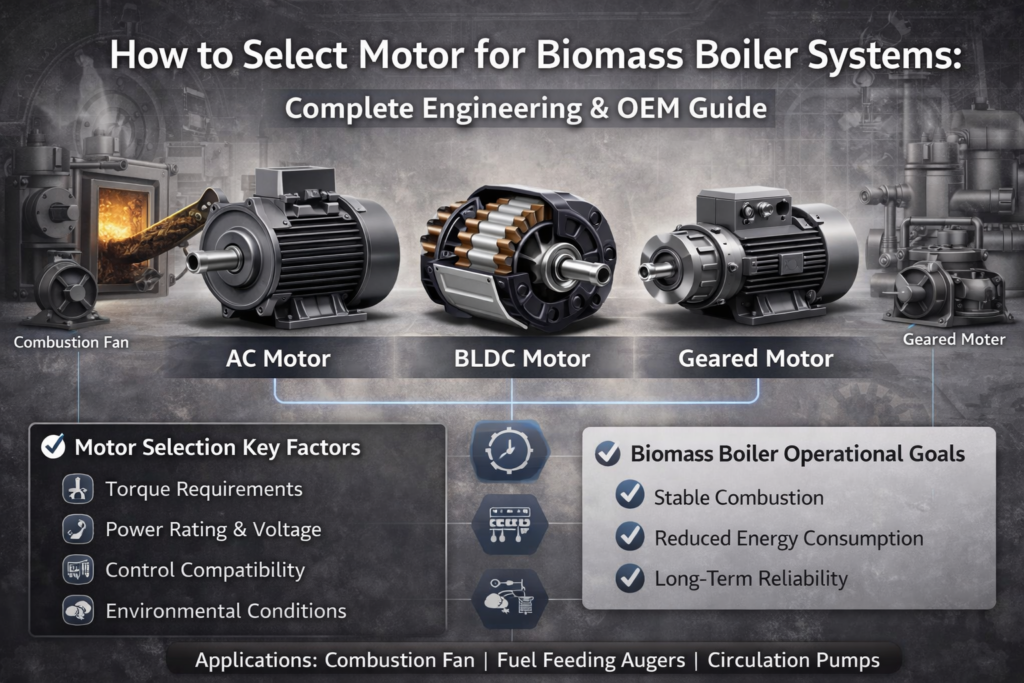
Come selezionare il motore per i sistemi di caldaie a biomassa: Ingegneria completa & Guida OEM
Frammento in primo piano:
Selecting a motor for biomass boiler systems requires careful evaluation of torque requirements, livello di potenza, voltaggio, control compatibility, e condizioni ambientali. Motors are used in key subsystems such as combustion fans, fuel feeding augers, and circulation pumps, where performance directly impacts efficiency and reliability. Engineers typically calculate required torque using load characteristics and select motors (AC, BLDC, or geared) based on efficiency, prestazione termica, e durata della vita. Proper motor selection ensures stable combustion, reduced energy consumption, and long-term operational reliability in industrial biomass applications.
What is Motor Selection for Biomass Boiler Systems?
Motor selection for biomass boiler systems refers to the process of choosing the appropriate motor type, misurare, and control system for various subsystems such as fans, trasportatori, e pompe. Unlike general-purpose motor selection, biomass applications require careful consideration of harsh operating environments, continuous duty cycles, and fluctuating load conditions.
Key Subsystems Requiring Motors
- Combustion fan motors (air supply)
- Induced draft fan motors (exhaust control)
- Fuel feeding motors (augers and conveyors)
- Motori delle pompe (heat transfer)
Each subsystem has unique torque, velocità, and reliability requirements, making proper motor selection critical.
Esplora le soluzioni: Motori BLDC industriali
Why Motor Selection is Critical in Biomass Boiler Systems
Incorrect motor selection is one of the most common causes of inefficiency and failure in caldaia a biomassa sistemi. Engineers often face challenges balancing cost, prestazione, e affidabilità.
Engineering Pain Points
- Undersized motors causing overload and failure
- Oversized motors increasing energy consumption
- Incompatible control systems reducing efficiency
System-Level Impact
Motor performance directly affects combustion stability, efficienza del carburante, and maintenance frequency. Per esempio, inconsistent airflow from poorly selected fan motors can lead to incomplete combustion and higher emissions.
Key Motor Types Used in Biomass Boiler Systems
Motori a induzione CA
Widely used due to robustness and cost-effectiveness. Suitable for pumps and fans in standard systems.
Motori BLDC
Offer higher efficiency and precise control, ideal for advanced systems with variable load conditions.
Motoriduttori
Provide high torque at low speed, essential for fuel feeding systems.
Servomotori
Used in high-precision applications requiring accurate control.
Integrazione personalizzata: OEM Biomass Boiler Motor Solutions
Efficiency Considerations in Motor Selection
Efficiency is a major factor affecting operational cost and system performance.
Confronto di efficienza
- Motori BLDC: up to 90–95%
- Motori a corrente alternata: 80–90%
- Geared motors: lower due to mechanical losses
Intuizione ingegneristica
High-efficiency motors reduce energy consumption, particularly in continuous operation systems such as biomass boilers. Over time, efficiency gains significantly lower total cost of ownership.
Torque Density and Load Matching
Torque density determines how compact and powerful a motor can be.
High Torque Applications
- Fuel feeding augers
- Sistemi di trasporto
High-Speed Applications
- Combustion fans
- Induced draft fans
BLDC motors offer higher torque density, enabling smaller motor sizes without compromising performance.
Requisiti di prestazioni termiche e raffreddamento
Biomass boiler environments are characterized by high temperatures and dust, making thermal performance critical.
Sfide termiche
- Heat from combustion chamber
- Continuous operation cycles
- Dust accumulation
Cooling Solutions
- Air-cooled motors
- Forced ventilation systems
- High-temperature insulation
Proper cooling ensures stable torque output and extends motor lifespan.
Control Systems and Motor Compatibility
Modern biomass systems rely on advanced control systems for optimal performance.
Control Options
- Azionamenti a frequenza variabile (VFD)
- Controller BLDC (Foc)
- PLC automation systems
Intuizione ingegneristica
Motor-controller compatibility is essential for achieving precise control of airflow, fuel feeding, and system efficiency.
BLDC vs AC vs Geared Motors: Che è meglio?
| Parametro | Motore BLDC | Motore a corrente alternata | Motoriduttore |
|---|---|---|---|
| Efficienza | Alto | Moderare | Moderare |
| Densità di coppia | Alto | Moderare | Molto alto |
| Controllo | Avanzato | Di base | Semplice |
| Costo | Moderare | Basso | Moderare |
| Applicazione | Tifosi, pompe | Uso generale | Sistemi di alimentazione |
Interpretazione ingegneristica
BLDC motors are preferred for efficiency and control, while AC motors are suitable for cost-sensitive applications. Geared motors are essential for high-torque needs.
How to Select a Motor for Biomass Boiler Systems
This section provides a practical framework for engineers and procurement teams.
Intervallo di tensione
- 24V–72V: control systems and small motors
- 220V-380V: motori industriali
Scala di potenza
- 0.5kW–5kW: feeding systems
- 5kW–50kW: fans and pumps
Velocità / Coppia
Match motor output to load requirements. Use torque calculations to avoid under-sizing.
Metodo di raffreddamento
- Air cooling for standard environments
- Enhanced cooling for high-temperature zones
Compatibilità del controller
Ensure compatibility with VFD or BLDC controllers for optimal performance.
Considerazioni specifiche sull'applicazione
- Fuel type and feeding mechanism
- Operating environment (polvere, umidità)
- Ciclo di lavoro (continuo vs intermittente)
CTA: Request datasheet or contact our engineers to develop a custom motor solution for your biomass boiler system.
Applications of Motors in Biomass Boiler Systems
Applicazioni industriali
- Centrali elettriche
- Manufacturing facilities
Sistemi HVAC
- District heating
- Commercial buildings
Agricultural Systems
- Drying equipment
- Greenhouse heating
Motor-driven subsystems ensure stable and efficient operation across all applications.
Future Trends in Motor Selection for Biomass Systems
The industry is moving toward more efficient and intelligent motor solutions.
Tendenze chiave
- Adoption of high-efficiency BLDC motors
- Integrazione con IoT e sistemi di controllo intelligenti
- Compact motor-drive integration
- Focus on energy optimization
Domande frequenti: How to Select a Motor for Biomass Boiler Systems
1. What is the best motor for biomass boiler systems?
BLDC motors are ideal for efficiency and control, while AC motors are suitable for cost-sensitive applications.
2. How do I calculate motor size?
Calculate torque based on load requirements and select motor power accordingly.
3. Why is torque important?
Torque determines the motor’s ability to handle load and maintain stable operation.
4. What factors affect motor lifespan?
Thermal conditions, load cycles, and maintenance significantly impact lifespan.
5. Should I use custom motors?
SÌ, OEM solutions ensure optimal performance and compatibility with system requirements.
Conclusione: Optimizing Biomass Boiler Performance with the Right Motor
Motor selection is a critical factor in biomass boiler system design. By carefully evaluating torque, efficienza, prestazione termica, and control compatibility, engineers can ensure optimal system performance and reliability.
Per i clienti OEM, investing in the right motor solution reduces risk, migliora l'efficienza, and lowers total cost of ownership.
Passaggio successivo: Contact our engineering team to request datasheets or develop a customized motor solution tailored to your application.
Riferimenti
- IEEE Industrial Motor Applications
- IEA Bioenergy Reports
- Renewable Energy Engineering Journals
- Industrial Heating System White Papers