
Rasaerba a filo vs Cordless: Motor Differences Explained
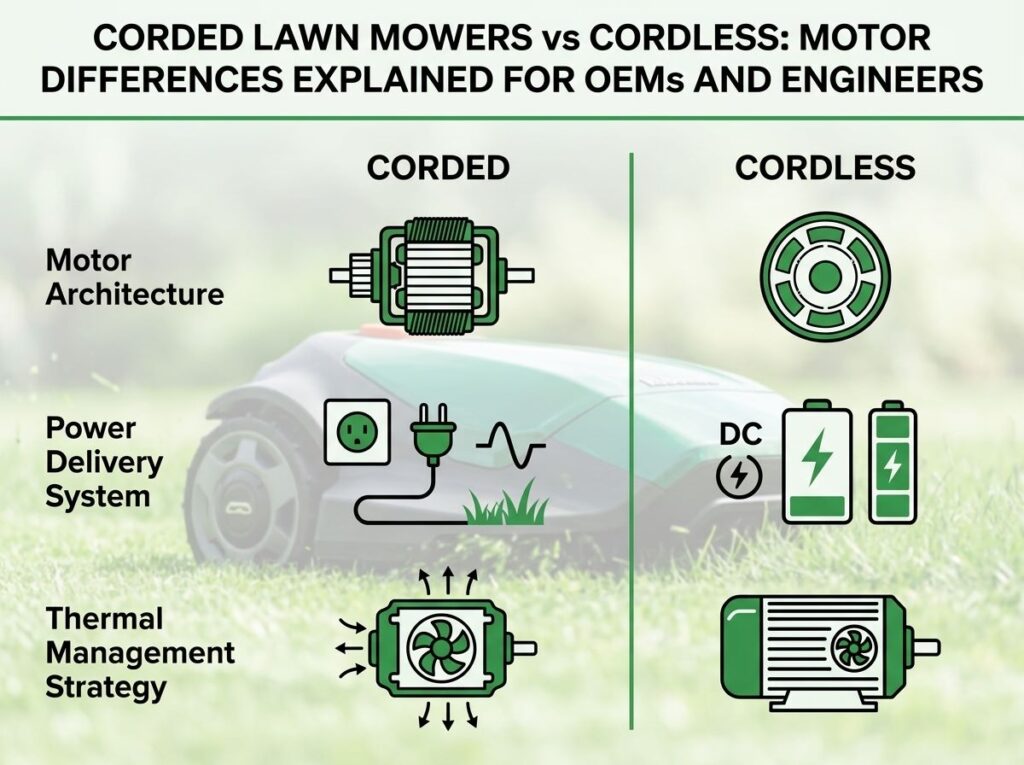
Corded and cordless lawn mowers use fundamentally different motor architectures, power delivery systems, and thermal management strategies. Corded lawn mowers traditionally rely on AC universal motors or induction motors connected directly to grid power, while cordless lawn mowers primarily use high-efficiency BLDC (CC senza spazzole) motors powered by lithium-ion battery systems.
Per gli ingegneri, Produttori OEM, and procurement teams, the motor difference is far more important than the power source alone. Motor topology directly affects torque density, cutting consistency, efficienza energetica, rumore, durata, thermal stability, e il costo totale del sistema. In modern commercial mower platforms, cordless BLDC motor systems increasingly outperform traditional corded solutions in controllability and efficiency, while corded motors still maintain advantages in continuous runtime and lower upfront cost.
This article explains the engineering-level motor differences between corded and cordless lawn mowers, including motor structure, sistemi di controllo, prestazione termica, affidabilità, OEM selection criteria, and future market trends.
What Is the Difference Between Corded and Cordless Lawn Mower Motors?
The primary difference between corded and cordless lawn mower motors lies in the electrical power architecture and motor control strategy. Corded lawn mowers receive continuous AC power from an electrical outlet, while cordless lawn mowers operate from DC battery packs combined with electronic motor controllers.
Corded Lawn Mower Motors
Most corded electric lawn mowers use either universal brushed motors or small AC induction motors. Universal motors are lightweight, poco costoso, and capable of high rotational speed. Because they can operate on both AC and DC power, manufacturers often choose them for low-cost consumer mower platforms.
Tuttavia, universal motors generate significant brush wear, rumore acustico, and heat under high-load grass cutting conditions. Torque regulation is also relatively limited because speed control is often mechanical or basic electronic phase control rather than closed-loop digital control.
Cordless Lawn Mower Motors
Cordless lawn mowers typically use BLDC motors integrated with inverter controllers and lithium battery systems. These motors eliminate brushes and mechanical commutation entirely. Electronic commutation allows precise current control, enabling higher efficiency and better torque delivery under varying grass density.
Modern OEM cordless mower systems increasingly adopt 48V, 60v, and 72V motor platforms because higher voltage reduces current draw and thermal stress. This architecture improves runtime, efficienza, and motor lifespan simultaneously.
For commercial-grade mower platforms, BLDC motors also provide superior compatibility with intelligent control features such as adaptive blade speed, inizio morbido, overload protection, and IoT diagnostics.
Why Are BLDC Motors Dominating Cordless Lawn Mowers?
BLDC motors have become the preferred solution for cordless lawn mower systems because they combine high efficiency, dimensione compatta, and advanced controllability. Compared with traditional brushed motors, BLDC designs significantly improve energy utilization and reduce maintenance requirements.
Higher Efficiency
Typical universal motors operate at approximately 60%–75% efficiency under real mowing conditions, especially when cutting thick or wet grass. By comparison, modern BLDC motors can exceed 85%–92% efficiency depending on controller quality and load profile.
Higher efficiency directly improves battery runtime in cordless systems. This is critical for OEMs competing in the commercial landscaping sector where runtime directly impacts labor productivity.
Better Torque Density
Torque density is one of the most important advantages of BLDC technology. Because electronic commutation optimizes phase switching continuously, BLDC motors maintain strong low-speed torque without excessive current spikes.
This becomes particularly important during sudden blade loading events such as:
- Wet grass cutting
- Tall vegetation
- Leaf accumulation
- Terreno irregolare
- Commercial landscaping applications
Higher torque density also allows OEM designers to reduce motor size and mower weight without sacrificing cutting performance.
Longer Lifespan
Brush wear is one of the most common failure points in universal motors. Since BLDC motors eliminate brushes entirely, operational lifespan increases substantially. Many industrial-grade BLDC mower motors achieve over 5,000–10,000 operating hours when thermal management is properly designed.
For commercial landscaping fleets, reduced maintenance significantly lowers total ownership cost.
Rasaerba a filo vs Cordless: Motor Performance Comparison
| Parametro | Corded Lawn Mower Motor | Cordless BLDC Lawn Mower Motor |
|---|---|---|
| Fonte di energia | AC Grid Power | Lithium Battery Pack |
| Typical Motor Type | universale / Motore a induzione | Motore BLDC |
| Efficienza | 60–75% | 85–92% |
| Densità di coppia | Moderare | Alto |
| Prestazioni termiche | High Heat Generation | Lower Heat Loss |
| Livello di rumore | Più alto | Inferiore |
| Manutenzione | Brush Replacement Required | Minimal Maintenance |
| Runtime Limitation | Unlimited | Battery Dependent |
| Complessità del controllore | Semplice | Advanced Electronic Control |
| OEM Integration | Limited Smart Features | Excellent Smart Integration |
| Applicazioni industriali | Light Residential Use | Residential + Commerciale |
Although corded mower systems still offer unlimited runtime and lower entry cost, cordless BLDC systems provide substantial engineering advantages in efficiency, precisione del controllo, prestazione acustica, e affidabilità a lungo termine.
Efficiency and Energy Consumption Differences
Efficiency is one of the most critical engineering metrics when evaluating lawn mower motor systems. Motor efficiency directly affects energy consumption, thermal stability, runtime, and overall operating cost.
Why Corded Motors Lose More Energy
Universal motors experience substantial energy loss through:
- Brush friction
- Commutator sparking
- Perdite di rame
- Magnetic hysteresis
- Resistenza meccanica
These losses increase dramatically during high-load mowing conditions. As motor temperature rises, winding resistance also increases, further reducing efficiency.
Perché i motori BLDC sono più efficienti
BLDC motors use permanent magnet rotors and electronic commutation, eliminating brush losses entirely. Advanced field-oriented control (Foc) algorithms further optimize phase current to maximize torque per ampere.
This efficiency advantage is especially important in battery-powered mower systems because every percentage point of efficiency directly impacts runtime.
Per esempio, a 48V BLDC mower motor operating at 90% efficiency can provide significantly longer runtime than a comparable brushed system operating at 70% efficienza.
OEM manufacturers increasingly prioritize efficiency because global energy regulations and sustainability standards continue tightening across outdoor power equipment markets.
Thermal Performance and Cooling Challenges
Thermal management is one of the most underestimated factors in lawn mower motor design. Heat accumulation directly affects insulation lifespan, controller reliability, bearing durability, and overall system stability.
Thermal Issues in Corded Motors
Universal motors generate high internal heat because brush friction and commutation create additional energy loss. During continuous heavy mowing, internal temperatures can rise rapidly beyond optimal operating conditions.
Many low-cost corded mower systems rely solely on passive airflow cooling generated by blade rotation. Under restricted airflow conditions, thermal stress increases significantly.
BLDC Thermal Advantages
BLDC motors inherently produce less heat because they eliminate mechanical commutation. Inoltre, stator windings are easier to cool because heat is generated primarily in the stationary section rather than the rotor.
Commercial cordless mower systems often incorporate:
- Dissipazione del calore dell'alloggiamento in alluminio
- Raffreddamento ad aria forzata
- Temperature sensors
- Dynamic current limiting
- Smart thermal shutdown protection
These features dramatically improve operational reliability under demanding commercial workloads.
For OEM mower manufacturers, proper thermal design is essential when integrating high-power 72V industrial motor platforms.
Sistemi di controllo: Simple AC Control vs Intelligent BLDC Control
The motor controller is one of the biggest differentiators between corded and cordless mower platforms.
Corded Motor Control
Corded mower systems often use relatively simple switching architectures. Some low-cost models provide only ON/OFF operation without closed-loop speed regulation.
Even variable-speed AC mower systems typically rely on:
- Triac phase-angle control
- Basic PWM circuits
- Limited feedback systems
Di conseguenza, blade speed may fluctuate significantly under changing grass density.
Controllo motore BLDC
Modern cordless lawn mowers use sophisticated inverter systems combined with microcontroller-based algorithms.
Advanced control features include:
- Field-oriented control (Foc)
- Sensorless commutation
- Feedback del sensore Hall
- Adaptive torque control
- Current limiting
- Regenerative braking
- Overload detection
These technologies improve cutting consistency while minimizing battery consumption.
For commercial robotic mower systems, intelligent BLDC control also enables autonomous navigation and AI-based workload optimization.
Affidabilità e durata: Which Motor Lasts Longer?
Reliability is a major purchasing factor for both commercial landscaping operators and OEM equipment brands.
Universal Motor Reliability Limitations
Brushed universal motors experience multiple wear mechanisms:
- Brush erosion
- Commutator wear
- Sparking damage
- Bearing contamination
- Thermal insulation aging
In demanding mowing environments containing dust, umidità, e vibrazioni, these failure modes accelerate rapidly.
BLDC Reliability Advantages
BLDC motors eliminate the brush system entirely, significantly reducing mechanical wear. Because there is no commutator contact, electrical arcing disappears as well.
Industrial-grade BLDC mower motors commonly achieve:
- Longer bearing life
- Vibrazioni inferiori
- Reduced maintenance intervals
- Higher thermal stability
- Improved environmental resistance
This makes BLDC motors especially suitable for:
- Commercial landscaping fleets
- Autonomous robotic mowers
- Municipal maintenance equipment
- Professional-grade outdoor power tools
How to Choose a Lawn Mower Motor for OEM Applications
Selecting the correct mower motor requires balancing efficiency, coppia, thermal stability, controller compatibility, and manufacturing cost.
Voltage Selection
Voltage directly affects current draw and system efficiency.
- 24Sistemi V: Small residential mowers
- 48Sistemi V: Mid-range cordless mowers
- 60V–72V systems: Commercial-grade platforms
Higher voltage reduces current, improving thermal efficiency and cable performance.
Power Range Selection
Typical lawn mower motor power ratings include:
- 500W–1000 W: Compact residential mowers
- 1.5kW–3kW: Medium-duty cordless systems
- 3kW–8kW: Commercial mower platforms
Heavy grass conditions require higher peak torque capability rather than simply higher continuous power.
Requisiti di velocità e coppia
Blade tip speed is critical for cutting quality. OEM engineers must balance:
- RPM stability
- Peak torque response
- Overload tolerance
- Acoustic noise
BLDC motors provide better torque regulation during transient loading conditions.
Metodo di raffreddamento
Cooling design should match duty cycle requirements:
- Passive air cooling
- Raffreddamento ad aria forzata
- Integrated aluminum heat sink
- Liquid cooling for industrial systems
Compatibilità del controller
Motor-controller integration is essential in cordless mower platforms.
Engineers should evaluate:
- Communication protocols
- Current handling capability
- Sensor compatibility
- Battery management integration
- Safety certifications
Greensky Power supports customized BLDC motor solutions for lawn mower OEMs, including integrated controller matching and custom voltage platforms.
Related solutions:
Corded vs Cordless Lawn Mowers in Commercial Applications
Commercial landscaping applications place significantly higher demands on motor systems than residential mowing.
Where Corded Mowers Still Work
Corded mowers remain suitable for:
- Small residential lawns
- Noise-sensitive areas
- Budget-focused consumer markets
- Light-duty trimming applications
Because runtime is unlimited, corded systems can continuously operate without battery charging downtime.
Why Commercial Markets Prefer Cordless BLDC Systems
Commercial landscaping companies increasingly prefer cordless platforms because they offer:
- Greater mobility
- Lower acoustic noise
- Reduced fuel dependency
- Lower maintenance cost
- Higher operational flexibility
Municipal regulations banning gasoline-powered outdoor equipment are also accelerating the transition toward battery-powered BLDC mower systems.
In robotic mowing applications, cordless BLDC architectures are effectively mandatory due to autonomous mobility requirements.
Future Trends in Lawn Mower Motor Technology
The global outdoor power equipment industry is rapidly transitioning toward intelligent electrified platforms.
High-Voltage Battery Systems
72V and higher battery architectures are becoming increasingly common in commercial mower platforms because they reduce current stress while improving power density.
Integrated Smart Controllers
Future mower motors will increasingly integrate:
- AI load optimization
- Wireless diagnostics
- Cloud connectivity
- Manutenzione predittiva
- Fleet management systems
Axial Flux Motor Adoption
Axial flux BLDC motors offer extremely high torque density with compact packaging. These motors may become attractive for next-generation robotic mower systems.
Sustainability and Efficiency Regulations
Global efficiency regulations are pushing manufacturers toward higher-performance motor platforms with lower energy consumption and reduced lifecycle emissions.
OEMs investing in advanced BLDC technologies today will be better positioned for long-term regulatory compliance and market competitiveness.
Domande frequenti: Corded Lawn Mowers vs Cordless Motor Differences
Are cordless lawn mower motors more efficient than corded motors?
SÌ. Most cordless lawn mowers use BLDC motors that achieve significantly higher efficiency than traditional universal motors used in corded systems. Higher efficiency reduces heat generation and improves runtime.
Why are BLDC motors better for lawn mowers?
BLDC motors provide higher torque density, Manutenzione inferiore, reduced noise, and better electronic control. These advantages improve cutting consistency and overall system reliability.
Do corded lawn mowers have more power?
Non necessariamente. While corded mowers have continuous power availability, modern high-voltage cordless BLDC systems can achieve equal or higher peak power output with better torque management.
What voltage is best for cordless lawn mower motors?
48V systems are common for residential applications, while 60V–72V platforms are increasingly preferred for commercial and industrial-grade mower equipment due to improved efficiency and thermal performance.
Which motor lasts longer: brushed or brushless?
Brushless motors typically last much longer because they eliminate brush wear and commutator damage. Industrial BLDC motors can operate for thousands of hours with minimal maintenance.
Can BLDC motors be customized for OEM lawn mower projects?
SÌ. OEM manufacturers commonly customize voltage, shaft configuration, cooling design, winding parameters, and controller integration for specific mower platforms and regional certification requirements.
Conclusione: Quale tecnologia motoristica è migliore?
Dal punto di vista ingegneristico, cordless BLDC lawn mower motors outperform traditional corded motor systems in efficiency, densità di coppia, controllability, gestione termica, e affidabilità a lungo termine.
Corded lawn mowers still provide advantages in low upfront cost and unlimited runtime for light residential applications. Tuttavia, the industry trend is clearly moving toward intelligent high-efficiency cordless systems driven by BLDC motor technology.
For OEMs and commercial equipment manufacturers, selecting the right motor platform now requires evaluating not only power output, but also thermal design, integrazione del controllore, battery architecture, and future regulatory requirements.
Greensky Power provides customized BLDC motor solutions for lawn mower manufacturers, Compreso:
- 48V and 72V mower motor systems
- High-efficiency industrial BLDC motors
- Integrated controller matching
- Custom OEM motor development
- Thermal optimization engineering
To request technical specifications, application recommendations, or OEM customization support, contact our engineering team for a detailed consultation.
Riferimenti
- https://www.energy.gov/eere/vehicles/articles/fact-861-february-23-2015-electric-vehicle-efficiency
- https://ieeexplore.ieee.org/document/9099627
- https://www.sciencedirect.com/topics/engineering/brushless-dc-motor
- https://www.nrel.gov/docs/fy19osti/73396.pdf
- https://www.mdpi.com/1996-1073/14/3/655
- https://www.britannica.com/technology/electric-motor
- https://www.energy.gov/energysaver/lawn-and-garden-equipment