
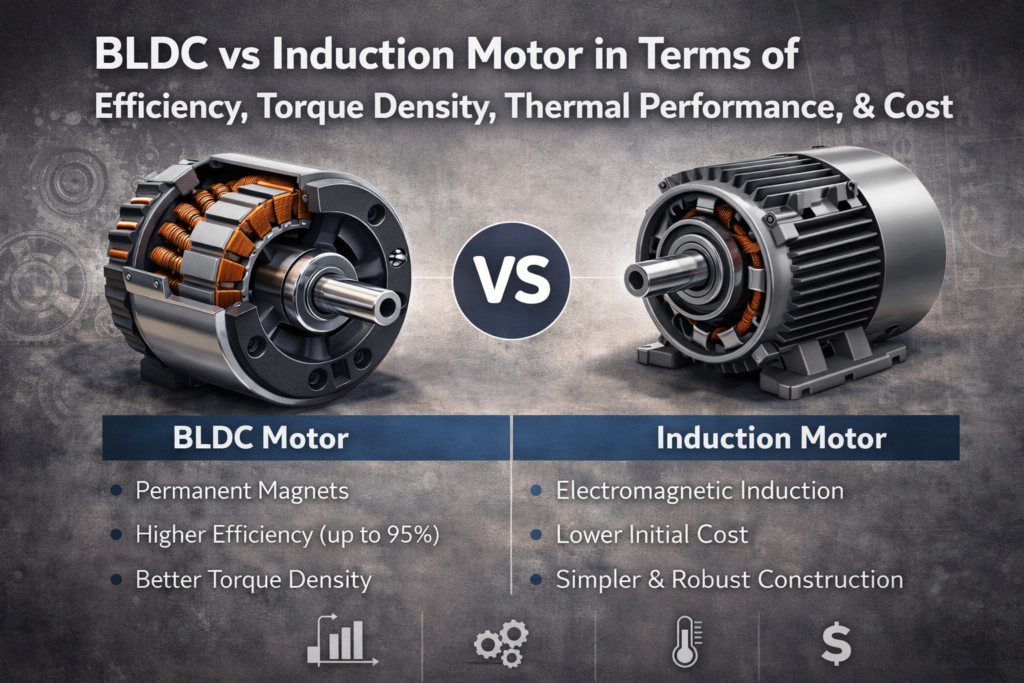
BLDC vs motore a induzione in termini di efficienza, Densità di coppia, Prestazioni termiche, e costo
Frammento in primo piano:
BLDC motors outperform induction motors in efficiency (fino a 95%), densità di coppia, and thermal performance due to permanent magnet design and electronic commutation. Motori asincroni, Tuttavia, offer lower upfront cost, simpler construction, and strong robustness for industrial environments. In applications such as biomass boilers, Sistemi HVAC, and electric drives, the choice depends on lifecycle cost, control requirements, and operating conditions. Per OEM e acquirenti industriali, BLDC motors are increasingly preferred for energy efficiency and precision control, while induction motors remain a cost-effective solution for standard-duty systems.
What is BLDC Motor and Induction Motor?
BLDC (CC senza spazzole) motors and induction motors are two dominant technologies in industrial motor applications. Understanding their working principles is essential before comparing efficiency, densità di coppia, prestazione termica, e costo.
BLDC Motor Definition
BLDC motors use permanent magnets on the rotor and electronic commutation to control current flow. This eliminates mechanical brushes and reduces energy loss, making them highly efficient and precise.
Induction Motor Definition
Induction motors operate using electromagnetic induction. The rotor is energized through induced current, which leads to inherent energy losses but offers robust and simple construction.
Explore BLDC solutions: BLDC Motor Portfolio
Why Compare BLDC vs Induction Motor?
Per ingegneri e responsabili degli acquisti, choosing between BLDC and induction motors directly affects system performance, operational cost, e affidabilità a lungo termine. This comparison is particularly critical in continuous-duty systems such as biomass boilers, pompe, e automazione industriale.
Key Decision Drivers
- Energy efficiency in 24/7 operazione
- Torque performance under varying loads
- Thermal behavior and cooling requirements
- Total cost of ownership (TCO)
Industry Reality
While induction motors dominate legacy systems, the shift toward energy efficiency is accelerating the adoption of BLDC motors in modern designs.
Efficienza: BLDC e motore a induzione
Efficiency determines how much electrical energy is converted into mechanical output, directly affecting operating cost.
Efficienza del motore BLDC
- Typically 90–95%
- Minimal rotor losses
- No brush friction
Induction Motor Efficiency
- Typically 75–90%
- Rotor copper losses
- Slip-related inefficiencies
Intuizione ingegneristica
In continuous applications such as biomass boiler fans or pumps, even a 5% efficiency difference can translate into significant annual energy savings. Over a 5–10 year lifecycle, this becomes a major cost factor.
Densità di coppia: BLDC e motore a induzione
Torque density refers to how much torque a motor can produce relative to its size and weight.
Motori BLDC
- High torque density due to permanent magnets
- Compatto e leggero
- Coppia di spunto elevata
Motori a induzione
- Moderate torque density
- Larger size for equivalent torque
- Lower starting torque without control systems
Approfondimento dell'applicazione
In biomass boiler systems, fuel feeding mechanisms require high torque at low speed, where BLDC or geared solutions outperform standard induction motors.
Prestazioni termiche e gestione del calore
Thermal performance is critical in industrial environments where motors operate continuously under load.
Motori BLDC
- Minore generazione di calore
- Higher efficiency reduces thermal stress
- Improved lifespan
Motori a induzione
- Higher heat due to rotor losses
- Requires robust cooling systems
Intuizione ingegneristica
Better thermal performance not only improves reliability but also allows higher power density in compact systems, reducing installation footprint.
Sistemi di controllo: BLDC e motore a induzione
Control capability significantly affects performance and flexibility.
Controllo motore BLDC
- Controllo orientato al campo (Foc)
- Precise speed and torque regulation
- Elevata risposta dinamica
Induction Motor Control
- Requires VFD for variable speed
- Less precise control compared to BLDC
Intuizione ingegneristica
Advanced control is essential for optimizing airflow and fuel feeding in biomass systems, making BLDC motors more suitable for modern automated systems.
Confronto tra affidabilità e durata della vita
Reliability determines maintenance cost and system uptime.
Motori BLDC
- No brushes → less wear
- Lunga durata (20,000–50,000 hours)
Motori a induzione
- Robust mechanical design
- Maintenance required for bearings and insulation
Intuizione ingegneristica
While both motor types are reliable, BLDC motors offer lower maintenance due to reduced mechanical components.
Analisi dei costi: BLDC e motore a induzione
| Parametro | Motore BLDC | Motore a induzione |
|---|---|---|
| Costo iniziale | Più alto | Inferiore |
| Efficienza | 90–95% | 75–90% |
| Costo di manutenzione | Basso | Moderare |
| Costo energetico | Basso | Più alto |
| Costo del ciclo di vita | Inferiore | Più alto |
Interpretazione ingegneristica
Although BLDC motors have higher upfront cost, their lower energy consumption and maintenance requirements result in lower total cost of ownership over time.
Advantages and Disadvantages of BLDC vs Induction Motor
Vantaggi del motore BLDC
- Alta efficienza
- Elevata densità di coppia
- Excellent control
- Manutenzione ridotta
BLDC Motor Disadvantages
- Costo più elevato
- Requires controller
Induction Motor Advantages
- Basso costo
- Design semplice
- High durability
Induction Motor Disadvantages
- Minore efficienza
- Higher heat generation
- Limited control
How to Choose Between BLDC vs Induction Motor for Industrial Applications
Motor selection should align with system requirements and long-term operational goals.
Intervallo di tensione
- BLDC: 24V–72V or higher
- Induzione: 220V–380V standard
Scala di potenza
- Small systems: 0.5kW–5kW
- Sistemi industriali: 5kW–100kW+
Velocità / Coppia
Match torque requirements to application load, especially for conveyors and fans.
Metodo di raffreddamento
- Air cooling for standard use
- Enhanced cooling for high-temperature environments
Compatibilità del controller
BLDC requires dedicated controllers; induction motors require VFD for variable speed.
Considerazioni specifiche sull'applicazione
- Continuous vs intermittent operation
- Sensibilità al costo energetico
- Automation level
CTA: Request datasheet or contact our engineers for customized motor solutions.
Applications of BLDC and Induction Motors
Applicazioni industriali
- Caldaie a biomassa
- Sistemi di produzione
HVAC e pompe
- Ventilatori e soffiatori
- Water circulation systems
Veicoli elettrici
- 48v / 72V drive motors
- Motori del mozzo
Explore EV solutions: Electric Vehicle Motors
Tendenze future: Will BLDC Replace Induction Motors?
The motor industry is evolving toward higher efficiency and smarter systems.
Tendenze chiave
- Adoption of BLDC in industrial applications
- Integration with IoT and smart control
- Focus on energy efficiency and sustainability
While induction motors will remain in use, BLDC motors are expected to dominate high-efficiency applications.
Domande frequenti: BLDC e motore a induzione
1. Quale motore è più efficiente?
BLDC motors are more efficient due to reduced electrical and mechanical losses.
2. Which motor has higher torque density?
BLDC motors provide higher torque density, allowing more compact designs.
3. Are induction motors cheaper?
SÌ, induction motors have lower upfront cost but higher operating cost.
4. Which motor lasts longer?
BLDC motors typically have longer lifespan due to reduced wear.
5. Which motor is better for industrial use?
It depends on the application—BLDC for efficiency and control, induction for cost-sensitive systems.
Conclusione: Which Motor is Better?
BLDC motors outperform induction motors in efficiency, densità di coppia, and thermal performance, rendendoli ideali per le moderne applicazioni industriali. Tuttavia, induction motors remain relevant due to their simplicity and lower initial cost.
Per OEM e acquirenti industriali, the decision should be based on lifecycle cost, requisiti di prestazione, and system integration needs.
Passaggio successivo: Contact our engineering team to develop a customized motor solution tailored to your application.
Riferimenti
- IEEE Motor Efficiency Studies
- IEA Energy Reports
- Industrial Motor Design Journals
- Electric Drive Engineering Textbooks