
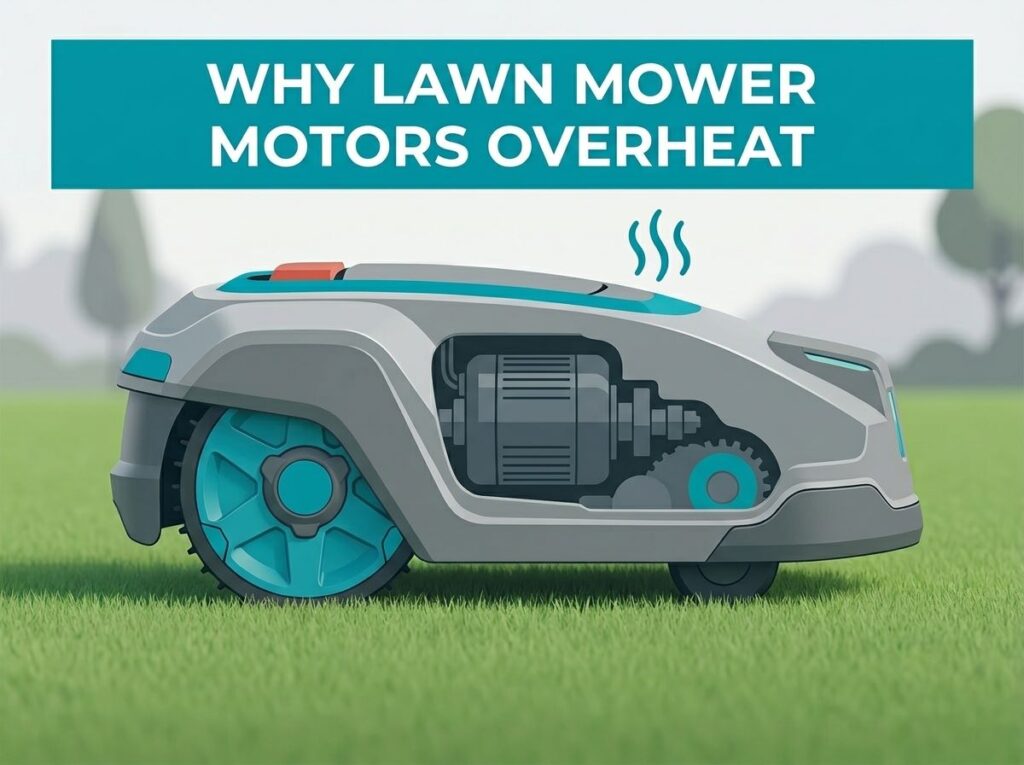
Pourquoi les moteurs des tondeuses à gazon surchauffent
Extrait en vedette:
Lawn mower motors overheat when heat generation exceeds the motor’s ability to dissipate it. Common causes include motor overload, insufficient cooling, excessive current draw, poor controller tuning, dull cutting blades, high ambient temperatures, and improper motor sizing. Overheating reduces efficiency, accelerates insulation aging, damages bearings and magnets, and significantly shortens motor lifespan. Modern high-efficiency BLDC motors combined with optimized thermal management systems provide the most effective solution for preventing overheating in residential, commercial, and robotic lawn mower applications.
For OEM manufacturers and engineers, understanding why lawn mower motors overheat is critical for improving product reliability, reducing warranty costs, extending service life, and delivering superior cutting performance under demanding operating conditions.
What Causes Lawn Mower Motors to Overheat?
Motor overheating occurs when electrical and mechanical losses generate heat faster than it can be removed from the motor structure. Every electric motor converts a portion of input energy into heat through copper losses, iron losses, mechanical friction, and switching losses.
Dans les applications de tondeuse à gazon, overheating risks are particularly high because motors operate outdoors under varying environmental conditions while experiencing rapidly changing loads caused by grass density, terrain, moisture content, and blade impacts.
Primary Sources of Heat Generation
- Pertes de cuivre (Pertes I²R)
- Core losses in stator laminations
- Frottement des roulements
- Windage losses
- Controller switching losses
- Mechanical overload conditions
Although all motors generate heat, properly engineered systems maintain thermal equilibrium where generated heat equals dissipated heat. Problems arise when this balance is disrupted.
Why Motor Overload Is the Leading Cause of Overheating
Overload operation remains the most common reason lawn mower motors overheat.
Motor torque demand increases dramatically when operators cut tall grass, végétation humide, dense weeds, or operate on steep slopes. Because motor current is directly proportional to torque demand, overload conditions quickly increase winding temperatures.
Common Overload Scenarios
- Cutting excessively tall grass
- Mowing wet vegetation
- Using dull blades
- Blade obstruction by debris
- Continuous operation at maximum load
- Improper deck design
Many OEMs underestimate transient torque peaks during real-world operation. While average load may appear acceptable, short-duration overload events can repeatedly stress the motor and accelerate thermal degradation.
Engineering Solution
The most effective solution is selecting a motor with sufficient torque reserve and overload capability. High-quality BLDC motors typically provide superior overload performance compared with traditional brushed motors and many low-cost AC motor designs.
How Motor Efficiency Affects Operating Temperature
Efficiency and temperature are directly connected. Motors with lower efficiency convert more electrical energy into waste heat.
Par exemple, a motor operating at 80% gaspillage d'efficacité 20% of its input power as heat, whereas a motor operating at 92% efficiency generates substantially less thermal energy.
Heat Generation Comparison
| Efficacité du moteur | Input Power | Useful Output | Heat Loss |
|---|---|---|---|
| 80% | 1000O | 800O | 200O |
| 85% | 1000O | 850O | 150O |
| 92% | 1000O | 920O | 80O |
This difference becomes significant during extended mowing cycles. Lower heat generation improves thermal performance, increases reliability, and extends motor lifespan.
BLDC vs Brushed Motors: Which Runs Cooler?
One of the most common engineering questions is whether BLDC motors run cooler than brushed motors.
| Paramètre | Moteur BLDC | Moteur brossé |
|---|---|---|
| Efficacité | 85–95% | 70–85% |
| Production de chaleur | Faible | Haut |
| Brush Friction | Aucun | Present |
| Entretien | Minimal | Fréquent |
| Stabilité thermique | Excellent | Modéré |
| Durée de vie | Long | Plus court |
Because BLDC motors eliminate brush friction and commutation losses, they generate less waste heat and maintain higher efficiency across a broader operating range.
This is one reason premium electric lawn mowers and robotic mower platforms increasingly rely on BLDC technology.
Why Poor Cooling Design Causes Motor Overheating
Even highly efficient motors will overheat if cooling systems are inadequate.
Heat must travel from windings to the stator, logement, and ultimately to the surrounding air. Any bottleneck in this thermal pathway increases operating temperature.
Common Cooling Problems
- Restricted airflow paths
- Small housing surface area
- Poor thermal conductivity materials
- Blocked cooling vents
- Dust accumulation
- Inadequate fan design
Cooling Methods Used in Lawn Mowers
| Méthode de refroidissement | Coût | Effectiveness |
|---|---|---|
| Convection naturelle | Faible | Modéré |
| Integrated Fan Cooling | Moyen | Haut |
| Refroidissement par air forcé | Plus haut | Très élevé |
| Refroidissement liquide | Très élevé | Excellent |
Most residential mowers use natural or fan-assisted cooling, while commercial equipment increasingly adopts advanced thermal management systems.
How Controller Settings Contribute to Overheating
Motor overheating is not always caused by the motor itself. Controller tuning plays a critical role in thermal performance.
Common Controller Issues
- Incorrect current limits
- Aggressive acceleration profiles
- Poor FOC tuning
- Improper PWM frequency
- Sensor calibration errors
When controller parameters are poorly optimized, motors draw excessive current and generate unnecessary heat even under moderate mechanical loads.
Advanced Field-Oriented Control (FOC) algorithms improve torque production efficiency while minimizing heat generation.
How Overheating Impacts Reliability and Lifespan
Temperature is one of the most influential factors affecting motor longevity.
Each component inside the motor responds differently to thermal stress, but all experience accelerated aging when temperatures rise beyond design limits.
Components Affected by Heat
- Stator winding insulation
- Permanent magnets
- Roulements
- Adhesives
- Electronic sensors
- Controller components
Repeated overheating events often result in gradual performance degradation before catastrophic failure occurs.
OEM manufacturers should evaluate long-term thermal exposure rather than focusing only on peak operating temperatures.
How to Choose a Lawn Mower Motor That Resists Overheating
Proper motor selection is the most effective way to prevent thermal issues before they occur.
Sélection de la plage de tension
- 24V robotic lawn mowers
- 36V residential models
- 48V premium electric mowers
- 72V plateformes commerciales
Power Range Recommendations
| Application | Recommended Power |
|---|---|
| Robotic Mower | 100W–1000W |
| Residential Mower | 500W–3000W |
| Commercial Mower | 3kW–10kW+ |
Exigences de vitesse et de couple
Motors should be selected based on worst-case operating conditions rather than average mowing loads. Adequate torque reserve prevents continuous overload operation and minimizes heat buildup.
Compatibilité du contrôleur
Choose motors designed for advanced FOC controllers capable of temperature monitoring, current limiting, and predictive thermal protection.
Pour les projets OEM, Greensky Power offers custom 48V and 72V BLDC motor platforms optimized for high-efficiency lawn mower applications. Request a datasheet or discuss your project with our engineering team.
Applications Where Thermal Management Is Critical
The thermal design principles used in lawn mower motors apply to many industries requiring compact, high-power electric drive systems.
Applications industrielles
- Robots mobiles autonomes
- AGV d’entrepôt
- Industrial drive systems
Applications automobiles et véhicules électriques
- Trottinettes électriques
- Utility EVs
- Moteurs de moyeu
Applications CVC
- Variable-speed fans
- Smart pumps
- Air handling units
Applications robotiques
- Tondeuses à gazon robotisées
- Robots agricoles
- Inspection robots
In all of these applications, efficient heat management directly impacts performance and reliability.
Future Trends in Lawn Mower Motor Thermal Management
The next generation of lawn mower motors will rely increasingly on intelligent thermal management technologies.
- Embedded temperature sensors
- AI-driven thermal prediction
- Digital twin simulations
- Contrôleurs de moteur intelligents
- Predictive maintenance systems
- High-conductivity housing materials
As battery-powered outdoor equipment becomes more powerful, thermal engineering will become a primary differentiator between premium and low-cost products.
FAQ: Pourquoi les moteurs des tondeuses à gazon surchauffent
Why does my lawn mower motor get hot so quickly?
Rapid heating is usually caused by overload conditions, blocked airflow, controller misconfiguration, or insufficient motor power for the application. High current draw produces excessive copper losses that quickly raise temperature.
Can overheating permanently damage a lawn mower motor?
Oui. Excessive heat can degrade winding insulation, weaken permanent magnets, damage bearings, and shorten the lifespan of electronic components. Repeated overheating significantly reduces reliability.
Are BLDC motors less likely to overheat?
Generally yes. BLDC motors operate at higher efficiency, eliminate brush friction losses, and provide better thermal performance than traditional brushed motors.
How can I reduce lawn mower motor temperature?
Use sharp blades, avoid overloading the mower, improve airflow, select an appropriately sized motor, and ensure controller settings are properly optimized.
Does higher motor efficiency reduce overheating?
Absolument. Higher efficiency means less energy is wasted as heat, resulting in lower operating temperatures and improved reliability.
What temperature is too hot for a lawn mower motor?
Acceptable temperatures depend on insulation class and motor design. Cependant, continuous operation above rated winding temperatures accelerates aging and increases failure risk.
Conclusion
Lawn mower motor overheating is typically caused by overload conditions, poor cooling design, faible efficacité, controller misconfiguration, or improper motor selection. While overheating may initially appear as a simple performance issue, it is often the root cause of reduced reliability, shortened lifespan, and increased warranty claims.
Modern high-efficiency BLDC motors combined with optimized thermal management strategies provide the most effective solution for residential, commercial, and robotic mower platforms.
Pour les fabricants OEM, investing in proper motor sizing, intégration du contrôleur, and cooling system design delivers long-term benefits through improved product durability and customer satisfaction.
Demander une fiche technique, obtenez une solution OEM, or contact our engineers to discuss custom solutions de moteur de tondeuse à gazon.
Références
- https://ieeexplore.ieee.org
- https://www.ieee.org
- https://www.energy.gov/eere/amo/articles/premium-efficiency-motor-selection-and-application-guide
- https://www.nrel.gov/docs/fy19osti/73396.pdf
- https://www.sciencedirect.com/topics/engineering/electric-motor
- https://www.sciencedirect.com/topics/engineering/thermal-management
- https://www.mdpi.com/1996-1073/14/3/655
- https://www.britannica.com/technology/electric-motor