
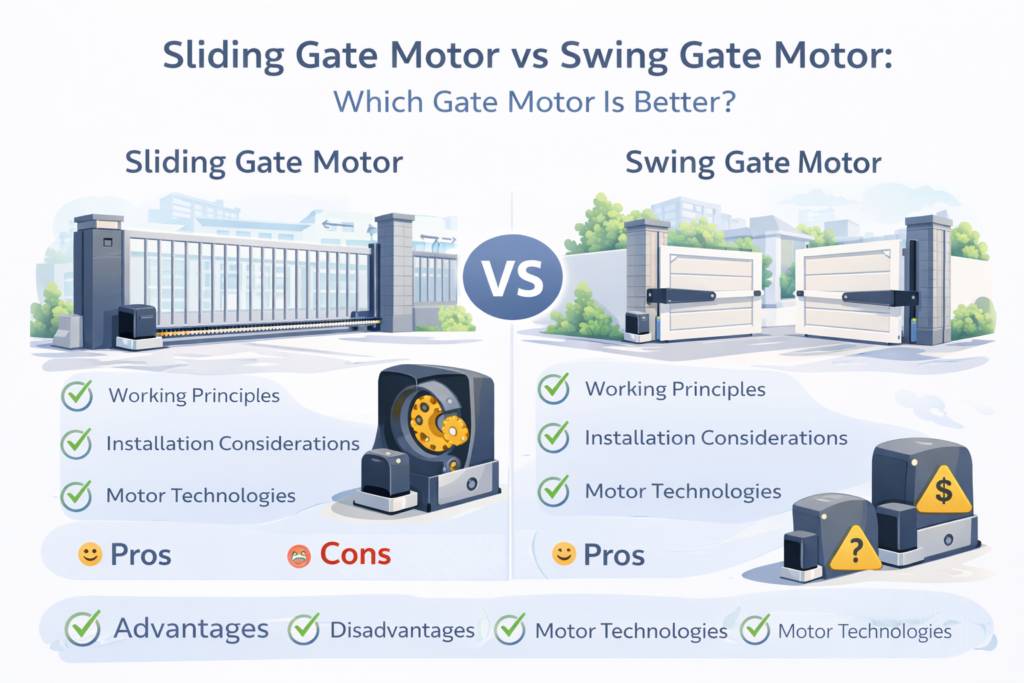
Moteur de portail coulissant vs moteur de portail battant: Quel moteur de portail est le meilleur?
Automatic gate systems are widely used in residential homes, commercial buildings, installations industrielles, and gated communities. They improve security, provide convenient access control, and enhance the overall functionality of entrances.
Cependant, when planning a gate automation system, one of the most common questions installers, property owners, and equipment manufacturers ask is:
Should you choose a sliding gate motor or a swing gate motor?
Both gate systems are widely used worldwide, but they are designed for different installation conditions, gate structures, et les exigences opérationnelles.
Understanding the differences between a sliding gate motor vs swing gate motor is essential for selecting the right solution for residential or commercial gate automation projects.
This guide explains the working principles, avantages, disadvantages, installation considerations, and motor technologies used in sliding and swing gate systems.
Réponse rapide: Moteur de portail coulissant vs moteur de portail battant
The main difference between a sliding gate motor and a swing gate motor lies in how the gate opens.
- Moteurs pour portails coulissants move the gate horizontally along a track.
- Swing gate motors open the gate inward or outward on hinges like a door.
Sliding gate motors are generally better for heavy gates and limited space environments, while swing gate motors are commonly used in residential properties with sufficient opening space.
What Is a Sliding Gate Motor?
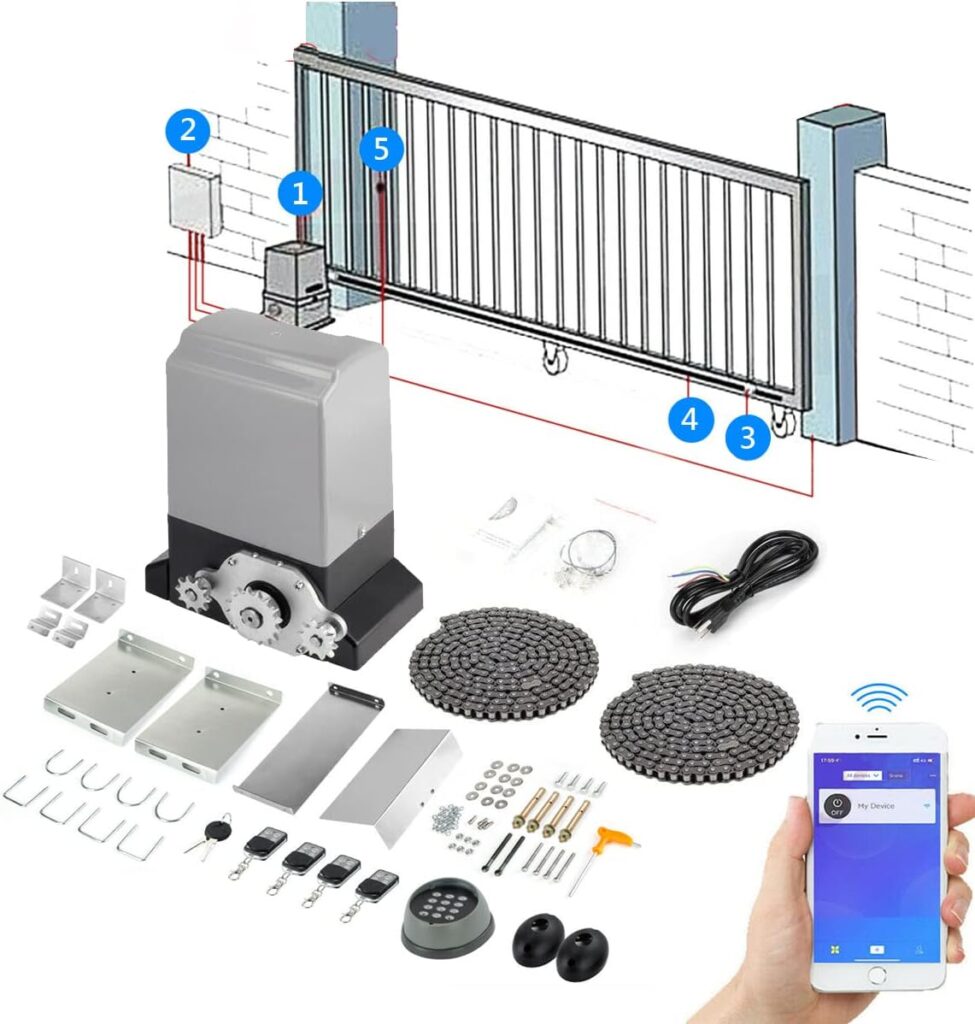
UN sliding gate motor is an electric drive system designed to move a gate sideways along a rail or track. The motor drives a gear that engages with a rack mounted on the gate, allowing the gate to slide open or closed.
Sliding gate systems are widely used in locations where driveway space is limited or where heavy gates must be automated.
How Sliding Gate Motors Work
The sliding gate motor rotates a pinion gear that meshes with a toothed rack installed along the gate. When the motor turns, the gear moves the gate horizontally.
Modern sliding gate systems often include:
- Electric gate motor avec boîte de vitesses
- Electronic control board
- Safety sensors
- Remote control access
- Obstacle detection system
Advantages of Sliding Gate Motors
- Suitable for heavy gates
- Fonctionnement stable
- Space-efficient design
- Haute durabilité
Disadvantages of Sliding Gate Motors
- Requires a ground track
- Track maintenance may be required
- Installation may require precise alignment
What Is a Swing Gate Motor?
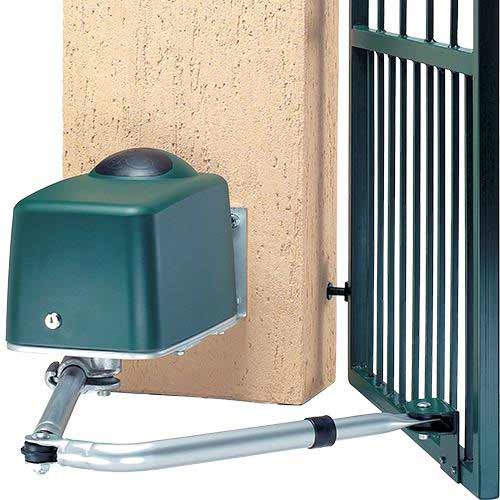
UN swing gate motor is designed to open gates that pivot on hinges. These gates move inward or outward similar to a traditional door.
Swing gate motors are very common in residential driveway entrances.
How Swing Gate Motors Work
Swing gate motors operate by pushing or pulling the gate leaf through a mechanical arm or actuator.
The motor generates rotational or linear movement that opens the gate.
Types of Swing Gate Motors
Linear Actuator Motors
Linear actuator motors extend and retract a rod that pushes or pulls the gate.
Articulated Arm Motors
These motors use a jointed arm mechanism and are suitable for installations with wide gate pillars.
Underground Motors
Underground motors are installed beneath the gate to keep the automation system hidden.
Advantages of Swing Gate Motors
- Simple installation
- Elegant gate appearance
- Suitable for residential properties
Disadvantages of Swing Gate Motors
- Requires sufficient swing space
- Less suitable for very heavy gates
- Wind resistance may affect performance
Sliding Gate vs Swing Gate: Différences clés
| Fonctionnalité | Moteur de portail coulissant | Moteur de portail battant |
|---|---|---|
| Gate Movement | Slides horizontally | Opens inward or outward |
| Espace requis | Requires side space | Requires swing clearance |
| Gate Weight Capacity | Suitable for heavy gates | Better for lighter gates |
| Installation Complexity | Modéré | Simple |
| Common Applications | Industrial and commercial | Residential properties |
Quel moteur de portail est le meilleur?
There is no universal answer to whether a sliding gate motor or swing gate motor is better. The best choice depends on installation conditions and gate design.
Choose a Sliding Gate Motor If:
- The gate is heavy
- The driveway has limited depth
- The gate must operate frequently
- Industrial durability is required
Choose a Swing Gate Motor If:
- The property has sufficient opening space
- The gate is relatively lightweight
- Aesthetic design is important
- Installation simplicity is preferred
Motor Technologies Used in Gate Automation
Both sliding and swing gate systems can use different motor technologies.
Moteurs à courant alternatif
AC motors are commonly used in heavy-duty industrial gate systems.
Advantages include durability and strong load capacity.
Moteurs à courant continu
DC motors are widely used in residential automation systems because they provide smooth speed control and lower energy consumption.
Moteurs CC sans balais
Modern gate automation systems increasingly use moteurs à courant continu sans balais. These motors eliminate carbon brushes and use electronic controllers for commutation.
Les avantages incluent:
- Durée de vie plus longue
- Efficacité supérieure
- Entretien réduit
- Fonctionnement silencieux
Brushless motors are becoming a preferred solution for modern gate automation equipment manufacturers.
Factors to Consider When Choosing a Gate Motor
Regardless of gate type, several factors should be evaluated when selecting a gate motor.
Poids du portail
Heavier gates require motors with higher torque.
Gate Length
Longer gates require more power to move.
Opening Frequency
Commercial installations require motors designed for high duty cycles.
Source de courant
Common motor voltages include 24V DC, 36V CC, 48V CC, and 220V AC.
Conditions environnementales
Outdoor installations require weather-resistant motor housings.
Common Applications of Sliding and Swing Gate Motors
Gate motors are widely used in many environments.
- Allées résidentielles
- Industrial factory entrances
- Commercial office buildings
- Parking facilities
- Gated communities
Different environments require different motor power levels and automation features.
Conclusion
Understanding the differences between a sliding gate motor vs swing gate motor is essential when designing an automatic gate system.
Sliding gate motors are ideal for heavy gates, industrial environments, and locations with limited driveway depth. Swing gate motors are commonly used for residential properties where space allows the gate to open inward or outward.
In both cases, modern gate automation systems increasingly use efficient DC and brushless DC motors because they offer longer lifespan, better energy efficiency, et un fonctionnement plus fluide.
Choosing the correct gate motor ensures reliable operation, sécurité améliorée, and long-term performance for automatic gate systems.
Références
https://www.faacgroup.com/automatic-gate-systems
https://www.niceforyou.com/gate-automation
https://www.bft-automation.com/products/gate-automation
https://www.centsys.co.za/gate-motors
https://www.liftmaster.com/gate-operators