
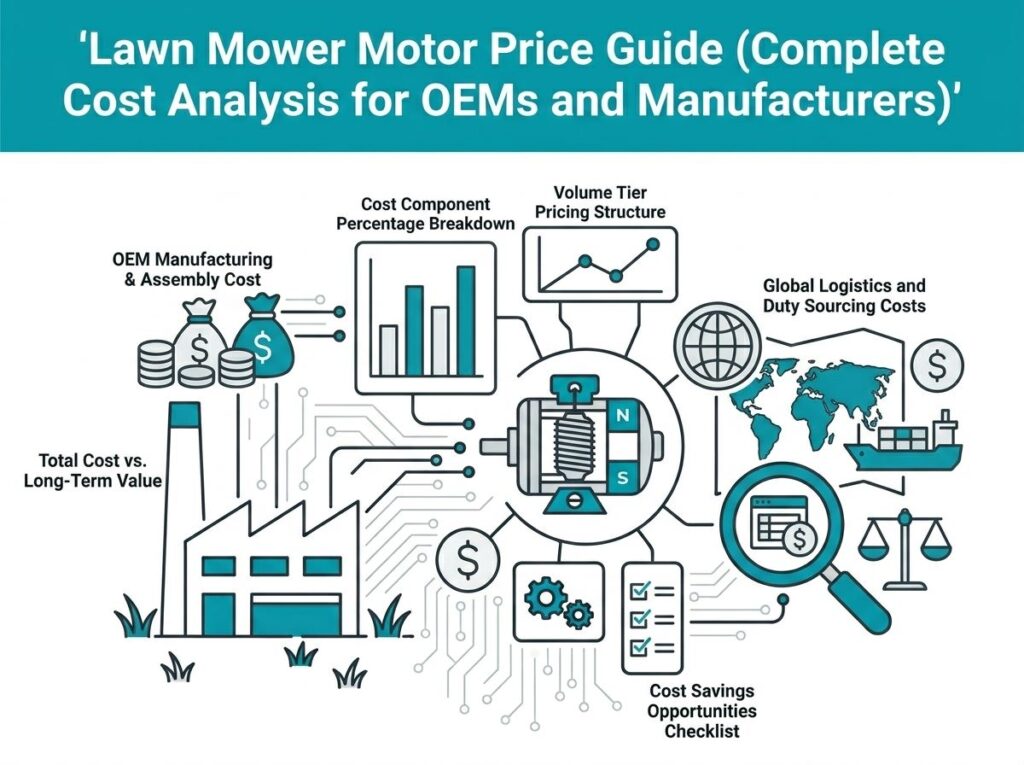
Guide des prix des moteurs de tondeuse à gazon
Réponse rapide
Le prix d'un moteur de tondeuse à gazon varie généralement de $20 terminer $300 par unité, selon le type de moteur, sortie, tension, efficacité, volume de production, et exigences de personnalisation. Pour les fabricants de tondeuses à gazon OEM, CC sans balais (BLDC) les moteurs offrent généralement le meilleur équilibre entre performances, durée de vie, efficacité, et coût total de possession. Alors que les moteurs BLDC à haut rendement ont des prix initiaux plus élevés que les moteurs à balais, ils réduisent la consommation d'énergie, exigences d'entretien, demandes de garantie, et fréquence de remplacement, ce qui en fait le choix préféré des tondeuses à gazon sans fil et robotisées modernes.
Lors de l’évaluation du prix des moteurs de tondeuse à gazon, les ingénieurs et les équipes d'approvisionnement doivent se concentrer non seulement sur le coût d'achat mais également sur l'efficacité, densité de couple, gestion de la chaleur, compatibilité du contrôleur, fiabilité, et coût du cycle de vie. Un moteur qui coûte 20% une augmentation initiale peut réduire considérablement les coûts totaux du système tout au long de la durée de vie du produit.
Quel est le prix moyen d’un moteur de tondeuse à gazon?
L'une des questions les plus courantes des responsables des achats OEM est la suivante :: “Combien coûte un moteur de tondeuse à gazon?”
La réponse dépend fortement de la technologie du moteur et des exigences de l'application..
Tondeuses à gazon électriques résidentielles, tondeuses à gazon robotisées, tondeuses commerciales à rayon de braquage zéro, et les tondeuses électriques autoportées nécessitent toutes des spécifications de moteur très différentes. Par conséquent, le prix du moteur varie considérablement.
| Type de moteur | Plage de puissance | Prix OEM typique | Demande principale |
|---|---|---|---|
| Moteur à courant continu brossé | 300W–1200W | $20–60$ | Tondeuses d'entrée de gamme |
| Moteur BLDC | 500W–3000W | $40–180$ | Tondeuses sans fil |
| BLDC haute efficacité | 1000W–5000W | $80–250$ | Tondeuses commerciales |
| Moteur de moyeu | 250W–1500W | $50–220$ | Systèmes de roues motrices |
| Moteur intégré + Manette | 500W–5000W | $120–350$+ | Tondeuses à gazon robotisées |
Pour la plupart des projets modernes de tondeuses à gazon à batterie, le marché s'oriente rapidement vers les moteurs BLDC à haut rendement car ils offrent une utilisation supérieure de l'énergie, durée d'exécution plus longue, fonctionnement plus silencieux, et des besoins de maintenance réduits.
Pourquoi le prix du moteur est plus que le simple coût d’achat
De nombreux acheteurs OEM se concentrent exclusivement sur le prix d’achat du moteur lors des évaluations des fournisseurs.. Cependant, les ingénieurs expérimentés comprennent que le moteur représente un sous-système critique qui influence les performances globales de la machine, fiabilité, et rentabilité.
Un moteur à faible coût peut initialement réduire les dépenses de nomenclature, mais des coûts cachés apparaissent souvent à travers:
- Consommation de batterie plus élevée
- Temps de tonte réduit
- Génération de chaleur excessive
- Défaillance prématurée des roulements
- Augmentation des demandes de garantie
- Coûts de maintenance plus élevés
- Baisse de la satisfaction client
Par exemple, améliorant l'efficacité du moteur de 80% pour 92% peut prolonger considérablement la durée de fonctionnement des tondeuses alimentées par batterie. Cela peut permettre aux fabricants de réduire la taille de la batterie tout en maintenant les objectifs d'autonomie..
Donc, L'analyse du coût total doit inclure:
- Prix initial du moteur
- Coût du contrôleur
- Impact sur le coût de la batterie
- Efficacité énergétique
- Frais de garantie
- Taux de remplacement
- Durée de vie prévue
Cette perspective du cycle de vie est particulièrement importante pour les fabricants de robots tondeuses à gazon, où l'efficacité énergétique a un impact direct sur la différenciation concurrentielle..
Facteurs clés qui influencent le prix des moteurs de tondeuse à gazon
1. Technologie du moteur
L'architecture du moteur reste le facteur de prix le plus important.
Les moteurs à balais utilisent des systèmes de commutation mécaniques et une électronique plus simple, ce qui entraîne une baisse des coûts de fabrication. Les moteurs BLDC nécessitent des aimants permanents, contrôleurs électroniques, et des procédés de fabrication sophistiqués, augmenter le prix initial.
Cependant, Les moteurs BLDC fournissent généralement:
- 30–Durée de vie 50% plus longue
- Efficacité supérieure
- Entretien réduit
- Fiabilité améliorée
2. Puissance nominale
À mesure que la puissance de sortie augmente, les coûts du moteur augmentent en raison de:
- Stators plus grands
- Plus d'enroulements en cuivre
- Aimants de qualité supérieure
- Arbres plus solides
- Systèmes thermiques améliorés
Un moteur de tondeuse de 500 W peut coûter moins cher que $50, tandis qu'un moteur d'entraînement de 5 kW de qualité commerciale peut dépasser $300.
3. Plateforme de tension
Les systèmes de tension courants comprennent:
- 24V
- 36V
- 48V
- 60V
- 72V
Les moteurs à tension plus élevée nécessitent généralement:
- Une meilleure isolation
- Contrôleurs améliorés
- Conception thermique améliorée
- Des certifications de sécurité plus strictes
Ces facteurs contribuent à l'augmentation des coûts de fabrication.
4. Indice de protection
L'équipement de pelouse extérieure fonctionne dans des conditions environnementales difficiles.
Des moteurs conçus pour atteindre:
- IP54
- IP65
- IP67
nécessitent des systèmes d'étanchéité, connecteurs étanches, revêtements résistants à la corrosion, et des conceptions de boîtiers avancées qui augmentent les coûts de production.
5. Exigences de personnalisation
La personnalisation OEM affecte considérablement les prix.
Les exemples incluent:
- Brides de montage personnalisées
- Arbres spéciaux
- Faisceaux de câbles dédiés
- Contrôleurs intégrés
- Communication CAN
- Courbes de couple uniques
- Étiquetage privé
Bien que la personnalisation augmente le coût unitaire, cela réduit souvent la complexité de l'assemblage et améliore l'intégration du système.
Prix du moteur BLDC par rapport au prix du moteur à balais
L’une des comparaisons les plus importantes pour les fabricants de tondeuses à gazon est celle des moteurs BLDC par rapport aux moteurs à balais..
| Facteur | Moteur BLDC | Moteur brossé |
|---|---|---|
| Prix d'achat | Plus haut | Inférieur |
| Efficacité | 85–95% | 70–80% |
| Entretien | Minimal | Remplacement de la brosse requis |
| Durée de vie | 10,000–30 000 heures | 2,000–5 000 heures |
| Bruit | Faible | Plus haut |
| Fiabilité | Excellent | Modéré |
| Autonomie de la batterie | Plus long | Plus court |
Bien que les moteurs à balais semblent moins chers au départ, l'analyse du cycle de vie privilégie généralement la technologie BLDC pour les équipements professionnels, tondeuses à gazon robotisées, et produits de consommation haut de gamme.
Comparaison des coûts des moteurs BLDC et des moteurs à induction
Les moteurs à induction restent courants dans les équipements industriels mais sont moins populaires dans les produits d'entretien des pelouses alimentés par batterie..
| Paramètre | Moteur BLDC | Moteur à induction |
|---|---|---|
| Efficacité | Haut | Modéré |
| Densité de couple | Excellent | Inférieur |
| Lester | Léger | Plus lourd |
| Compatibilité de la batterie | Excellent | Modéré |
| Complexité du contrôleur | Modéré | Haut |
| Performance thermique | Bien | Bien |
| Coût OEM | Modéré | Modéré à élevé |
Pour les applications de tondeuse à gazon sans fil, Les moteurs BLDC offrent généralement une valeur globale supérieure en raison de leurs avantages en termes d'efficacité et de densité de puissance..
Comment l’efficacité affecte directement le coût du moteur
L’efficacité du moteur est l’un des principaux facteurs de coûts dans la conception des tondeuses à gazon modernes.
Les moteurs à plus haut rendement nécessitent:
- Matériaux magnétiques haut de gamme
- Facteurs de remplissage en cuivre plus élevés
- Stratifications de précision
- Processus de bobinage avancés
- Conception électromagnétique optimisée
Ces mises à niveau augmentent les dépenses de fabrication mais offrent des avantages opérationnels mesurables.
Par exemple, un 92% un moteur efficace gaspille beaucoup moins d’énergie qu’un 80% moteur efficace. Une perte d’énergie réduite signifie:
- Durée d'exécution plus longue
- Besoins en batterie réduits
- Température de fonctionnement inférieure
- Fiabilité améliorée
- Durée de vie plus longue
Pour les robots tondeuses fonctionnant quotidiennement, ces avantages peuvent facilement justifier le coût élevé des moteurs à haut rendement.
Comment la gestion thermique affecte le prix des moteurs de tondeuse à gazon
La chaleur est l’un des principaux ennemis des performances et de la fiabilité des moteurs électriques.
Les températures excessives accélèrent:
- Dégradation de l'aimant
- Usure des roulements
- Vieillissement d'isolation
- Panne de composant électronique
Les moteurs de tondeuse haut de gamme intègrent donc des systèmes de gestion thermique avancés, notamment:
- Boîtiers en aluminium
- Chemins de circulation d'air optimisés
- Dissipateurs de chaleur
- Capteurs de température
- Algorithmes de protection thermique
Ces caractéristiques augmentent les coûts de fabrication mais améliorent considérablement la durabilité et la fiabilité sur le terrain.
Comment choisir un moteur de tondeuse à gazon pour votre application
Pour les fabricants OEM, Choisir un moteur de tondeuse à gazon ne consiste pas simplement à choisir l'option la moins chère. Le bon moteur doit satisfaire les objectifs de performance, contraintes de batterie, exigences de durabilité, Conditions environnementales, et stratégie produit à long terme.
Les fabricants de tondeuses à gazon les plus performants évaluent la sélection du moteur via une approche au niveau du système.. Au lieu de se concentrer uniquement sur le prix du moteur, les ingénieurs analysent la façon dont le moteur interagit avec les batteries, contrôleurs, systèmes de coupe, roues motrices, et algorithmes de contrôle logiciel.
Sélection de la plage de tension
La tension de la batterie a un impact direct sur les performances du moteur, efficacité, et le coût du système.
| Tension | Application typique | Plage de puissance | Niveau de coût |
|---|---|---|---|
| 24V | Tondeuses compactes | 300–800W | Faible |
| 36V | Tondeuses résidentielles | 500–1500W | Faible-Moyen |
| 48V | Tondeuses sans fil haut de gamme | 1000–3000W | Moyen |
| 60V | Tondeuses à conducteur marchant professionnelles | 2000–4000W | Moyen-élevé |
| 72V | Tondeuses autoportées commerciales | 3000–8000W | Haut |
Pour la plupart des plates-formes de tondeuses à gazon professionnelles sans fil, 48Les systèmes V représentent le meilleur équilibre entre coût, efficacité, sécurité, et l'acceptation du marché. Entre-temps, 72Les architectures V continuent de gagner en popularité dans les équipements de tonte électriques commerciaux en raison de leur capacité à réduire le courant et à améliorer l'efficacité globale du système..
Considérations sur la plage de puissance
Les besoins en énergie varient considérablement en fonction de la taille de la tondeuse et de son application..
- Tondeuses à gazon robotisées: 100W–1000W
- Tondeuses à conducteur marchant résidentielles: 800W–2500W
- Tondeuses à conducteur marchant professionnelles: 2000W–5000W
- Tondeuses électriques autoportées: 3000W–15 000 W+
Les moteurs sous-dimensionnés fonctionnent souvent en continu à proximité de la charge maximale, générant une chaleur excessive et réduisant la durée de vie. Les moteurs surdimensionnés augmentent les coûts de nomenclature et réduisent la compétitivité. Une bonne adaptation de puissance est donc essentielle.
Exigences de vitesse et de couple
Les moteurs de coupe et les moteurs d'entraînement ont des priorités de performances différentes.
Les moteurs à pales nécessitent généralement:
- Régime élevé
- Contrôle de vitesse stable
- Réponse rapide en cas de changement de densité de l'herbe
Les moteurs d'entraînement nécessitent généralement:
- Couple de démarrage élevé
- Capacité d'escalade
- Régulation précise de la vitesse
Les moteurs BLDC à couple élevé offrent souvent des performances supérieures car ils peuvent maintenir la vitesse de la lame même lors de la tonte d'herbe épaisse ou humide..
Sélection de la méthode de refroidissement
La gestion thermique affecte considérablement la fiabilité.
- Refroidissement naturel
- Refroidissement à air pulsé
- Refroidissement par ventilateur intégré
- Refroidissement liquide (systèmes commerciaux)
La plupart des tondeuses à gazon résidentielles reposent sur un refroidissement naturel ou assisté par ventilateur., tandis que les équipements commerciaux intègrent de plus en plus de conceptions thermiques avancées pour prendre en charge un fonctionnement continu.
Compatibilité du contrôleur
Les performances du moteur dépendent fortement de la qualité du contrôleur.
Avant de finaliser un fournisseur de moteur, Les équipes OEM doivent vérifier la compatibilité avec:
- contrôle focal
- Systèmes de capteurs à effet Hall
- Algorithmes sans capteur
- Communication CAN
- Intégration Bluetooth
- Systèmes de gestion de batterie
Un contrôleur bien adapté peut améliorer considérablement l’efficacité, performances sonores, et expérience utilisateur.
Combien coûtent les moteurs de tondeuses à gazon robotisées?
Les tondeuses à gazon robotisées représentent l'un des segments à la croissance la plus rapide du secteur des équipements électriques d'extérieur..
Contrairement aux tondeuses traditionnelles, les plates-formes robotiques nécessitent généralement plusieurs moteurs:
- Moteur de coupe
- Moteur d'entraînement de roue gauche
- Moteur d'entraînement de roue droite
- Moteurs de direction en option
Par conséquent, la sélection du moteur a un impact direct sur le coût total du système.
| Type de moteur | Prix typique | Application |
|---|---|---|
| Moteur BLDC de coupe | $25–80$ | Entraînement de lame |
| Moteur de moyeu de roue | $30–100$ | Système d'entraînement |
| Ensemble moteur intégré | $50–150$ | Systèmes robotiques haut de gamme |
| Moteur + Paquet de contrôleur | $80–250$ | Plateformes robotiques intelligentes |
Parce que les robots tondeuses fonctionnent de manière autonome et fonctionnent souvent quotidiennement, les fabricants privilégient l’efficacité, imperméabilisation, fiabilité, et durée de vie sur le coût d'achat initial le plus bas.
Explication des prix des moteurs personnalisés OEM
De nombreux fabricants de tondeuses à gazon finissent par passer des moteurs standards à des solutions de moteurs personnalisées..
Le développement de moteurs personnalisés augmente l'investissement initial mais offre souvent des avantages concurrentiels significatifs.
| Article de personnalisation | Impact sur les coûts |
|---|---|
| Conception d'arbre personnalisée | Faible |
| Logement spécial | Moyen |
| Conception étanche | Moyen |
| Contrôleur intégré | Moyen-élevé |
| Micrologiciel personnalisé | Haut |
| Communication CAN | Moyen |
| Outillage dédié | Haut |
Les solutions personnalisées réduisent fréquemment les coûts globaux de fabrication en simplifiant l'assemblage, réduire le nombre de pièces, et améliorer l'intégration du système.
Pour les projets OEM, Travailler directement avec un fabricant de moteurs spécialisé se traduit souvent par une meilleure valeur à long terme que l'achat de moteurs génériques sur catalogue..
Comment évaluer un fournisseur de moteurs BLDC pour la fabrication de tondeuses à gazon
Trouver le bon fournisseur est souvent plus important que d'obtenir le prix moteur le plus bas.
Un fournisseur capable d’accompagner le développement de produits, essai, attestation, et la mise à l'échelle peut réduire considérablement les risques du projet.
Capacité d'ingénierie
Recherchez des fournisseurs qui fournissent:
- Simulation moteur
- Optimisation électromagnétique
- Analyse thermique
- Prise en charge de la conception personnalisée
- Prototypage rapide
Capacité de fabrication
- Enroulement automatisé
- Systèmes d'insertion d'aimants
- Équilibrage dynamique
- Tests de fin de ligne
- Systèmes de traçabilité
Contrôle de qualité
- ISO 9001
- Inspection des matières entrantes
- Tests de performances
- Tests de vie
- Tests environnementaux
Des entreprises telles que Greensky Power se spécialisent dans les Solutions de moteurs BLDC pour tondeuse à gazon fabricants, offrant 48V, 60V, et plates-formes 72 V optimisées pour les équipements modernes alimentés par batterie.
Pour les projets OEM nécessitant des solutions personnalisées, les ingénieurs peuvent demander une fiche technique ou discuter des exigences via:
Pourquoi les moteurs à haut rendement génèrent souvent des coûts totaux inférieurs
L'une des idées fausses les plus répandues en matière d'approvisionnement est que le moteur le moins cher offre le meilleur rapport qualité-prix..
En réalité, les moteurs à haut rendement réduisent souvent les coûts globaux de possession.
| Catégorie de coût | Moteur standard | BLDC haute efficacité |
|---|---|---|
| Prix du moteur | Inférieur | Plus haut |
| Exigence de la batterie | Plus grand | Plus petit |
| Production de chaleur | Plus haut | Inférieur |
| Risque de garantie | Plus haut | Inférieur |
| Durée de vie | Plus court | Plus long |
| Coût total | Plus haut | Inférieur |
Pour les tondeuses à gazon robotisées et commerciales, l'efficacité énergétique influence directement la taille de la batterie, fréquence de charge, et les frais de fonctionnement. Ces facteurs l'emportent souvent sur les différences de prix d'achat du moteur..
Tendances futures des prix des moteurs de tondeuses à gazon
Plusieurs forces du marché façonnent les futurs coûts des moteurs de tondeuses à gazon.
Adoption accrue de la technologie BLDC
Alors que les volumes de production augmentent à l’échelle mondiale, Le prix du moteur BLDC continue de baisser tandis que les performances s'améliorent.
Croissance des tondeuses à gazon robotisées
Le marché des tondeuses robotisées est en pleine expansion, demande croissante de compacts, haute efficacité, moteurs étanches.
Systèmes de moteurs intelligents intégrés
Les futurs systèmes combineront de plus en plus:
- Moteur
- Manette
- Capteurs
- Connectivité
- Diagnostic
en modules intégrés, simplifiant l'assemblage et réduisant les coûts globaux du système.
Technologies avancées d’aimant
Les matériaux magnétiques améliorés continuent d'augmenter la densité de couple et l'efficacité tout en réduisant la taille du moteur.
Ces développements aideront les fabricants à produire des, plus silencieux, et des tondeuses à gazon plus efficaces.
Foire aux questions (FAQ)
Quel est le prix moyen d'un moteur de tondeuse à gazon?
La plupart des moteurs de tondeuse à gazon coûtent entre $20 et $300 selon le type de moteur, tension, puissance nominale, niveau d'efficacité, et volume de production. Les moteurs BLDC vont généralement de $40 pour $180 pour les applications OEM.
Pourquoi les moteurs BLDC sont-ils plus chers que les moteurs à balais?
Les moteurs BLDC utilisent des aimants permanents, contrôleurs électroniques, et des procédés de fabrication avancés. Bien qu'ils coûtent plus cher au départ, ils offrent une plus grande efficacité, entretien réduit, espérance de vie plus longue, et une meilleure fiabilité.
Quel est le meilleur type de moteur pour les tondeuses à gazon robotisées?
Les moteurs BLDC à haut rendement sont généralement le choix préféré car ils offrent un excellent rendement, taille compacte, faible bruit, contrôle précis, et longue durée de vie.
Comment l'efficacité du moteur affecte-t-elle les coûts des tondeuses à gazon?
Une efficacité plus élevée réduit la consommation de la batterie, génération de chaleur, et les frais de fonctionnement. Cela peut également permettre aux fabricants d'utiliser des batteries plus petites tout en maintenant les objectifs d'autonomie..
Un moteur personnalisé vaut-il le coût supplémentaire?
Pour les projets OEM de gros volumes, les moteurs personnalisés améliorent souvent les performances, simplifier l'assemblage, réduire la complexité du système, et renforcer la différenciation des produits, rentabiliser l'investissement.
Quelle tension est la meilleure pour les tondeuses à gazon sans fil?
48Les systèmes V offrent actuellement l'un des meilleurs équilibres entre puissance, efficacité, sécurité, et le coût. Les plateformes commerciales adoptent de plus en plus des architectures 60 V et 72 V.
Combien de temps durent les moteurs de tondeuse à gazon BLDC?
Les moteurs BLDC de haute qualité atteignent généralement 10 000 à 30 000 heures de fonctionnement lorsqu'ils sont correctement conçus et utilisés dans les limites thermiques..
Comment les acheteurs OEM peuvent-ils réduire les coûts des moteurs?
Les méthodes les plus efficaces incluent l’augmentation du volume des commandes, standardisation des plates-formes motrices, simplification des exigences de personnalisation, et travailler directement avec des constructeurs de moteurs expérimentés.
Conclusion
La vraie valeur d’un moteur de tondeuse à gazon ne peut être mesurée uniquement par son prix d’achat. Les ingénieurs et les équipes d’approvisionnement doivent évaluer l’efficacité, densité de couple, performances thermiques, compatibilité du contrôleur, fiabilité, et les coûts du cycle de vie.
Pour les plates-formes modernes de tondeuses à gazon sans fil et robotisées, Les moteurs BLDC à haut rendement offrent systématiquement le meilleur équilibre de performances, durabilité, et coût total de possession. Bien que les prix initiaux puissent être plus élevés que les alternatives traditionnelles, les avantages à long terme dépassent souvent l'investissement.
Si vous développez une nouvelle plate-forme de tondeuse à gazon, mise à niveau d'une gamme de produits existante, ou à la recherche d'une solution moteur personnalisée, sélectionner le bon fournisseur est essentiel.
Demander une fiche technique, obtenez une solution OEM, ou contactez nos ingénieurs pour discuter du 48V personnalisé, 60V, et solutions de moteur BLDC 72 V pour les applications de tondeuse à gazon.
Références
- https://www.energy.gov/eere/amo/electric-motors
- https://www.nema.org
- https://www.iea.org/reports/energy-efficiency-2024
- https://www.baldor.com
- https://www.machinedesign.com
- https://www.motioncontroltips.com
- https://www.electricaleasy.com
- https://www.sciencedirect.com/topics/engineering/brushless-dc-motor
- https://ieeexplore.ieee.org
- https://www.researchgate.net