
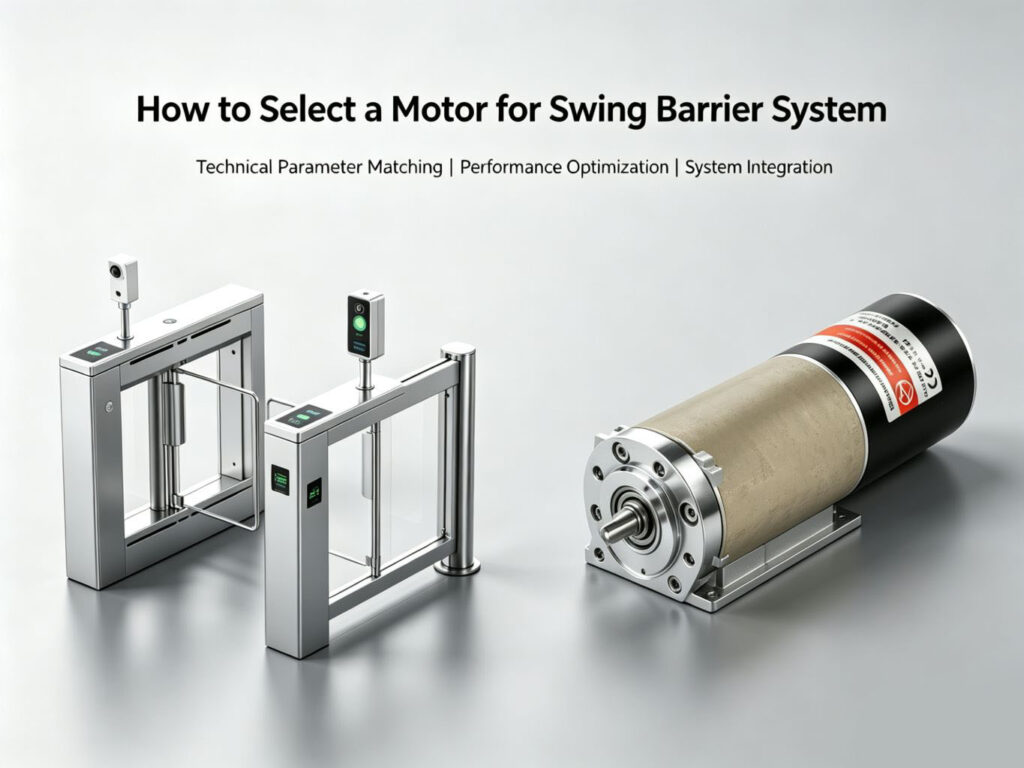
Comment sélectionner un moteur pour un système de barrière pivotante
Selecting the right motor for a swing barrier system directly affects operating stability, opening speed, efficacité énergétique, maintenance interval, et fiabilité à long terme. In modern access control systems, BLDC motors have become the preferred solution for swing barriers because they provide high torque density, precise electronic control, faible bruit, and long service life compared with brushed DC motors and traditional AC motors.
Pour les fabricants OEM, intégrateurs de systèmes, and procurement engineers, motor selection should not only focus on power output. Factors such as duty cycle, gestion de la chaleur, compatibilité du contrôleur, couple de maintien, acceleration profile, and emergency operation behavior are equally critical. This engineering guide explains how to choose the best motor for swing barrier systems while comparing different motor technologies from both technical and commercial perspectives.
What Is a Motor for a Swing Barrier System?
A swing barrier motor is the drive component responsible for opening and closing pedestrian access gates in security entrances, subway stations, office buildings, aéroports, usines, and commercial facilities. The motor converts electrical energy into controlled rotational motion, which is transmitted to the barrier arm through gears, linkages, or direct-drive mechanisms.
Modern swing barrier systems require precise motion control because the gate must operate smoothly under varying traffic conditions while maintaining user safety. Unlike simple door automation, swing barriers frequently start and stop, which creates demanding acceleration and deceleration cycles. Donc, the motor must provide:
- Stable low-speed torque
- Fast response time
- Low vibration and acoustic noise
- Haute précision de positionnement
- Reliable continuous-duty operation
- Minimal maintenance requirements
Most high-end systems now use BLDC motors with encoder feedback because electronic commutation improves efficiency and eliminates brush wear. In premium access control equipment, servo motors are also used when ultra-high precision positioning is required.
Related motor solutions:
Bldc motor for swing gate turnstile |
Custom BLDC motor
Why BLDC Motors Are Preferred for Swing Barrier Systems
BLDC motors are increasingly replacing brushed DC and AC induction motors in swing barrier systems due to their superior efficiency, durée de vie, et contrôlabilité. In access control applications, operational smoothness and reliability are more important than raw speed alone.
The absence of mechanical brushes eliminates friction losses and carbon dust generation. This significantly improves operational reliability in high-cycle environments such as metro stations and office buildings where gates may operate hundreds of thousands of cycles per month.
Densité de couple élevée
Swing barriers require sufficient starting torque to accelerate the gate arm quickly while maintaining smooth movement. BLDC motors deliver higher torque density than conventional induction motors, allowing compact designs with reduced gearbox size.
Superior Efficiency
BLDC motor efficiency commonly exceeds 85–90%, especially in 48V and 72V systems. Higher efficiency reduces heat generation inside compact gate enclosures and improves overall system reliability.
Electronic Precision Control
Electronic commutation enables precise acceleration and deceleration control. This minimizes impact force when the barrier reaches its stop position, reducing mechanical wear and improving passenger safety.
Longue durée de vie
Parce qu'il n'y a pas de pinceaux qui s'usent, BLDC motors typically provide significantly longer maintenance intervals. This is critical for public transportation systems where downtime directly impacts operational efficiency.
BLDC Motor vs Brushed DC Motor for Swing Barrier Systems
| Paramètre | Moteur BLDC | Moteur à courant continu brossé |
|---|---|---|
| Efficacité | 85–92% | 60–75% |
| Entretien | Très faible | Frequent brush replacement |
| Durée de vie | Long | Moyen |
| Bruit | Faible | Plus haut |
| Control Precision | Excellent | Limité |
| Performance thermique | Better | Modéré |
| Coût initial | Plus haut | Inférieur |
Brushed DC motors remain attractive for low-cost barrier systems because of their simple controller architecture and lower upfront cost. Cependant, their brush wear becomes a major disadvantage in high-frequency operation.
For OEM buyers focused on lifecycle cost rather than initial purchase price, BLDC motors generally offer better long-term ROI because maintenance downtime and component replacement costs are substantially reduced.
BLDC Motor vs Servo Motor for Swing Gate Turnstile Applications
| Paramètre | Moteur BLDC | Servomoteur |
|---|---|---|
| Précision de positionnement | Haut | Ultra-high |
| Coût | Modéré | Haut |
| Complexité du contrôleur | Moyen | Avancé |
| Stabilité du couple | Excellent | Excellent |
| Suitable for Mass Production | Oui | Selective |
| Industrial Reliability | Excellent | Excellent |
Servo motors provide extremely accurate positioning and dynamic response. They are often used in premium security systems where motion synchronization and intelligent obstacle detection are critical.
Cependant, servo systems involve more expensive controllers and more complex tuning processes. For most commercial swing barrier applications, high-quality BLDC motors with encoder feedback deliver sufficient performance at a more competitive total system cost.
Key Engineering Factors in Swing Barrier Motor Selection
Choosing the best motor for a swing barrier system requires balancing electrical, thermique, and mechanical parameters. Many failures in access control systems originate from improper motor sizing rather than motor quality itself.
Torque Requirement
Torque is the most critical parameter. Engineers must calculate:
- Barrier arm inertia
- Acceleration time
- Rapport de réduction
- Friction losses
- Safety holding torque
Insufficient torque causes unstable operation and excessive current draw.
Cycle de service
Swing barriers in subway stations operate far more frequently than office entrances. Continuous-duty systems require motors with strong thermal resistance and efficient cooling structures.
Contrôle de vitesse
Barrier opening speed affects user throughput and safety. Motors with encoder feedback provide smoother acceleration profiles and better anti-collision behavior.
Bruit et vibrations
Low-noise operation is increasingly important in premium commercial buildings. BLDC motors combined with optimized FOC (Contrôle orienté champ) algorithms significantly reduce acoustic noise.
How to Choose a Motor for Swing Barrier System
This section is particularly important for OEM engineers and procurement teams evaluating custom motor solutions.
Plage de tension
Most swing barrier systems use:
- 24V DC systems for compact gates
- 48V BLDC systems for commercial access control
- 72V systems for high-performance industrial gates
Higher voltage reduces current for the same power level, improving efficiency and reducing cable losses.
Plage de puissance
Typical swing barrier motors range from 50W to 500W depending on gate size, cycle de service, and mechanical structure.
Speed and Torque Matching
The motor should provide sufficient low-speed torque while maintaining stable acceleration. Excessively high-speed motors may require larger gear reductions, which increase mechanical complexity and backlash.
Méthode de refroidissement
For high-duty applications:
- Natural air cooling is suitable for low-cycle systems
- Aluminum housing improves thermal dissipation
- Forced cooling may be necessary in extreme environments
Compatibilité du contrôleur
The controller must support:
- contrôle focal
- Retour d'information du codeur
- Current limiting
- Détection d'obstacles
- Emergency release logic
Controller-motor matching directly impacts operational smoothness and lifespan.
Considérations spécifiques à l'application
For outdoor installations, Protection IP, corrosion resistance, and temperature tolerance become critical. In public transportation systems, reliability and emergency opening behavior are often more important than speed alone.
Request customized engineering support:
Obtenez un devis gratuit
Motor Efficiency and Thermal Performance in Swing Barrier Systems
Thermal performance is often underestimated during motor selection. In compact gate housings, poor heat dissipation can dramatically shorten electronic component lifespan.
Motor losses primarily include:
- Copper loss
- Iron loss
- Mechanical friction loss
- Controller switching loss
BLDC motors improve efficiency through optimized magnetic design and electronic commutation. Lower heat generation allows smaller enclosure designs while improving long-term reliability.
For high-frequency operation, thermal simulations should be considered during OEM development. Continuous overheating can cause:
- Magnet demagnetization
- Dégradation de l'isolation
- Bearing failure
- Controller instability
Industrial-grade BLDC motors with aluminum housing and optimized airflow design are increasingly preferred for premium access control systems.
Reliability and Lifespan Considerations
Reliability is one of the most important purchasing criteria for swing barrier manufacturers and facility operators. Downtime in security entrances directly affects user traffic and operational safety.
The lifespan of a swing barrier motor depends on:
- Bearing quality
- Gestion thermique
- Controller tuning
- Load profile
- Environmental protection
BLDC motors typically outperform brushed motors because they eliminate mechanical commutation wear. High-quality industrial motors can exceed tens of thousands of operational hours under proper load conditions.
OEM customers increasingly request:
- Long maintenance intervals
- Faible bruit acoustique
- Stable torque output
- High ingress protection ratings
- Smart diagnostics capability
For export-oriented equipment manufacturers, long-term reliability is also essential for reducing warranty claims and after-sales support costs.
Industrial Applications of Swing Barrier Motors
Swing barrier systems are used across multiple industries where pedestrian access control and security management are required.
Commercial Buildings
Office towers and smart buildings use compact low-noise BLDC motors to improve user experience and aesthetic integration.
Public Transportation
Subway stations and airports require high-duty-cycle motors capable of continuous operation with minimal maintenance.
Industrial Facilities
Factories and logistics centers prioritize durability, anti-collision protection, and environmental resistance.
EV and Smart Infrastructure
Modern smart city infrastructure increasingly integrates intelligent access systems connected with IoT platforms. Efficient BLDC motor systems support energy-saving requirements in these installations.
Related industrial solutions: Electric vehicle motor
Future Trends in Swing Barrier Motor Technology
The swing barrier industry is evolving toward smarter, plus silencieux, and more energy-efficient systems.
FOC Intelligent Control
Field-Oriented Control enables smoother operation and lower noise while improving torque precision.
Integrated Smart Diagnostics
Future motors will increasingly integrate:
- Temperature monitoring
- Current analysis
- Maintenance prédictive
- Remote diagnostics
Compact High-Torque Motors
As modern gate systems become smaller and more aesthetically integrated, high torque density motors are becoming essential.
Energy Efficiency Regulations
Global energy regulations continue pushing OEMs toward higher-efficiency motor systems, particularly in commercial infrastructure projects.
FAQ: Swing Barrier Motor Selection
What is the best motor for a swing barrier system?
BLDC motors are generally considered the best solution because they combine high efficiency, peu d'entretien, fonctionnement silencieux, and precise electronic control. For ultra-high precision systems, servo motors may also be suitable.
Why are BLDC motors used in turnstile systems?
BLDC motors provide smoother acceleration, meilleur contrôle du couple, espérance de vie plus longue, and reduced maintenance compared with brushed DC motors. These advantages are important in high-cycle access control applications.
How do I calculate motor torque for a swing gate turnstile?
Torque calculation depends on arm inertia, acceleration time, friction losses, rapport de démultiplication, and holding requirements. Engineers should also include a safety margin to prevent overload during peak operation.
What voltage is commonly used in swing barrier motors?
24V and 48V systems are the most common. Larger industrial systems may use 72V configurations for improved efficiency and lower current draw.
How long does a swing barrier BLDC motor last?
Industrial-grade BLDC motors can operate for many years under proper thermal and load conditions. Actual lifespan depends on controller tuning, protection environnementale, et cycle de service.
Conclusion
Selecting the right motor for a swing barrier system requires a balance between torque performance, efficacité, fiabilité, comportement thermique, and long-term maintenance cost. While brushed DC motors remain suitable for low-cost applications, BLDC motors have become the dominant solution for modern commercial and industrial swing barriers due to their superior control precision and operational lifespan.
Pour les fabricants OEM et les équipes d’approvisionnement, proper motor selection should focus not only on initial purchase cost but also on lifecycle performance, efficacité énergétique, intégration du contrôleur, and maintenance requirements.
Greensky Power provides customized BLDC motor solutions for swing gate turnstiles, access control systems, l'automatisation industrielle, and smart infrastructure applications.
✔ Demander une fiche technique
✔ Obtenez une solution de moteur OEM
✔ Contact our engineers for application-specific motor selection
Références
1. https://ieeexplore.ieee.org/
2. https://www.sciencedirect.com/topics/engineering/brushless-dc-motor
3. https://www.nidec.com/en/technology/motor/basic/
4. https://www.motioncontroltips.com/
5. https://www.controleng.com/
6. https://www.automationworld.com/
7. https://www.engineeringtoolbox.com/