
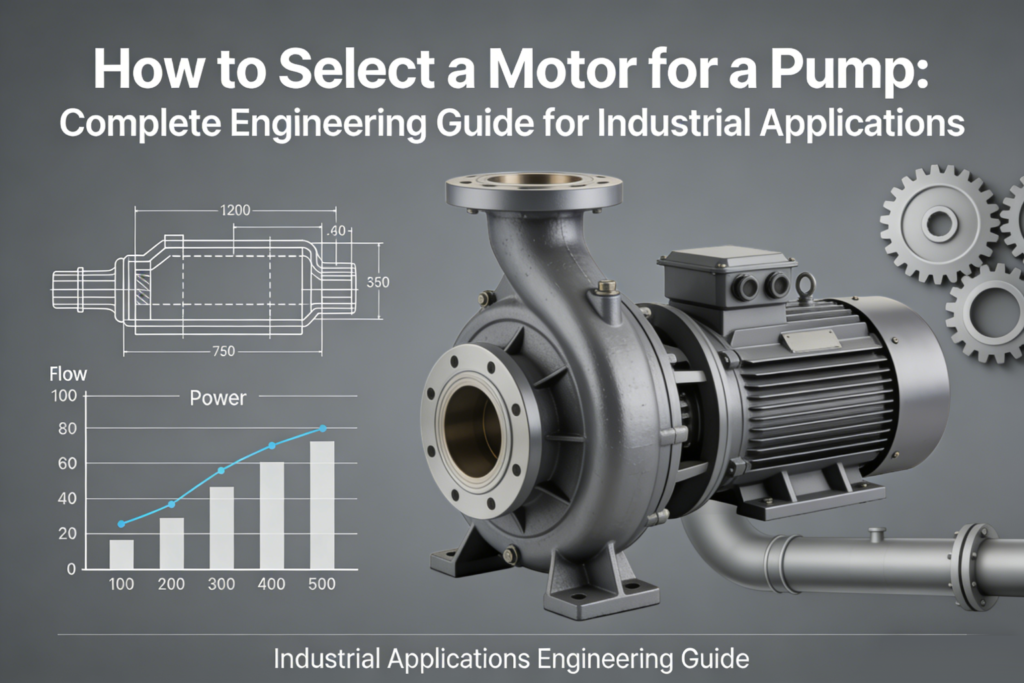
Comment sélectionner un moteur pour une pompe: Complete Engineering Guide for Industrial Applications
Extrait en vedette:
Selecting a motor for a pump requires matching flow, head, and load characteristics with the correct motor type, puissance nominale, and control method. Engineers must calculate required torque and speed, evaluate efficiency across operating points, and consider thermal performance and duty cycle. The optimal pump motor balances energy efficiency, fiabilité, et coût du cycle de vie. Pour les OEM et les acheteurs industriels, choosing between induction motors, Moteurs BLDC, and VFD-driven systems depends on application demands such as variable flow control, Conditions environnementales, and system integration requirements.
What Is Motor Selection for Pumps and Why It Matters
Motor selection for pumps is the engineering process of determining the appropriate motor type and specifications to drive a pump efficiently and reliably. Pumps are widely used in industrial systems such as water treatment, CVC, traitement chimique, et agricole. Because pumps often run continuously, even small inefficiencies in motor selection can result in significant energy losses and higher operating costs.
Improper motor selection can lead to several operational problems. An undersized motor may fail to deliver the required torque, causing overheating and premature failure. Inversement, an oversized motor will operate inefficiently at partial load, increasing energy consumption and reducing system efficiency. Donc, selecting the correct motor is critical for achieving optimal pump performance and minimizing lifecycle cost.
Pour les fabricants OEM, the choice of motor also impacts system integration, product competitiveness, and compliance with energy regulations. Many modern systems now use high-efficiency solutions such as BLDC motors (voir BLDC motor solutions) or VFD-driven AC motors to optimize performance.
Why Pump Motor Selection Impacts Efficiency and Cost
In pump systems, the motor typically accounts for the majority of energy consumption. Since pumps often operate continuously, even a small improvement in motor efficiency can result in significant cost savings over time. Par exemple, improving motor efficiency by 3–5% in a large industrial pump system can reduce annual electricity costs by thousands of dollars.
Efficiency is influenced by how well the motor matches the pump load. Pumps follow affinity laws, meaning power consumption changes with flow and speed. If a motor is not properly matched to these operating conditions, energy is wasted. Using a variable-speed drive (VFD) or BLDC controller allows the motor to adjust speed dynamically, improving efficiency under variable load conditions.
Du point de vue des achats, focusing only on initial cost is a common mistake. Engineers should instead evaluate total cost of ownership (TCO), which includes energy consumption, entretien, downtime risk, and replacement costs. Dans de nombreux cas, a higher-efficiency motor delivers a better return on investment despite a higher upfront price.
Types of Motors Used for Pump Applications
Moteurs à induction
Induction motors are the most common choice for pump applications due to their reliability, simplicité, et faible coût. They are ideal for constant-speed operations such as water supply and circulation pumps. Cependant, their efficiency decreases under variable load unless paired with a VFD.
Moteurs BLDC
Brushless DC motors offer high efficiency, contrôle précis de la vitesse, et taille compacte. They are increasingly used in modern pump systems, especially where energy savings and compact design are critical. BLDC motors are commonly found in HVAC pumps and smart water systems.
Moteurs synchrones
Synchronous motors provide constant speed and high efficiency, making them suitable for high-power pump applications. They are often used in large industrial plants where precise control and efficiency are essential.
Moteurs à courant continu
Traditional DC motors offer high starting torque but require more maintenance due to brush wear. They are less common in modern pump systems but still used in some niche applications.
BLDC vs Induction Motor for Pumps: Comparaison des performances
| Paramètre | Moteur BLDC | Moteur à induction |
|---|---|---|
| Efficacité | Haut (85–95%), stable across load range | Modéré (75–90%), lower at partial load |
| Densité de couple | Haut, design compact | Modéré, larger size |
| Contrôle | Requires electronic controller | Simple, VFD optional |
| Coût | Plus élevé dès le départ | Coût initial inférieur |
| Best Use | Variable-speed pumps | Constant-speed pumps |
From an engineering standpoint, BLDC motors are preferred for applications requiring high efficiency and precise flow control, while induction motors remain the standard choice for cost-sensitive and robust systems.
Key Engineering Considerations: Efficacité, Couple, Performance thermique
Efficacité
Motor efficiency determines how effectively electrical energy is converted into mechanical power. High-efficiency motors reduce energy losses and operating costs. BLDC motors typically offer higher efficiency than induction motors, especially under variable load conditions.
Exigences de couple
Pumps generally require relatively constant torque, but starting torque can be significant depending on the system. Engineers must ensure the motor can handle startup conditions without excessive current draw or overheating.
Performance thermique
Thermal management is critical in pump systems, especially in continuous operation. Motors must be designed to dissipate heat effectively to prevent insulation degradation and ensure long-term reliability.
Control Systems for Pump Motors: VFD vs BLDC Controller
Control systems play a crucial role in optimizing pump performance. VFDs allow induction motors to operate at variable speeds, improving efficiency and reducing energy consumption. They are widely used in industrial pump systems.
BLDC controllers provide precise speed and torque control using electronic commutation. These systems offer faster response and higher efficiency, making them suitable for advanced pump applications.
Pour les projets OEM, selecting the right control system is as important as choosing the motor itself. Integration complexity, coût, and performance requirements must all be considered.
How to Choose a Motor for a Pump
Plage de tension
Select a motor compatible with available power supply (par ex., 24V, 48V, 72V for DC systems or 220V/380V for AC systems). For mobile or battery-powered pumps, low-voltage BLDC motors are often used.
Plage de puissance
Determine required power based on flow rate and head. Use pump curves to calculate the operating point and ensure the motor provides sufficient power with a safety margin.
Vitesse et couple
Match motor speed to pump requirements. Centrifugal pumps typically require high speed, while positive displacement pumps may require higher torque at lower speeds.
Méthode de refroidissement
Choose appropriate cooling based on duty cycle. Options include air cooling, forced ventilation, or liquid cooling for high-power applications.
Compatibilité du contrôleur
Ensure compatibility with VFDs or BLDC controllers. Proper integration improves efficiency and control accuracy.
Considérations spécifiques à l'application
Consider environmental factors such as humidity, poussière, et la température. For harsh environments, use IP-rated motors with sealed enclosures.
Appel à l'action: Need help selecting the right pump motor? Demander une fiche technique ou contactez nos ingénieurs for tailored recommendations.
Applications of Pump Motors Across Industries
Pump motors are used across a wide range of industries. In industrial manufacturing, they are used for cooling systems, transfert chimique, and process control. In HVAC systems, pump motors circulate water for heating and cooling. In agriculture, they are used for irrigation and water management.
In automotive and EV systems, electric pumps driven by BLDC motors are used for cooling batteries and power electronics. En robotique et automatisation, compact and efficient motors are required for precision fluid control.
Advantages and Disadvantages of Pump Motor Types
| Type de moteur | Avantages | Inconvénients |
|---|---|---|
| BLDC | Haute efficacité, compact, contrôle précis | Coût plus élevé, nécessite un contrôleur |
| Induction | Faible coût, robust, simple | Lower efficiency at variable load |
| Synchrone | Haute efficacité, vitesse constante | Higher complexity and cost |
Future Trends in Pump Motor Technology
The pump motor industry is evolving toward higher efficiency and smarter systems. Energy regulations are driving the adoption of IE4 and IE5 motors, while digital technologies enable real-time monitoring and predictive maintenance.
BLDC motors and integrated motor-drive systems are becoming more common due to their efficiency and compact design. As power electronics costs decrease, more applications are shifting toward electronically controlled motors.
FAQ: Pump Motor Selection
1. How do I calculate motor power for a pump?
Motor power is calculated based on flow rate, head, et efficacité. Use pump equations to determine required hydraulic power and divide by system efficiency to find motor power.
2. Which motor is best for pumps?
Induction motors are best for constant-speed pumps, while BLDC motors are ideal for variable-speed and energy-efficient applications.
3. Why use a VFD in pump systems?
VFDs allow speed control, reducing energy consumption and improving system efficiency, especially in variable flow applications.
4. What is the lifespan of a pump motor?
With proper maintenance, pump motors can last 10–20 years. Factors such as load conditions, refroidissement, and environment affect lifespan.
5. How do I choose between BLDC and AC motors for pumps?
Choose BLDC for efficiency and control, and AC induction motors for cost and robustness. Evaluate based on application requirements.
Conclusion: Engineering-Based Pump Motor Selection
Selecting the right motor for a pump requires careful evaluation of performance, efficacité, et le coût. Engineers must consider load characteristics, méthodes de contrôle, and environmental factors to ensure reliable operation. Pour les OEM et les acheteurs industriels, focusing on lifecycle cost and system efficiency is essential.
Appel à l'action: Looking for a reliable pump motor solution? Get an OEM solution, request a datasheet, ou contactez nos ingénieurs aujourd'hui.
Références
- CEI 60034 – Machines Électriques Tournantes
- Hydraulic Institute Standards for Pumps
- IEEE Motor Efficiency Guidelines
- European Commission Motor Efficiency Regulations