
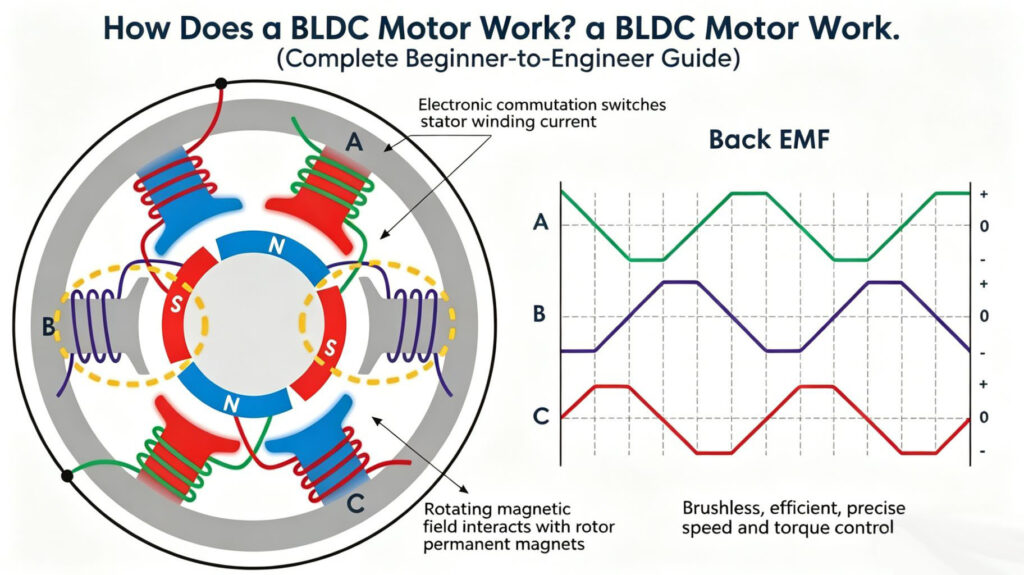
Comment fonctionne un moteur BLDC? (Guide complet du débutant à l'ingénieur)
Extrait en vedette:
Un moteur BLDC fonctionne en utilisant la commutation électronique pour commuter le courant dans les enroulements du stator, créant un champ magnétique tournant qui interagit avec les aimants permanents du rotor. Cela élimine les pinceaux, améliore l'efficacité, et permet un contrôle précis de la vitesse et du couple. Par rapport aux moteurs traditionnels, Les moteurs BLDC offrent un rendement plus élevé, meilleure performance thermique, et une durée de vie plus longue, ce qui les rend idéaux pour l’automatisation industrielle, véhicules électriques, et systèmes CVC.
Compréhension comment fonctionne un moteur BLDC est essentiel pour les ingénieurs, Concepteurs OEM, et les équipes achats sélectionnant des solutions moteurs hautes performances. Contrairement aux moteurs brossés, Les moteurs BLDC s'appuient sur une électronique de commande avancée et des principes électromagnétiques pour obtenir des performances supérieures.. Cet article fournit une analyse technique du fonctionnement du moteur BLDC., y compris les principes de travail, stratégies de contrôle, facteurs d'efficacité, et comment sélectionner la bonne solution pour les applications industrielles.
Qu'est-ce qu'un moteur BLDC et Comment ça marche?
Un BLDC (CC sans balais) le moteur est un moteur électrique qui fonctionne sans balais, utilisant la commutation électronique au lieu du contact mécanique.
Cela fonctionne en générant un champ magnétique tournant dans le stator, ce qui provoque le rotor (avec aimants permanents) suivre et faire pivoter.
Un contrôleur commute en permanence le courant dans les enroulements du stator pour maintenir un mouvement fluide et efficace.
Composants clés
- Rotor à aimants permanents
- Enroulements du stator (3-phase)
- Contrôleur électronique (ESC)
- Capteurs de position (Capteurs à effet Hall ou système sans capteur)
Les moteurs BLDC sont largement utilisés dans les applications nécessitant un rendement élevé et un contrôle précis, comme la robotique, VÉ, et automatisation industrielle.
👉 Explorez: Solutions de moteurs BLDC
Principe de fonctionnement du moteur BLDC (Étape par étape)
1. Le stator génère un champ magnétique rotatif
Le stator est constitué de plusieurs bobines. Lorsque le courant circule à travers ces bobines, ça crée des pôles magnétiques.
En alimentant différentes bobines en séquence, un champ magnétique tournant est produit.
2. Le rotor suit le champ magnétique
Le rotor est constitué d'aimants permanents. Ces aimants s'alignent naturellement avec le champ magnétique du stator, faisant tourner le rotor lorsque le champ tourne.
3. Le contrôleur commute le courant (Navette électronique)
Au lieu de pinceaux, un contrôleur utilise des capteurs (tels que les capteurs Hall) ou des algorithmes sans capteur pour détecter la position du rotor.
Il commute ensuite le courant entre les enroulements du stator au bon moment pour que le moteur continue de tourner en continu..
Diagramme simple (Conceptuel):
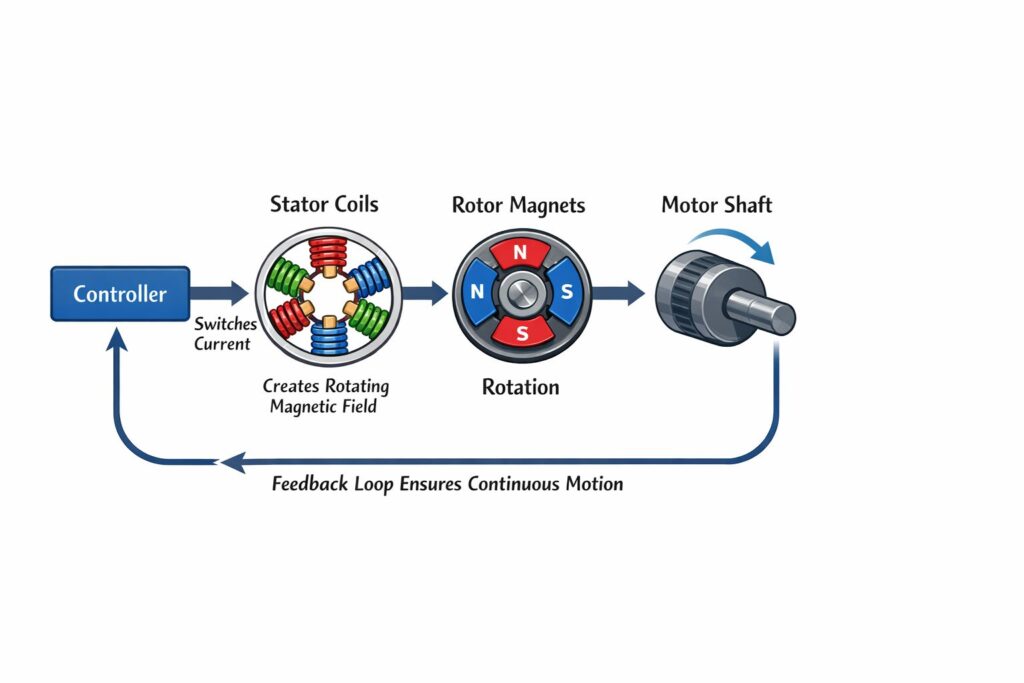
Structure du moteur BLDC expliquée
Stator
Le stator est la pièce fixe contenant des enroulements en cuivre. Il est responsable de générer le champ électromagnétique qui entraîne le moteur.
Rotor
Le rotor contient des aimants permanents et tourne à l'intérieur ou autour du stator selon la conception du moteur (rotor intérieur ou rotor extérieur).
Manette
Le contrôleur est le « cerveau » du système. Il gère la commutation de courant, contrôle de vitesse, et optimisation de l'efficacité.
Explication visuelle étape par étape
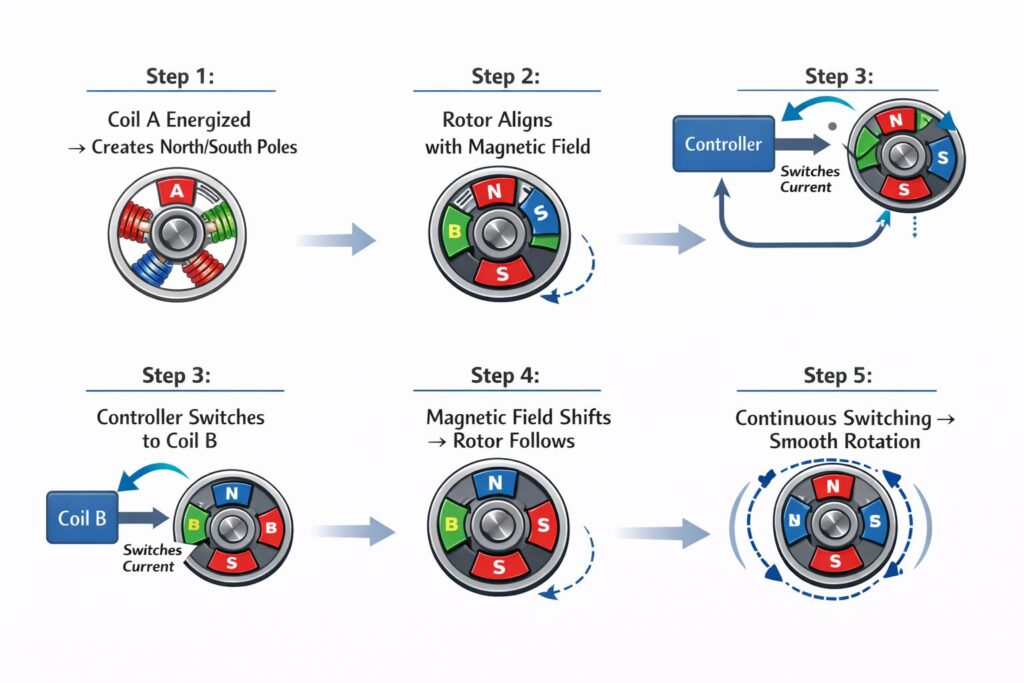
Étape 2: Le rotor s'aligne avec le champ magnétique
Étape 3: Le contrôleur passe à la bobine B
Étape 4: Le champ magnétique se déplace → le rotor suit
Étape 5: Commutation continue → rotation douce
Cette interaction électromagnétique étape par étape remplace la commutation mécanique trouvée dans les moteurs traditionnels, ce qui entraîne une efficacité plus élevée et une usure moindre.
Pourquoi les moteurs BLDC sont plus efficaces que les moteurs à balais
L'efficacité est l'une des principales raisons pour lesquelles les moteurs BLDC sont largement adoptés.
Raisons d'ingénierie
- Aucune perte par frottement des brosses
- Pertes électriques réduites
- Contrôle de courant optimisé
Les moteurs BLDC atteignent généralement des rendements supérieurs à 85 à 90 %, réduisant considérablement la consommation d’énergie dans les systèmes industriels.
Génération de couple et interaction de champ magnétique
Le couple dans un moteur BLDC est généré par l'interaction entre le champ magnétique du stator et les aimants du rotor.
Facteurs clés
- Intensité du champ magnétique
- Ampleur actuelle
- Alignement de la position du rotor
Le contrôle précis de ces facteurs permet aux moteurs BLDC de fournir une densité de couple élevée et un fonctionnement fluide.
Systèmes de contrôle dans les moteurs BLDC
Les systèmes de contrôle sont essentiels aux performances du moteur BLDC.
Types de contrôle
- Trapézoïdal (en six étapes) contrôle
- Contrôle orienté champ (FOC)
Fonctions du contrôleur
- Courant de commutation entre phases
- Régulation de vitesse
- Contrôle du couple
Les méthodes de contrôle avancées telles que FOC offrent une efficacité et des performances supérieures.
Performance thermique et gestion de la chaleur
La gestion thermique est essentielle à la fiabilité.
Avantages du BLDC
- Production de chaleur réduite grâce à un rendement élevé
- Chaleur concentrée dans le stator pour un refroidissement plus facile
Les méthodes de refroidissement incluent le refroidissement par air et le refroidissement liquide pour les applications haute puissance telles que les systèmes 48 V et 72 V..
Fiabilité et durée de vie des moteurs BLDC
Les moteurs BLDC offrent une durée de vie plus longue grâce à une usure mécanique réduite.
- Pas de balais → pas de composants d'usure
- Moins de chaleur → moins de dégradation de l'isolation
- Fonctionnement stable sous différentes charges
Cela les rend idéaux pour les applications industrielles à service continu.
Moteur BLDC vs moteur à balais vs moteur à courant alternatif
| Paramètre | Moteur BLDC | Moteur brossé | Moteur à courant alternatif |
|---|---|---|---|
| Efficacité | Haut | Modéré | Modéré |
| Entretien | Faible | Haut | Faible |
| Contrôle | Avancé | Simple | Modéré |
| Applications | VE, robotique | Appareils à faible coût | Systèmes industriels |
Les moteurs BLDC offrent le meilleur équilibre entre performances et efficacité pour les applications modernes.
Comment choisir un moteur BLDC pour votre application
La sélection du bon moteur BLDC nécessite une analyse minutieuse.
Critères de sélection clés
- Tension: 24V / 48V / 72Systèmes V
- Pouvoir: De la gamme watts à kW
- Vitesse & Couple: Basé sur les exigences de charge
- Refroidissement: Refroidissement par air ou liquide
- Compatibilité du contrôleur: Contrôleur ESC ou FOC
Exemples d'application
- Véhicules électriques → Moteur BLDC 48V/72V
- Robotique → moteur BLDC de précision
- CVC → moteur BLDC économe en énergie
👉 Demander une solution OEM: Développement de moteurs personnalisés
Applications industrielles des moteurs BLDC
- Véhicules électriques et vélos électriques
- Automatisation industrielle
- Systèmes CVC
- Pompes et compresseurs
👉 Explorez les moteurs EV: Solutions de moteurs de véhicules électriques
Coût vs performance: BLDC en vaut-il la peine?
| Facteur | Moteur BLDC | Moteur traditionnel |
|---|---|---|
| Coût initial | Plus haut | Inférieur |
| Efficacité | Plus haut | Inférieur |
| Durée de vie | Plus long | Plus court |
| Coût total | Baisse à long terme | Plus haut |
Pour la plupart des applications industrielles, Les moteurs BLDC offrent un meilleur retour sur investissement à long terme.
Tendances futures de la technologie des moteurs BLDC
Les moteurs BLDC sont à la pointe de la technologie moteur moderne.
- Intégration avec des systèmes de contrôle intelligents
- Croissance de la mobilité électrique
- Avancées dans le contrôle sans capteur
Ces tendances entraînent une adoption généralisée dans tous les secteurs.
Principaux avantages des moteurs BLDC
- Haute efficacité: La réduction des pertes d’énergie améliore les performances globales du système
- Longue durée de vie: Pas de brosses signifie moins d'usure et un fonctionnement plus long
- Faible entretien: Entretien minimal requis
- Densité de couple élevée: Plus de puissance dans un format compact
- Fonctionnement à faible bruit: Idéal pour les applications précises et silencieuses
Applications courantes des moteurs BLDC
- Véhicules électriques: Haute efficacité et contrôle du couple
- Ventilateurs & Systèmes CVC: Fonctionnement économe en énergie et silencieux
- Robotique: Contrôle précis de la vitesse et de la position
- Automatisation industrielle: Performances fiables et durables
Ces avantages font des moteurs BLDC un élément clé des systèmes économes en énergie et hautes performances dans tous les secteurs..
FAQ: Comment fonctionne un moteur BLDC
1. Comment un moteur BLDC génère-t-il du couple?
Le couple est généré par l'interaction entre le champ magnétique du stator et les aimants permanents du rotor., contrôlé électroniquement.
2. Pourquoi les moteurs BLDC sont-ils plus efficaces?
Ils éliminent la friction des brosses et utilisent un contrôle de courant optimisé, réduire les pertes d'énergie.
3. Quels sont les principaux avantages des moteurs BLDC?
Haute efficacité, peu d'entretien, Longue durée de vie, et un contrôle précis.
4. Où sont utilisés les moteurs BLDC?
Ils sont utilisés dans les véhicules électriques, robotique, Systèmes CVC, et automatisation industrielle.
5. Qu'est-ce qui contrôle un moteur BLDC?
Un moteur BLDC est contrôlé par un contrôleur électronique qui commute le courant dans les enroulements du stator en fonction de la position du rotor..
6. Un moteur BLDC a-t-il besoin d'un contrôleur?
Oui. Un contrôleur est essentiel pour commuter le courant et maintenir la rotation, car les moteurs BLDC ne peuvent pas fonctionner directement à partir d'une alimentation CC.
Conclusion: Pourquoi les moteurs BLDC dominent les applications modernes
Compréhension comment fonctionne un moteur BLDC fournit une base pour la sélection de solutions de moteurs hautes performances. Avec leur efficacité supérieure, fiabilité, et capacités de contrôle, Les moteurs BLDC deviennent la norme dans les applications industrielles et OEM modernes.
Besoin d'aide pour sélectionner le bon moteur BLDC?
✔ Demander une fiche technique
✔ Obtenez une solution de moteur OEM
✔ Contactez nos ingénieurs dès aujourd'hui
Références
- Transactions IEEE sur l'électronique industrielle
- Manuel de conception de moteurs électriques
- Normes d'efficacité CEI