
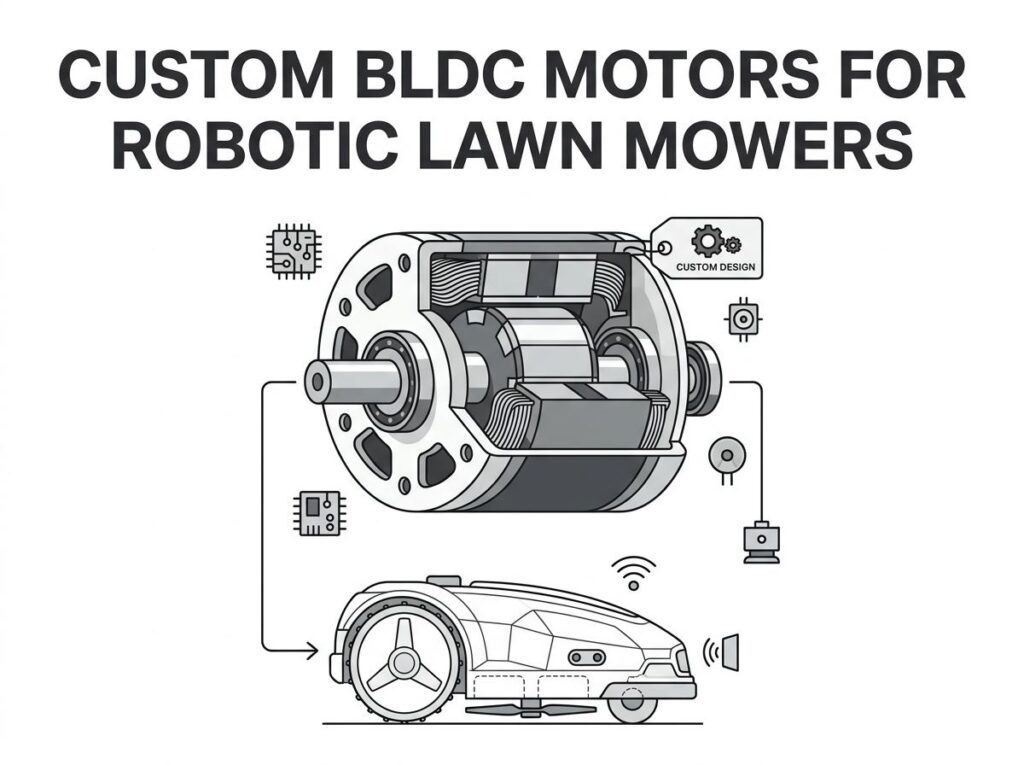
Moteurs BLDC personnalisés pour tondeuses à gazon robotisées
Réponse rapide: Why Are Custom BLDC Motors Important for Robotic Lawn Mowers?
Coutume BLDC motors for robotic lawn mowers are designed specifically to match the mower’s torque requirements, battery system, cutting performance, Conditions environnementales, et architecture de contrôle. Compared with standard off-the-shelf motors, custom brushless DC motors deliver higher efficiency, durée d'exécution plus longue, fiabilité améliorée, better waterproofing, moins de bruit, and optimized cost structures for OEM production.
As robotic lawn mowers become more intelligent and autonomous, motor design has become a critical differentiator. The right custom BLDC motor can increase mowing efficiency, prolonger la durée de vie de la batterie, improve hill-climbing capability, reduce thermal stress, and enhance product lifespan. For lawn mower manufacturers, selecting a custom motor partner is often one of the most important engineering decisions in the entire product development cycle.
What Are Custom BLDC Motors for Robotic Lawn Mowers?
A custom BLDC (CC sans balais) motor is an electric motor specifically engineered around the performance requirements of a robotic lawn mower rather than being selected from standard catalog products.
While standard motors can sometimes satisfy basic functional requirements, robotic lawn mowers operate under unique conditions:
- Continuous outdoor exposure
- Battery-powered operation
- Variable grass density
- Frequent start-stop cycles
- Obstacle avoidance maneuvers
- Slope climbing
- Strict noise limitations
- Long service life expectations
These requirements often force manufacturers to optimize motor parameters such as:
- Winding configuration
- Magnet grade
- Rotor inertia
- Stator lamination design
- Indice de protection IP
- Encoder or Hall sensor integration
- Operating voltage
- Thermal management strategy
Custom motor engineering allows OEM manufacturers to balance efficiency, performance, fiabilité, and manufacturing cost simultaneously.
This is why leading robotic mower brands rarely use generic motors in their flagship platforms.
Why Custom BLDC Motors Outperform Standard Motors in Robotic Lawn Mowers
Efficacité énergétique supérieure
Battery runtime is one of the most important performance metrics in robotic mowing systems.
Every percentage point of motor efficiency directly affects:
- Mowing coverage area
- Charging frequency
- Battery lifespan
- User satisfaction
A custom-designed BLDC motor can often achieve efficiencies exceeding 88–92%, compared with 75–85% for lower-cost generic motors.
Optimized Torque Output
Grass cutting requires high torque at relatively moderate blade speeds.
When mowing thick grass or wet vegetation, torque demand can increase dramatically.
A custom winding design allows engineers to maximize:
- Couple de départ
- Couple maximal
- Couple continu
- Efficiency under load
This creates a more stable mowing experience and reduces motor overheating risks.
Improved Packaging Efficiency
Space inside robotic mowers is extremely limited.
Custom motor dimensions can be optimized to:
- Reduce enclosure size
- Increase battery capacity
- Improve weight distribution
- Lower overall machine weight
This packaging flexibility often becomes a major competitive advantage.
Key Engineering Parameters in Custom Robotic Lawn Mower Motors
Efficacité du moteur
Efficiency determines how much battery energy becomes useful mechanical work.
Motor losses primarily include:
- Pertes de cuivre
- Iron losses
- Eddy current losses
- Pertes de friction mécaniques
- Controller switching losses
High-efficiency motor designs focus on minimizing all five loss categories simultaneously.
Densité de couple
Torque density measures how much torque can be generated within a given motor volume.
Higher torque density allows:
- Smaller motor packages
- Lighter mower platforms
- Higher climbing capability
- Improved obstacle traversal
Modern robotic lawn mower manufacturers increasingly prioritize torque density over simple peak power ratings.
Performance thermique
Heat is one of the biggest enemies of motor longevity.
Les températures excessives accélèrent:
- Dégradation de l'aimant
- Vieillissement d'isolation
- Usure des roulements
- Pannes du contrôleur
Custom motor thermal design frequently includes:
- Improved heat transfer paths
- Aluminum housing structures
- Thermal potting compounds
- Optimized winding fill factors
Intégration du système de contrôle
Motor performance depends heavily on controller interaction.
Custom designs often include:
- Capteurs à effet Hall
- Encodeurs magnétiques
- Algorithmes sans capteur
- Commande orientée terrain (FOC)
Proper integration dramatically improves motion accuracy and energy efficiency.
Fiabilité et durée de vie
Commercial robotic mowers are often expected to operate for:
- 5–10 years
- Thousands of operating hours
- Hundreds of charging cycles annually
Custom motors are engineered specifically to meet these lifecycle expectations.
Custom BLDC Motors vs Standard BLDC Motors
| Paramètre | Moteur BLDC personnalisé | Standard BLDC Motor |
|---|---|---|
| Efficacité | Optimized for application | Usage général |
| Torque Curve | Personnalisé | Fixed |
| Autonomie de la batterie | Plus long | Average |
| Waterproof Rating | IP65-IP68 available | Limited options |
| Noise Optimization | Designed for mower platform | Generic |
| OEM Branding | Disponible | Unavailable |
| Coût du cycle de vie | Baisse à long terme | Higher long-term |
Although custom motors usually require engineering investment during development, the lifetime value frequently exceeds the additional upfront cost.
Custom BLDC Motors vs Brushed DC Motors
| Fonctionnalité | Custom BLDC | CC brossé |
|---|---|---|
| Efficacité | 88-92% | 65-80% |
| Entretien | Minimal | Brush replacement |
| Bruit | Faible | Plus haut |
| Durée de vie | 10,000+ heures | 1,000-3,000 heures |
| Control Precision | Excellent | Limité |
| Battery Utilization | Superior | Inférieur |
| Fiabilité | Haut | Modéré |
For modern robotic lawn mowers, brushed motors have largely become obsolete due to efficiency and durability limitations.
How to Choose Custom BLDC Motors for Robotic Lawn Mowers
For procurement managers and engineering teams, motor selection should be based on complete system requirements rather than simply comparing motor power ratings.
Plage de tension
Common robotic mower battery systems include:
- 24V
- 36V
- 48V
- 72V
48V systems currently represent one of the best balances between safety, efficacité, and power density.
Plage de puissance
| Mower Type | Puissance du moteur |
|---|---|
| Résidentiel | 200W–800W |
| Résidentiel haut de gamme | 800W–1500W |
| Commercial | 1500W–5000W |
| Industrial Autonomous | 5kW+ |
Exigences de vitesse et de couple
Les ingénieurs devraient évaluer:
- Blade cutting load
- Slope requirements
- Wheel traction force
- Obstacle climbing performance
- Grass density variation
Custom torque curves often deliver superior real-world mowing performance compared with simply increasing motor power.
Méthode de refroidissement
Robotic lawn mower motors typically use:
- Refroidissement naturel par air
- Housing conduction cooling
- Integrated thermal dissipation structures
Outdoor operation makes thermal design particularly important.
Compatibilité du contrôleur
The motor must match:
- Contrôleurs FOC
- Sensorless control systems
- Hall-based controllers
- CAN communication systems
- Battery management architecture
Controller mismatch is one of the most common causes of poor field performance.
Request Datasheet: If your engineering team is evaluating a new robotic mower platform, obtaining motor performance curves and thermal maps before prototype development can significantly reduce development time.
Applications of Custom BLDC Motors Beyond Robotic Lawn Mowers
The technologies developed for robotic mower motors frequently translate into other advanced mobility and automation applications.
- Robots mobiles autonomes (AMR)
- Warehouse robotics
- Automated guided vehicles (VAG)
- Electric utility vehicles
- Smart agricultural equipment
- Service robotics
- Industrial automation systems
- Electric mobility platforms
Many manufacturers leverage common motor platforms across multiple product lines to reduce development costs and improve economies of scale.
Par exemple, a 48V moteur BLDC personnalisé originally designed for robotic lawn mowers may later be adapted into autonomous delivery robots or lightweight EV systems with minimal redesign.
How to Evaluate the Best BLDC Motor Supplier for Robotic Lawn Mower Projects
Choosing the right motor supplier is often more important than selecting the motor itself. Many robotic lawn mower programs fail not because of poor product concepts but because suppliers cannot consistently deliver the required performance, qualité, scalability, or engineering support.
Pour les fabricants OEM, the ideal supplier should function as an engineering partner rather than simply a component vendor.
Engineering Development Capability
A qualified custom motor supplier should be capable of:
- Electromagnetic simulation
- Thermal simulation
- Motor performance optimization
- Controller matching support
- Prototypage rapide
- Failure analysis
- System-level integration support
Suppliers with dedicated R&D teams can often identify design issues during development rather than after product launch.
Manufacturing Consistency
Mass-production consistency directly impacts field reliability.
Key indicators include:
- Automated winding equipment
- Automated magnet assembly
- Dynamic balancing systems
- 100% end-of-line testing
- ISO-certified quality management
A motor design is only as good as its manufacturing execution.
Supply Chain Stability
Robotic mower manufacturers frequently face seasonal demand fluctuations.
Suppliers should maintain:
- Stable magnet sourcing
- Copper supply security
- Controller component availability
- Production scalability
The ability to scale production rapidly often becomes a competitive advantage during peak lawn care seasons.
OEM Development Process for Custom Robotic Lawn Mower Motors
Successful motor development typically follows a structured engineering process.
Phase 1: Requirements Definition
The OEM defines:
- Battery voltage
- Required runtime
- Cutting capacity
- Maximum slope angle
- Target noise level
- Environmental protection requirements
- Cost targets
This phase establishes the engineering foundation of the project.
Phase 2: Electromagnetic Design
Motor engineers optimize:
- Slot-pole combinations
- Magnet topology
- Stator geometry
- Copper fill factor
- Back EMF characteristics
The objective is to maximize efficiency and torque density simultaneously.
Phase 3: Développement de prototypes
Prototype motors undergo:
- Dynamometer testing
- Thermal testing
- Noise testing
- Vibration testing
- Environmental validation
This stage often reveals opportunities for further optimization.
Phase 4: Vehicle Integration
The motor is integrated into the robotic mower platform.
Engineers evaluate:
- Battery consumption
- Cutting performance
- Slope climbing ability
- Autonomous navigation performance
- Real-world reliability
Phase 5: Mass Production Validation
Before full production, manufacturers validate:
- Process capability
- Quality consistency
- Supply chain readiness
- Long-term reliability
This systematic process minimizes product launch risks.
Waterproof and Outdoor Design Considerations for Robotic Lawn Mower Motors
Unlike indoor robotics, robotic lawn mowers operate continuously in highly challenging outdoor environments.
Exposure includes:
- Rain
- Dew
- Mud
- Poussière
- Fertilizer residue
- Grass particles
- Temperature cycling
Par conséquent, waterproof motor design becomes a critical engineering priority.
IP Protection Levels
| Indice de protection | Application typique |
|---|---|
| IP54 | Basic outdoor use |
| IP65 | Rain protection |
| IP67 | Temporary immersion resistance |
| IP68 | Severe outdoor environments |
Most premium robotic lawn mower manufacturers now specify IP67 or higher for critical motor assemblies.
Résistance à la corrosion
Corrosion can significantly reduce motor lifespan.
Protective measures often include:
- Anodized aluminum housings
- Stainless steel shafts
- Epoxy-coated magnets
- Specialized sealing systems
- Corrosion-resistant bearings
These design features ensure long-term reliability in outdoor operating conditions.
How Custom Motors Improve Battery Runtime in Robotic Lawn Mowers
Battery runtime remains one of the most visible performance indicators for end users.
Many manufacturers focus heavily on battery capacity while overlooking motor efficiency improvements.
En réalité, motor optimization can often provide larger gains than increasing battery size.
Efficiency Impact on Runtime
Consider two motors delivering identical output power:
| Paramètre | Moteur standard | Custom Motor |
|---|---|---|
| Efficacité | 82% | 91% |
| Input Power | 1220O | 1099O |
| Heat Loss | 220O | 99O |
| Autonomie de la batterie | Référence | Extended |
A seemingly small efficiency improvement can significantly increase mowing coverage per charge cycle.
Reduced Thermal Losses
Higher efficiency reduces waste heat generation.
Les avantages incluent:
- Longer battery life
- Lower controller stress
- Fiabilité améliorée
- Reduced cooling requirements
For robotic mower OEMs, efficiency improvements often provide one of the highest returns on engineering investment.
Future Trends in Custom BLDC Motors for Robotic Lawn Mowers
The robotic lawn mower industry is evolving rapidly as autonomous technologies mature.
Future motor designs will increasingly focus on intelligence, efficacité, et intégration système.
Higher Voltage Architectures
The market is gradually moving toward:
- 48V platforms
- 60V platforms
- 72V platforms
Higher voltages reduce current requirements, improving efficiency and lowering thermal stress.
Moteurs intelligents intégrés
Future motors will increasingly include:
- Embedded sensors
- Temperature monitoring
- Condition monitoring
- Predictive maintenance functions
- CAN communication capabilities
Smart motors will become active participants in autonomous mower control systems.
Advanced Magnetic Materials
New magnet technologies will improve:
- Densité de puissance
- Efficacité
- Stabilité thermique
- Motor compactness
These developments will enable smaller, lighter robotic mowers with longer runtimes.
AI-Assisted Motor Control
Artificial intelligence will increasingly optimize:
- Consommation d'énergie
- Cutting performance
- Battery utilization
- Terrain adaptation
The combination of custom BLDC motors and intelligent control systems will define next-generation robotic lawn mower platforms.
Why Greensky Is a Valuable OEM Motor Development Partner
For robotic lawn mower manufacturers, motor development success depends on balancing performance, fiabilité, manufacturability, et le coût.
Greensky provides custom BLDC motor development solutions covering:
- 24V–72V motor platforms
- Wheel drive motors
- Blade drive motors
- High-efficiency motor systems
- Waterproof outdoor motor designs
- OEM and ODM development support
Engineering teams can obtain:
- Performance simulations
- Motor customization support
- Prototype development services
- Production scalability planning
- Optimisation spécifique à l'application
For manufacturers developing next-generation robotic lawn mowers, early motor optimization often produces significant improvements in runtime, fiabilité, and product competitiveness.
Request Datasheet • Get OEM Solution • Contactez nos ingénieurs
Foire aux questions (FAQ)
Quel est le meilleur type de moteur pour les tondeuses à gazon robotisées?
BLDC motors are generally considered the best motor technology for robotic lawn mowers because they provide high efficiency, faibles besoins d'entretien, Longue durée de vie, contrôle précis de la vitesse, and excellent battery utilization. Most premium robotic mower brands rely on custom brushless motor systems.
Why use custom BLDC motors instead of standard motors?
Custom BLDC motors are optimized for the specific performance requirements of the mower. They provide improved efficiency, better torque characteristics, enhanced waterproofing, reduced noise, and superior integration with the battery and control system.
What voltage is commonly used in robotic lawn mower motors?
Modern robotic lawn mowers commonly use 24V, 36V, 48V, and increasingly 72V architectures. Premium commercial systems often favor 48V platforms because they balance safety, efficacité, la densité de puissance, and controller compatibility.
How long do robotic lawn mower BLDC motors last?
High-quality custom BLDC motors can achieve operational lifespans exceeding 10,000 hours when properly designed and maintained. Factors such as waterproofing, qualité des roulements, gestion de la chaleur, and controller tuning significantly influence actual service life.
What waterproof rating should a robotic lawn mower motor have?
Most premium robotic mower manufacturers target IP67 or IP68 ratings for critical motor systems. These ratings provide protection against dust ingress, rain exposure, moisture accumulation, and temporary immersion conditions commonly encountered in outdoor environments.
How does motor efficiency affect robotic mower performance?
Motor efficiency directly impacts battery runtime, mowing coverage area, génération de chaleur, fréquence de charge, et la fiabilité globale du système. Even a 5–10% efficiency improvement can create meaningful performance advantages in commercial robotic mower applications.
Conclusion
Custom BLDC motors have become one of the most important enabling technologies behind modern robotic lawn mowers. As autonomous mowing systems continue evolving, motor performance increasingly influences battery runtime, cutting quality, hill-climbing capability, fiabilité, et la compétitivité globale des produits.
Pour les fabricants OEM, the goal is not simply selecting a motor with adequate power. The objective is creating an optimized electromechanical system that balances efficiency, densité de couple, performances thermiques, control integration, waterproof protection, manufacturability, and long-term lifecycle cost.
Manufacturers that invest early in custom motor development typically achieve superior field performance, stronger brand differentiation, and lower total ownership costs over the life of the product.
Whether developing residential robotic mowers, commercial autonomous mowing systems, or next-generation smart landscaping equipment, partnering with an experienced custom BLDC motor supplier can significantly accelerate development while improving final product performance.
Références
- https://www.ieee.org
- https://www.nema.org
- https://www.energy.gov/eere/amo/electric-motors
- https://www.iec.ch
- https://www.motioncontroltips.com
- https://www.maxongroup.com
- https://www.portescap.com
- https://www.automationdirect.com
- https://www.ansys.com
- https://www.greensky-power.com