
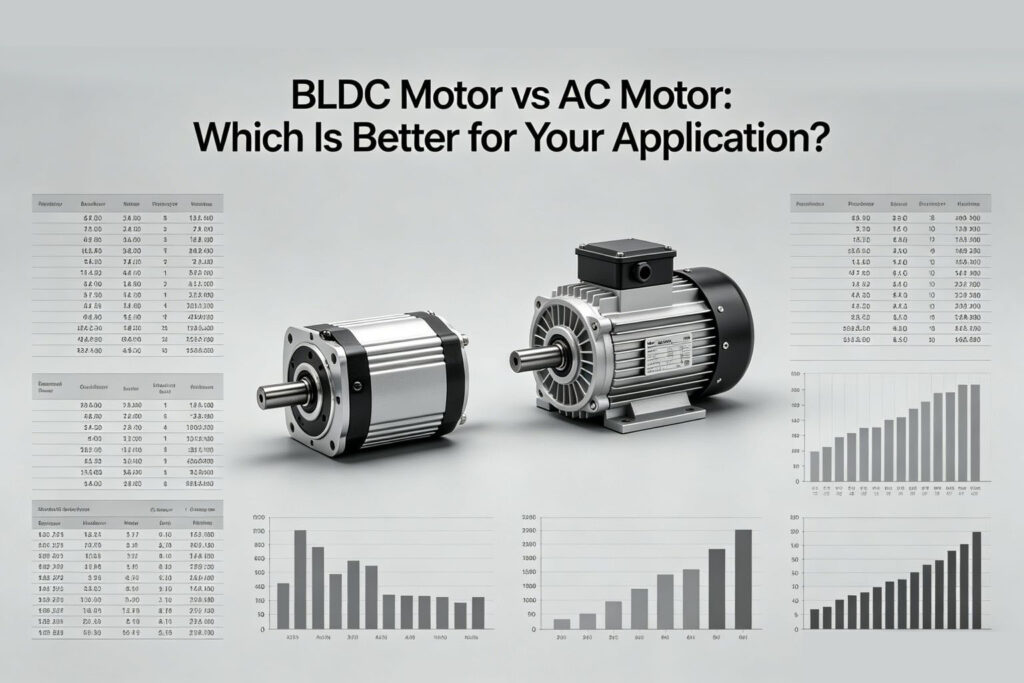
Moteur BLDC vs moteur AC: Quel est le meilleur pour votre application?
Extrait en vedette:
Moteurs BLDC are generally better for applications requiring high efficiency, contrôle précis, et taille compacte, while AC motors are preferred for cost-sensitive, haute puissance, and rugged industrial environments. The best choice depends on factors such as torque requirements, complexité du contrôle, thermal conditions, et coût du cycle de vie. Pour les OEM et les ingénieurs, selecting between BLDC and AC motors requires a performance-driven analysis rather than a simple cost comparison.
In modern industrial systems, choisir entre un BLDC motor vs AC motor is a critical engineering decision that directly impacts efficiency, fiabilité, et coût total de possession. Whether you are designing electric vehicles, Systèmes CVC, pompes, or automation equipment, understanding the differences between these motor technologies is essential for achieving optimal performance and ROI.
Qu'est-ce qu'un moteur BLDC?
Un courant continu sans balais (BLDC) motor is an electronically commutated motor that eliminates mechanical brushes by using a controller to switch current in the stator windings. The rotor typically contains permanent magnets, allowing for high torque density and efficiency.
Caractéristiques clés des moteurs BLDC
- Electronic commutation using Hall sensors or sensorless control
- Haute efficacité (typically 85–95%)
- Compact design with high power-to-weight ratio
- Low maintenance due to absence of brushes
BLDC motors are widely used in applications where efficiency and precise speed control are critical, comme la robotique, véhicules électriques, et systèmes CVC intelligents.
👉 Explore industrial solutions: Gamme de produits de moteurs BLDC
Qu'est-ce qu'un moteur à courant alternatif?
Moteurs à courant alternatif, including induction motors and synchronous motors, operate using alternating current supplied directly from the grid. The most common type in industrial applications is the induction motor, known for its simplicity and robustness.
Key Characteristics of AC Motors
- Construction simple et robuste
- Lower upfront cost compared to BLDC motors
- Suitable for high-power industrial applications
- Can operate directly from AC supply without complex electronics
AC motors dominate traditional industrial sectors such as pumps, compresseurs, and heavy machinery due to their reliability and scalability.
Moteur BLDC vs moteur AC: Principales différences expliquées
| Paramètre | Moteur BLDC | Moteur à courant alternatif (Induction) |
|---|---|---|
| Efficacité | 85–95% | 75–90% |
| Densité de couple | Haut | Modéré |
| Contrôle | Contrôle électronique avancé | Simple or VFD-based |
| Coût initial | Plus haut | Inférieur |
| Entretien | Faible | Faible à modéré |
| Applications | VE, robotique, CVC | Industrial pumps, Ventilateurs |
The fundamental difference lies in commutation: Les moteurs BLDC reposent sur la commutation électronique, while AC motors use electromagnetic induction. Cela conduit à des différences d’efficacité, control flexibility, et la complexité du système.
Pourquoi les moteurs BLDC sont plus efficaces
Efficiency is one of the most important factors in modern motor selection, especially in energy-sensitive applications.
Engineering Reasons for Higher Efficiency
- Aucune perte par frottement des brosses
- Reduced rotor heating due to permanent magnets
- Precise current control minimizes copper losses
In applications like electric vehicles or HVAC systems, a 5–10% efficiency improvement can significantly reduce energy consumption over time. This is why BLDC motors are increasingly replacing traditional AC motors in energy-regulated markets.
Comparaison de la densité de couple et des performances
Torque density determines how much torque a motor can deliver relative to its size. BLDC motors outperform AC motors in this aspect due to their permanent magnet design.
Avantages du BLDC
- Higher torque at lower speeds
- Meilleure réponse dynamique
- Compact footprint
AC Motor Characteristics
- Stable operation at constant speed
- Better suited for continuous-duty heavy loads
For OEM designs where space is limited, such as AGV robots or electric scooters, BLDC motors provide a clear advantage.
Thermal Performance and Cooling Considerations
La gestion thermique a un impact direct sur la durée de vie et la fiabilité du moteur. BLDC motors typically generate less heat due to higher efficiency, but their electronics require careful cooling design.
BLDC Cooling
- Air cooling or liquid cooling in high-power systems
- Controller heat dissipation must be considered
AC Motor Cooling
- Often uses fan-based cooling
- More tolerant of harsh environments
In industrial environments with high ambient temperatures, AC motors may still be preferred for their robustness.
Systèmes de contrôle: Moteur BLDC vs moteur AC
Control strategy is a major differentiator between these motor types.
Contrôle BLDC
- Nécessite un contrôleur de vitesse électronique (ESC)
- Prend en charge un contrôle précis de la vitesse et du couple
- Enables IoT and smart system integration
AC Motor Control
- Can run directly on AC supply
- Variateurs de fréquence (VFD) improve flexibility
For smart manufacturing and automation, BLDC motors provide superior control capabilities.
Comparaison de fiabilité et de durée de vie
Both BLDC and AC motors offer long service life, but their failure modes differ.
- BLDC: Longer lifespan due to no brushes, but sensitive to electronics failure
- Moteur à courant alternatif: Extremely robust, fewer electronic components
In mission-critical applications, engineers often consider redundancy and controller quality when selecting BLDC systems.
BLDC Motor vs AC Motor how to Choose for Your Application
Choosing the right motor requires balancing performance, coût, and system requirements.
Facteurs clés de sélection
- Tension: 24V, 48V, 72V for BLDC; 220V/380V for AC
- Pouvoir: From watts to hundreds of kW
- Vitesse & Couple: Match load requirements
- Refroidissement: Air vs liquid cooling
- Compatibilité du contrôleur: ESC vs VFD
Application-Specific Recommendations
- Véhicules électriques → Moteur BLDC
- Industrial pumps → AC motor
- Robotique → Moteur BLDC
- Heavy machinery → AC motor
👉 Request a custom solution: OEM Motor Design Service
Industrial Applications of BLDC and AC Motors
Different industries prioritize different performance characteristics.
Applications de moteurs BLDC
- Véhicules électriques et vélos électriques
- Robotique et automatisation
- Systèmes CVC
Applications de moteurs à courant alternatif
- Pompes et compresseurs
- Systèmes de convoyeurs
- Heavy-duty industrial equipment
👉 Explorez les solutions EV: Solutions de moteurs de véhicules électriques
Comparaison des coûts: BLDC vs AC Motor
| Facteur de coût | Moteur BLDC | Moteur à courant alternatif |
|---|---|---|
| Coût initial | Plus haut | Inférieur |
| Coût d'exploitation | Inférieur (haute efficacité) | Plus haut (perte d'énergie) |
| Entretien | Faible | Faible |
| Coût total de possession | Lower in long term | Higher in energy-intensive use |
For B2B buyers, lifecycle cost is often more important than upfront price, especially in energy-intensive applications.
Tendances futures: Why BLDC Motors Are Gaining Market Share
The global motor market is shifting toward energy-efficient solutions due to regulatory and sustainability pressures.
- Stricter energy efficiency regulations (IE3, IE4 standards)
- Growth of electric vehicles
- Smart manufacturing and Industry 4.0
BLDC motors are expected to see rapid adoption in both industrial and consumer applications.
FAQ: Moteur BLDC vs moteur AC
1. Quel moteur est le plus efficace, BLDC or AC?
BLDC motors are generally more efficient due to the absence of brushes and reduced energy losses. They can achieve efficiencies above 90%, making them ideal for energy-sensitive applications.
2. Why are AC motors still widely used?
AC motors are cost-effective, robust, and easy to operate. They are suitable for heavy-duty industrial applications where efficiency is less critical.
3. Le moteur BLDC est-il meilleur pour les véhicules électriques?
Oui, BLDC motors are widely used in EVs due to their high efficiency, taille compacte, et des capacités de contrôle précises.
4. What is the cost difference between BLDC and AC motors?
BLDC motors have higher upfront costs but lower operating costs, while AC motors are cheaper initially but less efficient over time.
5. Can AC motors replace BLDC motors?
Dans certaines applications, Oui. Cependant, for high-performance and energy-efficient systems, BLDC motors are generally preferred.
Conclusion: Quel moteur choisir?
Le choix entre un BLDC motor vs AC motor ultimately depends on your application requirements. If you prioritize efficiency, design compact, et contrôler la précision, BLDC motors are the better option. For cost-sensitive, applications industrielles de forte puissance, AC motors remain a reliable choice.
Pour les OEM et les acheteurs industriels, the best approach is to evaluate total lifecycle cost, exigences de performance, et complexité de l'intégration du système.
Besoin d'aide pour choisir le bon moteur?
✔ Demander une fiche technique
✔ Get OEM customization support
✔ Contactez nos ingénieurs dès aujourd'hui
Références
- Transactions IEEE sur l'électronique industrielle
- Agence internationale de l'énergie (AIE) Motor Systems Report
- IEC Efficiency Standards Documentation