
Why Do Power Tools Generally Use Brushed Motors?
What “Motor cepillado” Means in a Power Tool
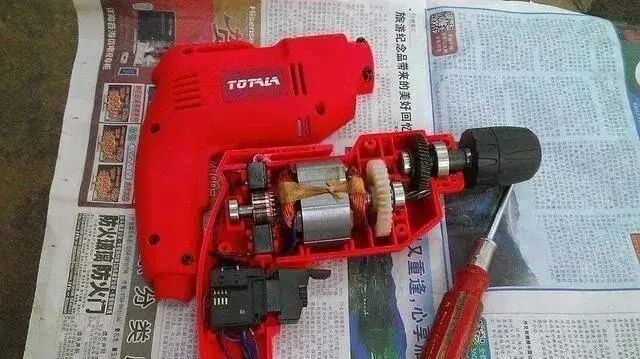
When an engineer says a power tool “uses a brushed motor,” they almost always mean a motores universales — a series-wound DC motor that, thanks to its commutator and carbon brushes, also runs on single-phase AC. (Cordless tools sometimes use a permanent-magnet DC, PMDC, motor, which is also brushed.) The brushes are spring-loaded carbon blocks that press on a spinning copper conmutador, reversing current in each armature coil so torque always acts in one direction.
The alternative is a CC sin escobillas (BLDC) motor, where the commutator is replaced by an electronic controller and fixed stator coils. No brushes means no sparking, no brush wear — but it means a circuit board, sensores, and firmware that a brushed tool simply does not have.

Principio del motor de escobillas CC
Como se muestra en la figura 1, Este es un modelo de estructura de motor de escobillas CC.. Dos imanes anisotrópicos fijos, colocado en medio de una bobina, Los extremos de la bobina estaban conectados a dos anillos de cobre semicirculares., Extremos de anillo de cobre y contacto de escobilla de carbón fijo., y luego a los extremos de las escobillas de carbón se conectaron a la fuente de alimentación de CC.
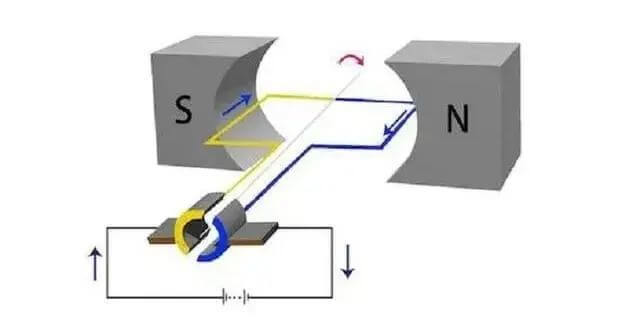
Cifra 1
Después de conectar la fuente de alimentación, la corriente es como se muestra con la flecha en la Figura 1. Según la regla de la mano izquierda, la bobina amarilla está sometida a una fuerza electromagnética vertical hacia arriba; la bobina azul está sometida a una fuerza electromagnética vertical hacia abajo. El rotor del motor comienza a girar en el sentido de las agujas del reloj y después 90 grados de rotación, como se muestra en la figura 2.
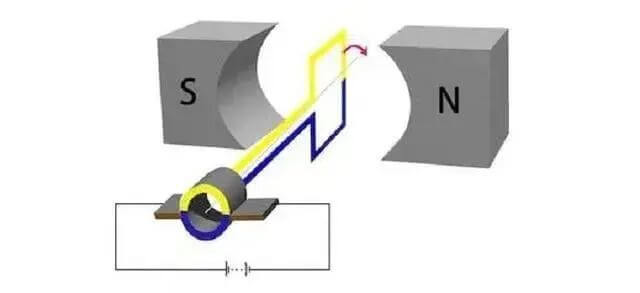
Cifra 2
En este momento, la escobilla de carbón está justo en el medio del espacio entre los dos anillos de cobre, y no hay corriente en todo el circuito de la bobina. Pero bajo la acción de la inercia., el rotor sigue girando.
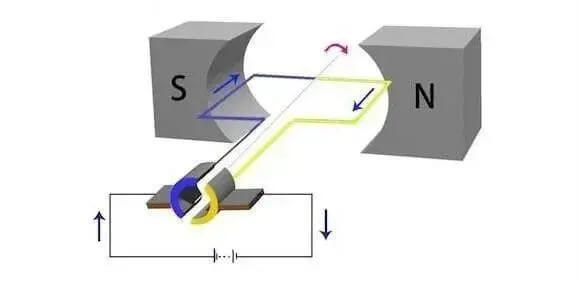
Cifra 3
Cuando el rotor gira a la posición anterior por inercia, La corriente de la bobina se muestra en la figura. 3. Según la regla de la mano izquierda, la bobina azul está sometida a una fuerza electromagnética vertical hacia arriba; la bobina amarilla está sometida a una fuerza electromagnética vertical hacia abajo. El rotor del motor continúa girando en el sentido de las agujas del reloj., después 90 grados, como se muestra en la figura 4: en este momento, La escobilla de carbón está justo en el espacio medio entre los dos anillos de cobre., y no hay corriente en todo el circuito de la bobina. Pero bajo la acción de la inercia., el rotor sigue girando. Luego se repiten los pasos anteriores., y el ciclo continúa.
Motor CC sin escobillas
Como se muestra en la figura 5, Este es un diagrama modelo de una estructura de motor DC sin escobillas.. Consta de un estator y un rotor., donde el rotor tiene un par de polos magnéticos; El estator está enrollado con muchos juegos de bobinas., En el diagrama se muestran seis juegos de bobinas..
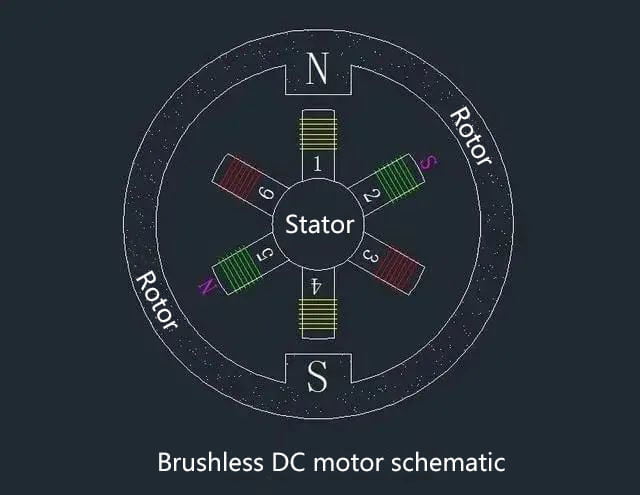
Cifra 5
Cuando pasamos corriente a las bobinas del estator. 2 y 5, las bobinas 2 y 5 producirá un campo magnético, y el estator es equivalente a una barra magnética, dónde 2 es la s (sur) poste y 5 es el norte (norte) polo. Dado que los polos del mismo sexo se atraen, El polo N del rotor girará hacia la bobina. 2 posición y el polo S del rotor girará hacia la bobina 5 posición, Cifra 6.
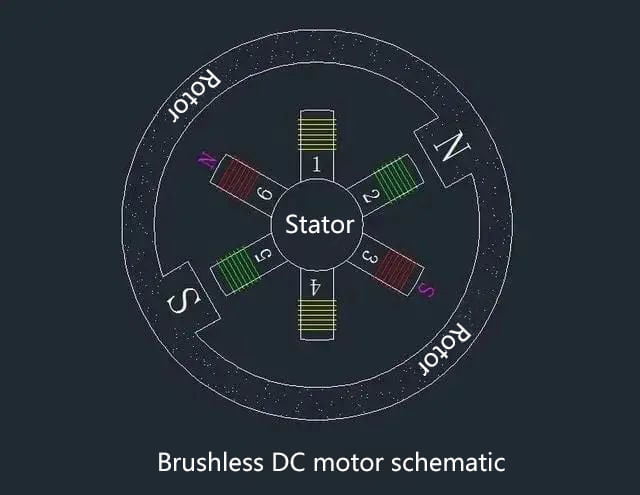
Cifra 6
Luego retiramos la corriente de las bobinas del estator. 2 y 5 y pasar corriente a las bobinas del estator. 3 y 6. En este momento, bobinas 3 y 6 producirá un campo magnético, y el estator es equivalente a una barra magnética, dónde 3 es la s (sur) poste y 6 es el norte (norte) polo. Dado que los polos magnéticos del mismo sexo se atraen entre sí, El polo N del rotor girará hacia la bobina. 3 posición y el polo S del rotor girará hacia la bobina 6 posición, Cifra 7.
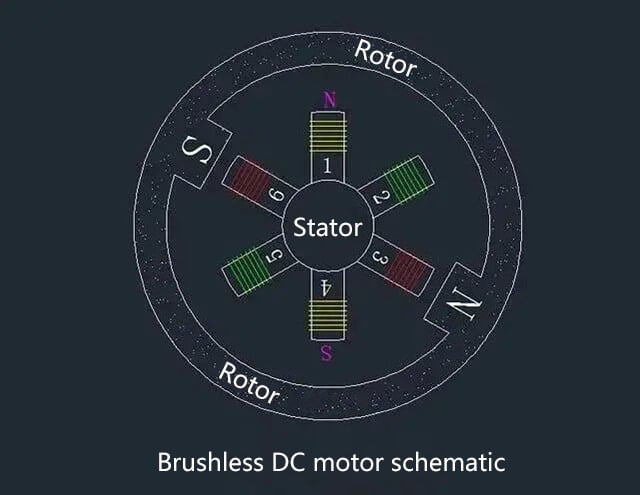
Cifra 7
Similarmente, luego retire la corriente de las bobinas del estator 3 y 6, y luego pasar la corriente a las bobinas del estator 4 y 1. En este momento, bobinas 4 y 1 producirá un campo magnético, y el estator es equivalente a una barra magnética, dónde 4 es la s (sur) poste y 1 es el norte (norte) polo. Como los polos opuestos se atraen, El polo N del rotor girará hacia la bobina. 4 posición y el polo S del rotor girará hacia la bobina 1 posición. Arriba a
Hasta este punto, el motor ha girado media vuelta …. La segunda media vuelta es el mismo que el principio anterior., así que no lo repetiremos aquí. Simplemente podemos entender el motor DC sin escobillas como pescar una zanahoria delante de un burro., para que el burro siga avanzando hacia la zanahoria.

Entonces, ¿cómo podemos pasar la corriente exacta a diferentes bobinas en diferentes momentos?? Esto requiere un circuito de conmutación actual. …… No entraré en detalles aquí.
Comparación de ventajas y desventajas del motor de CC con escobillas y del motor de CC sin escobillas
motor de cepillo de CC: arranque rápido, frenado oportuno, regulación de velocidad suave, control sencillo, estructura simple, barato. El caso es que el precio es barato.! El precio es barato! El precio es barato! Y tiene alta corriente de arranque, alto par (fuerza rotatoria) a baja velocidad, y puede transportar cargas muy pesadas.
Sin embargo, debido a la fricción entre las escobillas de carbón y el conmutador, El motor de cepillo DC es fácil de producir chispas., calor, ruido, interferencia electromagnética al ambiente externo, y baja eficiencia y corta vida. Porque la escobilla de carbón es un producto de desgaste, es fácil fallar, y necesita ser reemplazado después de un período de tiempo.

Motor sin escobillas de CC: Porque el motor DC sin escobillas elimina la escobilla de carbón., entonces el ruido es pequeño, sin mantenimiento, baja tasa de fracaso, larga vida útil, Y el tiempo de funcionamiento y el voltaje son más estables., para que la interferencia del equipo de radio sea pequeña. pero es caro! Caro! Caro!
Las herramientas eléctricas son herramientas muy comunes en la vida., y hay muchas marcas diferentes y una competencia feroz, Entonces la gente es muy sensible al precio.. Y las herramientas eléctricas que necesita para transportar una carga muy pesada., debe haber mucho par de arranque, como taladro de mano, taladro de impacto. De lo contrario, al perforar, Es fácil que el motor no funcione porque la broca está atascada..

Imagine un motor de CC con escobillas a bajo precio., alto par de arranque y capaz de transportar cargas pesadas; El motor sin escobillas tiene una baja tasa de fallas y una larga vida útil., pero es caro y el par de arranque es mucho menor que el del motor con escobillas.. si tu eliges, ¿Cómo elegirás?, Creo que la respuesta se explica por sí misma..
Brushed vs Brushless — The Core Difference
| Aspect | Cepillado (universal / PMDC) | sin escobillas (BLDC) |
|---|---|---|
| Conmutación | Mechanical — brushes + conmutador | Electronic — controller + Sensores de pasillo |
| Control electronics | Ninguno (cambiar + triac for AC speed) | Required driver PCB + firmware |
| Par de arranque | muy alto (stall current = V/Rₐ) | Alto, but limited by controller current cap |
| Fuente de energía | CA o CC (universal) | DC only (or via rectifier) |
| Fragile parts | None electronic — robust in dust/heat | Controller sensitive to moisture/ESD/spikes |
| Mantenimiento | Reemplazar cepillos (wear part) | Virtually maintenance-free |
| Upfront cost | Low — 30–50% cheaper | De primera calidad (20–50% more) |
How a Brushed (Universal) Motor Produces High Starting Torque
The reason brushed motors dominated drills, muelas, and saws comes down to one physics fact about the herida en serie diseño. Walk through it:
- The field and armature are in series. Field current equals armature current, so at high current the magnetic field is also at its strongest.
- At standstill, back-EMF is zero. The induced voltage E = kₑ·ω is proportional to speed ω; when ω = 0, E = 0.
- Current is only limited by winding resistance. I = (V − E)/Rₐ = V/Rₐ, which is huge because Rₐ is small (fractions of an ohm).
- Torque surges. T = kₜ·Iₐ, so the stall current produces a large stall torque — for a series (universal) motor, torque scales roughly with the square of current (T ∝ I²).
- As it spins up, back-EMF rises and current falls to a steady operating value — the motor self-regulates to the load.
- The commutator keeps it one-way. Brushes switch current direction in each coil at the right instant, so torque never cancels out.
This is exactly why a drill doesn’t stall when the bit binds in hardwood: the motor pulls a massive inrush current and converts it directly into torque. An IEEE analytical study of universal motors confirms they remain in use for “drills and saws” precisely because of their “wide variable-speed range, alto par de arranque, low cost and attractive power/weight ratio” (IEEEX, 5994773).
The Starting-Current Reality (Ejemplo resuelto)
Real brushed motors exploit this inrush rather than fight it. Measured on a maxon RE 30 brushed DC motor at 24 V (EDN, brushed DC motor current):
| Condición | Actual | Energía | Nota |
|---|---|---|---|
| Spin-up peak (≈1 ms) | 29 A | ≈700 W | Brief inrush to overcome inertia |
| Stall (rotor held) | 34 A | 816 W | Maximum torque condition |
| Continuous running | 2 A | 48 W | Rated operating point |
| Max allowed continuous | 3.5 A | 84 W | Thermal limit to avoid damage |
A brushless controller must cap this inrush with closed-loop current limiting; a brushed tool simply lets the copper and magnets handle it. maxon itself notes brushed DC motors “can be operated without external electronics… a useful alternative to BLDC motors,” with torque control “implemented using the current” y “low start-up voltage even after a long period in standstill” (maxon DCX program).
Brushed vs Brushless Power Tools — Quantitative Comparison
The reason the market has shifted (but not fully) is visible in the numbers. Ranges reflect typical consumer-to-professional corded and cordless tools.
| Parámetro | Cepillado (universal) | sin escobillas (BLDC) | Fuente / note |
|---|---|---|---|
| Eficiencia | 50–60% (cheap universal); 70–85% (good PMDC) | 85–90%+ | BLDC loses less to friction/heat |
| Upfront cost | Base | +20–50% premium | PowerToolLab, KitD data |
| Tiempo de ejecución de la batería (same pack) | Base | +30–50% more holes/charge | PowerToolLab drill test (276 VS 397 agujeros) |
| Cepillo / maintenance life | 500–2,000 h (consumer grinder 50–100 h) | Much longer (no wear part) | Duty-cycle dependent |
| Par de arranque | muy alto; self-limited only by Rₐ | Alto; capped by controller | T = k·Iₐ vs current limit |
| Rango de velocidad | 10,000–20,000+ RPM (geared down) | Ancho, EC-controlled | Universalmotor high-speed design |
| Environmental robustness | Excelente (no electronics to fry) | Bien, but controller vulnerable | Dust/heat/moisture sensitivity |
Why the Cost Gap Exists
| Componente | Cepillado | sin escobillas |
|---|---|---|
| Motor windings | Estándar, high-volume | Estándar |
| Conmutación | Commutator + carbon brushes (~$2) | Ninguno |
| Controlador | Ninguno (cambiar + triac) | tarjeta de circuito impreso + MOSFETs + firmware |
| Sensores | Ninguno | Sensores de pasillo (or sensorless algo) |
| Manufacturing complexity | Bajo | Alto (SMT, calibración) |
A 2020 deep-slot universal-motor study for power tools (Northwestern Polytechnical University & China’s National Engineering Research Center for Small & Motores de precisión) even optimized the slot design specifically “to reduce the cost of universal motor materials and improve production efficiency” (Springer JoPE, 2020) — cost is engineered in at the source.
Datos de ingeniería: Eficiencia, Temperatura & Life Limits
These are the numbers a design or procurement engineer actually uses when choosing motor architecture.
| Parámetro | Typical value | Estándar / note |
|---|---|---|
| Brushed universal efficiency | 50–60% (barato); up to ~75% loaded | Small universal motors lower at light load |
| Brushed PMDC efficiency | 70–85% | maxon RE series reaches ~90% |
| BLDC efficiency | 85–90%+ | UL / manufacturer lab data |
| Brushless cost premium | +20–50% | Controlador + sensors drive it |
| Brush service life | 500–2,000 h (grinder 50–100 h) | High current shortens life |
| Sin velocidad de carga (universal) | 10,000–20,000+ RPM | Gear-reduced to tool output |
| Commutator temp class | Clase B 130 ° C / F 155 ° C | CEI 60034-1 límites |
| Stall current | V / Rₐ (10–30× running) | EDN maxon RE30: 34 A stall @24 V |
Key Formulas
| Cantidad | Fórmula | Meaning for tool design |
|---|---|---|
| Atrás-EMF | E = kₑ · ω | Zero at standstill → max current at start |
| Esfuerzo de torsión | T = kₜ · Iₐ | Torque tracks armature current |
| Stall current | I_stall = V / Rₐ | Bounded only by winding resistance |
| Series-motor torque | T ∝ I² (approx.) | Universal motor: torque rises with current² |
| Velocidad (cargado) | N ∝ V / (k · Φ), inversely with load | Drops under load; no-load can overspeed |
Sparking Acceptance (CEI 60034-1)
The commutator sparks — that is normal, but only to a limit. CEI 60034-1 defines four sparking grades; a service tech should never accept Class 3.
| Clase | Descripción | Acceptable? |
|---|---|---|
| 1 | Sin chispas; commutator and brushes unchanged | Ideal at all loads |
| 1½ | Faint sparking at brush edges only | Permissible continuously |
| 2 | Permissible under stated overload | Allowed, but investigate |
| 3 | Dangerous sparking, fire/erosion risk | Never acceptable |
Best Applications for Brushed Power Tools
Brushed motors remain the right call wherever low cost, control sencillo, alto par de arranque, or rough-environment robustness outrank maintenance-free life.
| Solicitud | Why brushed fits | Watch-out |
|---|---|---|
| Corded drills / impact drivers (presupuesto) | Cheap, huge starting torque, AC line power | Brush wear over heavy use |
| Angle grinders | Universal motor spins 10k+ RPM natively | High current → short brush life |
| Corded saws / lijadoras | No battery runtime concern; robust | Commutator maintenance |
| DIY / homeowner tools | Low upfront cost, occasional use | Long idle → brush seat-in needed |
| Dusty / hot job sites | No fragile controller to fry | Vent ingress accelerates wear |
| Repair-focused fleets | Brushes are a cheap field-replaceable part | Spares inventory required |
When the application needs precise, low-maintenance motion instead, brushless or gear-reduced BLDC is the better fit — see our guide on why robotic arms need speed reducers.
Guía de selección: When to Choose a Brushed Motor
- Budget is the priority: if upfront cost dominates (DIY, give-away kits, high-volume OEM), brushed wins by 20–50%.
- The tool is corded or AC-powered: a universal motor runs straight off the line — no battery, no inverter.
- You need stall-grade starting torque: ejercicios, mezcladores, and augers that bind under load benefit from the V/Rₐ inrush.
- AC/DC flexibility matters: job-site generators or engine-driven welders can be DC; universal motors handle both.
- The environment is harsh: polvo, humedad, calor, and voltage spikes destroy controllers faster than they wear brushes.
- Field repair is expected: if operators swap brushes themselves, brushed keeps the tool out of the shop.
- Choose brushless instead when: cordless runtime, tool life, and low noise are worth the premium (professional daily use).
Common Engineering Mistakes With Brushed Power-Tool Motors
| Error | Why it hurts |
|---|---|
| Assuming “brushed = obsolete” | Misses the cost, esfuerzo de torsión, and robustness cases where brushed is still optimal |
| Ignoring brush life in the duty cycle | Consumer grinder brushes wear in 50–100 h; spares must be planned |
| Undersizing the supply for stall current | Stall pulls 10–30× running current; weak supplies brown out |
| Wrong brush grade for the load | High-current tools need electrographitic/metal-graphite, not pure carbon |
| Forgetting the IEC sparking limit | Clase 3 sparking erodes commutator and is a fire risk |
| Overlooking AC/DC requirement | A PMDC won’t run on AC; a universal will — verify the source |
Brushed Power-Tool Motor Troubleshooting (Problema → Causa → Solución)
| Problema | Causa probable | Solución |
|---|---|---|
| Weak / low torque under load | cepillos gastados, poor commutator contact, low supply | Replace brush set; clean/seat commutator; check voltage |
| Excessive sparking | Worn brush, wrong grade, grooved commutator | Fit correct grade; resurface commutator; set spring pressure |
| Motor runs hot | Sobrecarga, arcing, blocked vents, high ambient | Reducir la carga; clear vents; verify duty vs IEC class |
| Rapid brush wear | Too much spring pressure, abrasive dust, alta corriente | Reset pressure; clean environment; correct grade |
| No start / intermitente | Brushes gone, loose lead, seized bearing | New brush set; tighten lead; free shaft |
| Burns out on stall | Held stalled beyond thermal limit (I = V/Rₐ) | Add current limit / thermal cutoff; don’t bind the bit |
For the full diagnostic sequence — including winding resistance and insulation tests — use our DC motor troubleshooting guide.
Preguntas frecuentes
Why do power tools use brushed motors instead of brushless?
Cepillado (mostly universal) motors are 20–50% cheaper because they need no controller, sensores, or firmware, and they deliver very high starting torque by exploiting the stall inrush (I = V/Rₐ). They also run on AC or DC and survive dust and heat without fragile electronics. Brushless wins on battery life and longevity, but brushed stays best for budget, corded, and repairable tools.
Do brushed power tools have more torque than brushless?
At the instant of starting or binding, a brushed series motor can pull a larger current spike (only limited by winding resistance), so its cima starting torque is very high. Brushless motors are capped by their controller’s current limit, though they hold torque more consistently under sustained load and run more efficiently overall.
Are brushed power tools still good?
Yes — for corded tools, budget DIY use, ambientes hostiles, and fleets that field-replace brushes, brushed motors are a perfectly good, cost-effective choice. For professional cordless daily use where runtime and tool life dominate, brushless is the better long-term investment.
¿Por qué los motores con escobillas son más baratos??
They replace an entire electronic control system with a commutator and two carbon brushes. No PCB, no MOSFETs, no Hall sensors, no firmware calibration — just a switch (and a triac for AC speed control). High-volume winding and stamping keep per-unit cost low.
Can a brushed motor run on AC and DC?
A universal motor can — that is its defining feature and why it suits power tools plugged into any outlet or driven by a DC job-site source. A permanent-magnet DC (PMDC) brushed motor runs on DC only unless externally rectified.
How long do power-tool motor brushes last?
Typically 500–2,000 operating hours depending on current and duty; consumer-grade angle-grinder brushes can wear in as little as 50–100 hours under heavy use. Because brushes are a planned-replacement wear part, they are designed to be swapped cheaply rather than ending the tool’s life.
Why Choose Greensky for Brushed & Brushless Motion
Whether your tool design stays with brushed simplicity or moves to brushless efficiency, Greensky supplies both from one source, built to CEI 60034 y NEMA MG 1 dimensions so they drop into existing mounts:
- Brushed PMDC & universal motors with documented commutator specs, selectable brush grades, and replacement-brush programs for maintenance teams.
- sin escobillas (BLDC) motors and gear motors with matched Hall sensors and drives — eliminating brush wear, sparking, and commutation maintenance for cordless platforms.
- Integrated gear motors that multiply output torque, reducing the current (and brush stress) the motor core must handle — see our gearbox vs gear motor guide.
- Flange compatibility: IEC B5/B14 and NEMA C-face with customized pilot diameters — see our motor flange guide.
- Low-MOQ OEM/ODM: small batches for spares programs and custom shaft/encoder configurations.
Lectura relacionada
- ¿Qué es un motor de CC?? Tipos, Principle & Fórmulas
- What Are Motor Brushes? Tipos & Cómo funcionan
- Why Do Brushed Motors Spark? Causas & Fixes
- What Causes a DC Motor to Lose Torque?
- How to Troubleshoot a DC Motor: Step-by-Step Guide
- BLDC Motor Disadvantages Engineers Should Know
- Cómo cortocircuitar un motor de CC (Short-Circuit Braking)
- Motor de CA versus CC: Cuál elegir
- ¿Qué es una brida de motor?? IEC vs NEMA Mounting
- Gearbox vs Gear Motor: Diferencias & Selección
Referencias
- CEI 60034-1 — Rotating Electrical Machines: Calificación y rendimiento (temperatura & sparking classes). webstore.iec.ch/publication/67467
- CEI 60034-30-1 — Efficiency Classes for Rotating Electrical Machines (IE1-IE5). webstore.iec.ch/publication/67784
- SIN MG 1 — Motores y Generadores (seguridad, térmico, mounting dimensions). nema.org/standards/view/mg-1-motors-and-generators
- IEEE 112 — Standard Test Procedure for Polyphase Induction & Motores CC (efficiency/loss methods). standards.ieee.org/ieee/112/4213
- IEEE Xplore — Analytical model and parameter computation for universal motors (alto par de arranque, bajo costo). ieeexplore.ieee.org/document/5994773
- Qi, H. et al. (2020) — Design and research of deep slot universal motor for electric power tools. Journal of Power Electronics, Springer. DOI: 10.1007/s43236-020-00131-6
- maxon — Brushed DC motors (DCX program): operable without external electronics, current-based torque control. maxonmotor.com/dcx-program
- FAULHABER — DC-Motors Technical Information (brushed commutation, precious-metal brushes). faulhaber.com/en/technical-information
- A NOSOTROS. DOE — Electric Motor Efficiency Determination & Repair Guidance. energy.gov/eere/amo/articles/determination-electric-motors
- SKF — Electric motor maintenance and bearing lubrication. skf.com/us/products/maintenance-products/bearing-maintenance