
¿Qué tamaño de motor se necesita para una cortadora de césped??
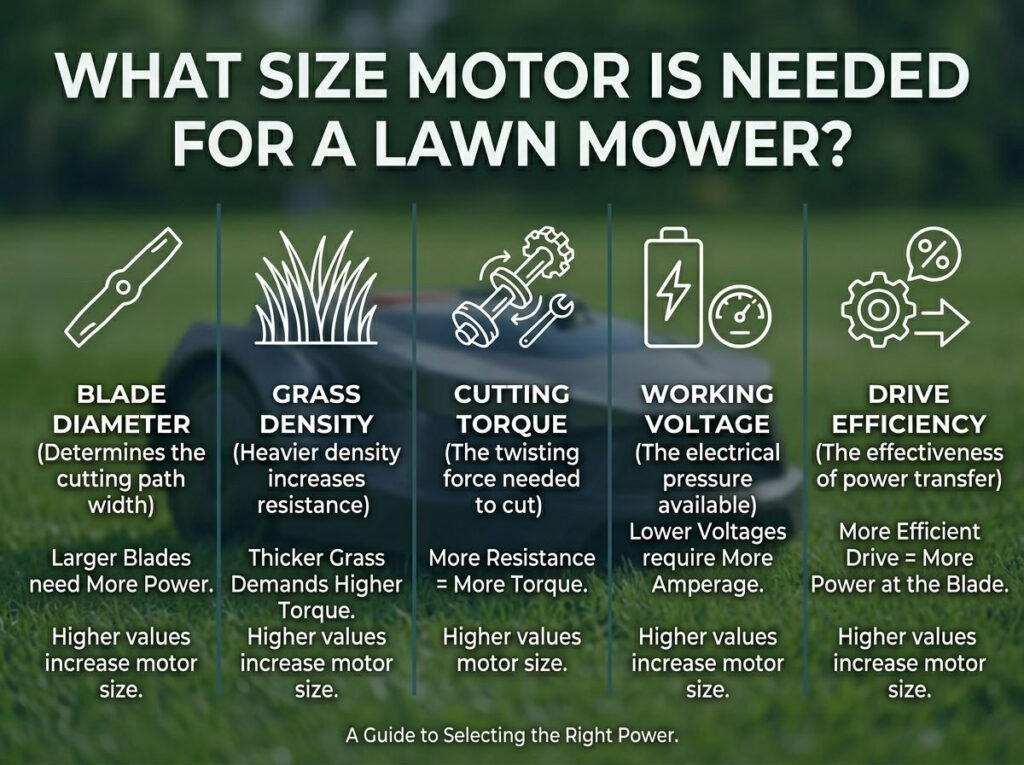
Fragmento destacado: The motor size needed for a lawn mower depends on blade diameter, grass density, cutting torque, tensión de funcionamiento, and drive efficiency. Most residential electric lawn mowers use motors ranging from 500W to 2.5kW, while commercial and riding lawn mowers may require 3kW to 10kW systems. Modern brushless DC (BLDC) motors are increasingly preferred because they deliver higher efficiency, mejor densidad de par, menor mantenimiento, and longer operating life compared with brushed motors or traditional induction motors. For OEM manufacturers and engineering teams, selecting the correct lawn mower motor requires balancing cutting performance, estabilidad térmica, tiempo de ejecución de la batería, compatibilidad del controlador, y confiabilidad a largo plazo.
What Determines the Required Lawn Mower Motor Size?
The required motor size for a lawn mower is not determined by power rating alone. In engineering practice, motor sizing depends on the interaction between cutting load, blade inertia, operating environment, and desired runtime. A mower cutting dry residential grass at moderate speed requires significantly less torque than a commercial mower operating in wet, dense vegetation.
Motor sizing begins with the blade load calculation. Larger cutting decks increase aerodynamic drag and rotational inertia. Por ejemplo, a 16-inch residential mower typically operates effectively with a 600W–1200W motor, while a 21-inch heavy-duty mower may require 1.8kW–3kW continuous power.
Another critical factor is torque reserve. Lawn mower motors experience transient overload conditions when encountering thick grass or debris. If the motor lacks sufficient torque margin, RPM drops rapidly, causing inefficient cutting and controller overheating. This is why modern OEM systems increasingly use high-torque BLDC motors with field-oriented control (FOC).
Battery voltage also affects motor sizing. A 48V system delivering 2kW requires lower current than a 24V system with the same power output, reducing copper losses and improving thermal efficiency. Commercial electric mowers commonly use 48V, 60V, or 72V architectures to improve efficiency and power density.
How Lawn Mower Motors Work
Electric lawn mower motors convert electrical energy into rotational mechanical energy that spins the cutting blade. In modern systems, the motor controller continuously regulates current and RPM based on cutting load.
Motor Structure
A typical electric mower motor contains:
- Devanados del estator
- Rotor assembly
- Aspectos
- Cooling structure
- controlador electrónico
- Position sensors or sensorless control algorithms
Brushless DC motors eliminate carbon brushes and mechanical commutation. En cambio, electronic commutation switches current through the stator phases to create a rotating magnetic field.
Power Transmission
The motor shaft directly drives the blade or transfers power through a belt reduction system. Direct-drive architectures reduce maintenance and improve efficiency, while belt-driven systems allow torque multiplication and blade isolation.
Load Response
Unlike fixed-speed induction motors, modern BLDC systems dynamically adjust torque output. When cutting load increases, the controller raises phase current to maintain blade speed. This adaptive behavior improves cutting consistency and battery efficiency.
Typical Lawn Mower Motor Sizes by Application
| Solicitud | Voltaje | Typical Power | Torque Requirement | Tipo de motor |
|---|---|---|---|---|
| Small Residential Mower | 18V–24V | 500W–800W | Bajo | Cepillado / BLDC |
| Mid-Size Cordless Mower | 36V–48V | 1kW–2kW | Medio | BLDC |
| Heavy-Duty Residential | 48V–60V | 2kilovatios–3kW | Medio-Alto | BLDC |
| Commercial Walk-Behind | 60V–72V | 3kilovatios–5kW | Alto | Industrial BLDC |
| Ride-On Electric Mower | 72V–96V | 5kilovatios–10kW | muy alto | Permanent Magnet Motor |
These ranges vary depending on blade geometry, gearbox ratio, airflow design, and cutting conditions. OEM manufacturers often customize torque curves and controller settings based on target market requirements.
Brushless vs Brushed Lawn Mower Motors
The transition from brushed motors to brushless DC motors represents one of the largest technological shifts in the lawn equipment industry. Engineers increasingly favor BLDC motors because of their superior efficiency, controllability, y confiabilidad.
| Parámetro | Motor sin escobillas | Motor cepillado |
|---|---|---|
| Eficiencia | 85%–93% | 65%–80% |
| Mantenimiento | Bajo | Brush replacement required |
| Densidad de par | Alto | Medio |
| Ruido | Más bajo | Más alto |
| Rendimiento térmico | Mejor | Limitado |
| Complejidad del controlador | Más alto | Más simple |
| Esperanza de vida | Largo | Moderado |
Brushed motors remain attractive for entry-level products because of their low upfront cost. Sin embargo, the total ownership cost becomes less favorable over time due to brush wear, sparking, eficiencia reducida, and thermal losses.
Brushless motors improve battery runtime because they minimize friction and electrical losses. They also enable intelligent torque management, which is especially valuable in robotic lawn mowers and premium cordless equipment.
Why Torque Matters More Than Peak Power
Many buyers focus exclusively on wattage ratings, but torque is often the more important engineering parameter in lawn mower performance.
The cutting blade behaves as a high-inertia rotating load. When the blade encounters dense grass, instantaneous torque demand rises sharply. A motor with insufficient low-speed torque may stall even if its peak power rating appears adequate.
High torque improves:
- Consistencia de corte
- Recovery speed after overload
- Grass collection airflow
- Wet grass performance
- Blade RPM stability
BLDC motors typically provide flatter torque curves across wide RPM ranges. This allows OEM manufacturers to reduce overall motor size while maintaining cutting performance.
Por ejemplo, a high-efficiency 48V BLDC motor rated at 2kW may outperform a conventional 2.5kW brushed system because of better torque delivery and reduced thermal losses.
Efficiency and Thermal Performance in Lawn Mower Motors
Motor efficiency directly influences battery runtime, generación de calor, y durabilidad a largo plazo. In lawn mower systems, thermal performance becomes especially critical because motors operate in dusty outdoor environments with limited cooling airflow.
Consideraciones de eficiencia
Modern brushless motors typically achieve efficiencies above 90% under optimized operating conditions. Reduced copper loss and elimination of brush friction significantly improve energy utilization.
Higher efficiency produces several engineering advantages:
- Mayor duración de la batería
- Reduced controller stress
- Smaller cooling requirements
- Lower operating temperature
- Fiabilidad mejorada del sistema
Gestión térmica
Heat buildup is one of the main causes of premature motor failure. Continuous overload conditions increase winding temperature and accelerate insulation degradation.
Commercial lawn mower motors often use:
- Aluminum housings
- Refrigeración por aire forzado
- Sensores de temperatura integrados
- High-temperature magnets
- Thermal shutdown protection
OEM suppliers increasingly design custom cooling architectures to support compact high-power mower platforms.
BLDC Motor vs Induction Motor for Lawn Mowers
Although BLDC motors dominate cordless lawn equipment, induction motors remain common in corded commercial systems.
| Parámetro | Motor CC CC | Motor de inducción |
|---|---|---|
| Eficiencia | Alto | Moderado |
| Peso | Bajo | Alto |
| Densidad de par | Alto | Más bajo |
| Precisión de control | Excelente | Moderado |
| Costo | Más alto | Más bajo |
| Battery Compatibility | Excelente | Pobre |
| Mantenimiento | Bajo | Bajo |
Induction motors offer durability and low maintenance, but their lower efficiency and higher weight make them less suitable for battery-powered systems.
BLDC motors provide superior variable-speed control and compactness, which is why they dominate robotic mowers, cordless residential equipment, and premium commercial platforms.
How to Choose the Right Lawn Mower Motor
Motor selection requires balancing cutting performance, eficiencia, costo, y durabilidad.
Rango de voltaje
Low-voltage systems below 24V are suitable for compact residential mowers. Mid-range 48V architectures provide an effective balance between safety and efficiency. Commercial systems increasingly use 72V platforms for higher power density.
Rango de poder
Residential applications generally require 500W–2.5kW. Commercial and riding mowers may exceed 5kW depending on deck size and duty cycle.
Velocidad y par
Blade RPM typically ranges between 2500–3500 RPM. Sin embargo, torque stability is more important than unloaded speed. Motors should maintain RPM under fluctuating load conditions.
Método de enfriamiento
Compact residential systems often use passive airflow cooling. Commercial applications require forced-air cooling or advanced thermal housing designs.
Compatibilidad del controlador
FOC controllers improve efficiency and torque smoothness. OEM engineers should verify communication protocols, Compatibilidad del sensor Hall, and regenerative control capability.
Application-Specific Requirements
Robotic mowers prioritize low noise and efficiency. Commercial mowers require overload durability and high continuous torque. Wet-grass applications need higher torque reserve and stronger thermal margins.
Greensky Power provides custom 48V and 72V industrial BLDC motor solutions for electric lawn mower OEM projects. Engineers can request datasheets or customized torque curves for specific mower platforms.
Applications of Modern Lawn Mower Motors
Lawn mower motor technology increasingly overlaps with broader industrial electrification trends.
Residential Lawn Equipment
Battery-powered residential mowers use compact BLDC motors to reduce maintenance and noise while improving runtime.
paisajismo comercial
Professional landscaping companies prioritize durability, continuous-duty thermal performance, and rapid charging capability.
Cortacésped robótico
Autonomous mowing systems require precision motor control, bajo consumo de energía, and high reliability. Sensorless BLDC motors are increasingly used to reduce system complexity.
Industrial Turf Equipment
Golf course maintenance equipment and municipal landscaping platforms require high-power electric drive systems with advanced thermal management.
Electric Utility Vehicles
Many mower motor technologies are now shared with light EV platforms, including controllers, battery systems, and hub motor architectures.
Future Trends in Lawn Mower Motor Technology
The global lawn equipment industry is rapidly transitioning toward electrification. Regulatory pressure, noise reduction requirements, and battery cost improvements are accelerating adoption of advanced BLDC motor systems.
Several engineering trends are shaping future lawn mower motor development:
- Higher-voltage battery platforms
- Integrated smart motor controllers
- AI-based load optimization
- Improved thermal materials
- Lightweight rare-earth magnet designs
- Connected IoT diagnostics
OEM manufacturers increasingly request custom motor designs optimized for efficiency, waterproofing, resistencia a las vibraciones, and compact integration.
As battery energy density improves, high-power electric riding mowers are expected to replace small gasoline platforms in commercial applications.
Common Lawn Mower Motor Selection Mistakes
Incorrect motor selection can significantly reduce mower reliability and customer satisfaction.
Undersized Torque Capacity
Motors selected only by peak wattage may fail under heavy grass load conditions.
Ignoring Thermal Limits
High ambient temperature and airflow restrictions can cause overheating even when motors appear adequately rated.
Controller Mismatch
Poor controller tuning reduces efficiency and may generate unstable torque behavior.
Improper Voltage Selection
Low-voltage systems require higher current, increasing wiring losses and thermal stress.
Insufficient Waterproofing
Lawn equipment operates in wet outdoor conditions. IP protection and corrosion resistance are critical for long-term reliability.
Preguntas frecuentes: Lawn Mower Motor Size and Selection
What size motor is best for a residential lawn mower?
Most residential electric lawn mowers use motors between 800W and 2kW. Smaller gardens may only require 500W–800W, while larger lawns with dense grass typically benefit from 48V brushless systems above 1.5kW.
Are brushless motors better for lawn mowers?
Sí. Brushless motors provide higher efficiency, menor mantenimiento, improved torque control, and longer operating life compared with brushed motors. They are especially effective in cordless and robotic lawn mower applications.
¿Cuánto par necesita el motor de una cortadora de césped??
Required torque depends on blade diameter, grass density, and cutting speed. Commercial systems require significantly higher torque reserve than small residential mowers to maintain stable RPM under heavy load.
What voltage is best for electric lawn mower motors?
48V systems are currently one of the most popular configurations because they balance efficiency, seguridad, and power density. Commercial applications increasingly use 60V and 72V architectures.
Can a lawn mower use an induction motor?
Sí. Induction motors are commonly used in corded electric mowers because of their durability and low maintenance. Sin embargo, battery-powered platforms increasingly favor BLDC motors because of higher efficiency and lighter weight.
¿Cuánto duran los motores de cortacésped BLDC??
Los motores BLDC de alta calidad pueden funcionar durante miles de horas con un mantenimiento mínimo. Lifespan depends on thermal management, bearing quality, controller design, y protección del medio ambiente.
Conclusión
Choosing the correct lawn mower motor size requires more than selecting a wattage rating. Engineers and OEM buyers must evaluate torque reserve, eficiencia, cooling capability, voltage architecture, y confiabilidad a largo plazo.
Modern brushless DC motors have become the preferred solution for electric lawn mower systems because they combine high torque density, intelligent control capability, mantenimiento reducido, and superior energy efficiency.
For OEM manufacturers developing next-generation electric lawn equipment, proper motor selection directly influences cutting performance, tiempo de ejecución de la batería, ruido acustico, and product lifespan.
Greensky Power supports global OEM customers with custom industrial BLDC motor solutions for electric lawn mower applications, including 48V and 72V systems optimized for efficiency, rendimiento térmico, y durabilidad.
Request datasheets, soluciones de motor personalizadas, or engineering consultation for your lawn mower project.
Referencias
- https://www.energy.gov/eere/vehicles/articles/fotw-1200-august-30-2021-electric-vehicle-motor-types
- https://www.iea.org/reports/global-ev-outlook-2024
- https://www.engineeringtoolbox.com/electric-motor-power-d_655.html
- https://www.nidec.com/en/technology/motor/basic/00013/
- https://www.maxongroup.com/maxon/view/content/brushless-dc-motor
- https://www.machinedesign.com/motors-drives/article/21833862/selecting-the-right-motor-for-your-application
- https://www.grin.com/document/491840