
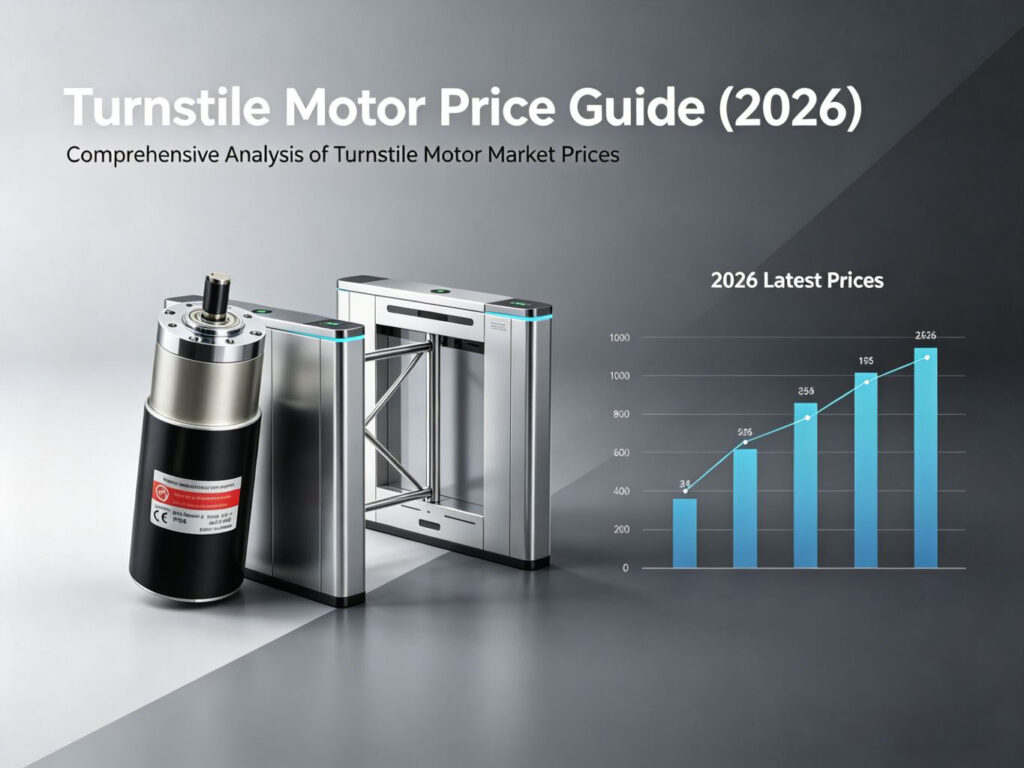
Guía de precios de motores de torniquete (2026)
Fragmento destacado:
Turnstile motor prices in 2026 vary widely depending on motor type, actuación, and customization level. Basic brushed DC motors typically cost $20–$80, BLDC motors range from $60–$250, and high-end servo motors can exceed $300. For most turnstile manufacturers, BLDC motors offer the best balance between cost, eficiencia, y esperanza de vida. Sin embargo, the true cost goes beyond purchase price—factors such as energy efficiency, mantenimiento, fiabilidad, and controller integration significantly impact total cost of ownership (costo total de propiedad). Selecting the right motor requires a full engineering and lifecycle cost evaluation.
What Is the Price of a Turnstile Motor in 2026?
The price of a turnstile motor depends on several technical and commercial factors, including motor type, potencia nominal, Voltaje, control method, and production volume. In OEM procurement, pricing is rarely fixed because customization plays a major role.
A partir de 2026, typical price ranges are:
| Tipo de motor | Typical Price Range (Dólar estadounidense) | Application Level |
|---|---|---|
| Motor de CC cepillado | $20 – $80 | Low-cost turnstiles |
| Motor CC CC | $60 – $250 | Mainstream & high-end systems |
| servomotor | $200 – $600+ | Premium precision systems |
These prices reflect base motor units without advanced customization, integración de la caja de cambios, or controller systems. For complete drive assemblies, costs can increase significantly.
👉For high-performance solutions, check our BLDC Motor for Turnstile
Why Turnstile Motor Prices Vary So Much
Turnstile motor pricing is influenced by multiple engineering and supply chain variables. Unlike commodity components, motors are often tailored to specific system requirements.
Key Cost Drivers
- Tipo de motor (BLDC, cepillado, servo)
- Power and torque requirements
- Voltage rating (24V, 48V, 72V)
- Controller and electronics integration
- Production volume (MOQ impact)
- personalización (eje, alojamiento, montaje)
Por ejemplo, a standard 24V BLDC motor for a tripod turnstile may cost under $100, while a custom 72V high-torque motor with integrated driver can exceed $300.
BLDC vs Cepillado vs Servo: Cost Comparison for Turnstiles
| Parámetro | Motor CC CC | Motor de CC cepillado | servomotor |
|---|---|---|---|
| Costo inicial | Medio | Bajo | Alto |
| Maintenance Cost | Bajo | Alto | Bajo |
| Eficiencia energética | Alto | Medio | muy alto |
| Esperanza de vida | Largo | Corto | Very Long |
| Costo total de propiedad | Bajo | Alto | Medio |
Desde una perspectiva de adquisiciones, brushed motors appear cheaper initially, but their higher maintenance and shorter lifespan increase long-term costs. BLDC motors provide the best lifecycle value.
Turnstile Motor Cost Breakdown (Perspectiva de ingeniería)
A motor’s price is not just based on materials—it reflects engineering design, manufacturing processes, and performance capabilities.
Material Cost
Includes copper windings, imanes, steel laminations, y vivienda. BLDC motors typically use rare-earth magnets, increasing cost but improving performance.
Manufacturing Cost
Precision assembly, balancing, and quality control contribute to cost. Higher torque density motors require tighter tolerances.
Electrónica & Controlador
BLDC and servo motors require drivers, sensores, y algoritmos de control. This adds 20–50% to total system cost.
Pruebas & Certificación
Industrial motors often require compliance with standards, increasing cost but ensuring reliability.
Eficiencia, Densidad de par & Thermal Impact on Cost
Eficiencia
Higher efficiency motors reduce electricity consumption. Con el tiempo, energy savings offset higher upfront costs.
Densidad de par
Compact high-torque motors reduce system size and mechanical complexity, lowering overall system cost.
Rendimiento térmico
Better heat dissipation prevents failures and extends lifespan, reducing maintenance expenses.
Fiabilidad & Esperanza de vida
BLDC motors can operate over 20,000 horas, while brushed motors may require replacement within 3,000–5,000 hours.
Hidden Costs: What Buyers Often Overlook
- Downtime due to motor failure
- Maintenance labor costs
- Energy consumption over years
- Controller compatibility issues
- Replacement and spare parts logistics
For high-traffic turnstiles, downtime can cost far more than the motor itself, making reliability a critical factor.
How to Choose a Turnstile Motor Based on Price & Actuación
Voltage Selection
24V systems are cost-effective, while 48V and 72V systems improve efficiency and reduce current losses.
Rango de poder
Typical range: 50W–500W depending on application.
Velocidad & Esfuerzo de torsión
After gearbox reduction, speeds typically range from 30–300 RPM with torque tailored to gate size.
Método de enfriamiento
Passive cooling is standard, but high-duty systems require enhanced heat dissipation.
Compatibilidad del controlador
Ensure compatibility with PWM, sensor de pasillo, or FOC controllers.
Consideraciones de aplicación
- Indoor vs outdoor use
- Requisitos del ciclo de trabajo
- Noise constraints
Aplicaciones: Matching Motor Cost to Use Case
Low-Cost Turnstiles
Use brushed motors to minimize upfront cost.
Edificios Comerciales
BLDC motors provide reliability and low maintenance.
Transportation Systems
High-duty applications require efficient BLDC motors.
High-End Security Systems
Servo motors justify their cost with precision control.
Explore BLDC motor solutions →
Tendencias futuras: Turnstile Motor Pricing in 2026–2030
- Decreasing BLDC motor costs due to mass production
- Integration of controllers reducing system cost
- Adoption of smart motors with IoT features
- Shift toward energy-efficient solutions
As technology evolves, BLDC motors are expected to dominate due to their balance of performance and cost.
Preguntas frecuentes: Turnstile Motor Pricing
1. What is the cheapest motor for turnstiles?
Brushed DC motors are the cheapest upfront, typically costing $20–$80, but have higher maintenance costs.
2. Why are BLDC motors more expensive?
They use advanced electronics and permanent magnets, improving efficiency and lifespan.
3. What is the best motor for cost-performance balance?
BLDC motors offer the best balance between cost, eficiencia, y durabilidad.
4. How much does a custom turnstile motor cost?
Custom motors typically cost 20–50% more depending on design requirements.
5. Is a servo motor worth the cost?
Sí, for high-end applications requiring precise control and smooth operation.
Conclusión: How to Optimize Turnstile Motor Cost
Choosing the right motor is not about selecting the cheapest option—it is about optimizing total cost of ownership. BLDC motors provide the best long-term value for most turnstile manufacturers, while brushed motors serve low-budget projects and servo motors target high-end systems.
OEM buyers should evaluate not only price but also efficiency, fiabilidad, and lifecycle cost to make informed decisions.
Need pricing or technical advice?
Request datasheets, get OEM solutions, or contact our engineers today.
Referencias
- https://ieeexplore.ieee.org
- https://www.ti.com/motor-drivers
- https://www.iec.ch
- https://www.motioncontrolonline.org