
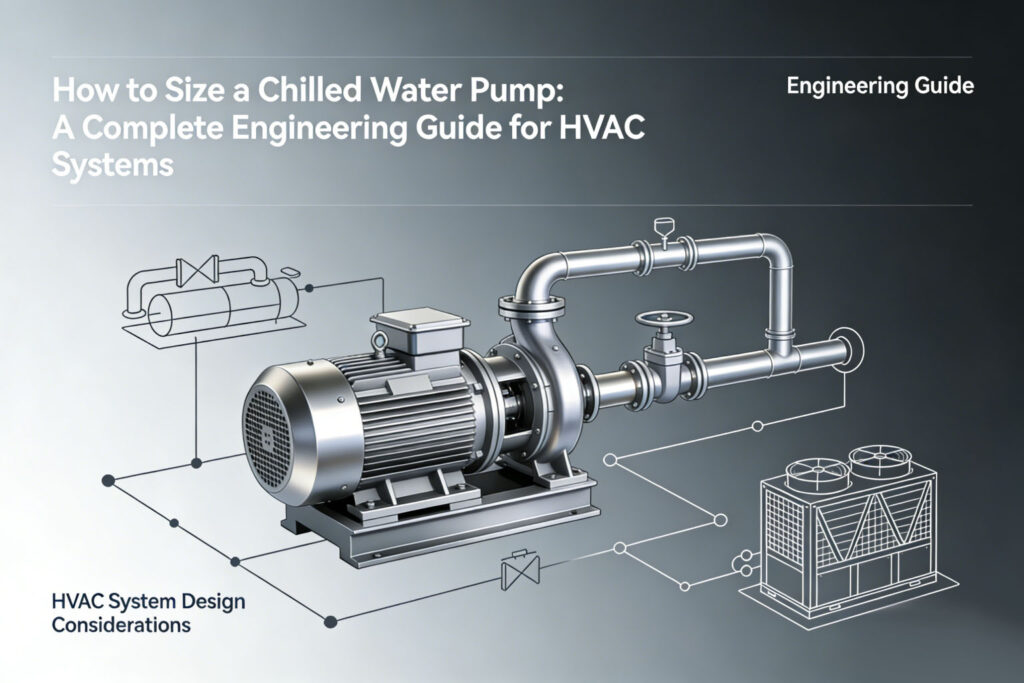
Cómo dimensionar una bomba de agua helada: Guía completa de ingeniería para sistemas HVAC
El tamaño adecuado de la bomba es uno de los pasos más críticos en el diseño de un sistema de agua helada eficiente.. Ya sea para sistemas HVAC comerciales, centros de datos, o procesos de refrigeración industrial, La selección del tamaño correcto de la bomba afecta directamente el rendimiento del sistema., consumo de energía, y confiabilidad a largo plazo.
Si estas buscando cómo dimensionar un bomba de agua enfriada, esta guía proporciona un enfoque de ingeniería completo, incluyendo fórmulas, métodos de cálculo, consideraciones del sistema, y consejos prácticos de selección.
Este artículo está diseñado para ingenieros., contratistas de climatización, y fabricantes OEM que necesitan soluciones de dimensionamiento de bombas precisas y confiables. También explica cómo los motores modernos de alta eficiencia, como los motores BLDC, pueden mejorar significativamente el rendimiento de la bomba..
Fragmento destacado: Cómo dimensionar una bomba de agua helada
para dimensionar un bomba de agua enfriada, necesita calcular el caudal requerido y la altura dinámica total (TDH).
- El caudal se basa en la carga de refrigeración (GPM o m³/h)
- La altura está determinada por la resistencia del sistema.
- Seleccione la bomba según la curva de rendimiento
- Combine con un motor de alta eficiencia para un rendimiento óptimo
El tamaño preciso de la bomba garantiza un funcionamiento eficiente, consumo de energía reducido, y larga vida útil del sistema.
Por qué es importante el tamaño de la bomba en los sistemas HVAC
El tamaño incorrecto de la bomba puede provocar problemas graves en el sistema.
Bombas de gran tamaño
- Exceso de consumo de energía
- Mayores costos operativos
- Mayor desgaste
Bombas de tamaño insuficiente
- Capacidad de refrigeración insuficiente
- Mal rendimiento del sistema
- inestabilidad de temperatura
El tamaño adecuado garantiza un equilibrio óptimo entre rendimiento y eficiencia..
Parámetros clave para el tamaño de la bomba de agua helada
1. Tasa de flujo (Q)
El caudal determina cuánta agua enfriada debe circular a través del sistema..
2. Cabeza dinámica total (TDH)
TDH representa la resistencia total que debe superar la bomba..
3. Carga de enfriamiento
Medido en toneladas de refrigeración. (TR) o kilovatios.
4. Diseño de sistemas de tuberías
Incluye longitud de tubería, guarniciones, y cambios de elevación.
Paso a paso: Cómo calcular el caudal
Fórmula básica
Caudal (GPM) = Carga de refrigeración (BTU/hora) ÷ (500 × ΔT)
Donde ΔT es la diferencia de temperatura entre el agua de suministro y de retorno..
Ejemplo de cálculo
Para un sistema de 100 toneladas:
- 1 tonelada = 12,000 BTU/hora
- Carga total = 1,200,000 BTU/hora
- Suponiendo ΔT = 10°F
Caudal = 1,200,000 ÷ (500 × 10) = 240 GPM
Paso a paso: Cómo calcular la carga dinámica total (TDH)
Componentes de la TDH
- Pérdida por fricción en tuberías.
- Pérdidas en accesorios y válvulas.
- Diferencias de elevación
Cálculo de pérdida por fricción
Basado en el diámetro de la tubería, tasa de flujo, y longitud.
Rango TDH típico
- Pequeños sistemas: 10–30 metros
- Sistemas medianos: 30–60 metros
- Grandes sistemas: 60+ metros
Comprensión de las curvas de rendimiento de la bomba
Después de calcular el caudal y la altura, Seleccione una bomba usando curvas de rendimiento..
Elementos clave de la curva
- Flujo vs cabeza
- Curva de eficiencia
- Consumo de energía
Elija una bomba que funcione cerca de su punto de mejor eficiencia (BEP).
Dimensionamiento de la bomba primaria versus secundaria
Bomba primaria
Maneja los requisitos de flujo del enfriador.
Bomba secundaria
Distribuye agua helada a diferentes zonas..
Cada bomba debe dimensionarse en función de su función específica..
Sistemas de flujo constante versus sistemas de flujo variable
Flujo constante
Caudal fijo independientemente de la carga..
Flujo variable
Ajusta el flujo según la demanda., mejorando la eficiencia.
Los sistemas de flujo variable requieren estrategias de control avanzadas.
Selección de motor para bombas de agua helada
El motor juega un papel fundamental en el rendimiento de la bomba..
Tipos de motores comunes
- motores de inducción de CA
- Motores de imanes permanentes
- Motores BLDC
Por qué es importante la eficiencia del motor
La eficiencia del motor impacta directamente en el consumo de energía del sistema..
Ventajas de los motores BLDC en aplicaciones de bombas
Los motores BLDC se utilizan cada vez más en los sistemas HVAC modernos..
- Eficiencia hasta 95%
- Control de velocidad preciso
- Menor consumo de energía
- Larga vida útil
- Bajo mantenimiento
Combinado con control de velocidad variable, Los motores BLDC mejoran significativamente la eficiencia del sistema.
Consejos prácticos para la selección de bombas
1. Calcula siempre antes de seleccionar
Evite seleccionar bombas basándose en suposiciones.
2. Elija equipos de alta eficiencia
Reduce los costos operativos a largo plazo.
3. Considere la expansión futura
Permitir el crecimiento del sistema..
4. Optimizar la estrategia de control
Utilice variadores de velocidad para mayor eficiencia.
5. Trabaje con proveedores confiables
Garantizar la calidad y el soporte del producto..
Errores comunes en el tamaño de las bombas
- Ignorar la resistencia del sistema
- Sobreestimar los márgenes de seguridad
- Despreciar la eficiencia del motor
- Configuración de control incorrecta
Estos errores pueden provocar un rendimiento deficiente y costes elevados..
Eficiencia Energética y Optimización de Costos
El consumo de energía es un factor de coste importante en los sistemas HVAC.
El tamaño adecuado de la bomba combinado con motores de alta eficiencia reduce los gastos operativos.
Los sistemas de flujo variable y los controles avanzados proporcionan ahorros adicionales.
Tendencias futuras en el diseño de bombas de agua helada
- Sistemas inteligentes de climatización
- Monitoreo basado en IoT
- Motores BLDC de alta eficiencia
- Algoritmos de control avanzados
Conclusión
Saber cómo dimensionar una bomba de agua helada es esencial para diseñar sistemas eficientes de climatización y refrigeración industrial.. Calculando con precisión el caudal y la altura dinámica total, Los ingenieros pueden seleccionar la bomba adecuada para un rendimiento óptimo..
Los sistemas modernos dependen cada vez más de motores de alta eficiencia, como los motores BLDC, para reducir el consumo de energía y mejorar la confiabilidad..
Para fabricantes OEM y profesionales de HVAC, El tamaño adecuado de la bomba y la selección del motor son clave para lograr la eficiencia del sistema y el ahorro de costos a largo plazo..
Referencias
https://www.ashrae.org/technical-resources
https://www.energy.gov/eere/buildings/articles/chilled-water-systems
https://www.sciencedirect.com/topics/engineering/chilled-water-system
https://www.engineeringtoolbox.com/pumps-d_637.html
https://www.carrier.com/commercial/en/us/products/chillers/