
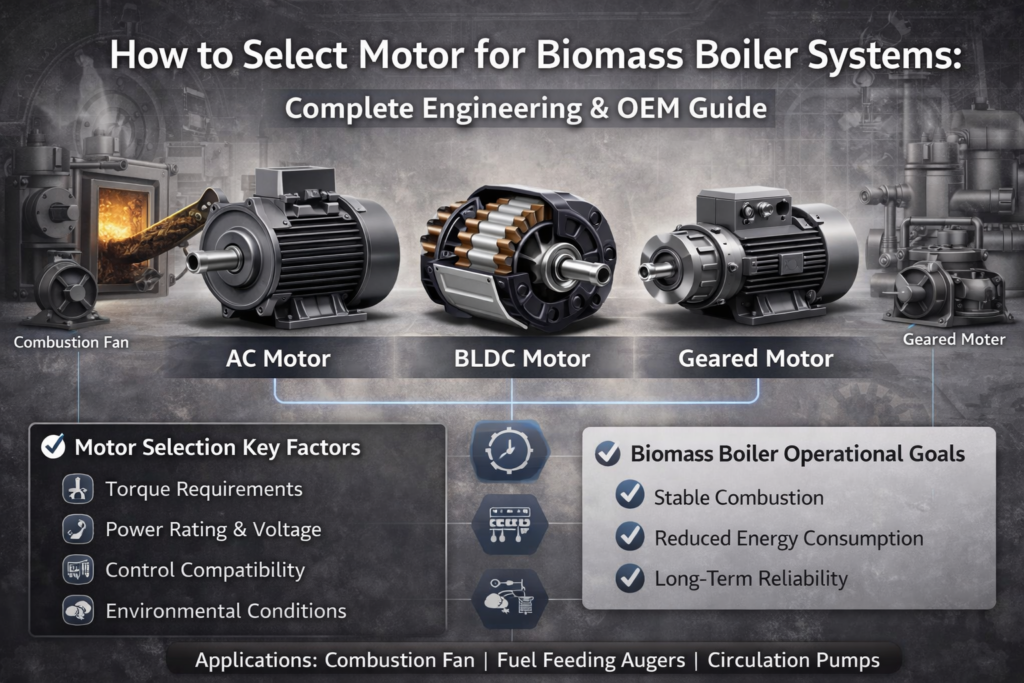
Cómo seleccionar un motor para sistemas de calderas de biomasa: Ingeniería completa & Guía OEM
Fragmento destacado:
Selecting a motor for biomass boiler systems requires careful evaluation of torque requirements, potencia nominal, Voltaje, control compatibility, y condiciones ambientales. Motors are used in key subsystems such as combustion fans, fuel feeding augers, and circulation pumps, where performance directly impacts efficiency and reliability. Engineers typically calculate required torque using load characteristics and select motors (C.A., BLDC, or geared) based on efficiency, rendimiento térmico, y esperanza de vida. Proper motor selection ensures stable combustion, consumo de energía reducido, and long-term operational reliability in industrial biomass applications.
What is Motor Selection for Biomass Boiler Systems?
Motor selection for sistemas de calderas de biomasa refers to the process of choosing the appropriate motor type, tamaño, and control system for various subsystems such as fans, transportadores, y bombas. Unlike general-purpose motor selection, biomass applications require careful consideration of harsh operating environments, continuous duty cycles, and fluctuating load conditions.
Key Subsystems Requiring Motors
- Motores de ventilador de combustión (air supply)
- Motores de ventilador de tiro inducido (exhaust control)
- Motores de alimentación de combustible (augers and conveyors)
- motores de bomba (heat transfer)
Each subsystem has unique torque, velocidad, and reliability requirements, making proper motor selection critical.
Explorar soluciones: Industrial BLDC Motors
Why Motor Selection is Critical in Biomass Boiler Systems
Incorrect motor selection is one of the most common causes of inefficiency and failure in caldera de biomasa sistemas. Engineers often face challenges balancing cost, actuación, y confiabilidad.
Engineering Pain Points
- Undersized motors causing overload and failure
- Oversized motors increasing energy consumption
- Incompatible control systems reducing efficiency
System-Level Impact
Motor performance directly affects combustion stability, eficiencia de combustible, and maintenance frequency. Por ejemplo, inconsistent airflow from poorly selected fan motors can lead to incomplete combustion and higher emissions.
Key Motor Types Used in Biomass Boiler Systems
Motores de inducción de CA
Ampliamente utilizado debido a su robustez y rentabilidad.. Suitable for pumps and fans in standard systems.
Motores BLDC
Offer higher efficiency and precise control, ideal for advanced systems with variable load conditions.
Motores con engranajes
Provide high torque at low speed, essential for fuel feeding systems.
Servomotores
Used in high-precision applications requiring accurate control.
Integración personalizada: OEM Biomass Boiler Motor Solutions
Efficiency Considerations in Motor Selection
Efficiency is a major factor affecting operational cost and system performance.
Comparación de eficiencia
- Motores BLDC: hasta 90-95%
- motores de corriente alterna: 80–90%
- Motorreductores: lower due to mechanical losses
Perspectiva de ingeniería
High-efficiency motors reduce energy consumption, particularly in continuous operation systems such as biomass boilers. Con el tiempo, efficiency gains significantly lower total cost of ownership.
Torque Density and Load Matching
Torque density determines how compact and powerful a motor can be.
Aplicaciones de alto par
- Fuel feeding augers
- Sistemas transportadores
Aplicaciones de alta velocidad
- Ventiladores de combustión
- Aficionados al draft inducido
BLDC motors offer higher torque density, enabling smaller motor sizes without compromising performance.
Requisitos de rendimiento térmico y refrigeración
Biomass boiler environments are characterized by high temperatures and dust, haciendo que el rendimiento térmico sea crítico.
Desafíos térmicos
- Heat from combustion chamber
- Ciclos de operación continuos
- Acumulación de polvo
Cooling Solutions
- Motores refrigerados por aire
- Forced ventilation systems
- Aislamiento de alta temperatura
Proper cooling ensures stable torque output and extends motor lifespan.
Control Systems and Motor Compatibility
Modern biomass systems rely on advanced control systems for optimal performance.
Control Options
- Variadores de frecuencia (variador de frecuencia)
- Controladores BLDC (FOC)
- PLC automation systems
Perspectiva de ingeniería
Motor-controller compatibility is essential for achieving precise control of airflow, alimentación de combustible, and system efficiency.
BLDC vs AC vs Geared Motors: cual es mejor?
| Parámetro | Motor CC CC | Motor AC | Motorreductor |
|---|---|---|---|
| Eficiencia | Alto | Moderado | Moderado |
| Densidad de par | Alto | Moderado | muy alto |
| Control | Avanzado | Básico | Simple |
| Costo | Moderado | Bajo | Moderado |
| Solicitud | aficionados, zapatillas | uso general | Sistemas de alimentación |
Interpretación de ingeniería
BLDC motors are preferred for efficiency and control, while AC motors are suitable for cost-sensitive applications. Geared motors are essential for high-torque needs.
How to Select a Motor for Biomass Boiler Systems
This section provides a practical framework for engineers and procurement teams.
Rango de voltaje
- 24V–72V: control systems and small motors
- 220V–380V: motores industriales
Rango de poder
- 0.5kilovatios–5kW: feeding systems
- 5kilovatios–50kW: ventiladores y bombas
Velocidad / Esfuerzo de torsión
Match motor output to load requirements. Use torque calculations to avoid under-sizing.
Método de enfriamiento
- Air cooling for standard environments
- Enhanced cooling for high-temperature zones
Compatibilidad del controlador
Ensure compatibility with VFD or BLDC controllers for optimal performance.
Consideraciones específicas de la aplicación
- Fuel type and feeding mechanism
- Operating environment (polvo, humedad)
- ciclo de trabajo (continuo vs intermitente)
llamada a la acción: Request datasheet or contact our engineers to develop a custom motor solution for your biomass boiler system.
Aplicaciones de motores en sistemas de calderas de biomasa
Aplicaciones industriales
- Plantas de energía
- Instalaciones de fabricación
Sistemas HVAC
- Calefacción urbana
- Edificios comerciales
Sistemas Agrícolas
- Drying equipment
- Calefacción de invernadero
Motor-driven subsystems ensure stable and efficient operation across all applications.
Future Trends in Motor Selection for Biomass Systems
The industry is moving toward more efficient and intelligent motor solutions.
Tendencias clave
- Adoption of high-efficiency BLDC motors
- Integración con IoT y sistemas de control inteligentes.
- Compact motor-drive integration
- Focus on energy optimization
Preguntas frecuentes: How to Select a Motor for Biomass Boiler Systems
1. What is the best motor for biomass boiler systems?
BLDC motors are ideal for efficiency and control, while AC motors are suitable for cost-sensitive applications.
2. How do I calculate motor size?
Calculate torque based on load requirements and select motor power accordingly.
3. Why is torque important?
Torque determines the motor’s ability to handle load and maintain stable operation.
4. What factors affect motor lifespan?
Thermal conditions, load cycles, and maintenance significantly impact lifespan.
5. Should I use custom motors?
Sí, OEM solutions ensure optimal performance and compatibility with system requirements.
Conclusión: Optimizing Biomass Boiler Performance with the Right Motor
Motor selection is a critical factor in biomass boiler system design. By carefully evaluating torque, eficiencia, rendimiento térmico, and control compatibility, engineers can ensure optimal system performance and reliability.
Para clientes OEM, investing in the right motor solution reduces risk, mejora la eficiencia, and lowers total cost of ownership.
Siguiente paso: Contact our engineering team to request datasheets or develop a customized motor solution tailored to your application.
Referencias
- Aplicaciones de motores industriales IEEE
- Informes de bioenergía de la AIE
- Revistas de ingeniería de energías renovables
- Libros blancos sobre sistemas de calefacción industrial