
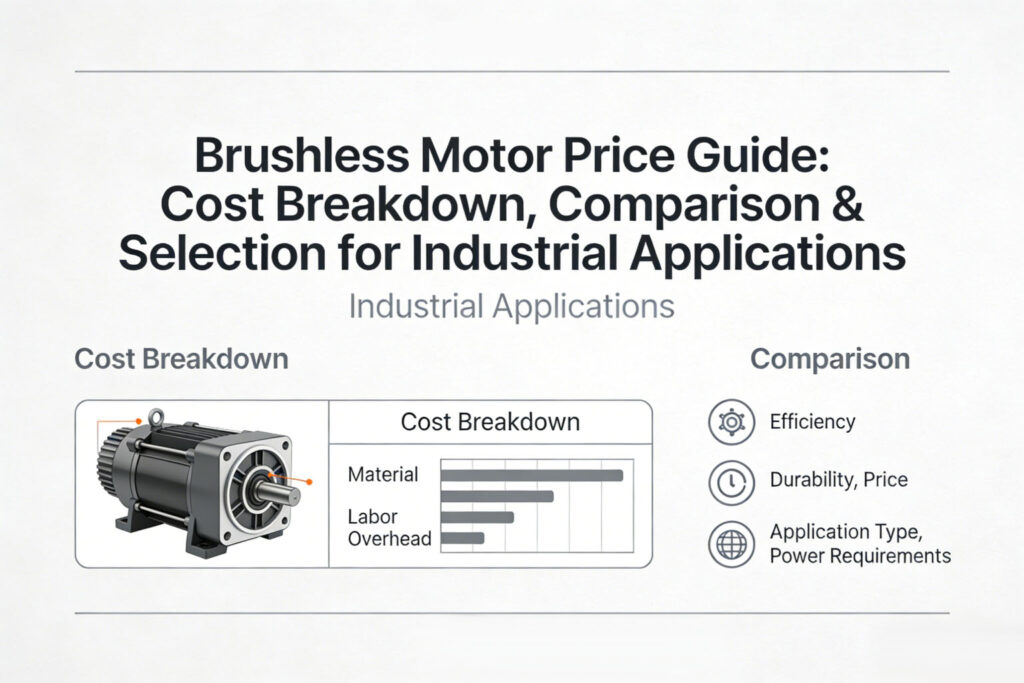
Guía de precios de motores sin escobillas: Desglose de costos, Comparación & Selection for Industrial Applications
Fragmento destacado:
The price of a brushless motor (Motor CC CC) varies widely depending on power rating, Voltaje, requisitos de par, materiales, and control complexity. Small BLDC motors may cost $10–$50, while industrial-grade units can range from $100 para acabar $1000. Compared to traditional brushed or induction motors, Los motores BLDC ofrecen mayor eficiencia, mejor rendimiento térmico, y una vida útil más larga, which often reduces total cost of ownership despite higher upfront pricing. For OEM buyers and engineers, selecting the right motor requires evaluating performance, fiabilidad, and system integration—not just initial cost.
What Is a Brushless Motor (Motor CC CC)?
Un motor CC sin escobillas (Motor CC CC) is an electric motor that uses electronic commutation instead of mechanical brushes. A diferencia de los motores con escobillas tradicionales, BLDC motors rely on controllers to switch current in the stator windings, creando un campo magnético giratorio que impulsa el rotor.
This design eliminates friction-related losses and wear associated with brushes, resultando en una mayor eficiencia, menor mantenimiento, and improved reliability. Los motores BLDC se utilizan ampliamente en la automatización industrial., vehículos eléctricos, sistemas de climatización, robótica, y bombas.
Desde una perspectiva de precios, the inclusion of permanent magnets (typically rare-earth materials like NdFeB) and the need for electronic controllers are the primary reasons BLDC motors cost more upfront than conventional motors.
Why Are Brushless Motors More Expensive Than Traditional Motors?
The higher cost of BLDC motors is driven by several engineering and supply chain factors. Primero, the use of permanent magnets significantly increases material costs, especially during periods of rare-earth price volatility. Segundo, BLDC systems require electronic speed controllers (Escaño), which add to system complexity and cost.
Además, manufacturing precision is higher for BLDC motors, particularly in rotor balancing and stator winding. This ensures high efficiency and torque density but increases production cost. Sin embargo, when evaluated over the lifecycle, BLDC motors often deliver better value due to energy savings and reduced maintenance.
Brushless Motor Price Range by Application
Small BLDC Motors (Low Power)
Typically used in consumer electronics, small fans, and compact devices. Los precios van desde $10 a $80 depending on voltage (12V–48V) y salida de par.
Medium Power BLDC Motors
Common in e-bikes, zapatillas, y equipos de automatización. Pricing typically falls between $80 y $300, depending on performance requirements and controller integration.
Industrial BLDC Motors
Used in HVAC systems, transportadores, robótica, and heavy-duty equipment. These motors can range from $300 para acabar $1000, especially when customized for OEM applications.
Por ejemplo, a 48V or 72V BLDC motor used in industrial or EV systems will vary significantly based on torque requirements, método de enfriamiento, and enclosure rating.
Key Factors That Affect Brushless Motor Price
Requisitos de potencia y par
Higher torque density requires stronger magnetic fields and more robust winding designs, increasing both material and manufacturing costs.
Voltage and Current Ratings
Higher voltage systems (p.ej., 72V or above) require better insulation and more advanced controllers, impacting total cost.
Magnet Material
Rare-earth magnets provide superior performance but are significantly more expensive than ferrite alternatives.
Método de enfriamiento
Air-cooled motors are more affordable, while liquid-cooled designs used in high-power applications increase cost but improve thermal performance.
Complejidad del controlador
Advanced control strategies (FOC, control sin sensores) require more sophisticated electronics, aumento del costo del sistema.
BLDC vs Brushed Motor Price Comparison
| Parámetro | Motor CC CC | Motor cepillado |
|---|---|---|
| Costo inicial | Más alto | Más bajo |
| Eficiencia | 85–95% | 70–80% |
| Mantenimiento | Bajo | Alto (desgaste del cepillo) |
| Esperanza de vida | Largo | más corto |
| Costo total de propiedad | Bajar con el tiempo | Higher due to maintenance |
Desde el punto de vista de la ingeniería, although brushed motors are cheaper upfront, BLDC motors provide better long-term value due to higher efficiency and reduced maintenance.
Comparación de costos de motores BLDC y de inducción
| Parámetro | Motor CC CC | Motor de inducción |
|---|---|---|
| Costo inicial | Medium to High | Bajo a Medio |
| Eficiencia | Más alto | Moderado |
| Sistema de control | Requiere controlador | Opcional (variador de frecuencia) |
| Densidad de par | Alto | Más bajo |
| Mantenimiento | Bajo | Bajo |
Induction motors remain popular due to simplicity and cost, but BLDC motors outperform them in efficiency and compactness—critical for modern industrial applications.
Rendimiento técnico frente a coste: Compensaciones de ingeniería
Eficiencia
Higher efficiency reduces energy consumption, which is crucial in continuous operations such as pumps or HVAC systems. Con el tiempo, energy savings can offset the higher initial cost of BLDC motors.
Densidad de par
BLDC motors provide higher torque per unit weight, enabling more compact system designs. This reduces material costs at the system level.
Rendimiento térmico
Better heat dissipation improves reliability and reduces downtime. This is especially important in high-load industrial environments.
Fiabilidad & Esperanza de vida
Sin pinceles, BLDC motors experience less mechanical wear, resulting in longer service intervals and lower maintenance costs.
How to Choose a Brushless Motor for Your Application
Rango de voltaje
Select based on system architecture. Common options include 24V, 48V, and 72V systems. Un voltaje más alto reduce la corriente y mejora la eficiencia.
Rango de poder
Determine required power based on load calculations. Oversizing increases cost unnecessarily, while undersizing reduces reliability.
Velocidad y par
Adapte las características del motor a las necesidades de la aplicación. Pumps and conveyors require steady torque, while EV applications require dynamic performance.
Método de enfriamiento
Air cooling is sufficient for most applications, but high-power systems may require liquid cooling.
Compatibilidad del controlador
Ensure the motor is compatible with the selected controller (FOC, sin sensores, Sensores de pasillo). This affects performance and cost.
Consideraciones específicas de la aplicación
Condiciones ambientales, ciclo de trabajo, and space constraints must be considered. Por ejemplo, dust-proof or waterproof designs may increase cost but are essential for reliability.
👉 For customized solutions, engineers often explore options like Motores BLDC, motores eléctricos, o soluciones de motor personalizadas.
Applications of Brushless Motors in Industry
Automatización Industrial
Utilizado en transportadores, robótica, and CNC systems where precision and efficiency are critical.
Vehículos eléctricos
BLDC motors dominate the EV market due to high efficiency and torque density.
Sistemas HVAC
Used in fans and compressors, improving energy efficiency and reducing operational costs.
Pumps and Fluid Systems
BLDC motors provide consistent performance and energy savings in continuous-duty applications.
Future Trends in Brushless Motor Pricing
The cost of BLDC motors is expected to decrease gradually due to improvements in manufacturing processes and economies of scale. Sin embargo, fluctuations in rare-earth material prices will continue to impact overall pricing.
Además, advancements in controller technology and integration are reducing system complexity and cost, making BLDC motors more accessible for a wider range of applications.
Preguntas frecuentes: Brushless Motor Price and Selection
1. Why are brushless motors more expensive?
BLDC motors use permanent magnets and require electronic controllers, increasing material and system costs. Sin embargo, they offer higher efficiency and longer lifespan, reducing total ownership cost.
2. Is a BLDC motor worth the higher price?
Sí, especially in applications with long operating hours. Energy savings and reduced maintenance often justify the higher initial investment.
3. What is the average price of a BLDC motor?
Los precios van desde $10 for small motors to over $1000 for industrial units, depending on power, Voltaje, and customization.
4. How does BLDC motor cost compare to AC motors?
BLDC motors typically cost more upfront but offer better efficiency and performance, making them cost-effective over time.
5. Can BLDC motors be customized for OEM projects?
Sí, OEM manufacturers can customize voltage, esfuerzo de torsión, alojamiento, and control systems to meet specific application requirements.
Conclusión: How to Balance Cost and Performance
Choosing the right brushless motor requires more than comparing price tags. Engineers and procurement managers must evaluate efficiency, densidad de par, rendimiento térmico, and reliability to determine the best solution.
While BLDC motors have a higher initial cost, their superior performance and lower maintenance requirements often make them the most cost-effective option in industrial applications.
👉 If you are evaluating motors for your project, you can request a datasheet, obtenga una solución OEM, or contact our engineers for technical consultation tailored to your application.
Referencias
- IEEE Transactions on Industrial Electronics – Motor Efficiency Studies
- A NOSOTROS. Department of Energy – Electric Motor Systems Handbook
- Normas IEC para motores eléctricos
- Industry reports on rare-earth material pricing and supply chain