
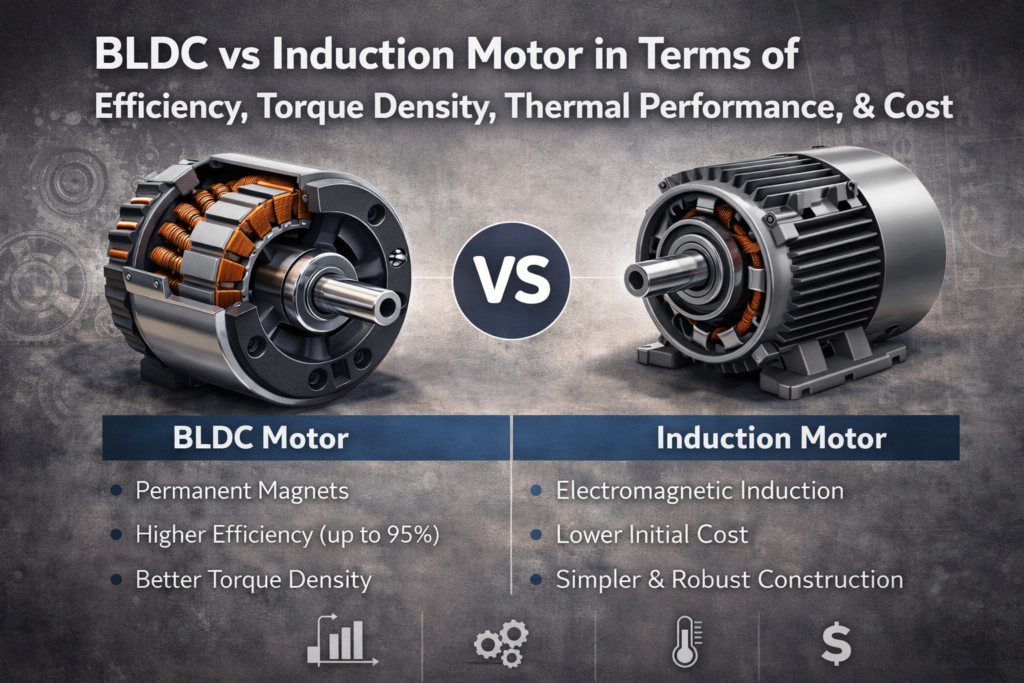
BLDC vs motor de inducción en términos de eficiencia, Densidad de par, Rendimiento térmico, y costo
Fragmento destacado:
BLDC motors outperform induction motors in efficiency (hasta 95%), densidad de par, and thermal performance due to permanent magnet design and electronic commutation. Motores de inducción, sin embargo, offer lower upfront cost, construcción más simple, and strong robustness for industrial environments. In applications such as biomass boilers, sistemas de climatización, and electric drives, the choice depends on lifecycle cost, control requirements, and operating conditions. Para fabricantes de equipos originales y compradores industriales, BLDC motors are increasingly preferred for energy efficiency and precision control, while induction motors remain a cost-effective solution for standard-duty systems.
What is BLDC Motor and Induction Motor?
BLDC (CC sin escobillas) motors and induction motors are two dominant technologies in industrial motor applications. Understanding their working principles is essential before comparing efficiency, densidad de par, rendimiento térmico, y costo.
BLDC Motor Definition
BLDC motors use permanent magnets on the rotor and electronic commutation to control current flow. This eliminates mechanical brushes and reduces energy loss, making them highly efficient and precise.
Induction Motor Definition
Induction motors operate using electromagnetic induction. The rotor is energized through induced current, which leads to inherent energy losses but offers robust and simple construction.
Explore BLDC solutions: BLDC Motor Portfolio
Why Compare BLDC vs Induction Motor?
Para ingenieros y gerentes de adquisiciones, choosing between BLDC and induction motors directly affects system performance, operational cost, y confiabilidad a largo plazo. This comparison is particularly critical in continuous-duty systems such as biomass boilers, zapatillas, y automatización industrial.
Key Decision Drivers
- Energy efficiency in 24/7 operación
- Torque performance under varying loads
- Thermal behavior and cooling requirements
- Total cost of ownership (costo total de propiedad)
Industry Reality
While induction motors dominate legacy systems, the shift toward energy efficiency is accelerating the adoption of BLDC motors in modern designs.
Eficiencia: BLDC frente a motor de inducción
Efficiency determines how much electrical energy is converted into mechanical output, directly affecting operating cost.
Eficiencia del motor BLDC
- Typically 90–95%
- Minimal rotor losses
- No brush friction
Induction Motor Efficiency
- Typically 75–90%
- Rotor copper losses
- Slip-related inefficiencies
Perspectiva de ingeniería
In continuous applications such as biomass boiler fans or pumps, even a 5% efficiency difference can translate into significant annual energy savings. Over a 5–10 year lifecycle, this becomes a major cost factor.
Densidad de par: BLDC frente a motor de inducción
La densidad de par se refiere a cuánto par puede producir un motor en relación con su tamaño y peso..
Motores BLDC
- High torque density due to permanent magnets
- Compacto y ligero
- Alto par de arranque
Motores de inducción
- Moderate torque density
- Larger size for equivalent torque
- Lower starting torque without control systems
Información sobre la aplicación
In biomass boiler systems, fuel feeding mechanisms require high torque at low speed, where BLDC or geared solutions outperform standard induction motors.
Rendimiento térmico y gestión del calor
Thermal performance is critical in industrial environments where motors operate continuously under load.
Motores BLDC
- Menor generación de calor
- Higher efficiency reduces thermal stress
- Improved lifespan
Motores de inducción
- Higher heat due to rotor losses
- Requires robust cooling systems
Perspectiva de ingeniería
Better thermal performance not only improves reliability but also allows higher power density in compact systems, reducing installation footprint.
Sistemas de control: BLDC frente a motor de inducción
Control capability significantly affects performance and flexibility.
Control de motores BLDC
- Control orientado al campo (FOC)
- Precise speed and torque regulation
- Alta respuesta dinámica
Induction Motor Control
- Requires VFD for variable speed
- Less precise control compared to BLDC
Perspectiva de ingeniería
Advanced control is essential for optimizing airflow and fuel feeding in biomass systems, making BLDC motors more suitable for modern automated systems.
Comparación de confiabilidad y vida útil
Reliability determines maintenance cost and system uptime.
Motores BLDC
- No brushes → less wear
- Larga vida útil (20,000–50,000 hours)
Motores de inducción
- Robust mechanical design
- Maintenance required for bearings and insulation
Perspectiva de ingeniería
While both motor types are reliable, BLDC motors offer lower maintenance due to reduced mechanical components.
Análisis de costos: BLDC frente a motor de inducción
| Parámetro | Motor CC CC | Motor de inducción |
|---|---|---|
| Costo inicial | Más alto | Más bajo |
| Eficiencia | 90–95% | 75–90% |
| Maintenance Cost | Bajo | Moderado |
| Costo de energía | Bajo | Más alto |
| Costo del ciclo de vida | Más bajo | Más alto |
Interpretación de ingeniería
Although BLDC motors have higher upfront cost, their lower energy consumption and maintenance requirements result in lower total cost of ownership over time.
Advantages and Disadvantages of BLDC vs Induction Motor
Ventajas del motor BLDC
- Alta eficiencia
- Alta densidad de par
- Excellent control
- Bajo mantenimiento
BLDC Motor Disadvantages
- Mayor costo
- Requiere controlador
Induction Motor Advantages
- Bajo costo
- diseño sencillo
- High durability
Induction Motor Disadvantages
- Menor eficiencia
- Higher heat generation
- Limited control
How to Choose Between BLDC vs Induction Motor for Industrial Applications
Motor selection should align with system requirements and long-term operational goals.
Rango de voltaje
- BLDC: 24V–72V or higher
- Inducción: 220V–380V standard
Rango de poder
- Pequeños sistemas: 0.5kilovatios–5kW
- Sistemas industriales: 5kW–100kW+
Velocidad / Esfuerzo de torsión
Match torque requirements to application load, especially for conveyors and fans.
Método de enfriamiento
- Air cooling for standard use
- Enhanced cooling for high-temperature environments
Compatibilidad del controlador
BLDC requires dedicated controllers; induction motors require VFD for variable speed.
Consideraciones específicas de la aplicación
- Operación continua versus intermitente
- Sensibilidad al costo de la energía
- Automation level
llamada a la acción: Request datasheet or contact our engineers for customized motor solutions.
Applications of BLDC and Induction Motors
Aplicaciones industriales
- Calderas de biomasa
- Sistemas de fabricación
HVAC y bombas
- ventiladores y sopladores
- Water circulation systems
Vehículos eléctricos
- 48V / 72V drive motors
- Motores de cubo
Explore EV solutions: Motores de vehículos eléctricos
Tendencias futuras: Will BLDC Replace Induction Motors?
The motor industry is evolving toward higher efficiency and smarter systems.
Tendencias clave
- Adoption of BLDC in industrial applications
- Integration with IoT and smart control
- Focus on energy efficiency and sustainability
While induction motors will remain in use, BLDC motors are expected to dominate high-efficiency applications.
Preguntas frecuentes: BLDC frente a motor de inducción
1. ¿Qué motor es más eficiente??
BLDC motors are more efficient due to reduced electrical and mechanical losses.
2. Which motor has higher torque density?
Los motores BLDC proporcionan una mayor densidad de par, allowing more compact designs.
3. Are induction motors cheaper?
Sí, induction motors have lower upfront cost but higher operating cost.
4. ¿Qué motor dura más??
BLDC motors typically have longer lifespan due to reduced wear.
5. Which motor is better for industrial use?
It depends on the application—BLDC for efficiency and control, induction for cost-sensitive systems.
Conclusión: Which Motor is Better?
BLDC motors outperform induction motors in efficiency, densidad de par, and thermal performance, haciéndolos ideales para aplicaciones industriales modernas. Sin embargo, induction motors remain relevant due to their simplicity and lower initial cost.
Para fabricantes de equipos originales y compradores industriales, the decision should be based on lifecycle cost, requisitos de desempeño, and system integration needs.
Siguiente paso: Contact our engineering team to develop a customized motor solution tailored to your application.
Referencias
- IEEE Motor Efficiency Studies
- IEA Energy Reports
- Industrial Motor Design Journals
- Electric Drive Engineering Textbooks