
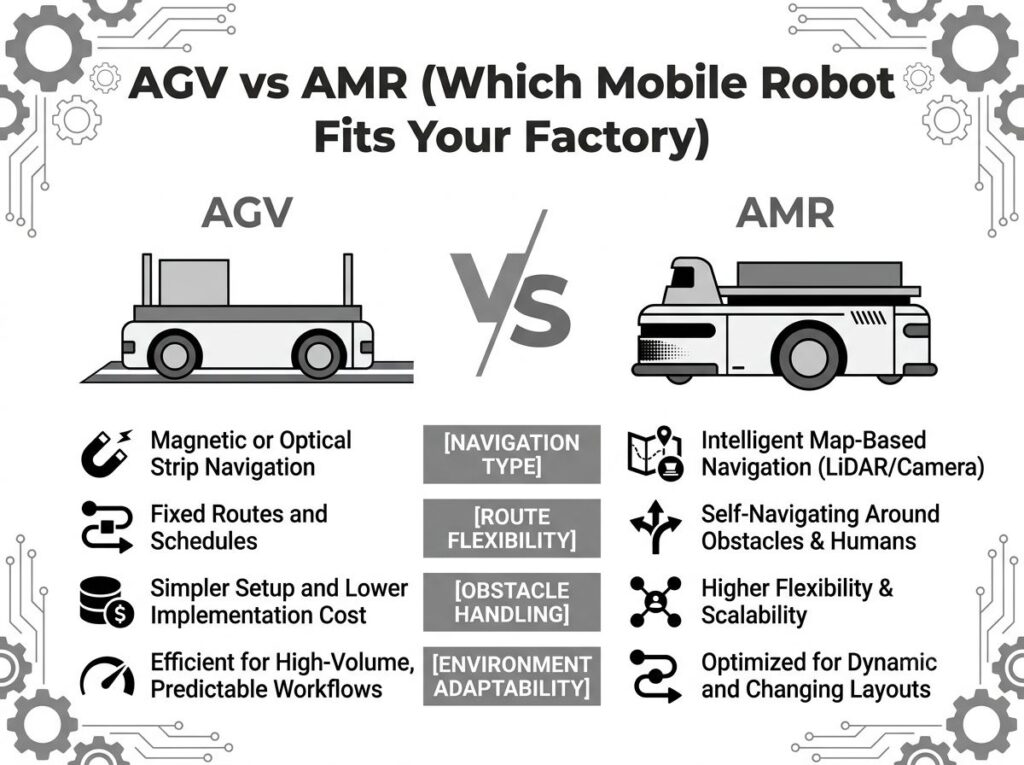
AGV frente a AMR: Navigation, Flexibility, Seguridad, Costo & Motor Selection — Which Mobile Robot Fits Your Factory?
Contenido de la página
PalancaIf you are automating material flow in a factory, warehouse, or distribution center, the AGV vs AMR decision is one of the most consequential choices on your project roadmap. An Automated Guided Vehicle (AGV) and an Autonomous Mobile Robot (RAM) both move goods without a human driver — but they do it in fundamentally different ways, with different infrastructure requirements, different safety behaviors, different scalability paths, and different drive system motor demands.
Most comparison articles stop at navigation and cost. This guide goes further: it covers the eight dimensions that matter in a real deployment — navigation, flexibility, seguridad, deployment speed, cost structure, escalabilidad, fiabilidad, y the motor and drive components that power both platforms — because the motor you select for your AGV or AMR drive wheel directly determines runtime, carga útil, y costo total de propiedad.
1. Definitions: What an AGV and an AMR Actually Are
1.1 AGV — Automated Guided Vehicle
An AGV is a driverless transport platform that moves along predefined routes. The route is defined by physical infrastructure embedded in the facility: magnetic tape on the floor, inductive wires buried under the surface, QR codes or optical lines painted at intervals, or laser reflectors mounted on walls. The AGV follows these markers like a train on rails — it has no ability to deviate from the programmed path, recalculate a route around an obstacle, or adapt when the layout changes.
Modern AGVs have evolved beyond simple magnetic-tape followers. Higher-end models now use laser-target navigation (reflectors mounted at known positions) and even SLAM-based mapping — but the defining characteristic remains: the route is pre-programmed, and the vehicle executes it deterministically. Whether the path guidance comes from tape, reflectors, or a digital map, an AGV does not choose its own route; it follows the one it was given.
AGV types by function:
| Tipo AGV | Función primaria | Typical Payload |
|---|---|---|
| Automated Guided Cart (AGC) | Nivel de entrada; follows magnetic tape; light parts transport | 50–300 kilogramos |
| Unit Load Carrier | Moves pallets, bins, or totes between fixed stations | 500–2.000 kilogramos |
| Tugger / Tractor | Pulls carts or trains of rolling bins along fixed loops | 1,000–5,000 kg (towed) |
| Carretilla elevadora AGV | Lifts and transports pallets at rack height | 1,000–2,500 kg |
| Heavy-Duty Carrier | Coils, plates, structural components | 5,000–50,000 kg |
1.2 AMR — Autonomous Mobile Robot
An AMR navigates without any pre-installed physical infrastructure. Using a sensor suite — typically LiDAR (360° laser scanner), 3D depth cameras, ultrasonic sensors, and an IMU — the AMR builds a real-time digital map of the facility through SLAM (Simultaneous Localization and Mapping). It calculates its position within that map, identifies obstacles, and dynamically plans the shortest or safest route to its destination. If a forklift blocks the aisle, the AMR does not stop and wait — it recalculates a detour around the forklift and continues the mission.
This is the core philosophical difference: an AGV asks “how do I follow this path?” — an AMR asks “what is the optimal way to reach my destination given current conditions?”
AMR types by function:
| AMR Type | Función primaria | Typical Payload |
|---|---|---|
| Shelf-Carrying (Bienes a persona) | Lifts and transports entire shelving units to pick stations | 300–1.000 kilogramos |
| Conveyor-Top Transfer | Automated bin/tote handoff at conveyor junctions | 20–200 kg |
| Sorting / Parcel | Top-carrying robots that divert to destination chutes | 5–30 kg |
| Collaborative (Human-Safe) | Navigates shared spaces alongside workers | 20–150 kilos |
| Forklift AMR | Autonomous pallet handling at rack level | 1,000–2,500 kg |
| Tugger AMR | Pulls cart trains through dynamic environments | 500–5,000 kg (towed) |
| Heavy-Duty AMR | Aeroespacial, acero, energy sector transport | 5,000–50,000 kg |
| Cleanroom AMR | ISO Class 5–8 semiconductor/pharma transport | Varía |
| Outdoor AMR | Campus, puerto, yard logistics with GPS+RTK | Varía |
2. Navigation: Fixed Path vs Dynamic Intelligence
| Navigation Aspect | AGV | RAM |
|---|---|---|
| Navigation Method | Magnetic tape, inductive wire, códigos QR, laser reflectors, or pre-programmed SLAM map | SLAM + sensor fusion (LiDAR, 3D vision, IMU) — no physical infrastructure needed |
| Path Definition | Pre-programmed; vehicle follows exact route | Destination-based; vehicle calculates optimal route in real time |
| Obstacle Encounter | Stops and waits until path is clear (or calls for manual intervention) | Detects obstacle, recalculates detour, continues mission |
| Layout Change Response | Requires physical infrastructure modification (re-tape, re-wire, re-position reflectors) + re-programming | Software update; robot re-maps facility automatically or via updated map file |
| Precisión de posicionamiento | ±5 mm (laser reflector) to ±10 mm (magnetic tape) | ±2–3 cm (SLAM); ±5 mm at docking station (with visual marker assist) |
| Best Navigation For | Long straight corridors, fixed loops, high-precision docking | Dynamic aisles, mixed human-robot traffic, frequently reconfigured layouts |
A note on “modern AGVs with SLAM”: Some AGV manufacturers now offer SLAM-based navigation, which eliminates the need for magnetic tape or reflectors. This is a genuine improvement — but the critical distinction remains: the AGV still follows a pre-defined path on its digital map, not a dynamically computed one. It cannot reroute around an unexpected obstacle. The SLAM map simply replaces the physical tape with a digital one; the vehicle still operates in a “follow the programmed route” modo, not a “choose the best route now” modo. If your vendor claims their AGV “uses SLAM,” ask specifically: “Does it dynamically replan paths around obstacles, or does it follow a fixed route on the SLAM map?”
3. Flexibility and Deployment Speed
| Dimensión | AGV | RAM |
|---|---|---|
| Deployment Time | 8–12 weeks (infrastructure installation + mapping + puesta en servicio) | 2–4 weeks (map the facility, configure fleet software, start missions) |
| Infrastructure Investment | High — tape/wire/reflector installation, floor preparation, traffic zone wiring | Near zero — no physical changes to the facility |
| Route Modification | Physical changes required: re-tape, re-position reflectors, re-wire zones | Software update — drag-and-drop new waypoints in fleet manager UI |
| New Station Addition | Weeks of infrastructure work + re-mapping | Minutes — add waypoint in software |
| Fleet Expansion | Requires traffic zone reconfiguration for each new vehicle | Add robot to fleet software; automatic task redistribution |
| Facility Relocation | Re-install all infrastructure at new site; weeks of downtime | Re-map new facility in 1–2 days; robots operational immediately |
| Mixed Traffic (gente, montacargas) | Difficult — fixed paths conflict with human traffic patterns | Designed for it — dynamic avoidance handles unpredictable movement |
The deployment time difference is often the deciding factor for time-sensitive projects. If your facility needs to be operational within a month, AGV infrastructure installation alone takes longer than the entire AMR deployment cycle. For a multi-site rollout where each warehouse has a different layout, AMR’s “map-and-go” model scales across locations with minimal engineering per site — AGV’s “install-then-operate” model multiplies infrastructure costs at every new facility.
4. Seguridad: Estándares, Sensores, and Real Behavior
4.1 Governing Standards
Both AGVs and AMRs fall under YO ASI 3691-4:2020 — “Industrial trucks — Safety requirements — Part 4: Driverless industrial trucks and their systems.” This standard explicitly covers both “vehículos guiados automatizados” y “autonomous mobile robots” as subclasses of driverless industrial trucks. Additional standards include ANSI/RIA R15.08-2-2020 (América del norte) y ISO 13849-1/2 (control system functional safety).
4.2 Safety Architecture Comparison
| Safety Dimension | AGV | RAM |
|---|---|---|
| Sensor Suite | Basic — bumper switches, simple proximity sensors, sometimes single-plane LiDAR | Advanced — 360° safety-rated LiDAR (SIL2/PLd), 3D depth cameras, ultrasonic, IMU |
| Obstacle Detection Range | 1–3 m (limited by sensor type) | Arriba a 30 metro (safety-rated LiDAR); response time <40 EM |
| Behavior When Blocked | Stop — wait for obstacle to clear (or fault and require manual reset) | Slow down, recalculate route, safely navigate around obstacle |
| Human Detection | Basic proximity — detects “something nearby” but not specifically a person | 3D vision + LiDAR — distinguishes people from objects; adjusts speed and path for human proximity |
| Safety Zone Control | Fixed zones defined during installation | Dynamic zones — robot reduces speed near people, in narrow aisles, at blind corners |
| Emergency Stop | Physical E-stop button + electromagnetic brake | Physical E-stop + dynamic braking (motor regenerative) + electromagnetic parking brake |
| Fleet-Level Safety | Zone-based traffic control — prevents two AGVs from entering same zone | Fleet manager with predictive conflict resolution + virtual traffic rules |
4.3 Safety Zone Structure (RAM)
| Zone | Distance | Behavior |
|---|---|---|
| Warning Zone (outer) | 2.5–3.5 m | Reduce speed; activate visual indicators (LED ring, status light) |
| Protection Zone (middle) | 1.5–2.5 m | Significant speed reduction; prepare to stop |
| Emergency Stop Zone (inner) | 0.3–1.5 m | Immediate controlled stop |
| Contact Zone (physical contact) | Contacto | parada mecánica; safety circuit切断 |
Important caveat: “RAM” does not automatically mean “safer.” The actual safety performance depends on the specific vendor’s implementation, sensor quality, and how well the fleet manager handles edge cases. A well-engineered AGV in a controlled traffic environment may be safer than a poorly configured AMR in a chaotic one. Evaluate the sistema, not just the label.
5. Drive System Architecture: The Motor Behind the Robot
This section is where most AGV vs AMR comparison articles stop. But for OEM robot builders and system integrators, the drive motor and gearbox are core BOM items that directly determine runtime, carga útil, velocidad, y costo total de propiedad. Both AGVs and AMRs share a common motor architecture requirement — but the demands differ by robot type, carga útil, and duty cycle.
5.1 Why BLDC Motors Dominate Both Platforms
Whether you are building a 50 kg sorting AMR or a 50-ton heavy-duty AGV, the drive motor choice converges on one technology: motores de CC sin escobillas (BLDC). The reasons are straightforward:
| Requisito | BLDC Motor Advantage |
|---|---|
| Battery Compatibility | 24V or 48VDC direct operation — no AC conversion needed; matches standard AGV/AMR battery packs |
| Gestión térmica | Stator windings on outer shell → superior heat dissipation vs brushed motors → longer duty cycle at higher loads |
| Mantenimiento | No brushes to replace; no brush dust; no arcing → zero scheduled motor maintenance; compatible with cleanroom environments |
| Control de velocidad | Constant torque across speed range via vector control; ±0.5% speed regulation with Hall sensors (servo-level precision without servo cost) |
| Compactness | Shorter axial length than equivalent brushed motor; critical for wheel-hub and compact AGV/AMR chassis designs |
| Eficiencia | IE5-class efficiency (per Dunkermotoren DC concepts); less battery drain → longer runtime per charge |
| Integrated Safety | Torque seguro apagado (STO) function available in integrated BLDC drives — critical for ISO 3691-4 cumplimiento |
BLDC motors occupy the middle ground between brushed DC motors (cheap but short-lived, heat-constrained, maintenance-heavy) y servomotores (highest performance but highest cost). For most AGV and AMR platforms, BLDC delivers the right balance: larga vida útil, battery-native operation, compact form factor, y rentabilidad. This is precisely the product space where Greensky’s BLDC motor line operates — 24/48VDC motors optimized for mobile platform drive applications.
5.2 Drive Configurations by Robot Type
| Tipo de unidad | Motor Configuration | Uso típico | Motor Count |
|---|---|---|---|
| Differential (2-rueda) | 2 BLDC gearmotors (izquierda + right wheel) | Standard AMR, sorting robot, collaborative AMR | 2 motores de accionamiento |
| Tricycle (1 conducir + 1 buey) | 1 BLDC drive motor + 1 steer motor (stepper or BLDC) | Entry-level AGV, unit-load carrier | 2 motores |
| Quad (2 conducir + 2 buey) | 2 BLDC drive motors + 2 steer motors | AGV de servicio pesado, forklift AMR | 4 motores |
| Omnidirectional (Mecanum) | 4 BLDC gearmotors (one per Mecanum wheel) | Conveyor-top AMR, tight-space operations | 4 motores de accionamiento |
5.3 Gearbox Selection: Parallel, Right-Angle, or Hub?
The gearbox paired with the BLDC drive motor determines output torque, velocidad de la rueda, and installation footprint. Three configurations dominate the AGV/AMR market:
| Tipo de caja de cambios | Ventajas | Mejor para | GreenSky Reference |
|---|---|---|---|
| Parallel Spur/Helical (inline) | Simple, rentable, moderate ratio range (3:1–50:1) | Standard differential-drive AMRs; entry AGVs | Greensky Gearbox Line |
| Right-Angle (hypoid/bevel) | 90° output shaft — motor mounted alongside wheel, saves axial space | Forklift AGVs, compact chassis with tight wheel wells | Greensky Gearbox Line |
| Hub/Wheel (planetario, eje hueco) | Motor integrated into wheel hub; eliminates coupling, cadena, cinturón; lowest footprint | High-end AMRs, omnidirectional platforms, space-constrained designs | Planetary vs Spur Gear Guide |
The gearbox choice affects more than just torque multiplication. A hub gearbox with hollow shaft eliminates the coupling, cadena, or belt between motor and wheel — reducing assembly time, eliminating maintenance points, and freeing chassis space for batteries and sensors. This is why premium AMR platforms (Dunkermotoren NG series, Ketterer drives) increasingly use hub-type planetary motorreductores. For AGV and AMR OEMs designing at scale, Greensky’s custom motor engineering can configure BLDC gearmotors with specific ratios, shaft dimensions, and braking options matched to your chassis design.
5.4 Motor Specifications by Payload Class
| Robot Payload Class | Typical BLDC Power | Voltaje | Rango de relación de transmisión | Approximate Motor Cost |
|---|---|---|---|---|
| 5–30 kg (sorting/collaborative) | 50–200 W per wheel | 24VCC | 10:1–30:1 | $30–$80 |
| 100–500 kilogramos (shelf-carrying, unit-load) | 200–500 W per wheel | 24–48VDC | 15:1–50:1 | $80–$200 |
| 1,000–2,500 kg (forklift, pallet truck) | 500–1,500 W per wheel | 48VCC | 20:1–80:1 | $200–$500 |
| 5,000–50,000 kg (trabajo pesado) | 1,500–5,000 W per wheel | 48–80VDC | 50:1–200:1 | $500–$1,500 |
Motor cost estimates based on Chinese-manufactured BLDC gearmotor wholesale pricing, 2025–2026. Actual BOM cost varies by specification, volumen, and customization level.
5.5 Motor Controller Requirements
los controlador del motor is the brain of the drive system — and AGV vs AMR differences extend here too. AGV controllers execute simple speed commands along a pre-programmed trajectory: comenzar, acelerar, cruise, decelerate, stop at waypoints. AMR controllers must handle dynamically computed velocity profiles — accelerating, decelerating, and steering in real-time based on continuously updated path plans from the navigation stack.
| Controller Requirement | AGV | RAM |
|---|---|---|
| Modo de control | Speed-position trajectory (pre-computed) | Real-time velocity vector (navigation-computed) |
| Resolución de comentarios | Sensores de pasillo (30 PPR) adequate for zone detection | Higher-resolution encoder preferred for precise docking and smooth motion |
| Communication Bus | Modbus RTU, CANopen — simple command set | EtherCAT, CAN FD — higher bandwidth for real-time trajectory updates |
| Braking Coordination | Dynamic braking + electromagnetic parking brake | Dynamic braking + electromagnetic brake + regenerative energy recovery (BLDC advantage) |
| Safety Integration | E-stop input to drive; STO function | STO + SLS (Safe Limited Speed) + SSM (Safe Speed Monitor) — ISO 13849 Por favor |
| Control de vectores | Required for ramp/gradient load handling | Required for smooth acceleration and precision docking |
For both AGV and AMR platforms, Greensky provides controladores de motores with vector control, multiple communication bus options, and integrated safety functions — configurable for 24V or 48V battery systems.
6. Estructura de costos: Initial Price vs Total Cost of Ownership
6.1 Per-Vehicle Cost Comparison
| Categoría de costo | AGV | RAM |
|---|---|---|
| Vehicle Unit Price (50–500 kg class) | $15,000–$35,000 | $25,000–$70,000 |
| Infrastructure Installation | $5,000–$50,000 (tape, cable, reflectors, zone controllers) | $0–$2,000 (mapping software only) |
| Commissioning & Tuning | 2–3 months of engineering | 2–4 weeks |
| Magnetic Tape/Reflector Replacement | Every 6–12 months (tener puesto, damage, floor cleaning) | Ninguno |
| Route Modification Cost | $5,000–$30,000 per layout change (physical rework + re-programming) | $0–$500 (software update) |
| Annual Maintenance (per vehicle) | $2,000–$5,000 (infraestructura + vehicle) | $1,000–$3,000 (software updates + sensor calibration) |
| 3-Year Total Cost of Ownership (5-unit fleet) | $150,000–$350,000 | $200,000–$450,000 |
| 5-Year Total Cost of Ownership (5-unit fleet, 2 layout changes) | $250,000–$500,000 | $250,000–$400,000 |
The crossover happens around year 3–4. Up front, AMR costs more — the sensor suite (LiDAR, 3D cameras, IMU) and onboard compute add $10,000–$35,000 per vehicle over an equivalent AGV. But AMR avoids the infrastructure installation and ongoing maintenance costs that compound for AGVs over time. If your facility undergoes even one significant layout change, the AGV’s physical rework cost ($5,000–$30,000 per change) narrows the gap. Two or more changes make AMR cheaper in total cost of ownership.
6.2 ROI by Application
| Solicitud | Faster ROI With | Typical ROI Period |
|---|---|---|
| Fixed-loop production line supply (automotor) | AGV | 12–18 months |
| Dynamic warehouse picking (e-commerce, 3PL) | RAM | <12 meses |
| Multi-zone factory with seasonal layout changes | RAM | 12–18 months |
| Cleanroom pharmaceutical transport | RAM (no tape in cleanroom) | 18–24 months |
| Heavy-load fixed route (acero, aeroespacial) | AGV | 18–24 months |
7. Scalability and Fleet Management
| Dimensión | AGV | RAM |
|---|---|---|
| Adding a New Vehicle | Install new zone controllers, re-program traffic rules, validate path — days of engineering | Add to fleet software; automatic task redistribution — minutes |
| Adding a New Station | Physical infrastructure changes + mapping | Add waypoint in software |
| Changing a Route | Tape/wire/reflector modification + re-programming | Software drag-and-drop |
| Multi-Site Deployment | Repeat infrastructure installation at each site | Re-map each site in 1–2 days; same fleet software |
| Fleet Interoperability (VDA 5050) | Limited — most AGV fleet managers are vendor-locked | Supported — modern AMR fleet managers support VDA 5050 for mixed-vendor fleets |
| WMS/ERP/MES Integration | Requires middleware or custom PLC integration | Direct API integration; standard WMS/ERP connectors |
8. Hybrid Fleet Strategy: When AGV + AMR Beats Either Alone
Many facilities are not purely “fixed” or purely “dynamic.” A typical factory has a stable raw-materials-to-production-line supply loop (ideal for AGV) alongside a dynamic order-picking and kitting area (ideal for AMR). Deploying both types in a coordinated fleet is increasingly common — and supported by fleet management platforms like KUKA.AMR Fleet, which manages both AGVs and AMRs through a single interface using the VDA 5050 interoperability standard.
8.1 Hybrid Deployment Pattern
| Zone | Vehicle Type | Razón |
|---|---|---|
| Raw material → production line (fixed loop) | AGV tugger or unit-load carrier | Same path every shift; high repeatability; heavy payload |
| Production line → staging area (variable) | AMR conveyor-top or collaborative | Staging positions change per product; human traffic in assembly zone |
| Staging → warehouse (semi-fixed) | AGV forklift | Fixed aisle structure; rack positions stable |
| Warehouse → shipping (dynamic picking) | AMR shelf-carrying or sorting | Order profiles change daily; human pickers at stations |
A hybrid fleet reduces total BOM cost: AGVs handle the heavy, predictable tasks at lower per-vehicle cost; AMRs handle the flexible, dynamic tasks where infrastructure modification would be prohibitively expensive. The fleet manager coordinates task allocation, traffic control, and charging schedules across both vehicle types.
9. Batería, Runtime, and Charging
| Parámetro | AGV | RAM |
|---|---|---|
| Battery Type | Li-ion (40–120 Ah); lead-acid in older models | Li-ion exclusively (40–120 Ah) |
| Runtime Per Charge | 6–14 hours (heavy loads reduce this) | 6–14 hours (sensor compute draws additional power) |
| Charging Strategy | Scheduled charging at fixed stations; battery swap systems for 24/7 | Opportunity charging (auto-dock when battery <20%); AI-optimized charging scheduling |
| Battery Cycle Life | 2,000–5,000 cycles | 2,000–5,000 cycles |
| Motor Impact on Runtime | BLDC efficiency (85–95%) vs brushed (60–70%) → 15–25% longer runtime per charge | Same BLDC advantage applies; sensor compute power draw (10–30 W) is the incremental drain |
The motor choice has a direct runtime impact. A BLDC gearmotor at 90% efficiency versus a brushed motor at 65% efficiency means 25% less energy consumed per transport cycle — which translates to 25% more runtime before charging, or the ability to use a smaller (lighter, cheaper) battery pack. Para 24/7 operaciones, this efficiency gap determines whether you need 1 o 2 robots per task (one running, one charging) — and that doubles or halves your fleet cost.
10. Five-Point Decision Framework
Work through these five questions in order. The pattern of answers will push you toward AGV, RAM, or a hybrid fleet — and clarify which tipo de motor y drive configuration your platform needs.
| # | Pregunta | Answer → AGV | Answer → AMR |
|---|---|---|---|
| 1 | Do routes and pick/drop stations change more than twice per year? | No — stable, predictable | Yes — frequent layout or workflow changes |
| 2 | Do people, montacargas, and temporary obstacles regularly occupy the travel path? | No — traffic is controlled or segregated | Yes — mixed traffic environment |
| 3 | Is payload >2,500 kg on a fixed loop? | Yes — heavy-duty AGV handles this efficiently | No — AMR payload range (up to ~2,500 kg) is adequate |
| 4 | Is deployment timeline <4 semanas? | No — can accommodate 8–12 week installation | Yes — AMR’s 2–4 week deployment fits the schedule |
| 5 | Does the facility plan multi-site rollout or greenfield expansion within 3 años? | No — single-site, operación estable | Yes — AMR scales across sites with minimal per-site engineering |
Reading the pattern: Si 3+ answers fall in the AGV column, deploy AGVs (or a hybrid fleet with AGVs for stable loops). Si 3+ fall in the AMR column, deploy AMRs. If answers split evenly, consider a hybrid fleet — AGVs for fixed loops, AMRs for dynamic zones. For the drive motor decision, both paths converge on BLDC gearmotors — the specific power rating, tipo de caja de cambios, y controller specification depend on your payload class and drive configuration (see Section 5).
For OEMs building AGV or AMR platforms at volume, Greensky’s full motor product range covers the power spectrum from 50W sorting-robot drive motors to multi-kilowatt heavy-duty traction motors — all tested per ISO-certified individual testing standards antes del envío. Our engineering team provides custom motor configuration — voltage, devanado, eje, frenado, and feedback options tailored to your chassis design and battery system.
11. Market Data and Industry Trends
11.1 Market Size
The global AGV + AMR market was valued at approximately $6.02 mil millones en 2024, with projections reaching $12–18 billion by 2033 (CAGR ~9%). Mobile robot shipments grew 53% year-over-year in 2022 (Interact Analysis), and revenue is forecast to rise from $3 mil millones (2022) to $8.5–9 billion by 2027. AMR adoption is accelerating: the AMR segment is growing faster than AGV, driven by e-commerce fulfillment, flexible manufacturing, and the declining cost of LiDAR and compute hardware.
11.2 Tendencias clave
1. AMR cost convergence. As LiDAR and compute module prices drop (volume production in China is a major driver), the per-vehicle cost gap between AGV and AMR is narrowing. In some payload classes, AMR unit prices are now within 30–40% of equivalent AGVs — making the flexibility premium more affordable.
2. Hybrid fleet normalization. VDA 5050 and other interoperability standards are enabling mixed AGV+AMR fleets managed by a single fleet platform. This is becoming the default deployment pattern for medium-to-large facilities.
3. AI-driven fleet optimization. Modern fleet managers use machine learning to optimize task allocation, predict congestion, and schedule charging — reducing idle time and increasing throughput without adding vehicles.
4. Motor efficiency as a competitive lever. As runtime demands increase (longer shifts, fewer charging interruptions), BLDC motor efficiency becomes a selling point for robot OEMs. IE5-class DC motor concepts (per Dunkermotoren) and regenerative braking capabilities are moving from premium features to standard expectations.
5. Outdoor and cross-building AMRs. GPS+RTK navigation (±2–3 cm accuracy outdoors) is enabling AMRs to operate across campus environments — between buildings, in yards, at ports — extending the AMR flexibility model beyond indoor warehouse boundaries.
12. Preguntas frecuentes
Q: Is an AMR always better than an AGV?
No. AMRs are superior in dynamic environments where routes change, obstacles appear unpredictably, and human-robot mixed traffic is the norm. But for a stable, high-volume production line where the same pallet travels the same path 500 times per day, an AGV’s deterministic route execution is more efficient — and substantially cheaper per vehicle. los “mejor” choice depends on your operational profile, not on which technology is newer.
Q: Can modern AGVs use SLAM navigation?
Yes — some AGV manufacturers now offer SLAM-based path planning. Sin embargo, the distinction is not the navigation sensor but the control philosophy: an AGV with SLAM still follows a pre-programmed route on its map. It cannot dynamically reroute around obstacles. The SLAM map replaces the physical tape with a digital map, but the vehicle’s behavior remains “follow the programmed path, stop if blocked.” An AMR’s behavior is “perceive the environment, calculate the best route, navigate around obstacles, arrive at the destination.” If your vendor markets “SLAM AGV,” clarify the obstacle-handling behavior before assuming it matches AMR capabilities.
Q: What motor does an AGV or AMR use?
Both platforms overwhelmingly use CC sin escobillas (BLDC) motorreductores for their drive wheels. The BLDC motor operates directly on 24V or 48V battery voltage, delivers constant torque across the speed range, requires no brush maintenance, and provides servo-level speed regulation (±0.5%) with Hall sensor feedback — at a fraction of servo motor cost. Steering motors may be motores paso a paso (for tricycle-drive AGVs) or additional BLDC motors (for quad-drive and omnidirectional configurations). The specific power rating (50W–5,000W) and gearbox ratio (10:1–200:1) depend on the robot’s payload class and drive configuration.
Q: How does motor efficiency affect AGV/AMR runtime?
Directly. A BLDC gearmotor at 90% efficiency consumes 25% less energy per transport cycle than a brushed DC motor at 65% eficiencia. On a 48V 80Ah battery pack, this efficiency gap translates to roughly 90 additional minutes of runtime per charge — or the ability to use a smaller (cheaper, lighter) battery while maintaining the same runtime. Para 24/7 operations running 3-shift schedules, higher motor efficiency means fewer robots needed (less charging downtime), which directly reduces fleet cost.
Q: Which is safer for human-robot shared spaces?
AMR, when properly configured, offer more sophisticated human safety behavior — 360° LiDAR detection, dynamic speed reduction near people, and real-time obstacle avoidance that keeps the robot moving rather than stopping and blocking the aisle. Sin embargo, safety is determined by implementation quality, not the AGV/AMR label. Evaluate the specific vendor’s sensor suite, safety zone configuration, y ISO 3691-4 compliance documentation. A well-engineered AGV in a zone-controlled environment can be very safe; a poorly configured AMR in a chaotic environment can be less safe.
Q: Can I deploy AGVs and AMRs in the same facility?
Yes — and this is increasingly the recommended approach for facilities that have both stable and dynamic logistics zones. Modern fleet management platforms (supporting VDA 5050 interoperability) can coordinate both vehicle types through a single interface, handling task allocation, traffic control, and charging scheduling across the mixed fleet. AGVs handle fixed-loop heavy transport; AMRs handle flexible picking, kitting, and human-zone delivery. This hybrid approach typically delivers the lowest total cost of ownership for medium-to-large facilities.
Referencias
- KUKA AG. “AGV vs. RAM: Diferencias, Aplicaciones, Costs & Decision Support.” KUKA Knowledge Hub, 2026. https://www.kuka.com/en-us/knowledge/agv-vs-amr
- Encord. “AGV frente a AMR: Key Differences for Warehouse Automation.” Encord Blog, Abril 2026. https://encord.com/blog/agv-vs-amr-for-warehouse-automation/
- Novus HiTech. “AGV and AMR Systems: The Complete Guide to Autonomous Mobile Robots for Smart Factories & Warehouses.” Novus HiTech, Junio 2026. https://novushitech.com/agv-amr-systems-guide/
- Coolyne. “AGV frente a AMR: Diferencias clave, Seguridad, Costo, and How to Choose the Right System.” Coolyne Blog, Junio 2026. https://www.coolyne.com/blog/agv-vs-amr
- FDataBot. “AGV frente a AMR: What Is the Difference and How to Choose Guide.” FDataBot, Mayo 2026. https://www.fdatabot.com/agv-vs-amr-what-is-the-difference-and-how-to-choose-guide/
- TofSensor. “AMR vs AGR: Diferencias clave, Costs, Use Cases & ROI Guide.” TofSensor Knowledge, Junio 2026. https://tofsensors.com/en-cn/blogs/tof-sensor-knowledge/amr-vs-agv-key-differences-costs-use-cases-roi-guide
- Oriental Motor Corp. “AGV Brushless DC Motor Benefits: Why BLDC Motors Are the Standard Drive for AGVs and AMRs.” Oriental Motor Technology, 2025. https://www.orientalmotor.com/brushless-dc-motors-gear-motors/technology/brushless-dc-motors-agv-designs.html
- Dunkermotoren GmbH. “AGV/AMV/AMR Gear Motors: BLDC Drive Solutions for Mobile Robotics.” Dunkermotoren Industries, 2025. https://www.dunkermotoren.com/en/industries/warehouse-automation/agv-gear-motor
- AtomBotix. “AGV frente a AMR: Diferencias clave explicadas.” AtomBotix Knowledge Base, 2026. https://www.atombotix.com/KnowledgeBase/37.html
- Interact Analysis. “Mobile Robot Shipments Grow by 53% en 2022; Sobre 4 Million Mobile Robots Installed by Q4 2027.” Interact Analysis, 2023. https://interactanalysis.com/insight/mobile-robot-shipments-grow-by-53-in-2022