
Why Do Power Tools Generally Use Brushed Motors?
Was “Bürstenmotor” Means in a Power Tool
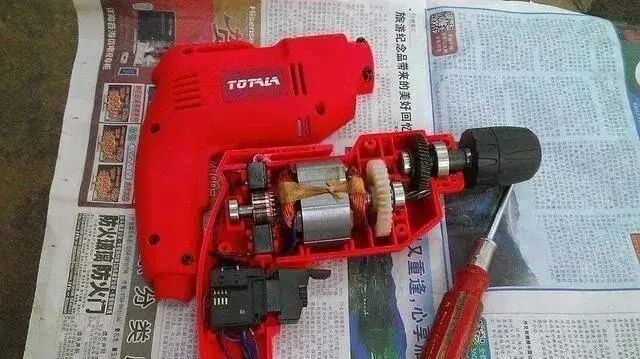
When an engineer says a power tool “uses a brushed motor,” they almost always mean a Universalmotor — a series-wound DC motor that, thanks to its commutator and carbon brushes, also runs on single-phase AC. (Cordless tools sometimes use a permanent-magnet DC, PMDC, Motor-, which is also brushed.) The brushes are spring-loaded carbon blocks that press on a spinning copper Kommutator, reversing current in each armature coil so torque always acts in one direction.
The alternative is a bürstenloser Gleichstrom (BLDC) Motor-, where the commutator is replaced by an electronic controller and fixed stator coils. No brushes means no sparking, no brush wear — but it means a circuit board, Sensoren, and firmware that a brushed tool simply does not have.

DC -Bürstenmotorprinzip
Wie in Abbildung gezeigt 1, Dies ist ein DC -Pinselmotor -Strukturmodell. Zwei feste anisotrope Magnete, in der Mitte einer Spule platziert, Die Enden der Spule wurden mit zwei halbkreisförmigen Kupferring verbunden, Kupferringenden und fester Kohlenstoffbürstenkontakt, und dann wurden an die Kohlenstoffbürstenenden mit der Gleichstromversorgung angeschlossen.
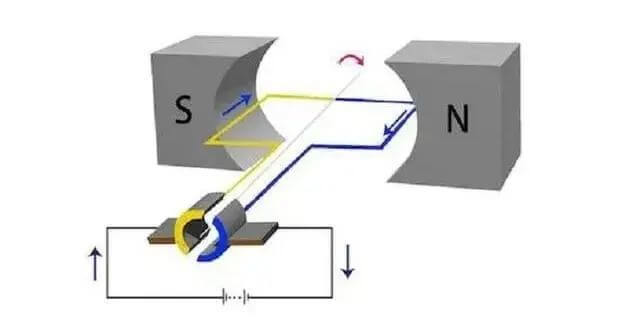
Figur 1
Nachdem die Stromversorgung angeschlossen ist, Der Strom ist wie der Pfeil in Abbildung dargestellt 1. Gemäß der linken Regel, Die gelbe Spule ist einer vertikalen elektromagnetischen Kraft nach oben ausgesetzt; Die blaue Spule wird einer vertikalen elektromagnetischen Kraft nach unten ausgesetzt. Der Motorrotor dreht sich im Uhrzeigersinn im Uhrzeigersinn und danach 90 Rotationsgrade, Wie in Abbildung gezeigt 2.
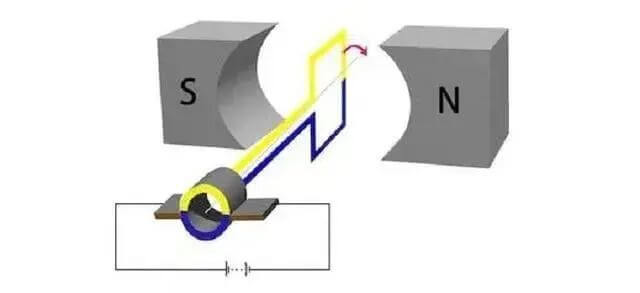
Figur 2
Zu diesem Zeitpunkt, Die Kohlenstoffbürste befindet sich nur in der Mitte des Spaltes zwischen den beiden Kupferringen, und es gibt keinen Strom in der gesamten Spulenschaltung. Aber unter der Aktion der Trägheit, Der Rotor dreht sich immer noch weiter.
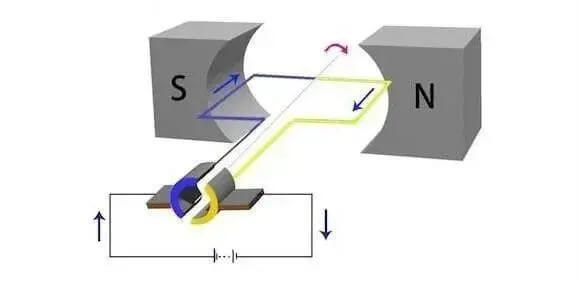
Figur 3
Wenn sich der Rotor unter Trägheit in die obige Position dreht, Der Spulenstrom ist in Abbildung dargestellt 3. Gemäß der linken Regel, Die blaue Spule ist einer vertikalen elektromagnetischen Kraft nach oben ausgesetzt; Die gelbe Spule ist einer vertikalen elektromagnetischen Kraft nach unten ausgesetzt. Der Motorrotor dreht sich weiter im Uhrzeigersinn, nach 90 Grad, Wie in Abbildung gezeigt 4: zu diesem Zeitpunkt, Die Kohlenstoffbürste befindet sich nur im mittleren Spalt zwischen den beiden Kupferringen, und es gibt keinen Strom in der gesamten Spulenschaltung. Aber unter der Aktion der Trägheit, Der Rotor dreht sich immer noch weiter. Dann werden die obigen Schritte wiederholt, Und der Zyklus geht weiter.
Bürstenloser Gleichstrommotor
Wie in Abbildung gezeigt 5, Dies ist ein Modelldiagramm einer dc -bürstenlosen Motorstruktur. Es besteht aus einem Stator und einem Rotor, wo der Rotor ein Paar magnetische Pole hat; Der Stator ist mit vielen Spulengruppen verwundet, Im Diagramm sind sechs Spulensätze gezeigt.
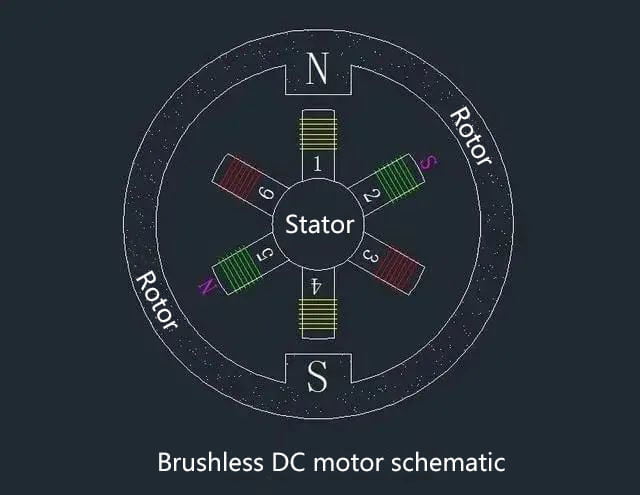
Figur 5
Wenn wir Strom an die Statorspulen weitergeben 2 und 5, die Spulen 2 und 5 wird ein Magnetfeld erzeugen, und der Stator entspricht einem Stabmagneten, Wo 2 ist der s (Süden) Stange und 5 ist das n (Norden) Pole. Da sich die gleichgeschlechtlichen Pole anziehen, Der Rotor -N -Pol dreht sich zur Spule 2 Position und der Rotorstange dreht sich zur Spule 5 Position, Figur 6.
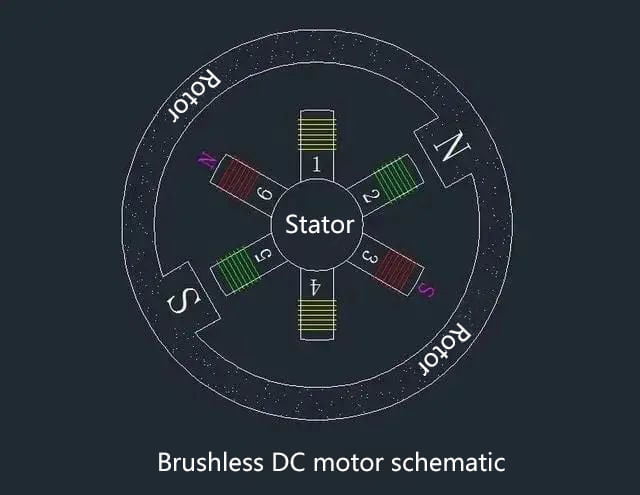
Figur 6
Dann ziehen wir den Strom aus den Statorspulen ab 2 und 5 und Strom an die Statorspulen weitergeben 3 und 6. Zu diesem Zeitpunkt, Spulen 3 und 6 wird ein Magnetfeld erzeugen, und der Stator entspricht einem Stabmagneten, Wo 3 ist der s (Süden) Stange und 6 ist das n (Norden) Pole. Da sich gleichgeschlechtliche Magnetpolen anziehen, Der Rotor -N -Pol dreht sich zur Spule 3 Position und der Rotorstange dreht sich zur Spule 6 Position, Figur 7.
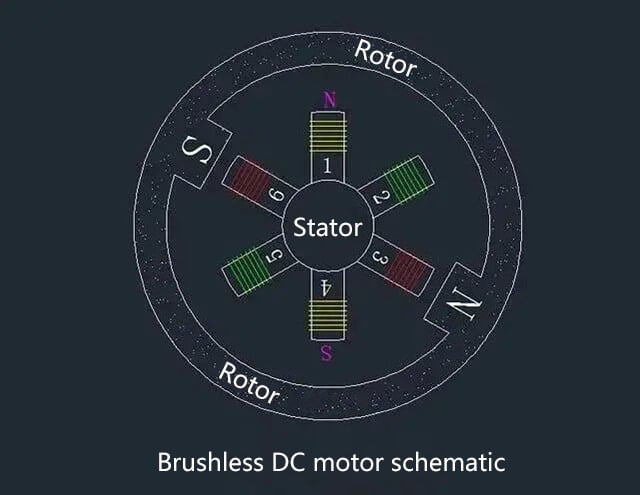
Figur 7
Ähnlich, Entfernen Sie den Strom von den Statorspulen 3 und 6, und dann den Strom an die Statorspulen weitergeben 4 und 1. Zu diesem Zeitpunkt, Spulen 4 und 1 wird ein Magnetfeld erzeugen, und der Stator entspricht einem Stabmagneten, Wo 4 ist der s (Süden) Stange und 1 ist das n (Norden) Pole. Da ziehen sich die gegenüberliegenden Pole an, Der Rotor -N -Pol dreht sich zur Spule 4 Position und der Rotorstange dreht sich zur Spule 1 Position. Bis zu
Bis zu diesem Punkt, Der Motor hat eine halbe Kurve gedreht …. Die zweite Hälfte ist das gleiche wie das vorherige Prinzip, Also werden wir es hier nicht wiederholen. Wir können einfach den dC bürstenlosen Motor als wie das Angeln einer Karotte vor einem Esel verstehen, so dass der Esel weiter in Richtung der Karotte bewegt wird.

Wie können wir also in verschiedenen Momenten den exakten Strom an verschiedene Spulen übergeben?? Dies erfordert eine aktuelle Kommutierungsschaltung …… Ich werde hier nicht ins Detail gehen.
Pinsel -DC -Motor und bürstenloser Gleichstrommotor und Nachteile Vergleich
DC-Bürstenmotor: schnelles Start, zeitnahes Bremsen, RECHTE SPEED REGULATION, Einfache Kontrolle, einfache Struktur, billig. Der Punkt ist, dass der Preis billig ist! Der Preis ist billig! Der Preis ist billig! Und es hat einen hohen Startstrom, hohes Drehmoment (rotierende Kraft) bei niedriger Geschwindigkeit, und kann sehr schwere Last tragen.
Jedoch, Wegen der Reibung zwischen Kohlenstoffbürste und Kommutator, DC -Bürstenmotor ist leicht zu produzieren Funken, Hitze, Lärm, elektromagnetische Störung der externen Umgebung, und geringe Effizienz und kurzes Leben. Weil die Carbonbürste ein Verschleißprodukt ist, Es ist leicht zu scheitern, und muss nach einer bestimmten Zeit ersetzt werden.

Bürstenloser Gleichstrommotor: Weil der DC bürstenlose Motor die Kohlenstoffbürste beseitigt, Das Geräusch ist also klein, Keine Wartung, niedrige Ausfallrate, lange lebensdauer, und die Laufzeit und Spannung ist stabiler, Damit die Funkgerätestörungen klein sein können. Aber es ist teuer! Teuer! Teuer!
Elektrowerkzeuge sind sehr häufige Werkzeuge im Leben, Und es gibt viele verschiedene Marken und heftige Konkurrenz, Die Menschen sind also sehr empfindlich gegenüber dem Preis. Und Elektrowerkzeuge, die es benötigt, um eine sehr schwere Belastung zu tragen, Muss viel Startdrehmoment sein, wie Handbohrer, Impact Drill. Andernfalls, Beim Bohren, Der Motor kann leicht nicht laufen, da das Bohrbit festsitzt.

Stellen Sie sich einen Pinsel -DC -Motor mit niedrigem Preis vor, Hoches Startdrehmoment und in der Lage, schwere Last zu tragen; bürstenloser Motor hat eine niedrige Ausfallrate und eine lange Lebensdauer, Aber es ist teuer und das Startdrehmoment ist weit weniger als Bürstenmotor. Wenn Sie wählen, Wie werden Sie wählen, Ich denke, die Antwort ist selbsterklärend.
Brushed vs Brushless — The Core Difference
| Aspect | Gebürstet (universal / PMDC) | Bürstenlos (BLDC) |
|---|---|---|
| Kommutierung | Mechanical — brushes + Kommutator | Electronic — controller + Hall-Sensoren |
| Control electronics | Keiner (schalten + triac for AC speed) | Required driver PCB + Firmware |
| Drehmoment Start | Sehr hoch (stall current = V/Rₐ) | Hoch, but limited by controller current cap |
| Power source | Wechselstrom oder Gleichstrom (universal) | DC only (or via rectifier) |
| Fragile parts | None electronic — robust in dust/heat | Controller sensitive to moisture/ESD/spikes |
| Wartung | Bürsten ersetzen (wear part) | Virtually maintenance-free |
| Upfront cost | Low — 30–50% cheaper | Prämie (20–50% more) |
How a Brushed (Universal) Motor Produces High Starting Torque
The reason brushed motors dominated drills, Schleifmaschinen, and saws comes down to one physics fact about the Seriengewickelt Entwurf. Walk through it:
- The field and armature are in series. Field current equals armature current, so at high current the magnetic field is also at its strongest.
- At standstill, back-EMF is zero. The induced voltage E = kₑ·ω is proportional to speed ω; when ω = 0, E = 0.
- Current is only limited by winding resistance. I = (V − E)/Rₐ = V/Rₐ, which is huge because Rₐ is small (fractions of an ohm).
- Torque surges. T = kₜ·Iₐ, so the stall current produces a large stall torque — for a series (universal) Motor-, torque scales roughly with the square of current (T ∝ I²).
- As it spins up, back-EMF rises and current falls to a steady operating value — the motor self-regulates to the load.
- The commutator keeps it one-way. Brushes switch current direction in each coil at the right instant, so torque never cancels out.
This is exactly why a drill doesn’t stall when the bit binds in hardwood: the motor pulls a massive inrush current and converts it directly into torque. An IEEE analytical study of universal motors confirms they remain in use for “drills and saws” precisely because of their “wide variable-speed range, hohes Anlaufdrehmoment, low cost and attractive power/weight ratio” (IEEEX, 5994773).
The Starting-Current Reality (Ausgearbeitetes Beispiel)
Real brushed motors exploit this inrush rather than fight it. Measured on a maxon RE 30 brushed DC motor at 24 v (EDN, brushed DC motor current):
| Zustand | Aktuell | Leistung | Notiz |
|---|---|---|---|
| Spin-up peak (≈1 ms) | 29 EIN | ≈700 W | Brief inrush to overcome inertia |
| Stall (rotor held) | 34 EIN | 816 W | Maximum torque condition |
| Continuous running | 2 EIN | 48 W | Rated operating point |
| Max allowed continuous | 3.5 EIN | 84 W | Thermal limit to avoid damage |
A brushless controller must cap this inrush with closed-loop current limiting; a brushed tool simply lets the copper and magnets handle it. maxon itself notes brushed DC motors “can be operated without external electronics… a useful alternative to BLDC motors,” with torque control “implemented using the current” und “low start-up voltage even after a long period in standstill” (maxon DCX program).
Brushed vs Brushless Power Tools — Quantitative Comparison
The reason the market has shifted (but not fully) is visible in the numbers. Ranges reflect typical consumer-to-professional corded and cordless tools.
| Parameter | Gebürstet (universal) | Bürstenlos (BLDC) | Quelle / note |
|---|---|---|---|
| Effizienz | 50–60% (cheap universal); 70–85 % (good PMDC) | 85–90%+ | BLDC loses less to friction/heat |
| Upfront cost | Grundlinie | +20–50% premium | PowerToolLab, KitD data |
| Battery runtime (same pack) | Grundlinie | +30–50% more holes/charge | PowerToolLab drill test (276 vs 397 holes) |
| Bürste / maintenance life | 500–2,000 h (consumer grinder 50–100 h) | Much longer (no wear part) | Duty-cycle dependent |
| Drehmoment Start | Sehr hoch; self-limited only by Rₐ | Hoch; capped by controller | T = k·Iₐ vs current limit |
| Geschwindigkeitsbereich | 10,000–20,000+ RPM (geared down) | Breit, EC-controlled | Universalmotor high-speed design |
| Environmental robustness | Exzellent (no electronics to fry) | Gut, but controller vulnerable | Dust/heat/moisture sensitivity |
Why the Cost Gap Exists
| Komponente | Gebürstet | Bürstenlos |
|---|---|---|
| Motor windings | Standard, high-volume | Standard |
| Kommutierung | Kommutator + carbon brushes (~$2) | Keiner |
| Regler | Keiner (schalten + triac) | Leiterplatte + MOSFETs + Firmware |
| Sensoren | Keiner | Hall-Sensoren (or sensorless algo) |
| Manufacturing complexity | Niedrig | Hoch (SMT, Kalibrierung) |
EIN 2020 deep-slot universal-motor study for power tools (Northwestern Polytechnical University & China’s National Engineering Research Center for Small & Präzisionsmotoren) even optimized the Slot-Design specifically “to reduce the cost of universal motor materials and improve production efficiency” (Springer JoPE, 2020) — cost is engineered in at the source.
Technische Daten: Effizienz, Temperatur & Life Limits
These are the numbers a design or procurement engineer actually uses when choosing motor architecture.
| Parameter | Typical value | Standard / note |
|---|---|---|
| Brushed universal efficiency | 50–60% (billig); up to ~75% loaded | Small universal motors lower at light load |
| Brushed PMDC efficiency | 70–85 % | maxon RE series reaches ~90% |
| BLDC-Effizienz | 85–90%+ | UL / manufacturer lab data |
| Brushless cost premium | +20–50% | Regler + sensors drive it |
| Brush service life | 500–2,000 h (grinder 50–100 h) | High current shortens life |
| Leerlaufdrehzahl (universal) | 10,000–20,000+ RPM | Gear-reduced to tool output |
| Commutator temp class | Klasse b 130 ° C / F 155 ° C | IEC 60034-1 Grenzen |
| Stall current | v / Rₐ (10–30× running) | EDN maxon RE30: 34 A stall @24 V |
Key Formulas
| Menge | Formel | Meaning for tool design |
|---|---|---|
| Gegen-EMF | E = kₑ · ω | Zero at standstill → max current at start |
| Drehmoment | T = kₜ · Iₐ | Torque tracks armature current |
| Stall current | I_stall = V / Rₐ | Bounded only by winding resistance |
| Series-motor torque | T ∝ I² (approx.) | Universal motor: torque rises with current² |
| Geschwindigkeit (loaded) | N ∝ V / (k · Φ), inversely with load | Drops under load; no-load can overspeed |
Sparking Acceptance (IEC 60034-1)
The commutator sparks — that is normal, but only to a limit. IEC 60034-1 defines four sparking grades; a service tech should never accept Class 3.
| Klasse | Beschreibung | Akzeptabel? |
|---|---|---|
| 1 | Keine Funkenbildung; Kommutator und Bürsten unverändert | Ideal bei allen Belastungen |
| 1½ | Schwache Funkenbildung nur an den Bürstenrändern | Dauerhaft zulässig |
| 2 | Permissible under stated overload | Erlaubt, aber untersuchen |
| 3 | Gefährliche Funkenbildung, Brand-/Erosionsgefahr | Nie akzeptabel |
Best Applications for Brushed Power Tools
Brushed motors remain the right call wherever low cost, Einfache Kontrolle, hohes Anlaufdrehmoment, or rough-environment robustness outrank maintenance-free life.
| Anwendung | Why brushed fits | Watch-out |
|---|---|---|
| Corded drills / impact drivers (Budget) | Cheap, huge starting torque, AC line power | Brush wear over heavy use |
| Angle grinders | Universal motor spins 10k+ RPM natively | High current → short brush life |
| Corded saws / Schleifmaschinen | No battery runtime concern; robust | Commutator maintenance |
| DIY / homeowner tools | Low upfront cost, occasional use | Long idle → brush seat-in needed |
| Dusty / hot job sites | No fragile controller to fry | Vent ingress accelerates wear |
| Repair-focused fleets | Brushes are a cheap field-replaceable part | Spares inventory required |
When the application needs precise, low-maintenance motion instead, brushless or gear-reduced BLDC is the better fit — see our guide on why robotic arms need speed reducers.
Auswahlhilfe: When to Choose a Brushed Motor
- Budget is the priority: if upfront cost dominates (DIY, give-away kits, high-volume OEM), brushed wins by 20–50%.
- The tool is corded or AC-powered: a universal motor runs straight off the line — no battery, no inverter.
- You need stall-grade starting torque: Bohrer, Mischer, and augers that bind under load benefit from the V/Rₐ inrush.
- AC/DC flexibility matters: job-site generators or engine-driven welders can be DC; universal motors handle both.
- The environment is harsh: Staub, Feuchtigkeit, Hitze, and voltage spikes destroy controllers faster than they wear brushes.
- Field repair is expected: if operators swap brushes themselves, brushed keeps the tool out of the shop.
- Choose brushless instead when: cordless runtime, tool life, and low noise are worth the premium (professional daily use).
Common Engineering Mistakes With Brushed Power-Tool Motors
| Fehler | Why it hurts |
|---|---|
| Assuming “brushed = obsolete” | Misses the cost, Drehmoment, and robustness cases where brushed is still optimal |
| Ignoring brush life in the duty cycle | Consumer grinder brushes wear in 50–100 h; spares must be planned |
| Undersizing the supply for stall current | Stall pulls 10–30× running current; weak supplies brown out |
| Wrong brush grade for the load | High-current tools need electrographitic/metal-graphite, not pure carbon |
| Forgetting the IEC sparking limit | Klasse 3 sparking erodes commutator and is a fire risk |
| Overlooking AC/DC requirement | A PMDC won’t run on AC; a universal will — verify the source |
Brushed Power-Tool Motor Troubleshooting (Problem → Ursache → Lösung)
| Problem | Wahrscheinliche Ursache | Lösung |
|---|---|---|
| Weak / low torque under load | Abgenutzte Bürsten, poor commutator contact, low supply | Replace brush set; clean/seat commutator; check voltage |
| Übermäßige Funkenbildung | Abgenutzte Bürste, wrong grade, grooved commutator | Fit correct grade; Kommutator wieder auftauchen; set spring pressure |
| Motor runs hot | Überlast, arcing, blocked vents, high ambient | Belastung reduzieren; klare Lüftungsschlitze; verify duty vs IEC class |
| Rapid brush wear | Too much spring pressure, abrasive dust, high current | Reset pressure; clean environment; correct grade |
| No start / intermittent | Brushes gone, loose lead, Lager festgefressen | New brush set; tighten lead; free shaft |
| Burns out on stall | Held stalled beyond thermal limit (I = V/Rₐ) | Add current limit / thermal cutoff; don’t bind the bit |
For the full diagnostic sequence — including winding resistance and insulation tests — use our DC motor troubleshooting guide.
Häufig gestellte Fragen
Why do power tools use brushed motors instead of brushless?
Gebürstet (mostly universal) motors are 20–50% cheaper because they need no controller, Sensoren, or firmware, and they deliver very high starting torque by exploiting the stall inrush (I = V/Rₐ). They also run on AC or DC and survive dust and heat without fragile electronics. Brushless wins on battery life and longevity, but brushed stays best for budget, corded, and repairable tools.
Do brushed power tools have more torque than brushless?
At the instant of starting or binding, a brushed series motor can pull a larger current spike (only limited by winding resistance), so its Gipfel starting torque is very high. Brushless motors are capped by their controller’s current limit, though they hold torque more consistently under sustained load and run more efficiently overall.
Are brushed power tools still good?
Yes — for corded tools, budget DIY use, harsh environments, and fleets that field-replace brushes, brushed motors are a perfectly good, cost-effective choice. For professional cordless daily use where runtime and tool life dominate, brushless is the better long-term investment.
Why are brushed motors cheaper?
They replace an entire electronic control system with a commutator and two carbon brushes. No PCB, no MOSFETs, no Hall sensors, no firmware calibration — just a switch (and a triac for AC speed control). High-volume winding and stamping keep per-unit cost low.
Can a brushed motor run on AC and DC?
EIN universal motor can — that is its defining feature and why it suits power tools plugged into any outlet or driven by a DC job-site source. A permanent-magnet DC (PMDC) brushed motor runs on DC only unless externally rectified.
How long do power-tool motor brushes last?
Typically 500–2,000 operating hours depending on current and duty; consumer-grade angle-grinder brushes can wear in as little as 50–100 hours under heavy use. Because brushes are a planned-replacement wear part, they are designed to be swapped cheaply rather than ending the tool’s life.
Why Choose Greensky for Brushed & Brushless Motion
Whether your tool design stays with brushed simplicity or moves to brushless efficiency, Greensky supplies both from one source, built to IEC 60034 und NEMA MG 1 Abmessungen, sodass sie in vorhandene Halterungen passen:
- Brushed PMDC & universal motors with documented commutator specs, selectable brush grades, and replacement-brush programs for maintenance teams.
- Bürstenlos (BLDC) motors and gear motors with matched Hall sensors and drives — eliminating brush wear, sparking, and commutation maintenance for cordless platforms.
- Integrated gear motors that multiply output torque, reducing the current (and brush stress) the motor core must handle — see our gearbox vs gear motor guide.
- Flanschkompatibilität: IEC B5/B14 and NEMA C-face with customized pilot diameters — see our Motorflanschführung.
- Low-MOQ OEM/ODM: Kleinserien für Ersatzteilprogramme und kundenspezifische Wellen-/Encoderkonfigurationen.
Verwandte Lektüre
- Was ist ein Gleichstrommotor?? Typen, Prinzip & Formeln
- What Are Motor Brushes? Typen & Wie sie funktionieren
- Warum zünden Bürstenmotoren?? Ursachen & Korrekturen
- What Causes a DC Motor to Lose Torque?
- So beheben Sie Fehler bei einem Gleichstrommotor: Step-by-Step Guide
- Nachteile von BLDC-Motoren, die Ingenieure kennen sollten
- How to Short a DC Motor (Short-Circuit Braking)
- Wechselstrom- oder Gleichstrommotor: Was Sie wählen sollten
- Was ist ein Motorflansch?? IEC- vs. NEMA-Montage
- Getriebe vs. Getriebemotor: Unterschiede & Auswahl
Referenzen
- IEC 60034-1 — Rotierende elektrische Maschinen: Bewertung und Leistung (Temperatur & zündende Kurse). webstore.iec.ch/publication/67467
- IEC 60034-30-1 — Effizienzklassen für rotierende elektrische Maschinen (IE1–IE5). webstore.iec.ch/publication/67784
- KEIN MG 1 — Motoren und Generatoren (Sicherheit, Thermal-, mounting dimensions). nema.org/standards/view/mg-1-motors-and-generators
- IEEE 112 — Standard Test Procedure for Polyphase Induction & Gleichstrommotoren (efficiency/loss methods). Standards.ieee.org/ieee/112/4213
- IEEE Xplore — Analytical model and parameter computation for universal motors (hohes Anlaufdrehmoment, niedrige Kosten). ieeexplore.ieee.org/document/5994773
- Qi, H. et al. (2020) — Design and research of deep slot universal motor for electric power tools. Journal of Power Electronics, Springer. DOI: 10.1007/s43236-020-00131-6
- maxon — Brushed DC motors (DCX program): operable without external electronics, current-based torque control. maxonmotor.com/dcx-program
- FAULHABER — DC-Motors Technical Information (brushed commutation, precious-metal brushes). faulhaber.com/de/technische-informationen
- UNS. DOE – Bestimmung des Wirkungsgrads von Elektromotoren & Repair Guidance. energy.gov/eere/amo/articles/determination-electric-motors
- SKF — Electric motor maintenance and bearing lubrication. skf.com/us/products/maintenance-products/ Bearing-maintenance