
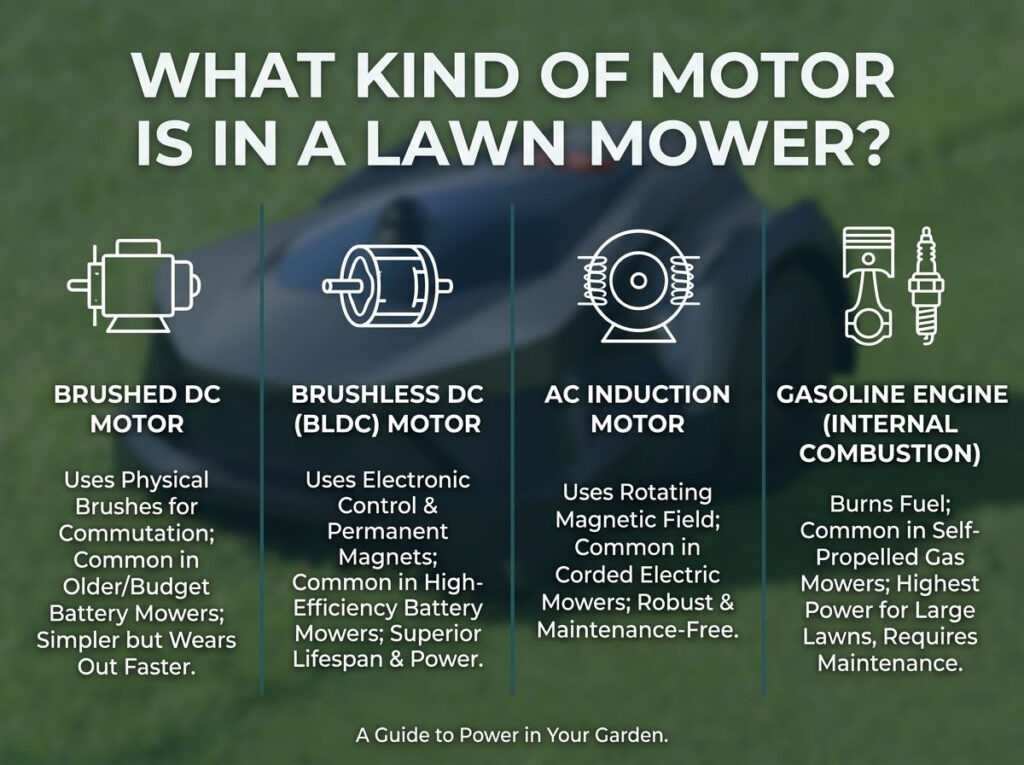
Was für ein Motor ist in einem Rasenmäher verbaut??
Featured Snippet Answer:
Modern lawn mowers use several different motor technologies depending on cost, power level, Effizienzanforderungen, and application type. The most common motor types include brushed DC motors, bürstenloser Gleichstrom (BLDC) Motoren, AC-Induktionsmotoren, and gasoline engine-driven mechanical systems. In today’s electric lawn mower market, BLDC motors are becoming the preferred solution because they offer higher efficiency, bessere Drehmomentkontrolle, geringerer Wartungsaufwand, leiserer Betrieb, und längere Lebensdauer. OEM manufacturers increasingly select 48V and 72V brushless motors for cordless lawn mowers due to improved battery efficiency and smart electronic control compatibility.
For industrial buyers, choosing the right lawn mower motor directly affects cutting performance, runtime, thermische Stabilität, Wartungskosten, and product reliability. This guide explains how lawn mower motors work, compares different motor technologies, and provides engineering-level motor selection advice for OEM mower manufacturers and procurement teams.
What Kind of Motor Is Used in a Lawn Mower?
Lawn mower motors can be divided into two primary categories: electric motors and internal combustion engine systems. The global market is rapidly shifting toward electric lawn mower motors because of environmental regulations, lower noise requirements, and advances in lithium battery technology.
Common Lawn Mower Motor Types
| Motorentyp | Typische Anwendung | Main Advantages | Main Limitations |
|---|---|---|---|
| Gebürsteter Gleichstrommotor | Low-cost cordless mowers | Einfache Struktur, low initial cost | Bürstenverschleiß, geringere Effizienz |
| Bürstenloser Gleichstrom (BLDC) Motor | Premium cordless lawn mowers | Hohe Effizienz, smart control | Higher controller cost |
| AC-Induktionsmotor | Corded electric lawn mowers | Zuverlässig, preiswert | Requires AC power source |
| Universal Motor | Entry-level electric tools | Schnelle Geschwindigkeit, kompakt | High noise and maintenance |
| Gasoline Engine | Commercial heavy-duty mowers | Very high power density | Lärm, Emissionen, Wartung |
Among these technologies, brushless DC motors now dominate high-performance cordless lawn mower platforms because they achieve better energy efficiency and higher torque density while supporting advanced electronic control systems.
How Does a Lawn Mower Motor Work?
The working principle depends on the motor technology used. In electric lawn mowers, electrical energy from either an AC source or lithium battery is converted into rotational mechanical energy to drive the cutting blade.
How Brushed DC Motors Work
Brushed DC motors use carbon brushes and a commutator to mechanically switch current direction inside the rotor winding. As current flows through the armature, electromagnetic force generates rotational torque.
Although brushed motors are inexpensive, brush friction creates energy loss, Wärmeerzeugung, electrical sparks, and wear over time. These issues reduce overall efficiency and reliability in demanding lawn mower applications.
How BLDC Lawn Mower Motors Work
Brushless DC motors eliminate physical brushes entirely. Stattdessen, an electronic controller performs commutation using Hall sensors or sensorless algorithms.
The controller energizes stator windings sequentially to generate a rotating magnetic field. Permanent magnets on the rotor follow this field and produce rotational torque.
The main advantages of BLDC mower motors include:
- Höhere Effizienz
- Lower thermal loss
- Höhere Drehmomentdichte
- Lower acoustic noise
- Längere Lebensdauer
- Smart speed regulation
This is why modern OEM cordless mower platforms increasingly adopt 48V and 72V BLDC systems.
Why Brushless Motors Are Becoming Standard in Lawn Mowers
The global shift toward brushless lawn mower motors is driven by performance requirements, stricter environmental standards, and consumer demand for cordless equipment.
Höhere Effizienz
BLDC motors commonly achieve efficiency levels between 85% und 92%, significantly higher than brushed motors. Improved efficiency directly increases battery runtime, which is critical for cordless lawn mowers.
Lower electrical losses also reduce heat generation inside the motor housing, improving thermal stability during continuous operation.
Better Torque Control
Lawn mowers frequently encounter changing grass density and uneven terrain. Brushless motor controllers can dynamically adjust torque output in real time.
This adaptive control prevents blade slowdown during heavy cutting conditions while reducing unnecessary power consumption during lighter loads.
Längere Lebensdauer
Brushless motors eliminate carbon brush wear, one of the most common failure points in traditional DC motors. For commercial lawn equipment, this dramatically reduces maintenance requirements.
Typical BLDC mower motors can exceed 5,000 operating hours under proper thermal management conditions.
Lower Noise and Vibration
Noise reduction is increasingly important in residential and urban landscaping applications. Brushless motors produce smoother torque output and lower acoustic noise compared with brushed systems and gasoline engines.
Brushless vs Brushed Motor Lawn Mower Comparison
One of the most common OEM purchasing questions is whether brushless motors justify their higher initial cost.
| Parameter | Bürstenlosen Motor | Bürstenmotor |
|---|---|---|
| Effizienz | 85–92 % | 70–80 % |
| Wartung | Sehr niedrig | Bürstenaustausch erforderlich |
| Geräuschpegel | Niedrig | Mäßig bis hoch |
| Wärmeleistung | Exzellent | Average |
| Lebensdauer | Lang | Kürzer |
| Drehmomentkontrolle | Advanced electronic control | Begrenzt |
| Anfängliche Kosten | Höher | Untere |
| Akkulaufzeit | Länger | Kürzer |
Aus ingenieurwissenschaftlicher Sicht, the higher upfront cost of BLDC motors is often offset by lower maintenance cost, improved battery utilization, and longer product lifespan.
BLDC Motor vs Gasoline Engine for Lawn Mowers
Although gasoline lawn mowers still dominate certain commercial sectors, electric brushless systems are rapidly replacing small combustion engines.
| Faktor | BLDC Electric Mower | Gasoline Mower |
|---|---|---|
| Energieeffizienz | Sehr hoch | Niedrig |
| Lärm | Niedrig | Sehr hoch |
| Wartung | Minimal | Frequent oil and filter service |
| Emissionen | Zero direct emissions | High emissions |
| Torque Response | Instant | Slower throttle response |
| Betriebskosten | Niedrig | Higher fuel cost |
| Commercial Runtime | Battery dependent | Lange Laufzeit |
Commercial landscaping companies are increasingly adopting high-voltage BLDC platforms because battery technology improvements now support longer operating durations with reduced environmental impact.
Key Engineering Factors in Lawn Mower Motor Design
Effizienz
Motor efficiency directly affects runtime and battery sizing. A motor operating at 90% efficiency wastes far less energy as heat than a 75% efficient system.
Für OEM-Hersteller, improved efficiency allows:
- Smaller battery packs
- Longer runtime
- Lower thermal stress
- Reduzierter Kühlbedarf
Drehmomentdichte
Lawn mower motors require high torque density because cutting blades experience sudden load spikes when encountering dense grass or debris.
BLDC motors offer excellent torque density because permanent magnet rotor designs produce strong magnetic fields within compact motor dimensions.
Thermalmanagement
Thermal performance is critical in enclosed mower decks where airflow may be limited.
Key cooling strategies include:
- Aluminum motor housings
- Internal cooling fans
- High-efficiency winding design
- Temperatursensoren
- Intelligent controller derating
Poor thermal management significantly reduces insulation life and bearing reliability.
Kontrollsysteme
Modern brushless mower motors rely heavily on intelligent motor controllers. Advanced control algorithms improve efficiency and cutting consistency.
Common controller functions include:
- FOC (Feldorientierte Steuerung)
- Soft start functionality
- Load-adaptive speed control
- Battery protection
- Overcurrent protection
- Temperaturüberwachung
How to Choose a Lawn Mower Motor for OEM Applications
Selecting the right lawn mower motor requires balancing cost, cutting performance, runtime, and environmental operating conditions.
Spannungsbereich
Common cordless mower voltage platforms include:
- 18V–24V for lightweight residential mowers
- 36V–48V for mid-range residential systems
- 72V+ for commercial-grade equipment
Higher voltage systems reduce current requirements and improve electrical efficiency.
Leistungsbereich
| Mower Type | Typical Motor Power |
|---|---|
| Compact residential mower | 500W–1000W |
| Standard cordless mower | 1000W–2000W |
| Commercial mower | 3000W–7000W |
Geschwindigkeits- und Drehmomentanforderungen
Lawn mower blades typically operate between 2,500 RPM and 3,500 U/min.
Jedoch, torque stability under dynamic load conditions is more important than maximum no-load speed.
OEM buyers should prioritize:
- Peak torque capability
- Low-speed torque stability
- Dynamic load response
- Controller tuning compatibility
Kühlmethode
Commercial lawn mowers often require enhanced cooling systems because of continuous heavy-duty operation.
Cooling options include:
- Natürliche Luftkühlung
- Forced-air cooling
- Integrated fan systems
- Liquid cooling for large commercial equipment
Controller-Kompatibilität
Brushless lawn mower motors require compatible electronic speed controllers (Escs).
Important controller considerations include:
- Voltage matching
- Peak current handling
- Communication protocol support
- FOC compatibility
- Regenerative braking capability
Greensky Power provides custom BLDC motor solutions with integrated controller matching for OEM lawn equipment manufacturers.
Related internal pages:
- /bldc-motor/
- /custom-motor/
- /electric-vehicle-motor/
Applications of Lawn Mower Motors Beyond Residential Equipment
Motor technologies developed for lawn mowers are increasingly used across multiple industrial sectors.
Robotic Lawn Mowers
Autonomous robotic mowers rely heavily on compact BLDC motors because they require:
- Wenig Lärm
- Hohe Effizienz
- Präzise Geschwindigkeitsregelung
- Long battery runtime
Commercial Landscaping Equipment
Commercial landscaping fleets increasingly transition to electric platforms because municipalities now impose stricter emissions and noise regulations.
Agricultural Cutting Equipment
Brushless motor technologies are also expanding into agricultural trimming systems and intelligent grass management equipment.
Industrial Outdoor Equipment
Many industrial cleaning machines and outdoor power tools use similar motor architectures, einschließlich:
- Leaf blowers
- Snow throwers
- Garden tractors
- Autonomous utility robots
Future Trends in Lawn Mower Motor Technology
The lawn mower motor industry is rapidly evolving due to battery technology improvements and stricter environmental standards.
Higher Voltage Platforms
72V and even 120V battery systems are becoming more common in commercial landscaping equipment.
Higher voltage systems reduce copper loss and improve overall drivetrain efficiency.
Integrated Smart Control Systems
Future mower motors will increasingly integrate:
- IoT connectivity
- Vorausschauende Wartung
- Cloud-Diagnose
- AI-based torque optimization
Fortschrittliche magnetische Materialien
Improved permanent magnet materials increase torque density while reducing motor size and weight.
Energy Recovery Systems
Some future mower systems may integrate regenerative braking or energy recovery technologies to improve runtime efficiency.
Why OEM Buyers Prefer Custom BLDC Lawn Mower Motors
Standard off-the-shelf motors often fail to optimize overall mower performance.
OEM manufacturers increasingly require custom motor solutions tailored to:
- Specific blade diameters
- Battery platforms
- Cooling constraints
- Noise targets
- Controller architecture
- Product positioning
Custom brushless motor design allows manufacturers to optimize:
- Efficiency curves
- Drehmomentabgabe
- Thermische Stabilität
- Acoustic performance
- Haltbarkeit
Greensky Power supports OEM lawn mower manufacturers with custom 48V and 72V BLDC motor solutions designed for high efficiency and industrial-grade reliability.
Datenblatt anfordern, Holen Sie sich eine OEM-Lösung, oder contact our engineers for customized lawn mower motor development support.
FAQ: Was für ein Motor ist in einem Rasenmäher verbaut??
1. What type of motor is best for a lawn mower?
Brushless DC motors are generally considered the best solution for modern cordless lawn mowers because they provide higher efficiency, geringerer Wartungsaufwand, leiserer Betrieb, and longer lifespan compared with brushed motors. Commercial-grade systems increasingly use 48V and 72V BLDC motors.
2. Are lawn mower motors AC or DC?
Corded electric lawn mowers often use AC induction motors, while cordless battery-powered lawn mowers primarily use DC motor systems, especially brushless DC motors. Gasoline lawn mowers use combustion engines rather than electric motors.
3. Why are brushless lawn mower motors more efficient?
Brushless motors eliminate brush friction and mechanical commutation losses. Electronic commutation allows more precise energy delivery, improving overall efficiency and reducing heat generation. This increases battery runtime and extends motor lifespan.
4. What voltage motor is used in cordless lawn mowers?
Most cordless lawn mowers operate on 18V, 36v, 48v, or 72V systems. Residential models typically use lower voltages, while commercial landscaping equipment increasingly adopts higher-voltage platforms for improved efficiency and torque output.
5. How long does a brushless lawn mower motor last?
A high-quality BLDC lawn mower motor can exceed 5,000 operating hours when properly cooled and matched with an appropriate controller. Lifespan depends heavily on thermal management, bearing quality, and operating load conditions.
6. Are brushless motors worth the higher cost?
For most OEM applications, Jawohl. Allerdings haben BLDC-Motoren höhere Vorlaufkosten, they reduce maintenance, improve battery efficiency, increase reliability, and provide better cutting performance. Total lifecycle cost is often significantly lower.
Fazit
The answer to “what kind of motor is in a lawn mower” depends on the mower’s design goals, application environment, and cost target. While brushed DC motors and gasoline engines still exist in certain market segments, brushless DC motor technology is rapidly becoming the industry standard.
BLDC lawn mower motors provide superior efficiency, höhere Drehmomentdichte, bessere thermische Leistung, intelligent control capability, and longer operational lifespan. These advantages are especially important for OEM manufacturers seeking competitive cordless mower platforms.
As battery technology continues advancing, the future of lawn mower systems will increasingly rely on high-efficiency brushless motor architectures integrated with intelligent control systems.
Greensky Power provides OEM-focused brushless motor solutions for lawn mowers, robotic landscaping equipment, and outdoor power tools. Our engineering team supports custom voltage platforms, Controller-Integration, thermal optimization, and industrial-grade motor reliability.
Datenblatt anfordern | Holen Sie sich eine OEM-Lösung | Kontaktieren Sie unsere Ingenieure
Holen Sie sich ein kostenloses Angebot
Referenzen
1. https://www.energy.gov/eere/articles/how-electric-motors-work
2. https://www.iea.org/reports/energy-efficiency-2023
3. https://www.nema.org/standards/view/motors-and-generators
4. https://www.sciencedirect.com/topics/engineering/brushless-dc-motor
5. https://www.britannica.com/technology/electric-motor
6. https://ieeexplore.ieee.org/document/9099624
7. https://www.energy.gov/eere/vehicles/articles/fotw-1173-january-25-2021-electric-vehicle-batteries
8. https://www.mdpi.com/journal/energies