
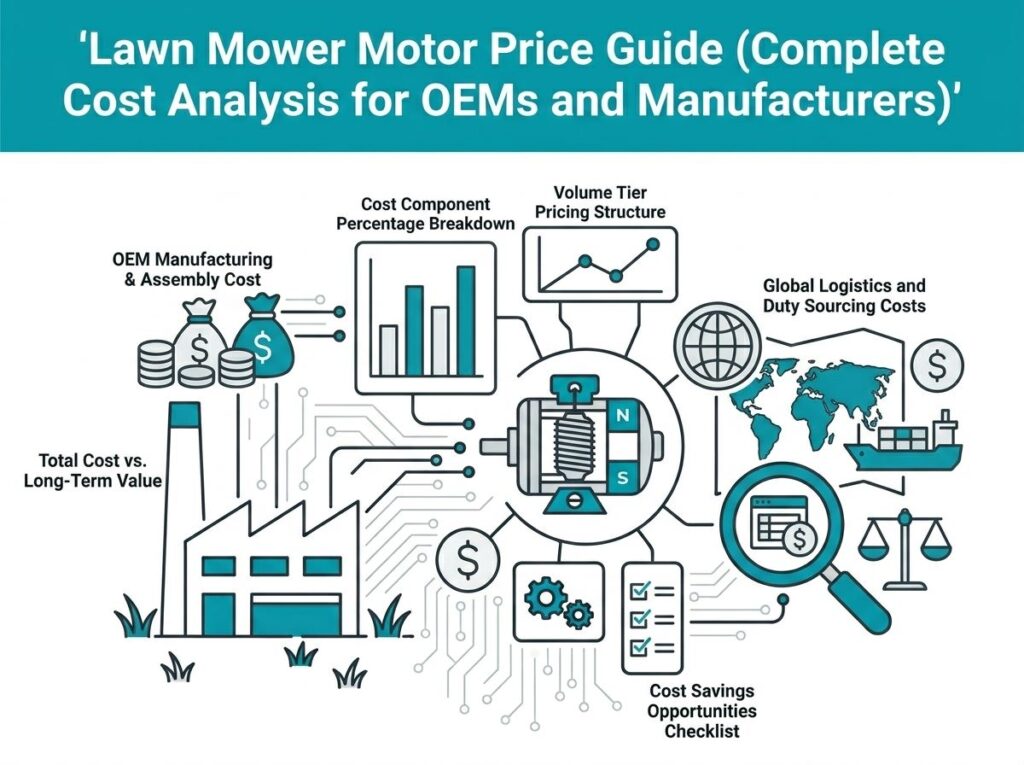
Preisführer für Rasenmähermotoren
Schnelle Antwort
The price of a lawn mower motor typically ranges from $20 zu Ende $300 per unit, abhängig vom Motortyp, Leistungsabgabe, Stromspannung, Effizienz, Produktionsvolumen, and customization requirements. For OEM lawn mower manufacturers, bürstenloser Gleichstrom (BLDC) motors generally offer the best balance between performance, Lebensdauer, Effizienz, and total ownership cost. While high-efficiency BLDC motors have higher initial prices than brushed motors, they reduce energy consumption, Wartungsanforderungen, warranty claims, and replacement frequency, making them the preferred choice for modern cordless and robotic lawn mowers.
When evaluating lawn mower motor pricing, engineers and procurement teams should focus not only on purchase cost but also on efficiency, Drehmomentdichte, Wärmemanagement, Controller-Kompatibilität, Zuverlässigkeit, und Lebenszykluskosten. A motor that costs 20% more initially may reduce total system costs significantly over the product’s service life.
What Is the Average Lawn Mower Motor Price?
One of the most common questions from OEM purchasing managers is: “How much does a lawn mower motor cost?”
The answer depends heavily on motor technology and application requirements.
Residential electric lawn mowers, Roboter-Rasenmäher, commercial zero-turn mowers, and ride-on electric mowers all require vastly different motor specifications. Folglich, motor pricing varies considerably.
| Motorentyp | Leistungsbereich | Typical OEM Price | Primary Application |
|---|---|---|---|
| Gebürsteter Gleichstrommotor | 300W–1200W | $20–$60 | Entry-level mowers |
| BLDC-Motor | 500W–3000W | $40–180 $ | Cordless mowers |
| High-Efficiency BLDC | 1000W–5000W | $80–$250 | Commercial mowers |
| Nabenmotor | 250W–1500W | $50–$220 | Drive wheel systems |
| Integrierter Motor + Regler | 500W–5000W | $120–$350+ | Roboter-Rasenmäher |
For most modern battery-powered lawn mower projects, the market is rapidly shifting toward high-efficiency BLDC motors because they deliver superior energy utilization, longer runtime, leiserer Betrieb, and lower maintenance requirements.
Why Motor Price Is More Than Just the Purchase Cost
Many OEM buyers focus exclusively on motor purchase price during supplier evaluations. Jedoch, experienced engineers understand that the motor represents a critical subsystem influencing overall machine performance, Zuverlässigkeit, and profitability.
A low-cost motor may initially reduce BOM expenses, but hidden costs often emerge through:
- Higher battery consumption
- Reduced mowing runtime
- Übermäßige Wärmeentwicklung
- Vorzeitiger Lagerausfall
- Increased warranty claims
- Higher maintenance costs
- Lower customer satisfaction
Zum Beispiel, improving motor efficiency from 80% zu 92% can significantly extend operating time in battery-powered mowers. This may allow manufacturers to reduce battery size while maintaining runtime targets.
Deswegen, total cost analysis should include:
- Initial motor price
- Controller-Kosten
- Battery cost impact
- Energieeffizienz
- Warranty costs
- Replacement rates
- Expected service life
This lifecycle perspective is especially important for robotic lawn mower manufacturers where energy efficiency directly impacts competitive differentiation.
Key Factors That Influence Lawn Mower Motor Pricing
1. Motorentechnik
Motor architecture remains the largest pricing factor.
Brushed motors use mechanical commutation systems and simpler electronics, resulting in lower manufacturing costs. BLDC motors require permanent magnets, elektronische Steuerungen, and sophisticated manufacturing processes, increasing upfront pricing.
Jedoch, BLDC motors typically provide:
- 30–50% longer lifespan
- Höhere Effizienz
- Geringerer Wartungsaufwand
- Verbesserte Zuverlässigkeit
2. Nennleistung
As power output increases, motor costs rise due to:
- Larger stators
- More copper windings
- Higher-grade magnets
- Stronger shafts
- Improved thermal systems
A 500W mower motor may cost less than $50, while a commercial-grade 5kW drive motor can exceed $300.
3. Voltage Platform
Common voltage systems include:
- 24v
- 36v
- 48v
- 60v
- 72v
Higher voltage motors generally require:
- Bessere Isolierung
- Enhanced controllers
- Improved thermal design
- Stricter safety certifications
These factors contribute to increased manufacturing costs.
4. Schutzklasse
Outdoor lawn equipment operates under harsh environmental conditions.
Motors designed to achieve:
- IP54
- IP65
- IP67
require sealing systems, waterproof connectors, corrosion-resistant coatings, and advanced housing designs that increase production costs.
5. Customization Requirements
OEM customization significantly affects pricing.
Beispiele hierfür sind:
- Custom mounting flanges
- Special shafts
- Dedicated wiring harnesses
- Integrated controllers
- CAN-Kommunikation
- Unique torque curves
- Private Etikettierung
Although customization increases unit cost, it often reduces assembly complexity and improves system integration.
BLDC Motor Price vs Brushed Motor Price
One of the most important comparisons for lawn mower manufacturers is BLDC versus brushed motors.
| Faktor | BLDC-Motor | Bürstenmotor |
|---|---|---|
| Purchase Price | Höher | Untere |
| Effizienz | 85–95 % | 70–80 % |
| Wartung | Minimal | Bürstenaustausch erforderlich |
| Lebensdauer | 10,000–30,000 hrs | 2,000–5,000 hrs |
| Lärm | Niedrig | Höher |
| Zuverlässigkeit | Exzellent | Mäßig |
| Akkulaufzeit | Länger | Kürzer |
Although brushed motors appear cheaper initially, lifecycle analysis usually favors BLDC technology for professional equipment, Roboter-Rasenmäher, and premium consumer products.
BLDC Motor vs Induction Motor Cost Comparison
Induction motors remain common in industrial equipment but are less popular in battery-powered lawn care products.
| Parameter | BLDC-Motor | Induktionsmotor |
|---|---|---|
| Effizienz | Hoch | Mäßig |
| Drehmomentdichte | Exzellent | Untere |
| Gewicht | Leicht | Schwerer |
| Batteriekompatibilität | Exzellent | Mäßig |
| Controller-Komplexität | Mäßig | Hoch |
| Wärmeleistung | Gut | Gut |
| OEM Cost | Mäßig | Moderate to High |
For cordless lawn mower applications, BLDC motors generally provide superior overall value due to their efficiency and power density advantages.
How Efficiency Directly Impacts Motor Cost
Motor efficiency is one of the strongest cost drivers in modern lawn mower design.
Higher efficiency motors require:
- Premium magnetic materials
- Higher copper fill factors
- Precision laminations
- Advanced winding processes
- Optimized electromagnetic design
These upgrades increase manufacturing expenses but deliver measurable operational benefits.
Zum Beispiel, a 92% efficient motor wastes significantly less energy than an 80% effizienter Motor. Reduced energy loss means:
- Longer runtime
- Smaller battery requirements
- Lower operating temperature
- Verbesserte Zuverlässigkeit
- Längere Lebensdauer
For robotic lawn mowers operating daily, these benefits can easily justify the premium cost of high-efficiency motors.
How Thermal Management Affects Lawn Mower Motor Pricing
Heat is one of the primary enemies of electric motor performance and reliability.
Excessive temperatures accelerate:
- Magnet degradation
- Lagerverschleiß
- Alterung der Isolierung
- Electronic component failure
Premium mower motors therefore incorporate advanced thermal management systems including:
- Aluminum housings
- Optimized airflow paths
- Heat sinks
- Temperatursensoren
- Thermal protection algorithms
These features increase manufacturing costs but dramatically improve durability and field reliability.
How to Choose a Lawn Mower Motor for Your Application
Für OEM-Hersteller, selecting a lawn mower motor is not simply a matter of choosing the lowest-priced option. The correct motor must satisfy performance targets, battery constraints, durability requirements, Umweltbedingungen, and long-term product strategy.
The most successful lawn mower manufacturers evaluate motor selection through a system-level approach. Instead of focusing solely on motor price, engineers analyze how the motor interacts with batteries, Controller, cutting systems, drive wheels, and software control algorithms.
Voltage Range Selection
Battery voltage directly impacts motor performance, Effizienz, und Systemkosten.
| Stromspannung | Typische Anwendung | Leistungsbereich | Cost Level |
|---|---|---|---|
| 24v | Compact mowers | 300–800W | Niedrig |
| 36v | Residential mowers | 500–1500W | Low-Medium |
| 48v | Premium cordless mowers | 1000–3000W | Medium |
| 60v | Commercial walk-behind mowers | 2000–4000W | Mittelhoch |
| 72v | Commercial ride-on mowers | 3000–8000W | Hoch |
For most professional cordless lawn mower platforms, 48V systems represent the best balance between cost, Effizienz, Sicherheit, and market acceptance. In der Zwischenzeit, 72V architectures continue gaining popularity in commercial electric mowing equipment due to their ability to reduce current and improve overall system efficiency.
Power Range Considerations
Power requirements vary significantly depending on mower size and application.
- Roboter-Rasenmäher: 100W–1000W
- Residential walk-behind mowers: 800W–2500W
- Commercial walk-behind mowers: 2000W–5000W
- Ride-on electric mowers: 3000W–15000W+
Undersized motors often operate continuously near maximum load, generating excessive heat and reducing service life. Oversized motors increase BOM costs and reduce competitiveness. Proper power matching is therefore critical.
Geschwindigkeits- und Drehmomentanforderungen
Cutting motors and drive motors have different performance priorities.
Blade motors generally require:
- High RPM
- Stabile Geschwindigkeitsregelung
- Fast response under changing grass density
Drive motors generally require:
- Hohes Anlaufdrehmoment
- Hill-climbing capability
- Precise speed regulation
High-torque BLDC motors often provide superior performance because they can maintain blade speed even when mowing thick or wet grass.
Auswahl der Kühlmethode
Thermal management significantly affects reliability.
- Natural cooling
- Forced-air cooling
- Integrated fan cooling
- Flüssigkeitskühlung (commercial systems)
Most residential lawn mowers rely on natural or fan-assisted cooling, while commercial equipment increasingly incorporates advanced thermal designs to support continuous operation.
Controller-Kompatibilität
Motor performance depends heavily on controller quality.
Before finalizing a motor supplier, OEM teams should verify compatibility with:
- FOC-Steuerung
- Hall sensor systems
- Sensorless algorithms
- CAN-Kommunikation
- Bluetooth integration
- Battery management systems
A well-matched controller can significantly improve efficiency, noise performance, and user experience.
How Much Do Robotic Lawn Mower Motors Cost?
Robotic lawn mowers represent one of the fastest-growing segments in the outdoor power equipment industry.
Unlike traditional mowers, robotic platforms typically require multiple motors:
- Cutting motor
- Left wheel drive motor
- Right wheel drive motor
- Optional steering motors
Infolge, motor selection directly impacts total system cost.
| Motorentyp | Typical Price | Anwendung |
|---|---|---|
| Cutting BLDC Motor | $25–80 $ | Blade drive |
| Wheel Hub Motor | $30–$100 | Drive system |
| Integrated Motor Assembly | $50–$150 | Premium robotic systems |
| Motor + Controller Package | $80–$250 | Smart robotic platforms |
Because robotic mowers operate autonomously and often run daily, Hersteller legen Wert auf Effizienz, waterproofing, Zuverlässigkeit, and lifespan over the lowest initial purchase cost.
OEM Custom Motor Pricing Explained
Many lawn mower manufacturers eventually move from standard motors to customized motor solutions.
Custom motor development increases upfront investment but often delivers significant competitive advantages.
| Customization Item | Cost Impact |
|---|---|
| Custom Shaft Design | Niedrig |
| Special Housing | Medium |
| Waterproof Design | Medium |
| Integrated Controller | Mittelhoch |
| Custom Firmware | Hoch |
| CAN Communication | Medium |
| Dedicated Tooling | Hoch |
Custom solutions frequently reduce overall manufacturing costs by simplifying assembly, reducing part counts, and improving system integration.
Für OEM-Projekte, working directly with a specialized motor manufacturer often results in better long-term value than purchasing generic catalog motors.
How to Evaluate a BLDC Motor Supplier for Lawn Mower Manufacturing
Finding the right supplier is often more important than achieving the lowest motor price.
A supplier capable of supporting product development, testen, Zertifizierung, and scaling can significantly reduce project risk.
Technische Fähigkeiten
Look for suppliers that provide:
- Motor simulation
- Electromagnetic optimization
- Thermal analysis
- Custom design support
- Rapid prototyping
Manufacturing Capability
- Automated winding
- Magnet insertion systems
- Dynamic balancing
- End-of-line testing
- Traceability systems
Qualitätskontrolle
- ISO 9001
- Wareneingangskontrolle
- Leistungstests
- Lebenstest
- Umwelttests
Companies such as Greensky Power specialize in customized BLDC motor solutions for lawn mower manufacturers, offering 48V, 60v, and 72V platforms optimized for modern battery-powered equipment.
For OEM projects requiring custom solutions, engineers may request a datasheet or discuss requirements through:
Holen Sie sich ein kostenloses Angebot
Why High-Efficiency Motors Often Deliver Lower Total Costs
One of the biggest misconceptions in procurement is that the lowest-priced motor provides the best value.
In Wirklichkeit, high-efficiency motors frequently lower overall ownership costs.
| Kostenkategorie | Standardmotor | High-Efficiency BLDC |
|---|---|---|
| Motorpreis | Untere | Höher |
| Batteriebedarf | Larger | Smaller |
| Hitzeerzeugung | Höher | Untere |
| Warranty Risk | Höher | Untere |
| Lebensdauer | Kürzer | Länger |
| Gesamtkosten | Höher | Untere |
For robotic and commercial lawn mowers, energy efficiency directly influences battery size, charging frequency, and operating costs. These factors often outweigh differences in motor purchase price.
Future Trends in Lawn Mower Motor Pricing
Several market forces are shaping future lawn mower motor costs.
Higher Adoption of BLDC Technology
As production volumes increase globally, BLDC motor pricing continues to decline while performance improves.
Growth of Robotic Lawn Mowers
The robotic mower market is expanding rapidly, increasing demand for compact, hohe Effizienz, waterproof motors.
Integrated Smart Motor Systems
Future systems will increasingly combine:
- Motor
- Regler
- Sensoren
- Connectivity
- Diagnostics
into integrated modules, simplifying assembly and reducing overall system costs.
Advanced Magnet Technologies
Improved magnetic materials continue increasing torque density and efficiency while reducing motor size.
These developments will help manufacturers produce lighter, quieter, and more efficient lawn mowers.
Häufig gestellte Fragen (FAQ)
What is the average price of a lawn mower motor?
Most lawn mower motors cost between $20 und $300 abhängig vom Motortyp, Stromspannung, Nennleistung, efficiency level, and production volume. BLDC motors typically range from $40 zu $180 for OEM applications.
Why are BLDC motors more expensive than brushed motors?
BLDC motors use permanent magnets, elektronische Steuerungen, and advanced manufacturing processes. Although they cost more initially, they offer higher efficiency, geringerer Wartungsaufwand, Längere Lebensspanne, and better reliability.
What is the best motor type for robotic lawn mowers?
High-efficiency BLDC motors are generally the preferred choice because they provide excellent efficiency, kompakte Größe, wenig Lärm, präzise steuerung, and long operating life.
How does motor efficiency affect lawn mower costs?
Higher efficiency reduces battery consumption, Wärmeerzeugung, and operating costs. It may also allow manufacturers to use smaller battery packs while maintaining runtime targets.
Is a custom motor worth the extra cost?
For large-volume OEM projects, custom motors often improve performance, simplify assembly, reduce system complexity, and strengthen product differentiation, making the investment worthwhile.
What voltage is best for cordless lawn mowers?
48V systems currently offer one of the best balances between power, Effizienz, Sicherheit, und kosten. Commercial platforms increasingly adopt 60V and 72V architectures.
How long do BLDC lawn mower motors last?
High-quality BLDC motors typically achieve 10,000–30,000 operating hours when properly designed and operated within thermal limits.
How can OEM buyers reduce motor costs?
The most effective methods include increasing order volume, standardizing motor platforms, simplifying customization requirements, and working directly with experienced motor manufacturers.
Fazit
The true value of a lawn mower motor cannot be measured solely by its purchase price. Engineers and procurement teams must evaluate efficiency, Drehmomentdichte, thermische Leistung, Controller-Kompatibilität, Zuverlässigkeit, and lifecycle costs.
For modern cordless and robotic lawn mower platforms, high-efficiency BLDC motors consistently provide the best balance of performance, Haltbarkeit, and total ownership cost. Although initial prices may be higher than traditional alternatives, the long-term benefits often outweigh the investment.
If you are developing a new lawn mower platform, upgrading an existing product line, or seeking a custom motor solution, selecting the right supplier is critical.
Fordern Sie ein Datenblatt an, Holen Sie sich eine OEM-Lösung, oder contact our engineers to discuss customized 48V, 60v, and 72V BLDC motor solutions for lawn mower applications.
Referenzen
- https://www.energy.gov/eere/amo/electric-motors
- https://www.nema.org
- https://www.iea.org/reports/energy-efficiency-2024
- https://www.baldor.com
- https://www.machinedesign.com
- https://www.motioncontroltips.com
- https://www.electricaleasy.com
- https://www.sciencedirect.com/topics/engineering/brushless-dc-motor
- https://ieeexplore.ieee.org
- https://www.researchgate.net