
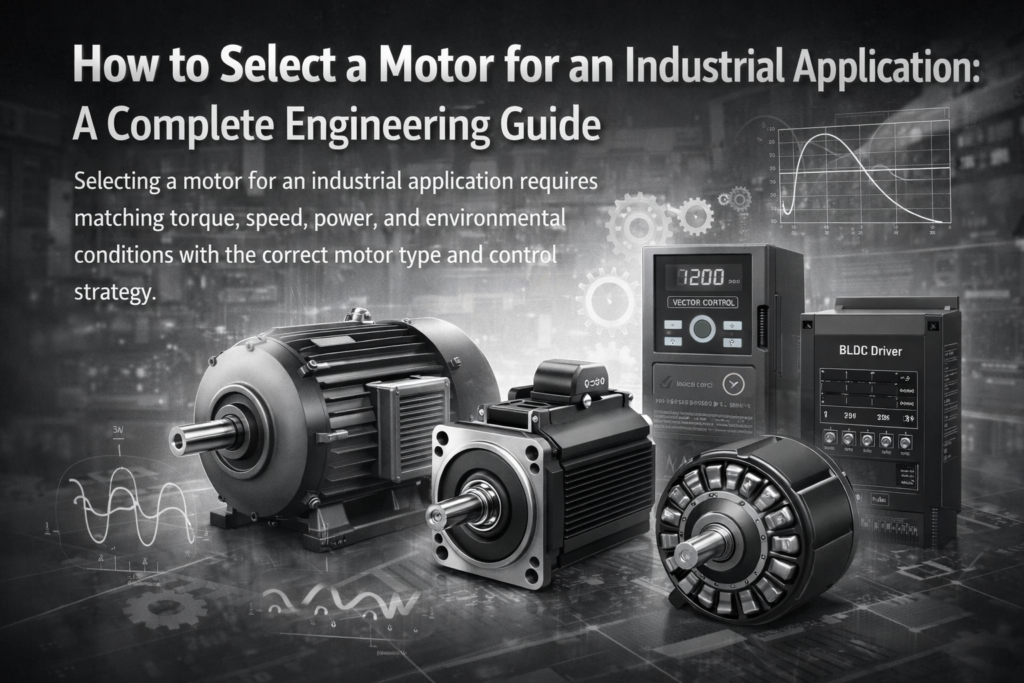
So wählen Sie einen Motor für eine industrielle Anwendung aus: A Complete Engineering Guide
Ausgewählter Ausschnitt:
Selecting a motor for an industrial application requires matching torque, Geschwindigkeit, Energie, and environmental conditions with the correct motor type and control strategy. Engineers must evaluate efficiency, thermische Leistung, Arbeitszyklus, and load characteristics to ensure reliability and cost-effectiveness. The best motor selection balances performance, Lebensdauer, und Gesamtbetriebskosten (Gesamtbetriebskosten), rather than focusing only on upfront price. Für OEMs und Beschaffungsteams, proper motor sizing and compatibility with controllers (such as VFD or BLDC drivers) are critical to achieving optimal system efficiency and long-term operational stability.
What Is Industrial Motor Selection and Why It Matters
Industrial motor selection is the engineering process of choosing the correct motor type, Größe, and control method for a specific application. It directly impacts system performance, Energieverbrauch, Zuverlässigkeit, and maintenance cost. In industriellen Umgebungen, motors are often responsible for over 60% of total electricity consumption, making efficiency a key factor in operational cost.
Improper motor selection can lead to overheating, excessive wear, or insufficient torque, all of which reduce equipment lifespan. Zum Beispiel, undersized motors may stall under peak load, while oversized motors operate inefficiently at partial load. Engineers must consider not only mechanical load requirements but also electrical supply conditions, Arbeitszyklen, and environmental factors.
From a B2B perspective, OEM customers increasingly prioritize energy-efficient and customizable solutions. This is why many systems now integrate advanced motor technologies such as BLDC motors (see BLDC-Motorlösungen) or inverter-driven AC motors for optimized performance.
Why Choosing the Right Motor Impacts Efficiency and Cost
The choice of motor significantly affects both energy efficiency and lifecycle cost. Industrial motors typically operate for thousands of hours annually, so even small efficiency improvements can translate into substantial energy savings. Zum Beispiel, a 5% efficiency gain in a continuously running motor can reduce electricity costs by thousands of dollars over its lifetime.
Efficiency is influenced by motor design, load matching, and control method. BLDC motors offer high efficiency due to the absence of rotor copper losses, while induction motors are robust but may suffer from slip-related losses. Zusätzlich, motors operating far below their rated load tend to have poor efficiency and power factor.
From a procurement standpoint, focusing solely on initial purchase cost is a common mistake. Stattdessen, engineers should evaluate Total Cost of Ownership (Gesamtbetriebskosten), which includes energy consumption, Wartung, downtime risk, und Wiederbeschaffungskosten. In many industrial applications, energy cost accounts for over 90% of a motor’s lifecycle expense.
Types of Motors Used in Industrial Applications
Induktionsmotoren
Induction motors are the most widely used in industrial applications due to their simplicity, Robustheit, und niedrige Kosten. They are ideal for constant-speed applications such as pumps, Fans, und Förderbänder. Jedoch, their efficiency decreases under variable load conditions unless paired with a VFD.
BLDC-Motoren
Bürstenloser Gleichstrom (BLDC) motors offer higher efficiency, präzise Geschwindigkeitsregelung, and superior torque density. They are increasingly used in robotics, EV-Systeme (see EV motor solutions), und Automatisierungsgeräte. Their main limitation is higher initial cost and the need for electronic controllers.
Synchronmotoren
Synchronous motors provide constant speed regardless of load and are often used in high-power applications requiring precise control. They typically have higher efficiency than induction motors but are more complex and expensive.
Gleichstrommotoren
Traditional brushed DC motors offer simple control and high starting torque but require frequent maintenance due to brush wear. They are gradually being replaced by BLDC alternatives in modern industrial systems.
BLDC vs. Induktionsmotor: Performance and Cost Comparison
| Parameter | BLDC-Motor | Induktionsmotor |
|---|---|---|
| Effizienz | 85–95 %, high across load range | 75–90 %, lower at partial load |
| Drehmomentdichte | Hoch, kompaktes Design | Mäßig, larger size required |
| Kontrolle | Erfordert Controller (precise) | Einfach, VFD optional |
| Kosten | Höhere Anschaffungskosten | Lower upfront cost |
| Wartung | Niedrig | Niedrig bis mäßig |
Aus ingenieurwissenschaftlicher Sicht, BLDC motors are preferred when efficiency and compactness are critical, while induction motors are chosen for cost-sensitive, rugged environments. Für OEM-Projekte, the decision often depends on whether energy savings justify the higher upfront investment.
Key Engineering Factors: Effizienz, Drehmomentdichte, Wärmeleistung
Effizienz
Der Wirkungsgrad bestimmt, wie viel elektrische Energie in mechanische Leistung umgewandelt wird. High-efficiency motors reduce heat generation and energy loss, improving system reliability. BLDC motors excel in efficiency due to reduced rotor losses, while induction motors may require optimization through VFD control.
Drehmomentdichte
Die Drehmomentdichte bezieht sich auf die Menge an Drehmoment, die pro Volumeneinheit erzeugt wird. High torque density allows for smaller, lighter motors, which is critical in space-constrained applications such as robotics or EV systems. BLDC motors typically offer superior torque density compared to induction motors.
Wärmeleistung
Thermal management is essential for maintaining motor lifespan. Excessive heat degrades insulation and reduces reliability. Engineers must consider cooling methods such as air cooling, liquid cooling, or forced ventilation. Proper thermal design ensures consistent performance under continuous operation.
Kontrollsysteme: VFD vs BLDC Controller
Control systems play a critical role in motor performance. Induction motors are often paired with Variable Frequency Drives (VFDs) to enable speed control and improve efficiency. VFDs adjust the frequency and voltage supplied to the motor, allowing precise control of speed and torque.
BLDC motors require electronic controllers that manage commutation and speed control using sensors or sensorless algorithms. These controllers provide higher precision and faster response, making them suitable for dynamic applications.
From a system integration perspective, controller compatibility is a key selection factor. OEM customers often require customized control solutions, which can be explored via custom motor development.
How to Choose a Motor for Industrial Applications
Spannungsbereich
Select a motor compatible with available power supply (z.B., 24v, 48v, 72v, or 380V AC). For mobile or battery-powered systems, low-voltage BLDC motors are common.
Leistungsbereich
Bestimmen Sie die erforderliche Leistung anhand von Lastberechnungen. Oversizing increases cost and reduces efficiency, while undersizing risks failure.
Geschwindigkeit und Drehmoment
Match motor speed (U/min) and torque to application requirements. High-torque applications such as mixers require gear reduction or high-torque motors.
Kühlmethode
Choose between natural air cooling, forced air, or liquid cooling depending on operating conditions and duty cycle.
Controller-Kompatibilität
Ensure the motor works with the intended control system (VFD, BLDC controller). Integration complexity can affect project cost and timeline.
Anwendungsspezifische Überlegungen
Consider environmental factors such as dust, Feuchtigkeit, and temperature. For harsh environments, IP-rated motors and sealed designs are recommended.
CTA: Benötigen Sie Hilfe bei der Auswahl des richtigen Motors?? Fordern Sie ein Datenblatt an oder contact our engineers for application-specific recommendations.
Industrial Applications and Use Cases
Industrial motors are used across a wide range of applications, each with unique requirements. In der Herstellung, motors drive conveyors, Kompressoren, und Werkzeugmaschinen, where reliability and continuous operation are critical. In HVAC systems, motors power fans and pumps, where energy efficiency directly impacts operating cost.
In Robotik und Automatisierung, BLDC motors are preferred for their precision and high torque density. Bei Elektrofahrzeugen, hub motors and high-efficiency BLDC motors enable compact and efficient propulsion systems. For heavy-duty applications such as mixers or crushers, induction motors are often selected for their durability and ability to handle overload conditions.
Advantages and Disadvantages of Different Motor Types
| Motorentyp | Vorteile | Nachteile |
|---|---|---|
| BLDC | Hohe Effizienz, geringer Wartungsaufwand, kompakt | Höhere Kosten, erfordert Controller |
| Induktion | Niedrige Kosten, robust, simple design | Lower efficiency at variable load |
| Gleichstrom | Hohes Anlaufdrehmoment, Einfache Kontrolle | High maintenance (Bürstenverschleiß) |
Future Trends in Industrial Motor Selection
The future of industrial motor selection is driven by energy efficiency regulations, Elektrifizierung, und Automatisierung. High-efficiency motors such as IE4 and IE5 are becoming standard in many regions. Zusätzlich, the adoption of smart motor systems with integrated sensors and IoT connectivity enables predictive maintenance and real-time performance monitoring.
BLDC motors are gaining popularity due to their efficiency and compatibility with digital control systems. As power electronics costs decrease, more industrial applications are transitioning from traditional induction motors to electronically controlled solutions.
FAQ: Industrial Motor Selection
1. How do I calculate the required motor power?
Motor power is calculated based on torque and speed requirements. Use the formula P = T × ω, where T is torque and ω is angular velocity. Engineers must also account for efficiency losses and safety factors to ensure reliable operation.
2. Which motor is best for industrial applications?
The best motor depends on the application. Induction motors are ideal for general-purpose use, while BLDC motors are better for high-efficiency and precision applications. The choice depends on cost, Leistung, und Kontrollanforderungen.
3. Why is motor efficiency important?
Motor efficiency directly affects energy consumption and operating cost. High-efficiency motors reduce electricity usage, Wärmeerzeugung, and environmental impact, making them essential for modern industrial systems.
4. What is the lifespan of an industrial motor?
Motor lifespan depends on design, Betriebsbedingungen, und Wartung. High-quality motors can last 10–20 years with proper care. Factors such as overheating, overloading, and poor lubrication can significantly reduce lifespan.
5. How do I choose between BLDC and induction motors?
Choose BLDC motors for high efficiency, kompakte Größe, und präzise Steuerung. Choose induction motors for cost-sensitive and rugged applications. Evaluate total cost of ownership rather than just initial price.
Fazit: Engineering-Driven Motor Selection for Better ROI
Selecting the right motor for an industrial application requires a balance between performance, kosten, und Zuverlässigkeit. Engineers must evaluate efficiency, Drehmomentdichte, thermische Leistung, and control strategy to ensure optimal system operation. Für OEMs und Beschaffungsteams, focusing on lifecycle cost and application-specific requirements is key to achieving long-term value.
CTA: Looking for the right motor solution? Holen Sie sich eine OEM-Lösung, Fordern Sie ein Datenblatt an, oder contact our engineers today to optimize your industrial application.
Referenzen
- IEC 60034 – Rotating Electrical Machines Standards
- IEEE-Richtlinien zur Motoreffizienz
- European Commission – Motor Efficiency Regulations (IE Classes)
- Boldea, I., “Electric Machines: Steady-State, Transients, and Design”