
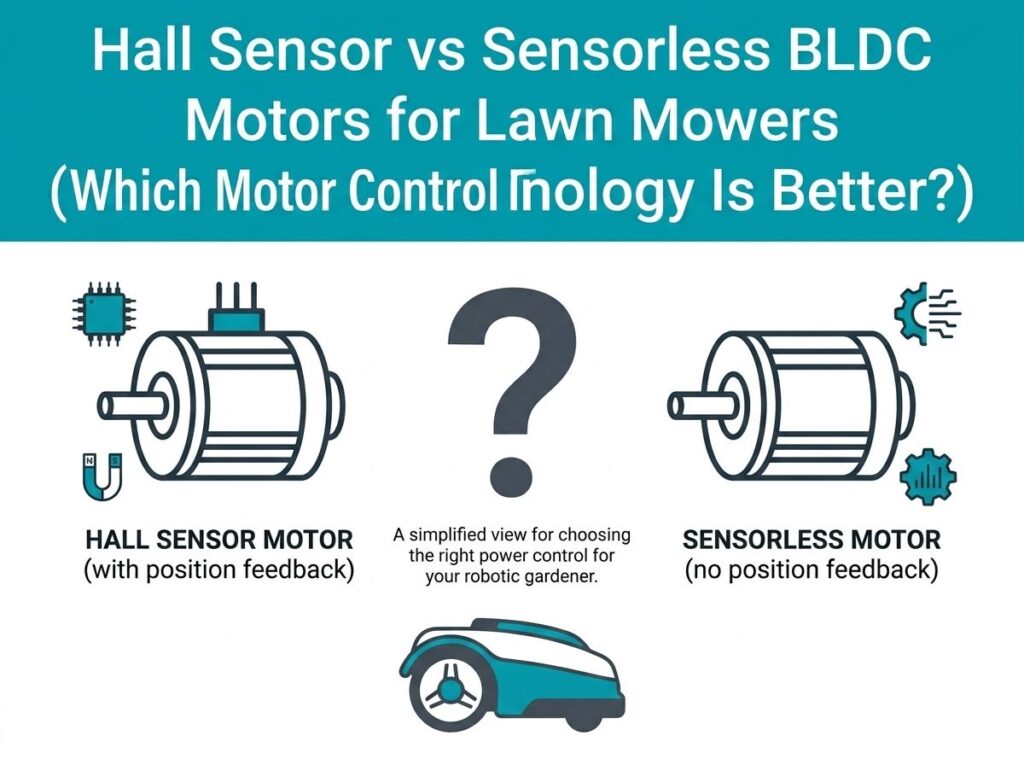
Hall-Sensor vs. sensorlose BLDC-Motoren für Rasenmäher: Welche Technologie ist besser??
Schnelle Antwort
Sowohl Hallsensor- als auch sensorlose BLDC-Motoren bieten einen hohen Wirkungsgrad und eine lange Lebensdauer für Elektrorasenmäher, Sie unterscheiden sich jedoch erheblich in der Startleistung, Drehmomentregelung bei niedriger Drehzahl, Zuverlässigkeit, und Systemkosten. Hall-Sensor-BLDC-Motoren nutzen integrierte Positionssensoren, um eine präzise Rotorrückmeldung zu liefern, Damit sind sie ideal für Roboter-Rasenmäher, Schneidanwendungen mit hohem Drehmoment, und anspruchsvolles Gelände. Sensorlose BLDC-Motoren machen physische Sensoren überflüssig, Reduzierung von Kosten und Komplexität bei gleichzeitiger Verbesserung der Umweltverträglichkeit. Für die meisten Premium-Rasenmäherroboter, Hall-Sensor-Motoren bieten eine überragende Steuerungs- und Startzuverlässigkeit, wohingegen sensorlose Motoren bei kostensensiblen Konstruktionen mit konstanten Betriebsgeschwindigkeiten häufig bevorzugt werden.
Für OEM-Ingenieure und Beschaffungsteams, Die Wahl zwischen Hall-Sensor- und sensorloser BLDC-Technologie erfordert eine ausgewogene Leistung, Effizienz, Haltbarkeit, Controller-Komplexität, und Gesamtsystemkosten, anstatt nur die Motorpreise zu vergleichen.
Was ist ein Hall-Sensor-BLDC-Motor??
Ein Hall-Sensor-BLDC-Motor verfügt über elektronische Hall-Effekt-Sensoren im Motorgehäuse, um die Rotorposition in Echtzeit zu erkennen. Diese Sensoren liefern kontinuierlich eine Kommutierungsrückmeldung an die Motorsteuerung, Dies ermöglicht ein genaues Schalten des Stroms durch die Statorwicklungen.
Bei Rasenmäheranwendungen, Hall-Sensoren ermöglichen einen sanften Anlauf aus dem Stillstand, starkes Drehmoment bei niedrigen Drehzahlen, präzise Geschwindigkeitsregulierung, und zuverlässigen Betrieb unter schnell wechselnden Lasten. Bei Rasenmährobotern kommt es häufig vor, dass das Schneidmesser plötzlichen Widerstand durch dichtes Gras erfährt, nasse Vegetation, oder unebenes Gelände. Genaue Rotorpositionsinformationen ermöglichen es der Steuerung, sofort zu reagieren und einen stabilen Betrieb aufrechtzuerhalten.
Denn Hall-Sensoren liefern eine direkte Positionsrückmeldung, Hallbasierte BLDC-Systeme werden häufig verwendet:
- Antriebsmotoren für Roboter-Rasenmäher
- Messerschneidemotoren
- Autonome Outdoor-Roboter
- AGV-Traktionssysteme
- Hilfsmotoren für Elektrofahrzeuge
Obwohl Hall-Sensoren die Komponentenanzahl leicht erhöhen, Sie verbessern häufig die Gesamtleistung und Zuverlässigkeit der Maschine bei anspruchsvollen Außenanwendungen.
Was ist ein sensorloser BLDC-Motor??
Ein sensorloser BLDC-Motor eliminiert physische Rotorpositionssensoren und schätzt stattdessen die Rotorposition mithilfe der gegenelektromotorischen Kraft (Gegen-EMF) entsteht beim Motorbetrieb.
Anstatt sich auf dedizierte Hall-Geräte zu verlassen, Der Controller analysiert kontinuierlich Spannungswellenformen und Stromverhalten, um zu bestimmen, wann eine Kommutierung erfolgen sollte.
Zu den Hauptvorteilen sensorloser Systeme gehören::
- Geringere Komponentenanzahl
- Reduzierte Herstellungskosten
- Verbesserte Umweltabdichtung
- Weniger Kabelverbindungen
- Vereinfachte Motorkonstruktion
Jedoch, denn die Gegen-EMK wird erst dann messbar, wenn der Motor eine ausreichende Drehzahl erreicht, Sensorlose Systeme stehen typischerweise beim Start und im Betrieb bei niedriger Geschwindigkeit vor Herausforderungen.
Für Rasenmäherhersteller, Diese Einschränkung ist besonders wichtig, wenn die Schneidmesser unter hoher Last starten müssen oder wenn Roboterantriebsmotoren an steilen Hängen mit niedriger Geschwindigkeit arbeiten.
Warum die Rückmeldung der Motorposition bei Rasenmäheranwendungen wichtig ist
Viele Ingenieure konzentrieren sich bei der Auswahl eines Rasenmähermotors zunächst auf Nennleistung und Effizienz. In Wirklichkeit, Die Rückmeldung der Rotorposition hat oft einen größeren Einfluss auf das Benutzererlebnis.
Elektrische Rasenmähermotoren arbeiten selten unter konstanten Lastbedingungen. Stattdessen, sie begegnen:
- Dichte Grasflächen
- Nasse Vegetation
- Klingenschläge
- Unebenes Gelände
- Plötzliche Beschleunigungsanforderungen
- Schwankungen der Batteriespannung
Ein Hall-Sensorsystem kann die Rotorposition sofort identifizieren und die Drehmomenterzeugung während dieser transienten Ereignisse optimieren. Sensorlose Systeme erfordern Schätzalgorithmen, Dies kann unter schwierigen Bedingungen zu Verzögerungen oder verringerter Genauigkeit führen.
Da Roboter-Rasenmäher intelligenter und autonomer werden, Präzises motorisches Feedback trägt zunehmend zur Navigationsgenauigkeit bei, Energiemanagement, und Hindernisbewältigung.
Hall-Sensor vs. sensorlose BLDC-Motoren: Vollständiger technischer Vergleich
| Parameter | Hall-Sensor BLDC | Sensorloser BLDC |
|---|---|---|
| Startleistung | Exzellent | Mäßig |
| Drehmoment bei niedriger Drehzahl | Exzellent | Begrenzt |
| Effizienz | 85–93 % | 86–94% |
| Controller-Komplexität | Untere | Höher |
| Kosten | Höher | Untere |
| Komplexität der Verkabelung | Höher | Untere |
| Umweltverträglichkeit | Gut | Exzellent |
| Drehmomentstabilität | Exzellent | Gut |
| Eignung eines Mähroboters | Exzellent | Mäßig |
| Eignung für gewerbliche Rasenmäher | Exzellent | Gut |
Für High-End-Rasenmäherroboter, Die verbesserte Steuerbarkeit von Hall-Sensorsystemen überwiegt oft deren etwas höhere Kosten.
Effizienzvergleich: Verbessert sensorlose Technologie die Effizienz??
Hall-Sensor-Motoreffizienz
Moderne Hall-Sensor-BLDC-Motoren erreichen typischerweise Wirkungsgrade zwischen 85% und 93%. Der Stromverbrauch der Hall-Sensoren selbst ist im Verhältnis zur gesamten Motorleistung vernachlässigbar.
Sensorlose Motoreffizienz
Sensorlose Motoren können einen geringfügig höheren Spitzenwirkungsgrad erreichen, da Sensorverluste eliminiert und das mechanische Design vereinfacht werden. Jedoch, Die tatsächliche Feldleistung hängt oft stärker von den Steuerungsalgorithmen ab als von der Anwesenheit von Sensoren.
Echte Rasenmäher-Perspektive
Bei Rasenmäheranwendungen, Effizienzunterschiede sind normalerweise geringer als 2%. Batteriekapazität, Blattaerodynamik, Geländebedingungen, und Controller-Tuning haben im Allgemeinen einen größeren Einfluss auf die Laufzeit als die Hall-Sensor-Auswahl.
Für Robotermäher, die acht oder mehr Stunden am Tag arbeiten, Drehmomentoptimierung führt häufig zu größeren Energieeinsparungen als kleine Effizienzverbesserungen.
Drehmomentdichte und Leistungsanalyse bei niedriger Drehzahl
Die Drehmomentdichte ist eine der wichtigsten Leistungskennzahlen bei Rasenmährobotern.
Antriebsmotoren müssen:
- Steigungen erklimmen
- Navigieren Sie durch Hindernisse
- Behalten Sie die Traktion bei
- Arbeiten Sie effizient bei niedrigen Geschwindigkeiten
Hall-Sensor-Motoren bieten ein überlegenes Drehmoment bei niedriger Drehzahl, da die Rotorposition sofort beim Start bekannt ist.
Sensorlose Systeme erfordern oft:
- Startsequenzen im offenen Regelkreis
- Verfahren zur Rotorausrichtung
- Algorithmen zur Geschwindigkeitssteigerung
Diese Ansätze funktionieren bei vorhersehbaren Belastungen gut, können jedoch weniger zuverlässig werden, wenn schweres Gras plötzliche Drehmomentspitzen verursacht.
Für Radmotoren von Rasenmährobotern, Die Hall-Sensor-Technologie bleibt die bevorzugte Lösung zur Maximierung der Traktion und Steigleistung.
Überlegungen zur thermischen Leistung und Zuverlässigkeit
Hitzeerzeugung
Die thermische Leistung beeinflusst sowohl die Motorlebensdauer als auch die Batterieeffizienz.
Denn Hall-Sensorsysteme erreichen bei niedrigen Geschwindigkeiten eine genauere Kommutierung, Sie verursachen häufig weniger Kupferverluste während des Anlaufs und des Übergangsbetriebs.
Sensorzuverlässigkeit
Moderne Hall-Sensoren sind äußerst zuverlässig und in der Regel für Tausende von Betriebsstunden unter Außenbedingungen ausgelegt.
Ausfallrisiken können dadurch minimiert werden:
- Motorabdichtung IP67
- Vergussmassen
- Schutzbeschichtung
- Sensoren in Automobilqualität
Sensorlose Zuverlässigkeit
Sensorlose Motoren eliminieren das Risiko eines Sensorausfalls vollständig. Jedoch, Sie erhöhen die Abhängigkeit von Softwarealgorithmen und der Controllerqualität.
Für OEMs, Die Zuverlässigkeit sollte auf der gesamten Systemebene bewertet werden, anstatt sich nur auf die Motorhardware zu konzentrieren.
Hall-Sensor-BLDC vs. sensorloser BLDC vs. bürstenbehaftete Gleichstrommotoren
| Besonderheit | Hall BLDC | Sensorloser BLDC | Gebürsteter DC |
|---|---|---|---|
| Effizienz | Hoch | Sehr hoch | Mäßig |
| Wartung | Sehr niedrig | Sehr niedrig | Hoch |
| Anlaufdrehmoment | Exzellent | Mäßig | Gut |
| Lebensdauer | Lang | Lang | Kürzer |
| Lärm | Niedrig | Niedrig | Höher |
| Zuverlässigkeit im Freien | Exzellent | Exzellent | Mäßig |
| Eignung eines Mähroboters | Am besten | Gut | Arm |
So wählen Sie einen BLDC-Motor für Rasenmäheranwendungen aus
Die Wahl der richtigen Motorarchitektur erfordert die Bewertung der gesamten Mäherplattform, anstatt sich nur auf die Motorspezifikationen zu konzentrieren.
Spannungsbereich
- 24V–36V: Robotermäher der Einstiegsklasse
- 48v: Mainstream-Wohnplattformen
- 60V–72V: Kommerzielle Robotermäher
- 72V+: Professionelle Landschaftsbauausrüstung
Leistungsbereich
- Antriebsmotoren: 200W–1000W
- Schneidmotoren: 500W–3000W
- Kommerzielle Systeme: 3kW+
Geschwindigkeits- und Drehmomentanforderungen
Anwendungen, die einen häufigen Start erfordern, Hangklettern, und Präzisionssteuerung profitieren im Allgemeinen von Hall-Sensormotoren.
Anwendungen, die mit stabilen Geschwindigkeiten arbeiten, können sensorlose Systeme effektiv nutzen.
Kühlmethode
- Natürliche Konvektion
- Ableitung durch Aluminiumgehäuse
- Integrierte Kühlkörper
- Zwangskühlung für Hochleistungssysteme
Controller-Kompatibilität
Stellen Sie sicher, dass der Controller unterstützt:
- Hall-Sensor-Eingänge
- FOC-Steuerung
- CAN-Kommunikation
- Regeneratives Bremsen
- Integration des Batteriemanagements
Anwendungsspezifische Überlegungen
- Steilheit des Geländes
- Schnittdichte
- Batteriekapazität
- Lärmanforderungen
- Zielgarantiezeitraum
- IP-Schutzanforderungen
Für Erstausrüster von Premium-Robotermähern, BLDC-Motoren mit Hall-Sensor bieten häufig die beste Balance zwischen Leistung und Kundenzufriedenheit.
Datenblatt anfordern | Holen Sie sich eine OEM-Lösung | Kontaktieren Sie unsere Ingenieure
Anwendungen über Rasenmäher hinaus
Die gleichen Hall-Sensor- und sensorlosen BLDC-Technologien werden in allen Industriesektoren häufig eingesetzt.
Industrielle Anwendungen
- AGVs
- Lagerroboter
- Fördersysteme
- Landwirtschaftliche Automatisierung
Automotive- und EV-Anwendungen
- Elektroroller
- E-Bikes
- Nutzfahrzeuge
- Hilfsfahrzeugsysteme
HVAC und Pumpen
Sensorlose Motoren werden besonders häufig in Lüftern und Pumpen eingesetzt, bei denen die Anlauflasten vorhersehbar bleiben.
Robotik
Präzisionsrobotik bevorzugt häufig Hall-Sensor-Feedback aufgrund der überlegenen Steuerung bei niedriger Geschwindigkeit und Positionierungsgenauigkeit.
Verwandte Anleitung
- Leistungsstarker bürstenloser Gleichstrommotor für Rasenmäher
- Wasserdichtes Motordesign für Rasenmäher
- Drehmoment des Rasenmähermotors erklärt
- Kundenspezifischer BLDC-Motor
Zukünftige Trends in der BLDC-Motorsteuerung für Rasenmäher
Die Unterscheidung zwischen Hall-Sensor- und sensorlosen Systemen wird mit der Entwicklung fortschrittlicher Steuerungsalgorithmen immer weniger streng.
Zu den aufkommenden Trends gehören:
- Feldorientierte Steuerung (FOC)
- Hybride sensorgestützte Steuerung
- KI-basierte Lastvorhersage
- Integrierte Motor-Controller-Pakete
- Vorausschauende Wartungsanalysen
- Robotermäher-Plattformen mit höherer Spannung
Viele Rasenmäherroboter der nächsten Generation werden intelligente Steuerungen verwenden, die je nach Betriebsbedingungen zwischen sensorbasiertem und sensorlosem Betrieb wechseln können.
FAQ: Hall-Sensor vs. sensorlose BLDC-Motoren für Rasenmäher
Was für Roboter-Rasenmäher besser ist, Hallsensor oder sensorlose BLDC-Motoren?
BLDC-Motoren mit Hallsensor eignen sich im Allgemeinen besser für Rasenmäherroboter, da sie einen zuverlässigen Start ermöglichen, starkes Drehmoment bei niedriger Drehzahl, und genaue Kontrolle auf Steigungen und unebenem Gelände.
Sind sensorlose BLDC-Motoren effizienter??
Sensorlose Motoren können einen etwas höheren Spitzenwirkungsgrad erreichen, aber der Unterschied ist normalerweise gering. Die Gesamtsystemeffizienz hängt mehr von der Controller-Abstimmung und den Lastbedingungen ab.
Verkürzen Hall-Sensoren die Lebensdauer des Motors??
Nein. Moderne Hall-Sensoren sind äußerst zuverlässig und halten in der Regel die gesamte Lebensdauer des Motors, wenn sie in ordnungsgemäß abgedichteten Motorgehäusen geschützt sind.
Warum verwenden viele Hersteller von Mährobotern immer noch Hall-Sensoren??
Denn Robotermäher arbeiten häufig mit niedriger Geschwindigkeit und wechselnden Belastungen. Hall-Sensoren verbessern die Anlaufzuverlässigkeit und die Drehmomentkontrolle unter diesen Bedingungen.
Sind sensorlose Motoren günstiger??
Ja. Durch den Verzicht auf Hall-Sensoren werden die Komponentenkosten gesenkt, Montagekomplexität, und Verkabelungsanforderungen, Sensorlose Systeme für kostensensible Produkte attraktiv machen.
Kann ein wasserdichter Rasenmähermotor Hall-Sensoren verwenden??
Absolut. Die meisten Premium-Robotermähermotoren mit Schutzart IP67 kombinieren Hall-Sensoren mit Kapselung, Dichtungstechnologien, und wasserdichte Anschlüsse sorgen für einen zuverlässigen Betrieb im Freien.
Fazit
Bei der Debatte zwischen Hall-Sensor und sensorlosem BLDC-Motor geht es nicht darum, eine allgemein überlegene Technologie zu identifizieren. Stattdessen, Es geht darum, die optimale Lösung für bestimmte Betriebsbedingungen des Rasenmähers auszuwählen.
BLDC-Motoren mit Hallsensor zeichnen sich durch eine hervorragende Anlaufleistung aus, Drehmoment bei niedriger Drehzahl, und Präzisionskontrolle, Damit sind sie die erste Wahl für Mähroboter und hochwertige Outdoor-Geräte. Sensorlose BLDC-Motoren bieten geringere Kosten, vereinfachte Konstruktion, und hervorragende Effizienz für Anwendungen mit stabilen Geschwindigkeiten.
Für die meisten OEM-Roboter-Rasenmäherprojekte, BLDC-Motoren mit Hall-Sensor bieten weiterhin die beste Leistungskombination, Zuverlässigkeit, und Kundenerlebnis. Jedoch, Sensorlose Lösungen bleiben für kostensensible Plattformen, bei denen die Betriebsbedingungen vorhersehbar sind, äußerst attraktiv.
Greensky Power entwickelt kundenspezifische 48V, 60v, und 72-V-BLDC-Motorlösungen für Roboter-Rasenmäher, autonome Outdoor-Ausrüstung, und intelligente Mobilitätssysteme. Unser Engineering-Team kann Ihnen bei der Motorauswahl behilflich sein, Controller-Anpassung, wasserdichtes Design, und OEM-Anpassung.
Datenblatt anfordern | Holen Sie sich eine OEM-Lösung | Kontaktieren Sie unsere Ingenieure
Holen Sie sich ein kostenloses Angebot
Referenzen
- https://www.ti.com/lit/an/sprabz3/sprabz3.pdf
- https://www.infineon.com
- https://www.nxp.com
- https://ieeexplore.ieee.org
- https://www.mdpi.com
- https://www.sciencedirect.com
- https://www.motioncontroltips.com
- https://www.maxongroup.com
- https://www.analog.com
- https://www.microchip.com