
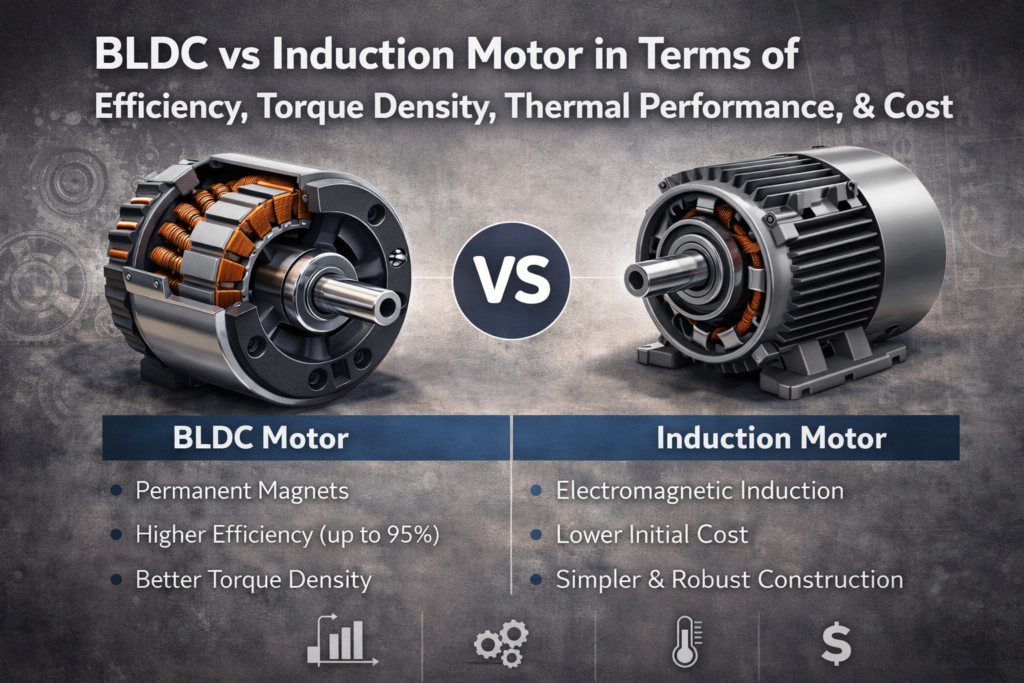
BLDC vs. Induktionsmotor in Bezug auf die Effizienz, Drehmomentdichte, Wärmeleistung, und Kosten
Ausgewählter Ausschnitt:
BLDC-Motoren übertreffen Induktionsmotoren hinsichtlich der Effizienz (bis zu 95%), Drehmomentdichte, und thermische Leistung aufgrund des Permanentmagnetdesigns und der elektronischen Kommutierung. Induktionsmotoren, Jedoch, bieten niedrigere Vorabkosten, einfachere Konstruktion, und starke Robustheit für industrielle Umgebungen. In Anwendungen wie Biomassekesseln, HVAC-Systeme, und Elektroantriebe, Die Wahl hängt von den Lebenszykluskosten ab, Kontrollanforderungen, und Betriebsbedingungen. Für OEMs und industrielle Einkäufer, BLDC-Motoren werden aufgrund ihrer Energieeffizienz und präzisen Steuerung zunehmend bevorzugt, während Induktionsmotoren weiterhin eine kostengünstige Lösung für Systeme mit Standardbetrieb bleiben.
Was ist ein BLDC-Motor und ein Induktionsmotor??
BLDC (Bürstenloser Gleichstrom) Motoren und Induktionsmotoren sind zwei dominierende Technologien in industriellen Motoranwendungen. Bevor Sie die Effizienz vergleichen, ist es wichtig, ihre Funktionsprinzipien zu verstehen, Drehmomentdichte, thermische Leistung, und kosten.
BLDC-Motordefinition
BLDC-Motoren verwenden Permanentmagnete am Rotor und elektronische Kommutierung zur Steuerung des Stromflusses. Dadurch entfallen mechanische Bürsten und der Energieverlust wird reduziert, Dadurch sind sie äußerst effizient und präzise.
Definition des Induktionsmotors
Induktionsmotoren arbeiten mit elektromagnetischer Induktion. Der Rotor wird durch induzierten Strom mit Energie versorgt, was zu inhärenten Energieverlusten führt, aber eine robuste und einfache Konstruktion bietet.
Entdecken Sie BLDC-Lösungen: BLDC Motor Portfolio
Warum BLDC mit Induktionsmotor vergleichen??
Für Ingenieure und Einkaufsmanager, Die Wahl zwischen BLDC- und Induktionsmotoren wirkt sich direkt auf die Systemleistung aus, Betriebskosten, und langfristige Zuverlässigkeit. Dieser Vergleich ist besonders wichtig bei Systemen im Dauerbetrieb wie Biomassekesseln, Pumps, und industrielle Automatisierung.
Wichtige Entscheidungstreiber
- Energieeffizienz in 24/7 Betrieb
- Drehmomentleistung bei wechselnden Lasten
- Thermisches Verhalten und Kühlanforderungen
- Gesamtbetriebskosten (Gesamtbetriebskosten)
Branchenrealität
Während Induktionsmotoren die älteren Systeme dominieren, Der Wandel hin zur Energieeffizienz beschleunigt die Einführung von BLDC-Motoren in modernen Designs.
Effizienz: BLDC vs. Induktionsmotor
Der Wirkungsgrad bestimmt, wie viel elektrische Energie in mechanische Leistung umgewandelt wird, wirkt sich direkt auf die Betriebskosten aus.
Effizienz des BLDC-Motors
- Typischerweise 90–95 %
- Minimale Rotorverluste
- Keine Bürstenreibung
Effizienz des Induktionsmotors
- Typischerweise 75–90 %
- Kupferverluste im Rotor
- Schlupfbedingte Ineffizienzen
Technische Einblicke
In kontinuierlichen Anwendungen wie Biomassekesselventilatoren oder Pumpen, sogar ein 5% Effizienzunterschiede können zu erheblichen jährlichen Energieeinsparungen führen. Über einen Lebenszyklus von 5–10 Jahren, Dies wird zu einem großen Kostenfaktor.
Drehmomentdichte: BLDC vs. Induktionsmotor
Die Drehmomentdichte gibt an, wie viel Drehmoment ein Motor im Verhältnis zu seiner Größe und seinem Gewicht erzeugen kann.
BLDC-Motoren
- Hohe Drehmomentdichte durch Permanentmagnete
- Kompakt und leicht
- Hohes Anlaufdrehmoment
Induktionsmotoren
- Mäßige Drehmomentdichte
- Größere Größe für gleiches Drehmoment
- Geringeres Anlaufdrehmoment ohne Steuerungssysteme
Anwendungseinblick
In Biomassekesselanlagen, Kraftstoffzufuhrmechanismen erfordern ein hohes Drehmoment bei niedriger Drehzahl, wo BLDC- oder Getriebelösungen Standard-Induktionsmotoren übertreffen.
Wärmeleistung und Wärmemanagement
Die thermische Leistung ist in Industrieumgebungen, in denen Motoren kontinuierlich unter Last arbeiten, von entscheidender Bedeutung.
BLDC-Motoren
- Geringere Wärmeentwicklung
- Höhere Effizienz reduziert thermische Belastung
- Verbesserte Lebensdauer
Induktionsmotoren
- Höhere Erwärmung durch Rotorverluste
- Erfordert robuste Kühlsysteme
Technische Einblicke
Eine bessere thermische Leistung verbessert nicht nur die Zuverlässigkeit, sondern ermöglicht auch eine höhere Leistungsdichte in kompakten Systemen, Reduzierung des Installations-Footprints.
Kontrollsysteme: BLDC vs. Induktionsmotor
Die Steuerungsfähigkeit wirkt sich erheblich auf Leistung und Flexibilität aus.
BLDC-Motorsteuerung
- Feldorientierte Steuerung (FOC)
- Präzise Drehzahl- und Drehmomentregelung
- Hohe dynamische Reaktion
Steuerung des Induktionsmotors
- Erfordert VFD für variable Geschwindigkeit
- Weniger präzise Steuerung im Vergleich zu BLDC
Technische Einblicke
Eine fortschrittliche Steuerung ist für die Optimierung des Luftstroms und der Brennstoffzufuhr in Biomassesystemen unerlässlich, Dadurch eignen sich BLDC-Motoren besser für moderne automatisierte Systeme.
Vergleich von Zuverlässigkeit und Lebensdauer
Die Zuverlässigkeit bestimmt die Wartungskosten und die Systemverfügbarkeit.
BLDC-Motoren
- Keine Bürsten → weniger Verschleiß
- Lange Lebensdauer (20,000–50.000 Stunden)
Induktionsmotoren
- Robustes mechanisches Design
- Wartungsbedarf für Lager und Isolierung
Technische Einblicke
Dabei sind beide Motortypen zuverlässig, BLDC-Motoren bieten aufgrund der reduzierten mechanischen Komponenten einen geringeren Wartungsaufwand.
Kostenanalyse: BLDC vs. Induktionsmotor
| Parameter | BLDC-Motor | Induktionsmotor |
|---|---|---|
| Anfängliche Kosten | Höher | Untere |
| Effizienz | 90–95 % | 75–90 % |
| Wartungskosten | Niedrig | Mäßig |
| Energiekosten | Niedrig | Höher |
| Lebenszykluskosten | Untere | Höher |
Technische Interpretation
Allerdings haben BLDC-Motoren höhere Vorlaufkosten, Ihr geringerer Energieverbrauch und Wartungsaufwand führen im Laufe der Zeit zu niedrigeren Gesamtbetriebskosten.
Vor- und Nachteile von BLDC gegenüber Induktionsmotoren
Vorteile des BLDC-Motors
- Hohe Effizienz
- Hohe Drehmomentdichte
- Hervorragende Kontrolle
- Geringer Wartungsaufwand
Nachteile des BLDC-Motors
- Höhere Kosten
- Erfordert Controller
Vorteile des Induktionsmotors
- Niedrige Kosten
- Einfaches Design
- Hohe Haltbarkeit
Nachteile des Induktionsmotors
- Geringere Effizienz
- Höhere Wärmeentwicklung
- Begrenzte Kontrolle
So wählen Sie zwischen BLDC- und Induktionsmotoren für industrielle Anwendungen
Die Motorauswahl sollte sich an den Systemanforderungen und den langfristigen Betriebszielen orientieren.
Spannungsbereich
- BLDC: 24V–72 V oder höher
- Induktion: 220V–380V-Standard
Leistungsbereich
- Kleine Systeme: 0.5kW–5 kW
- Industrielle Systeme: 5kW–100 kW+
Geschwindigkeit / Drehmoment
Passen Sie die Drehmomentanforderungen an die Anwendungslast an, speziell für Förderbänder und Ventilatoren.
Kühlmethode
- Luftkühlung für den Standardgebrauch
- Verbesserte Kühlung für Umgebungen mit hohen Temperaturen
Controller-Kompatibilität
BLDC erfordert dedizierte Controller; Induktionsmotoren erfordern VFD für variable Geschwindigkeit.
Anwendungsspezifische Überlegungen
- Kontinuierlicher oder intermittierender Betrieb
- Energiekostensensitivität
- Automatisierungsgrad
CTA: Fordern Sie ein Datenblatt an oder kontaktieren Sie unsere Ingenieure für maßgeschneiderte Motorlösungen.
Anwendungen von BLDC- und Induktionsmotoren
Industrielle Anwendungen
- Biomassekessel
- Fertigungssysteme
HVAC und Pumpen
- Ventilatoren und Gebläse
- Wasserzirkulationssysteme
Elektrofahrzeuge
- 48v / 72V-Antriebsmotoren
- Nabenmotoren
Entdecken Sie EV-Lösungen: Motoren für Elektrofahrzeuge
Zukünftige Trends: Wird BLDC Induktionsmotoren ersetzen??
Die Automobilindustrie entwickelt sich hin zu höherer Effizienz und intelligenteren Systemen.
Schlüsseltrends
- Einführung von BLDC in industriellen Anwendungen
- Integration mit IoT und intelligenter Steuerung
- Fokus auf Energieeffizienz und Nachhaltigkeit
Während Induktionsmotoren weiterhin im Einsatz bleiben, Es wird erwartet, dass BLDC-Motoren hocheffiziente Anwendungen dominieren werden.
FAQ: BLDC vs. Induktionsmotor
1. Welcher Motor ist effizienter??
BLDC-Motoren sind aufgrund geringerer elektrischer und mechanischer Verluste effizienter.
2. Welcher Motor hat eine höhere Drehmomentdichte??
BLDC-Motoren bieten eine höhere Drehmomentdichte, was kompaktere Designs ermöglicht.
3. Sind Induktionsmotoren günstiger??
Ja, Induktionsmotoren haben geringere Vorlaufkosten, aber höhere Betriebskosten.
4. Welcher Motor hält länger??
BLDC-Motoren haben aufgrund des geringeren Verschleißes typischerweise eine längere Lebensdauer.
5. Welcher Motor eignet sich besser für den industriellen Einsatz??
Es kommt auf die Anwendung an – BLDC für Effizienz und Kontrolle, Induktion für kostensensible Systeme.
Fazit: Welcher Motor ist besser??
BLDC-Motoren übertreffen Induktionsmotoren hinsichtlich der Effizienz, Drehmomentdichte, und thermische Leistung, Damit sind sie ideal für moderne Industrieanwendungen. Jedoch, Induktionsmotoren bleiben aufgrund ihrer Einfachheit und geringeren Anschaffungskosten relevant.
Für OEMs und industrielle Einkäufer, Die Entscheidung sollte auf den Lebenszykluskosten basieren, Leistungsanforderungen, und Systemintegrationsanforderungen.
Nächster Schritt: Kontaktieren Sie unser Engineering-Team, um eine maßgeschneiderte Motorlösung zu entwickeln, die auf Ihre Anwendung zugeschnitten ist.
Referenzen
- IEEE-Studien zur Motoreffizienz
- IEA-Energieberichte
- Zeitschriften für industrielles Motordesign
- Lehrbücher zur elektrischen Antriebstechnik