
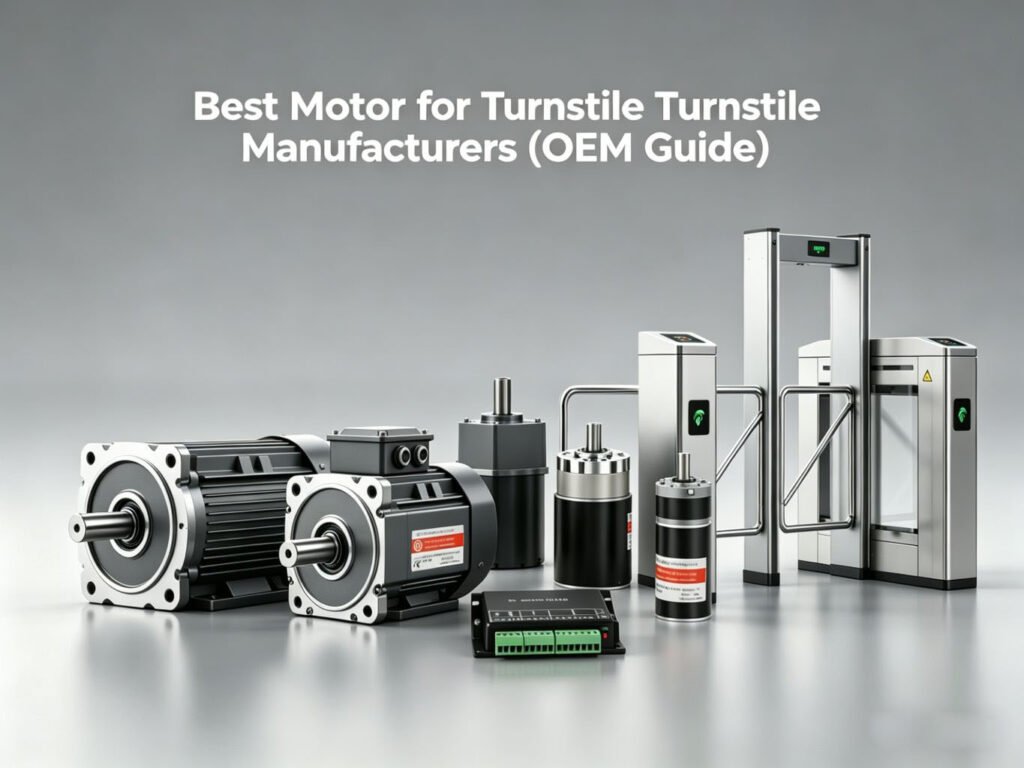
Bester Motor für Drehkreuzhersteller (OEM-Leitfaden)
Ausgewählter Ausschnitt:
The best motor for turnstile systems depends on performance, Haltbarkeit, und Kontrollanforderungen. For modern OEM turnstile manufacturers, BLDC motors are typically the optimal choice due to their high efficiency, präzise steuerung, lange Lebensspanne, und wartungsarm. Jedoch, brushed DC motors and servo motors are still used in cost-sensitive or high-precision applications. Selecting the right motor requires evaluating torque, Geschwindigkeit, Stromspannung, control method, and duty cycle to match real-world operating conditions.
What Motor Is Used in Turnstile Systems?
Turnstile systems rely on controlled rotational motion to regulate pedestrian access. The motor serves as the core actuator, converting electrical energy into mechanical torque to drive the barrier arm or gate. The most commonly used motor types include BLDC motors, bürstenbehaftete Gleichstrommotoren, und Servomotoren, each offering different performance characteristics.
In traditional systems, brushed DC motors were widely used due to their simple structure and low cost. Jedoch, modern smart turnstiles increasingly adopt BLDC motors because they offer higher efficiency, Längere Lebensspanne, and better integration with electronic control systems.
Servo motors are typically used in high-end applications where precise positioning, sanfte Bewegung, and dynamic control are required, such as speed gates in airports or metro systems.
👉Für leistungsstarke Lösungen, Schauen Sie sich unsere an BLDC-Motor für Drehkreuz
Key Motor Functions in Turnstiles
- Drive rotation of arms or panels
- Control opening/closing speed
- Provide torque resistance for safety
- Enable bidirectional motion
Why Motor Selection Matters for Turnstile Manufacturers
Motor selection directly impacts system performance, Zuverlässigkeit, und langfristige Wartungskosten. Für OEM-Hersteller, choosing the wrong motor can lead to overheating, premature failure, poor user experience, and increased warranty claims.
Turnstiles operate in high-frequency environments such as metro stations, Bürogebäude, und Stadien. This requires motors capable of continuous duty cycles, stabile drehmoment ausgang, and fast response times.
Zusätzlich, modern turnstiles must integrate with access control systems, requiring motors that support advanced control strategies such as PWM or field-oriented control.
BLDC vs Brushed vs Servo Motor for Turnstiles
| Parameter | BLDC-Motor | Gebürsteter Gleichstrommotor | Servomotor |
|---|---|---|---|
| Effizienz | Hoch (85–92 %) | Medium (70–80 %) | Sehr hoch |
| Wartung | Niedrig | Hoch (Bürstenverschleiß) | Niedrig |
| Komplexität kontrollieren | Medium | Niedrig | Hoch |
| Kosten | Medium | Niedrig | Hoch |
| Lebensdauer | Lang | Short | Very Long |
| Beste Anwendung | Modern turnstiles | Budget systems | High-end gates |
Aus ingenieurwissenschaftlicher Sicht, BLDC motors provide the best balance between performance and cost. Brushed motors may still be viable for low-cost projects, while servo motors are justified when precision and responsiveness are critical.
Advantages of BLDC Motors for Turnstile OEMs
Hohe Effizienz
BLDC motors eliminate brush friction losses, improving efficiency and reducing heat generation. This is critical in turnstiles operating continuously throughout the day.
Lange Lebensdauer
Ohne Bürsten, mechanical wear is minimized, extending operational life and reducing maintenance intervals.
Präzise Kontrolle
BLDC motors support advanced control methods such as FOC, Ermöglicht eine sanfte Beschleunigung, Verzögerung, and positioning.
Geräuscharmer Betrieb
Essential for indoor environments like offices and airports.
Typical solutions include 24V–72V BLDC motors integrated with gearboxes for torque amplification. OEM manufacturers often request customized designs for torque output and mounting structure.
Explore BLDC motor solutions →
Disadvantages of BLDC Motors
Despite their advantages, BLDC motors require electronic controllers, increasing system complexity and cost. Zusätzlich, integration requires proper tuning of control algorithms.
Jedoch, for most industrial applications, these challenges are outweighed by performance gains and lifecycle cost savings.
Key Engineering Factors: Effizienz, Drehmomentdichte & Wärmeleistung
Effizienz
Higher efficiency reduces power consumption and operating cost. In high-traffic environments, even small efficiency improvements significantly impact total energy usage.
Drehmomentdichte
Turnstiles require compact motors capable of delivering sufficient torque. BLDC motors offer higher torque density compared to brushed motors, allowing smaller designs.
Wärmeleistung
Heat is a major failure factor. Motors must be designed with proper cooling methods such as natural convection or aluminum housing heat dissipation.
Zuverlässigkeit & Lebensdauer
Continuous operation demands motors with minimal wear components. BLDC motors excel due to the absence of brushes.
Kontrollsysteme: Why They Matter in Turnstile Motors
The motor controller determines how effectively the motor performs under real-world conditions. In turnstiles, control systems must ensure smooth motion, quick response, und Sicherheitskonformität.
Common Control Methods
- PWM-Steuerung (Basic)
- Hall sensor-based commutation
- Feldorientierte Steuerung (FOC)
FOC control enables precise torque control and smooth rotation, making it ideal for high-end turnstiles.
So wählen Sie einen Drehkreuzmotor aus (Drehmoment, U/min, Spannungsführer)
Spannungsbereich
Most turnstiles use 24V, 48v, or 72V systems. Higher voltage improves efficiency and reduces current losses.
Leistungsbereich
Typical power ranges from 50W to 500W depending on gate size and load.
Geschwindigkeit (U/min)
Turnstile motors usually operate between 30–300 RPM after gearbox reduction.
Drehmomentanforderungen
Torque depends on arm length, Gewicht, and resistance. Safety margins must be included.
Kühlmethode
Passive cooling is common, but high-duty applications may require enhanced heat dissipation.
Controller-Kompatibilität
Ensure motor matches controller type (Hallsensor, Encoder, FOC driver).
Anwendungsspezifische Überlegungen
- Innen- und Außenumgebung
- Arbeitszyklus (kontinuierlich vs. intermittierend)
- Lärmanforderungen
Request OEM motor customization →
Turnstile Applications and Motor Requirements
Industriell & Gewerbebauten
Require reliable, low-maintenance motors with moderate torque.
Transportsysteme
High-duty cycles demand efficient and durable BLDC motors.
High-End Security Systems
Require servo or high-performance BLDC motors for precision control.
EV Integration
Some modern turnstiles integrate battery systems, requiring energy-efficient motors.
Learn about EV motor solutions →
Zukünftige Trends in der Drehkreuzmotorentechnologie
The industry is moving toward intelligent, connected systems. BLDC motors with integrated drivers and IoT capabilities are becoming standard.
- Smart control integration
- Energy-efficient designs
- Compact high-torque motors
- Predictive maintenance systems
OEM manufacturers increasingly demand customized motor solutions tailored to their specific system architecture.
FAQ: Turnstile Motor Selection
1. What is the best motor for turnstiles?
BLDC motors are generally the best choice due to their efficiency, lange Lebensspanne, und geringer Wartungsaufwand.
2. Why are BLDC motors better than brushed motors?
They eliminate brush wear, improving reliability and reducing maintenance while offering better efficiency.
3. What torque is required for a turnstile motor?
It depends on gate design, but typically ranges from 1 Nm zu 20 Nm after gearbox reduction.
4. Can servo motors be used in turnstiles?
Ja, especially in high-end applications requiring precise motion control and fast response.
5. How long does a turnstile motor last?
BLDC motors can last over 20,000 Std., significantly longer than brushed motors.
Fazit: Which Motor Should Turnstile OEMs Choose?
For most turnstile manufacturers, BLDC motors represent the best balance between performance, kosten, und Zuverlässigkeit. They enable efficient operation, präzise steuerung, und lange Lebensdauer, making them ideal for modern access control systems.
Brushed motors remain relevant for low-cost solutions, while servo motors are suitable for premium systems requiring advanced control.
Letzten Endes, selecting the best motor requires a holistic evaluation of application requirements, Betriebsbedingungen, and long-term cost considerations.
Benötigen Sie Hilfe bei der Auswahl des richtigen Motors??
Request datasheets, get OEM solutions, or contact our engineers for technical consultation.
Referenzen
- IEEE-Transaktionen zur Industrieelektronik
- IEC Motor Standards Documentation
- Handbuch für Elektromotoren – H. Wayne Beaty
- Brushless Motor Control Theory – TI Application Notes