
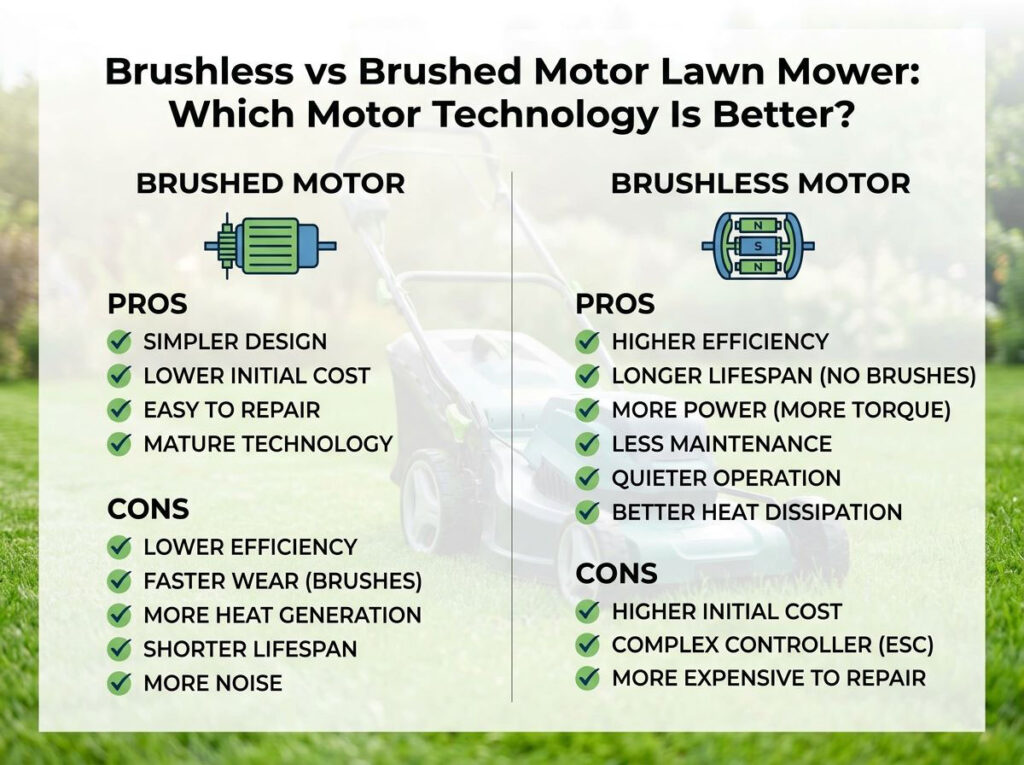
Børsteløs vs børstet motorplæneklipper: Hvilken motorteknologi er bedre?
Brushless vs brushed motor lawn mower comparisons have become increasingly important as the global lawn care industry shifts toward electric power systems. While brushed motors remain common in low-cost residential equipment, Børstefri DC (BLDC) motors are rapidly dominating premium residential, kommercielle, and robotic lawn mower platforms due to their superior efficiency, torque density, Termisk styring, and lifespan.
A brushed lawn mower motor uses mechanical brushes and a commutator to transfer electrical current to the rotating armature. I modsætning, a brushless lawn mower motor uses electronic commutation controlled by an inverter or controller. This eliminates brush wear, reduces friction losses, improves efficiency, and enables intelligent torque control.
For OEM manufacturers, procurement teams, and equipment engineers, motor selection directly impacts cutting performance, battery runtime, noise level, vedligeholdelseskrav, and long-term operating cost. Understanding the engineering differences between brushless and brushed motor systems is essential when designing next-generation electric lawn mowers for residential, kommercielle, or robotic applications.
What Is a Brushed Motor Lawn Mower?
A brushed motor lawn mower uses a traditional DC motor architecture where carbon brushes physically contact a commutator to transfer electrical current to the rotor windings. As current flows through the armature, electromagnetic force generates rotational torque that spins the mower blade.
Brushed motors became popular in early electric lawn mower systems because they are:
- Simple to manufacture
- Low in initial cost
- Easy to control
- Widely available
Typical brushed lawn mower motors operate in:
- 12V–36V residential systems
- Corded AC-powered mowers
- Low-duty consumer equipment
How Brushed Motors Work
In brushed motors, the commutator mechanically switches current between armature windings as the rotor spins. Carbon brushes maintain sliding electrical contact with the commutator segments.
Although this design is mechanically straightforward, the friction between brushes and commutator introduces:
- Energy loss
- Varmeudvikling
- Brush wear
- Electrical arcing
- Higher maintenance requirements
As mower runtime and duty cycle increase, these limitations become more significant.
What Is a Brushless Motor Lawn Mower?
A brushless motor lawn mower uses a BLDC motor with electronic commutation instead of mechanical brushes. The controller sequentially energizes stator windings to create a rotating magnetic field that drives the rotor.
Modern brushless mower motors typically integrate:
- Permanent magnet rotors
- Hall-effekt sensorer
- Electronic speed controllers
- MOSFET inverter stages
- Thermal protection systems
- Field-oriented control algorithms
Brushless technology enables significantly higher efficiency and torque control precision compared with brushed systems.
Why OEMs Prefer BLDC Lawn Mower Motors
Commercial equipment manufacturers increasingly adopt BLDC motors because they support:
- Højere effekttæthed
- Longer battery runtime
- Adaptive blade speed
- Reduceret vedligeholdelse
- Lower operating noise
- Improved thermal stability
- Smart system integration
Brushless motor systems are now standard in:
- Premium cordless lawn mowers
- Commercial landscaping equipment
- Robotplæneklippere
- Professional turf maintenance systems
Børsteløs vs børstet motorplæneklipper: Nøgleforskelle
| Parameter | Børsteløs motor | Brushed Motor |
|---|---|---|
| Effektivitet | 85–93 % | 65–75% |
| Opretholdelse | Very Low | Regular Brush Replacement |
| Støjniveau | Lav | Højere |
| Momenttæthed | Høj | Moderat |
| Termisk ydeevne | Fremragende | Begrænset |
| Lifespan | Long | Shorter |
| Controller Complexity | Højere | Sænke |
| Initial Cost | Højere | Sænke |
| Battery Runtime | Longer | Shorter |
| Kommercielle applikationer | Fremragende | Begrænset |
From an engineering perspective, brushless motors deliver superior overall system performance despite higher upfront cost. Over the mower lifecycle, improved efficiency and reduced maintenance typically offset the initial investment.
Why Brushless Motors Are More Efficient
Reduceret mekanisk friktion
Brushed motors lose energy through physical brush friction against the commutator. Brushless motors eliminate this contact entirely, significantly reducing mechanical loss.
Lower Electrical Loss
Brushless controllers optimize current delivery electronically, minimizing resistive losses and improving electromagnetic efficiency.
Better Thermal Control
Because less energy converts into heat, BLDC motors maintain higher operating efficiency under continuous load.
This directly improves:
- Battery runtime
- Continuous-duty capability
- Motor lifespan
- Blade speed stability
Variable-Speed Optimization
Brushless lawn mower motors dynamically adjust RPM according to grass load conditions. During light mowing, the controller reduces power consumption automatically.
This adaptive power management is especially important in battery-powered commercial mower fleets where runtime optimization affects operational productivity.
Torque Density and Cutting Performance Explained
Torque density is one of the most important engineering metrics in lawn mower motor selection.
High torque density means the motor can produce strong cutting force while remaining compact and lightweight.
Why Torque Matters in Lawn Mowers
Lawn mower motors must maintain blade speed when encountering:
- Wet grass
- Tall grass
- Dense vegetation
- Uneven terrain
Insufficient torque causes:
- Blade slowdown
- Uneven cutting
- Motor overheating
- Higher current draw
BLDC Torque Advantages
Brushless motors generate stronger low-speed torque because electronic controllers continuously optimize phase current delivery.
This improves:
- Starting torque
- Heavy-load cutting performance
- Blade acceleration
- Energieffektivitet
Commercial landscaping equipment increasingly relies on high-torque BLDC systems operating at 48V or 72V.
Termisk ydeevne: Why Heat Management Matters
Thermal management directly affects lawn mower motor reliability and lifespan.
Heat Sources in Lawn Mower Motors
Major heat sources include:
- Copper losses
- Magnetic core losses
- Brush friction
- Bearing friction
- Power electronics switching losses
Why Brushed Motors Run Hotter
Brush friction and electrical arcing create additional heat inside brushed motors. High internal temperature accelerates:
- Brush wear
- Commutator degradation
- Insulation aging
- Bearing damage
Brushless Cooling Advantages
BLDC motorer distribute heat more effectively because windings are located on the stator rather than the rotating armature. This improves thermal dissipation and simplifies cooling design.
Commercial brushless mower motors often integrate:
- Aluminum cooling housings
- Forced airflow systems
- Thermal sensors
- Smart overload protection
Reliability and Lifespan Comparison
Brush Wear Problems
Brushes are consumable components. Over time, they degrade because of friction and electrical erosion.
Common brushed motor failure modes include:
- Brush wear
- Commutator pitting
- Electrical sparking
- Carbon dust contamination
Why Brushless Motors Last Longer
Brushless motors eliminate physical electrical contact inside the motor. Som resultat, there are fewer wear components.
High-quality BLDC mower motors can operate for thousands of hours with minimal maintenance.
This makes them ideal for:
- Commercial landscaping fleets
- Municipal maintenance equipment
- Robotic mower systems
- Professional turf management
Lifecycle Cost Analysis
Although brushless motors have higher initial cost, their total ownership cost is usually lower because:
- Maintenance is reduced
- Energy efficiency is higher
- Downtime decreases
- Battery runtime improves
Brushless vs Brushed Lawn Mower Motors for Commercial Applications
| Commercial Requirement | Børsteløs motor | Brushed Motor |
|---|---|---|
| Continuous Duty Operation | Fremragende | Begrænset |
| Heavy Grass Cutting | Strong Performance | Moderat |
| Battery Runtime | Long | Shorter |
| Fleet Maintenance | Minimal | Højere |
| Noise Restrictions | Low Noise | Higher Noise |
| Smart Control Integration | Fremragende | Begrænset |
Commercial lawn care operators prioritize:
- Low downtime
- Long operating hours
- Reduceret vedligeholdelse
- Predictable performance
Af disse grunde, commercial OEMs increasingly transition toward brushless electric mower systems.
How to Choose a Lawn Mower Motor for OEM Applications
Voltage Range Selection
Voltage architecture influences efficiency, cable size, and thermal performance.
- 24V: Small residential mowers
- 36V: Medium-duty consumer equipment
- 48V: Commercial walk-behind mowers
- 72V: Heavy-duty professional systems
Power Range
Typical motor power ranges include:
- 500W–1200W: Residential
- 1.5kW–3kW: Commercial push mowers
- 4kW-10kW: Riding mowers
Afkølingsmetode
OEM designers should evaluate:
- Natural cooling
- Forced-air cooling
- Aluminum housing heat dissipation
- Environmental sealing
Controller kompatibilitet
Advanced brushless mower motors increasingly require:
- Field-oriented control
- CAN communication
- Battery management integration
- Thermal protection systems
Application-Specific Design Considerations
Commercial lawn mower OEMs often require custom motor platforms optimized for:
- Noise reduction
- Peak torque delivery
- Blade response time
- IP-rated waterproofing
- Long-duty cycles
To request a datasheet or discuss custom mower motor development, OEM buyers can contact Greensky engineers for application-specific recommendations.
Applications of Brushless and Brushed Lawn Mower Motors
Residential Lawn Mowers
Brushed motors still appear in low-cost residential lawn mowers because initial price sensitivity remains important in entry-level consumer markets.
Imidlertid, premium residential mowers increasingly use brushless systems because homeowners value:
- Lower noise
- Longer runtime
- Reduceret vedligeholdelse
- Better cutting consistency
Commercial Landscaping Equipment
Commercial operators require high efficiency and long-duty operation. Brushless motors dominate this segment because of their superior reliability and thermal stability.
Robotic Lawn Mowers
Robotic mower systems almost exclusively use brushless motors because intelligent speed control and battery optimization are critical.
Industrial Turf Equipment
Golf courses, municipal maintenance fleets, and sports facilities increasingly adopt high-voltage brushless mower systems to reduce fuel consumption and maintenance cost.
Future Trends in Lawn Mower Motor Technology
72V High-Efficiency Platforms
Commercial lawn mower systems are rapidly transitioning toward 72V architectures because higher voltage improves efficiency and reduces current-related heating.
Feltorienteret kontrol (FOC)
FOC algorithms improve torque smoothness, noise reduction, and energy efficiency in advanced brushless mower systems.
Integrated Smart Motors
Future electric lawn mower motors increasingly integrate:
- Motorstyringer
- IoT monitoring
- Wireless diagnostics
- Predictive maintenance
Sustainable Landscaping Equipment
Environmental regulations continue pushing the lawn care industry toward low-emission electric equipment, accelerating global demand for brushless mower motors.
FAQ: Børsteløs vs børstet motorplæneklipper
Is a brushless lawn mower better than a brushed mower?
Ja. Brushless lawn mowers typically provide higher efficiency, længere levetid, lavere vedligeholdelse, and better torque control. They are especially beneficial in commercial and robotic mower applications where reliability and runtime are critical.
Why are brushless lawn mower motors more expensive?
Brushless motors require electronic controllers, permanent magnets, and more advanced control algorithms. Although initial cost is higher, lifecycle operating cost is often lower because maintenance and energy consumption decrease significantly.
Which motor lasts longer in a lawn mower?
Brushless motors generally last much longer because they eliminate mechanical brush wear and electrical arcing. High-quality BLDC mower motors can operate for thousands of hours with minimal maintenance.
Do brushless lawn mower motors have more torque?
Ja. Brushless motors usually provide higher torque density and better low-speed torque control. This improves cutting performance in thick or wet grass conditions.
Are brushed motors still used in lawn mowers?
Ja. Brushed motors remain common in low-cost residential lawn mowers because they are inexpensive and simple. Imidlertid, commercial and premium mower markets increasingly favor brushless technology.
What voltage is best for commercial electric lawn mowers?
Commercial electric lawn mowers commonly use 48V or 72V systems because higher voltage improves efficiency, reduces current losses, and supports continuous-duty operation.
Konklusion
The brushless vs brushed motor lawn mower debate increasingly favors brushless technology as the electric lawn care market evolves toward higher efficiency, lavere vedligeholdelse, and intelligent control systems.
While brushed motors still serve low-cost residential applications, BLDC motors now dominate premium residential, kommercielle, robotic, and industrial mowing equipment because they offer:
- Højere effektivitet
- Superior torque density
- Længere levetid
- Better thermal performance
- Reduceret vedligeholdelse
- Advanced electronic control
For OEM manufacturers and procurement teams, selecting the correct lawn mower motor platform requires balancing performance, lifecycle cost, Termisk styring, and application-specific operating conditions.
As 48V and 72V high-efficiency electric mower systems continue expanding globally, brushless motors will remain the dominant solution for next-generation lawn care equipment.
To request datasheets, discuss OEM lawn mower motor solutions, or evaluate custom BLDC motor platforms, contact Greensky Power engineering specialists for technical consultation.
Referencer
1. https://www.energy.gov/eere/amo/articles/determining-electric-motor-load-and-efficiency
2. https://www.sciencedirect.com/topics/engineering/brushless-dc-motor
3. https://www.nema.org/standards/view/motors-and-generators
4. https://www.iea.org/reports/energy-efficiency-2023
5. https://www.controleng.com/articles/understanding-bldc-motor-control-algorithms/
6. https://www.mdpi.com/topics/Brushless_DC_Motor
7. https://www.electronicdesign.com/technologies/power/article/21195984/understanding-brushless-dc-motors